市場の朝食屋台で、私は「これ」の一言で温かい豆乳にありついた
The first time I walked into that wet market in a southern Chinese city, the morning had not fully opened yet. Low bulbs hung over the entrance and shone on the damp concrete floor, while drops of water clung to green leaves as if it had just rained indoors. As a foreign visitor, I had only planned to buy fruit and watch how local people began their day. But when I reached a row of breakfast stalls, a column of white steam stopped me. It rose from a large stainless-steel bucket with the warm smell of soybeans, rice, and something faintly smoky. Behind the stall stood the owner, a woman in an apron dusted with flour, moving fast as she ladled soy milk for regulars and slipped fried dough sticks into paper bags. My Chinese was limited, and the menu behind the glass was blurred by steam. I stood there feeling like a student on the first day of class: hungry, present, and not sure how to speak.
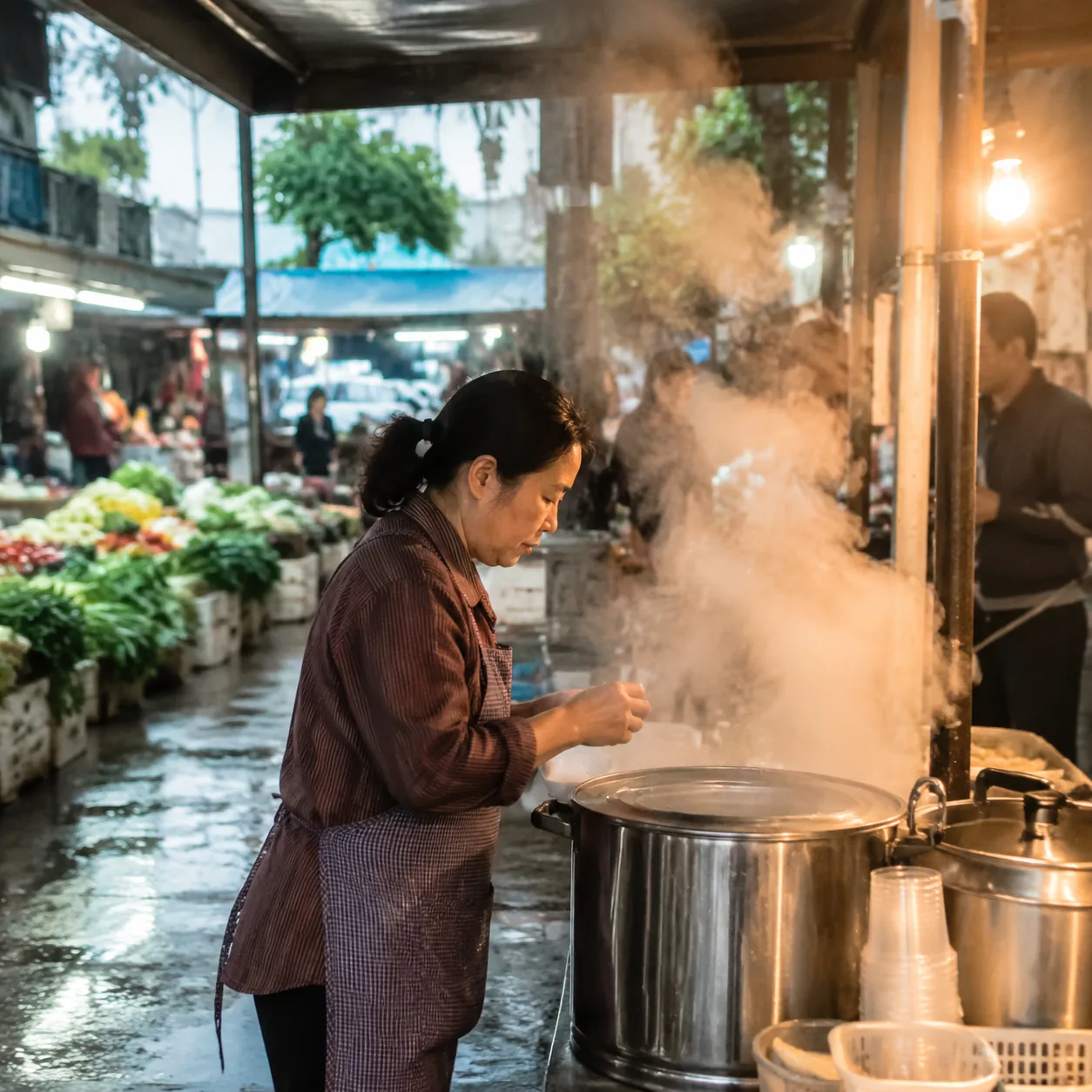
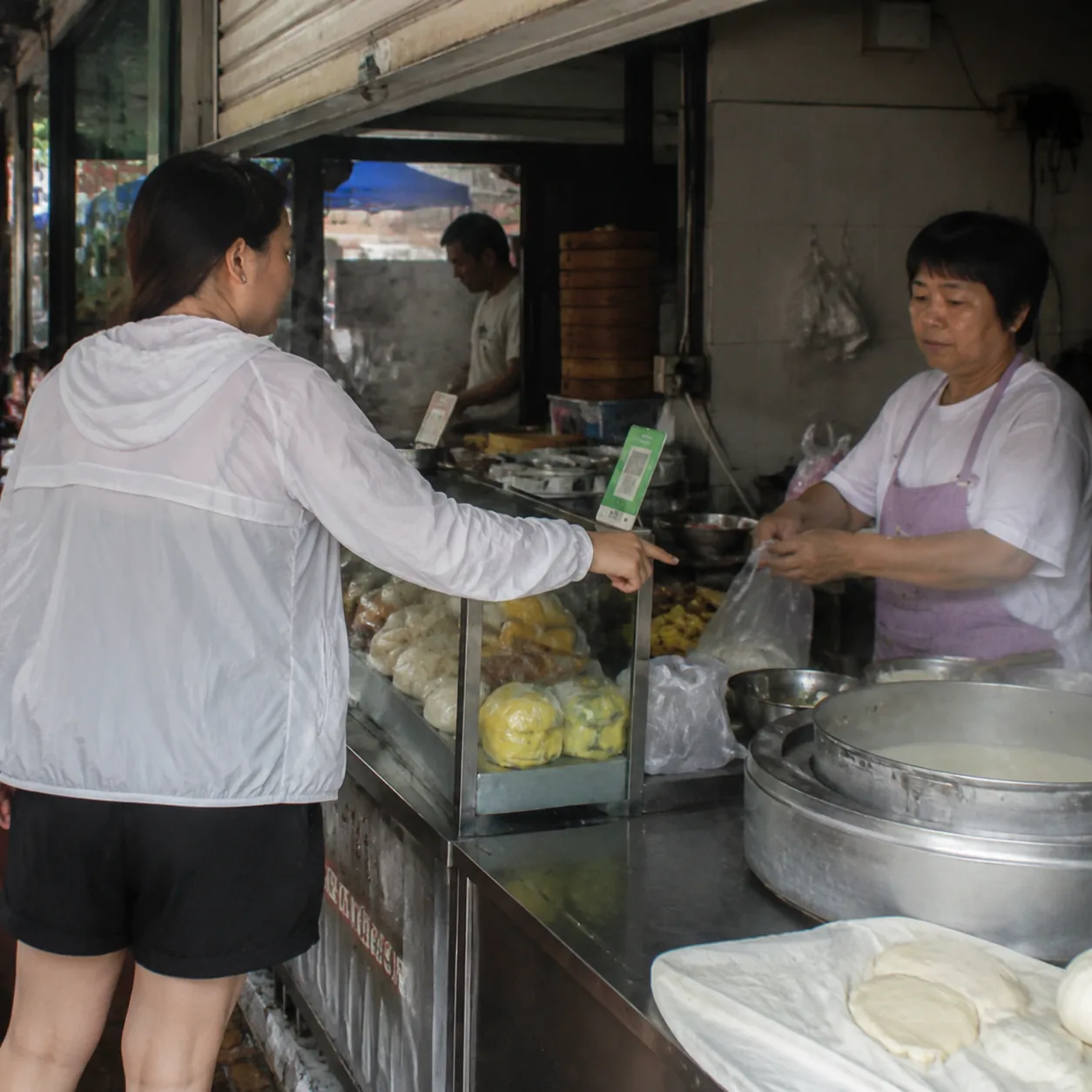
There were not many people in front of the stall, but everyone seemed certain. An uncle in slippers arrived, said a few words without even looking up, and the woman pushed a bowl of tofu pudding toward him. A schoolgirl held out coins, and two buns appeared in a bag almost immediately. When my turn came, I opened my mouth and found only scattered words in my head: soy milk, hot, one, thank you. I did not know whether the soy milk here was sweet or salty, and I did not know whether to ask for a cup, a bowl, or a bag. My finger hovered in front of the glass case, then pointed toward the steaming bucket. I managed the simplest word I had: “This one.” The owner looked at me, then at the bucket, as if checking that I really meant it. She smiled and asked, “Hot?” I understood that word and nodded quickly, repeating, “Hot, this one.” At that moment, one fingertip felt more useful than a whole page of vocabulary.
She ladled soy milk from the bucket into a clear plastic cup, then pressed a thin lid on top. The lid was not sealed completely, so steam escaped from the edge and curled into the cooler morning air. When I took the cup, the heat made my palm pull back. She immediately slipped it into a small plastic bag and twisted the handles into a knot I could carry. She did not look impatient at my clumsiness. Instead, she spoke slowly and said, “Careful, it is hot.” I understood enough of the words, and the rest came from her face. I stepped to the side so others could order. Around me, fish sellers rinsed their tables, a cleaver struck a chopping board, vegetable sellers called prices in dialect, and my attention stayed on the bag of hot soy milk in my hand. It swayed gently like a little lantern filled with breakfast courage.
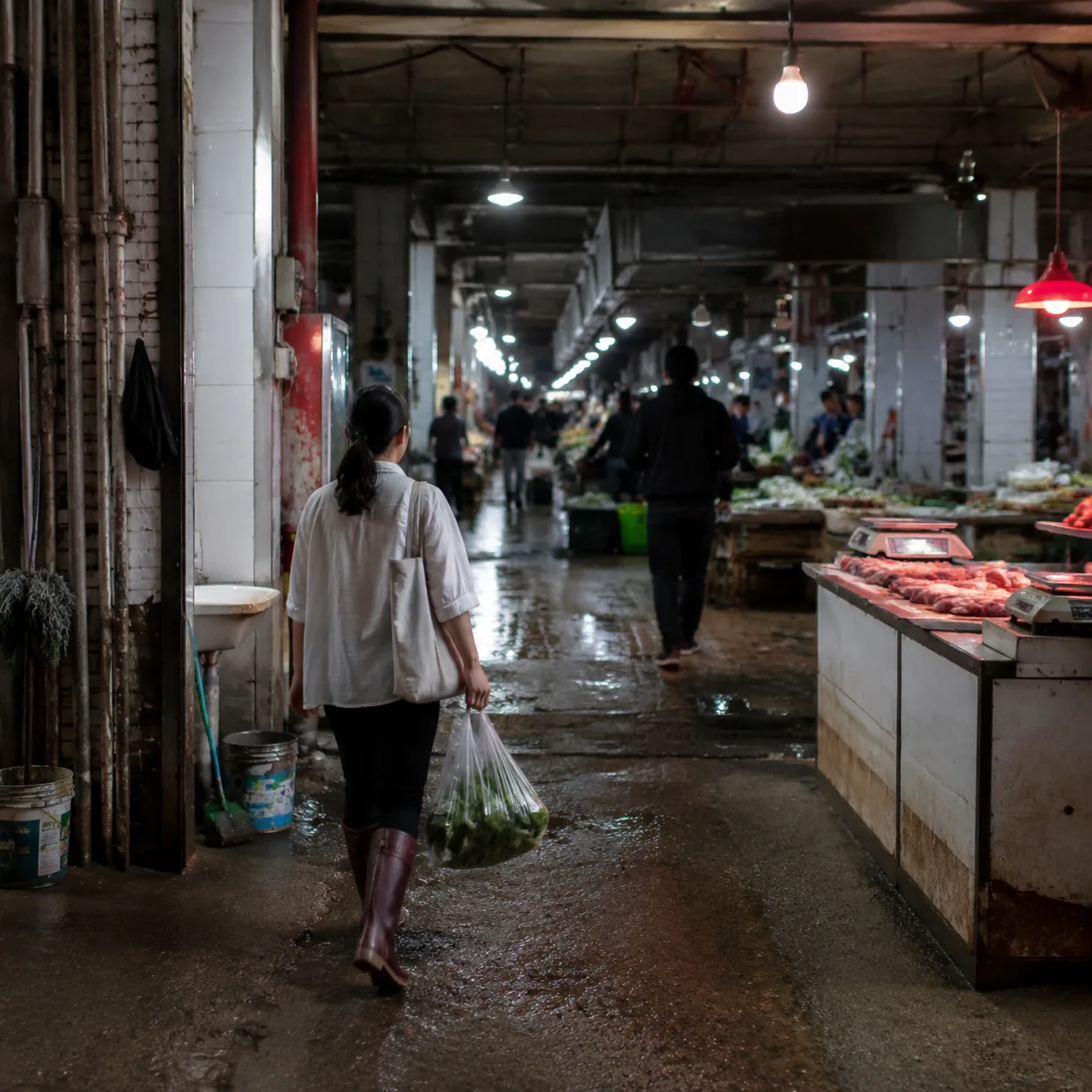
I had planned to find a seat, but the wet market breakfast stall did not follow the restaurant logic I knew. Some people drank while standing. Some hung soy milk from bicycle handlebars. Some tucked fried dough under one arm and continued buying vegetables. I copied them and stood where I would not block the flow. I pushed the straw through the lid. The first sip was too hot, so I took only a little. The soy milk did not taste like the flat version I had known from supermarket cartons. It was thicker, with the scent of soybean skin, and the sweetness was light, as if the morning itself had not fully woken up. Steam touched my nose and fogged my glasses. While I wiped the lenses, I heard the owner say something to a customer. A few people looked at me and smiled, not with mockery, but with the amusement of watching someone finally fit into the rhythm of the morning.
That “this one” was not perfect Chinese, but it let me enter a very specific scene. I did not explain my country, describe my travel plan, or produce a polished sentence. I simply admitted that I saw something, wanted it, and could not name it clearly, so I extended my hand. Pointing may sound lazy, but in that moment it was honest. It told the owner I needed help, and it told me not to make communication too dignified. What makes me nervous while traveling is not getting lost as much as revealing my inexperience when everyone else seems fluent in the situation. The breakfast stall did not give me time to perform confidence. People behind me were waiting for buns, food was turning in pans, and the hot soy milk did not pause its steam for my grammar. I had to use the shortest word and the most direct gesture to make a temporary agreement with the morning.
I walked farther through the market while the soy milk slowly cooled in my hand. Beside the tofu stall, white blocks were stacked like quiet little houses. An auntie selling scallions tapped the roots against the ground to line them up, making a soft rustling sound. An old man put newly bought greens into a cloth bag, leaving a bright edge of leaves showing at the top. By the time I reached the bottom of the cup, the soy milk had become easier to drink and my tongue no longer feared the heat. It was not a sharp heat, but a steady warmth traveling from my palm into my body. I suddenly understood that breakfast in many places is not only food; it is a small ticket the city gives to people who are awake. Holding it, I was no longer only watching. I had joined a slow, repeated, dependable daily pattern. I still could not understand every market call, but I could understand the temperature inside the cup.
When I returned to the stall, the owner was pouring a fresh batch of soy milk into the bucket. Steam surged up and covered her face for half a second before drifting away. She saw my empty cup and asked a sentence I did not fully understand. I guessed she was asking whether it tasted good, so I raised my thumb and said, “Delicious.” I said that word clearly because it was necessary that morning. Her smile widened, and then she turned to serve someone else. I did not treat this as a victory of language. It felt more like a small permission to participate. When you arrive in an unfamiliar place, you may think you need many words before you can begin to live there. Sometimes life hands you a cup of hot soy milk first, and only afterward teaches you how the words should grow.
After that day, I felt much less afraid of wet markets. Not because I suddenly spoke fluent Chinese, but because I knew I could begin with a point. Pointing is not the destination; it only pushes silence open a little. Next time I might add “one,” and after that perhaps “not too sweet,” and later I might understand when the owner asks whether I want fried dough. Language in a place like this is not an exam. It is more like a small path worn down by many feet. You follow it slowly, get your shoes wet, sometimes step in the wrong direction, and still arrive in front of a steaming cup. What that soy milk helped me remember was not that I spoke well, but that someone was willing to meet me inside my incompleteness.
If I think of that market now, the first thing that returns is not its location on a map or the name of the stall, but that cloud of white steam. It rose from the bucket, crossed the glass case, blurred the menu, and blurred my anxiety about whether I could speak. The owner’s hands, the knot in the plastic bag, the sound of the straw breaking the lid, and the soybean warmth of the first too-hot sip all became a small but firm memory. Some doors in travel are not pushed open; they are slowly steamed open by a hot drink. Standing before that wet market breakfast stall, I exchanged one “this one” for hot soy milk, and also for a lighter way of being: come closer first, learn afterward; taste first, complete the sentence later.