霧の江辺、一夜の重慶火鍋
When I arrived in Chongqing that evening, the river looked as if it were steaming after a boil. I came out of the metro station holding my jacket, and the first thing I noticed was the damp river air on my nose; only after that did I smell the hotpot restaurant at the corner. It was not just a spicy smell. It was a heavy mix of beef tallow, Sichuan pepper, ginger, garlic, and hot metal, like an invitation written in heat. I was a foreign traveler in China, with enough Chinese to order food and ask directions, so I asked my friend Lan, who worked in Chongqing, to eat with me. She smiled and said that for a first serious Chongqing hotpot evening, the question was not only whether I could take the spice. I also needed to learn how to choose the pot, set the oil dish, watch the queue number, protect my belongings, and know when to put the chopsticks down.
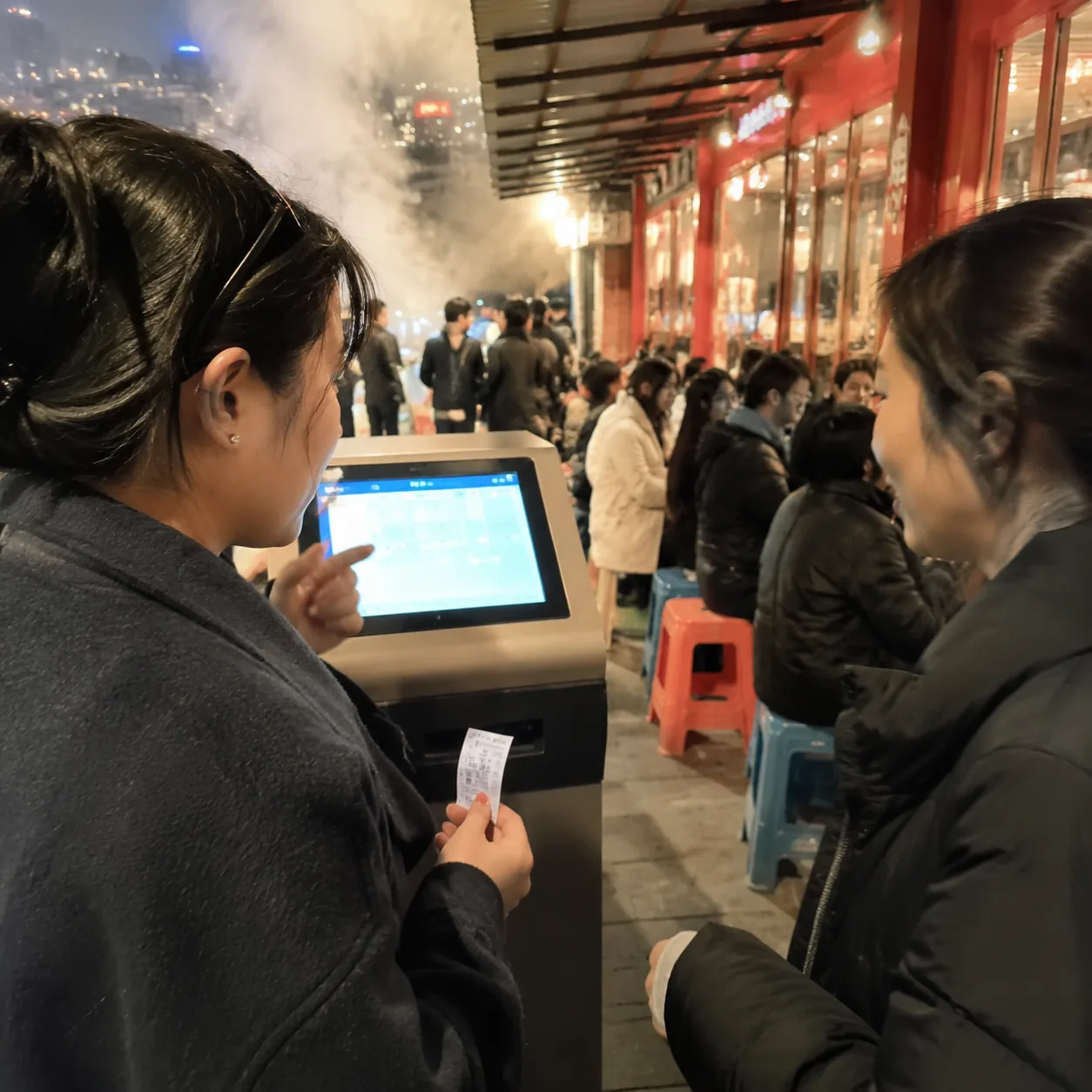
The waiting area outside the restaurant was already full. Plastic stools stood in rows under the awning, and fog mixed with kitchen steam until the bridge lights in the distance looked blurred. I was about to walk inside, but Lan pulled me back and pointed at a small machine by the door. “Take a number first.” The machine printed a slip marked A37. The screen was calling A29, and several tables of people were staring at the digits as if they were waiting to board a flight. When a server passed, Lan asked in the local dialect how long it might take. The server said twenty minutes if it moved quickly, half an hour if not. Lan translated it for me and reminded me not to stand in the middle of the doorway. People were carrying pots and dishes in and out, and hot soup plus a wet floor was not a good place for daydreaming.

While we waited, I began to notice that Chongqing hotpot had its own layers of sound. From inside came the bubbling of soup bases, the low hum of ventilation pipes, the bright tap of a metal strainer against the rim of a pot, and, farther away, the small click of chopsticks resting on a bowl. Conversation between tables was dense, packed together like the fog by the river. I had thought hotpot was simply about eating, but sitting at the entrance with a queue slip in my hand, I realized it was more like an evening with a rhythm: take a number, wait to be called, choose the pot, then slowly give your body over to the steaming table. Lan saw me staring at the screen and laughed that I looked nervous. I said I was not nervous, only afraid of missing our number. She said we could explain to the server if that happened, but it was better not to make everyone wait.
When A37 was called, I followed Lan inside. My first impression was not heat, but moving air. Each table had ventilation equipment above or around it; some pipes came down from the ceiling, while others were built near the edge of the pot. The server led us to a window seat, where the river fog outside was even thicker and a thin film of moisture covered the glass. Lan told me to put my backpack under the chair on the wall side, not hanging on the outside of the chair back, and not to leave my phone casually near the table edge. She said a hotpot restaurant was crowded, the walking lanes were narrow, and people were busy carrying dishes, picking food from the pot, and standing up for napkins. Keeping things safe was not about mistrusting people; it was about avoiding trouble. I pushed my passport holder and wallet deep into the bag, zipped it shut, and then settled into my seat.
After the menu arrived, the first problem was the soup base. The pictures showed red soup, a split pot, a nine-grid pot, mushroom broth, tomato broth, and a clear-oil spicy base. I had eaten “mala hotpot” overseas before, but that spice had felt more like a sauce. The red oil here looked like a breathing red lake. Lan did not choose for me. Instead, she asked, “Do you want to learn tonight, or do you want to challenge yourself?” I said I wanted to learn and did not want to regret it the next day. She nodded and suggested a split pot: one side Chongqing beef-tallow mild spicy, the other side mushroom broth. She told the server that it was my first time eating hotpot in Chongqing, so they should not use a local person’s idea of “mild.” It had to be genuinely lighter. The server looked at me seriously and said they could make it very mild, but after the pot boiled for a while, the flavor would still become heavier, so I should not force myself.
While we waited for the pot, Lan took me to mix an oil dish. The condiment counter looked like a small laboratory: minced garlic, cilantro, chopped scallions, oyster sauce, vinegar, crushed peanuts, sesame seeds, salt, and sesame oil all stood in neat rows. I was about to add a little of everything, but she stopped me at once. “Don’t turn your oil dish into an international conference.” She showed me the basic Chongqing version: half a small bowl of sesame oil, one spoon of minced garlic, a tiny bit of salt, plus cilantro and scallions if I liked, and a little vinegar if I wanted it softer. She explained that sesame oil was not there to make the food greasier. It gave meat and vegetables coming out of the red soup a cooler layer and kept the spice from hitting the tongue too directly. I copied her bowl, and the smell was much fresher than I expected, which made me feel calmer.

When the pot arrived, the table suddenly became the center of the evening. On the red-soup side, chilies and Sichuan peppercorns floated while beef tallow slowly melted, like small lights appearing on a red surface. The mushroom broth side was much quieter, with a few mushrooms and scallion sections drifting in pale soup. The server first reminded us that the rim of the pot was very hot, so we should not rest our hands on the metal ring or put tissues and plastic bags too close to it. She adjusted the heat and then pointed out cooking times for several dishes on the menu: tripe should be dipped quickly, duck intestine cooked very fast, yellow throat needed a little longer, potatoes and lotus root should not be overcooked, and meat slices needed to change color and then be checked. I listened carefully, because I knew I did not just want to eat. I wanted to understand the rules of the meal.
We ordered tripe, duck blood, yellow throat, beef, tofu skin, lotus root, potatoes, celtuce, and a plate of greens. Lan did not let me dump everything into the pot at once. She said Chongqing hotpot was not stew; many items had to be cooked in batches so their texture stayed right. I picked up a piece of tripe clumsily, almost letting it slide back onto the plate. Lan used serving chopsticks to demonstrate, dipping it lightly in and out of the red soup while counting, “One, two, three…” Her voice was half covered by laughter from the next table and the bubbling of the pot, but I saw the edge of the tripe curl and understood it was ready. She placed it in my oil dish. I waited a few seconds before eating. First came sesame oil and garlic, then the numbing feeling of Sichuan pepper, and finally the chili heat rose slowly from the back of my throat.
I did not cough immediately, which made me a little proud, but Lan noticed my ears turning red. She picked tofu skin from the mushroom broth side and gave it to me, saying that not every bite should come from the red soup. I needed to alternate temperature and spice. She also told me to drink room-temperature water instead of pouring down an iced drink all at once. At the next table, someone swished duck intestine through the pot so quickly that the chopsticks looked as if they were writing in heat. On the other side, someone used a strainer to lift potatoes, and it tapped the pot wall with a clear ring. Every table in the restaurant felt like a small stage. The movements were different, but they all circled around the same sounds: soup boiling, chopsticks touching, bowls clinking, and the ventilation fan quietly pulling away white steam.
By the second round, I began to understand that the spice level was not fixed. The very mild pot was gentle at first, but the longer it boiled, the more the chilies and peppercorns sank in, and the red soup became thicker. Lan asked me to try one slice of beef in the mushroom broth and one in the red soup so I could compare. I found that the beef from the red soup was more fragrant, but it also made me eat too quickly, because spice can make a person excited, like a sudden stronger wind by the river. When the server came to add broth, she reminded us that if it felt too spicy, she could dilute it with clear soup or lower the heat. She did not laugh at me or speak in an exaggerated way about foreigners not handling spice. She simply put the options on the table. I liked that practical kindness.
I also learned that hotpot safety was not only about spice; it was about heat. Duck blood coming out of the pot looked quiet, but inside it was as hot as a small volcano. The first time I rushed, bit one corner, and immediately had to stop because of the steam in my mouth. I put it back into the oil dish and waited. Lan said red soup hides the danger of temperature because people focus so much on the chili that they forget the burn. She told me to use a small bowl for food just lifted from the pot, and not to let oil drip onto the table or my legs. She also said not to stretch my arm across the pot when picking food, and especially not to hold my phone near the pot just for a photo. Watching the red soup roll and pop, I felt that this advice was more useful than any travel guide.
At one point, I thought I had adapted, so I ate several slices of red-soup beef and lotus root in a row. The lotus root was crisp, the beef was tender, and the garlic in the oil dish made it hard to stop. A few minutes later, sweat began to appear on my forehead, my back grew warm, and my lips felt as if tiny electric currents were touching them. I tried to keep looking calm, but Lan pressed down my chopsticks and said, “Now rest.” She gave me some greens from the mushroom broth and told me to breathe slowly. When the server passed and saw my face, she lowered the heat by one level and added more tissues to the table. I did not feel embarrassed. Instead, I felt the meal had finally changed from “trying local food” into real learning.
While resting, I looked outside the window. Fog pressed against the glass by the river, and faraway car lights slid past in strings, like stars softened by water. The restaurant was bright, the outside was dark, and the glass reflected our pot, bowls, oil dishes, and a ring of red light from the soup. Lan said that in Chongqing, people often eat hotpot not just to get full quickly, but to slowly warm an evening. Friends talk about work, families talk about children, travelers learn to cook tripe correctly, servers move between tables, and everyone is pulled a little closer by the steam from the pot. I listened to the next table discussing tomorrow’s weather and heard someone in the kitchen call for extra dishes. For a moment I felt that I was sitting inside the city’s ordinary life instead of watching it from outside.
Later I asked Lan how to know when to stop eating. She did not answer immediately. Instead, she asked me to observe myself: Was I still tasting the food, or was I only chasing the next hit of excitement? Were my hands starting to shake, or my stomach tightening? Did every bite require water before I could swallow? She said hotpot easily misleads people. If food remains on the table, they think they should continue; if friends are still picking from the pot, they feel they cannot stop. But when traveling, the body is the most important luggage, and chili does not become gentle just because you are a guest. She put the remaining potatoes into the mushroom broth and said the last bites should let the stomach slow down, not end with the strongest spice. I had never thought of “stopping” as part of how to eat.
We did not finish every dish. A few slices of lotus root and some greens were left, and the server asked if we wanted to pack anything. Lan said the greens were not convenient, and the lotus root was fine to leave. I felt a little embarrassed at first, thinking it was wasteful, but she said ordering also required experience. It was better to order less the first time, and next time I would understand the portions. When we paid, I realized the memory of the meal was not only in the flavor but also in each small step: watching the screen after taking a number, avoiding people carrying pots at the entrance, choosing a split pot instead of insisting on full red soup, mixing a simple oil dish, putting my bag in a safe place, waiting for food to cool, pausing when the spice rose, and leaving the table while I still felt comfortable.
When we stepped out of the restaurant, the night fog had grown heavier. My clothes carried the smell of hotpot, and my hair seemed to hold a little beef tallow and Sichuan pepper. By the street, someone had just taken a queue number and was looking down at the paper slip; someone else had finished eating and came out with red cheeks, laughing while walking. Lan asked whether I would want to eat it again next time. I said yes, but next time I would take a number earlier, still order a split pot, keep the oil dish simple, and alternate red soup with mild broth. She nodded and said that counted as a beginning. River wind came over with fog and moisture. My mouth still felt a little numb, but my stomach was calm. That night, I did not conquer Chongqing hotpot, and it did not defeat me. I simply learned to sit beside a pot, listen seriously to its sounds, respect its heat, and respect my own body.