広州の朝茶の食卓で点心を覚える
The first time I truly sat down in a Guangzhou morning tea restaurant, the air felt as if it had just been lifted from a bamboo steamer. Drops of water still clung to the banyan leaves outside, the arcade signs glowed softly, and people at the entrance held their queue numbers like small tickets to a morning ritual. I thought I had come only for breakfast, but as soon as I stepped into the hall and heard porcelain cups touching, teapots settling on tables, and cart wheels whispering across the tile floor, I understood that this was not just eating. There was an invisible grammar here, hidden in the way people reached, nodded, offered seats, tilted lids, and called for service. I was a foreigner from elsewhere, with enough Chinese to manage a few sentences and enough menu knowledge to guess half the items, but at that steaming round table I learned my first lesson: in Guangzhou, ordering dim sum begins not with reading dish names, but with watching people.
The waiter led me to a shared table where three elderly diners were already seated. One uncle wore a white short-sleeved shirt with the cuffs neatly rolled; one auntie wore a jade bangle and rested her fingers lightly on the edge of her teacup; another grandmother had folded her newspaper into a narrow strip and placed it on her lap. I asked in Mandarin whether I could sit, and the auntie smiled, pulling the chair out a little. “Sit, sit. Morning tea is like this. More people make it lively.” When I sat down, I instinctively hung my backpack over the chair, and the uncle immediately pointed to a small basket near my feet. Put the bag there, he indicated, or it would block the way; the cart needed to pass. It was a tiny correction, but it felt like the first threshold: the table did not belong only to me, the aisle did not belong only to the staff, and the whole restaurant moved because everyone made room for one another.
I had assumed that the most important first step was choosing tea, so I hurried to flip through the menu, searching for Longjing or pu’er. The auntie noticed my serious scanning and asked what tea I wanted. I said I wanted pu’er because dim sum could be oily. She nodded, then added, “You can also have chrysanthemum pu’er. It is not so heavy.” I misunderstood at first, imagining it as a special floral blend ordered mainly by tourists. She waved that idea away. Locals drank it too, she said, especially on damp mornings like this, when the mouth wanted something clearer. So I ordered chrysanthemum pu’er. The waiter brought a teapot and a large bowl, but the auntie did not drink immediately. She poured the first infusion into the bowl, rotated her chopsticks in the hot water, and warmed the rims of the cups. I watched, puzzled, and she said, “Washing the cups. Not because they are dirty. It is habit, and it warms them.” She said it as casually as if explaining which end of the chopsticks to hold.
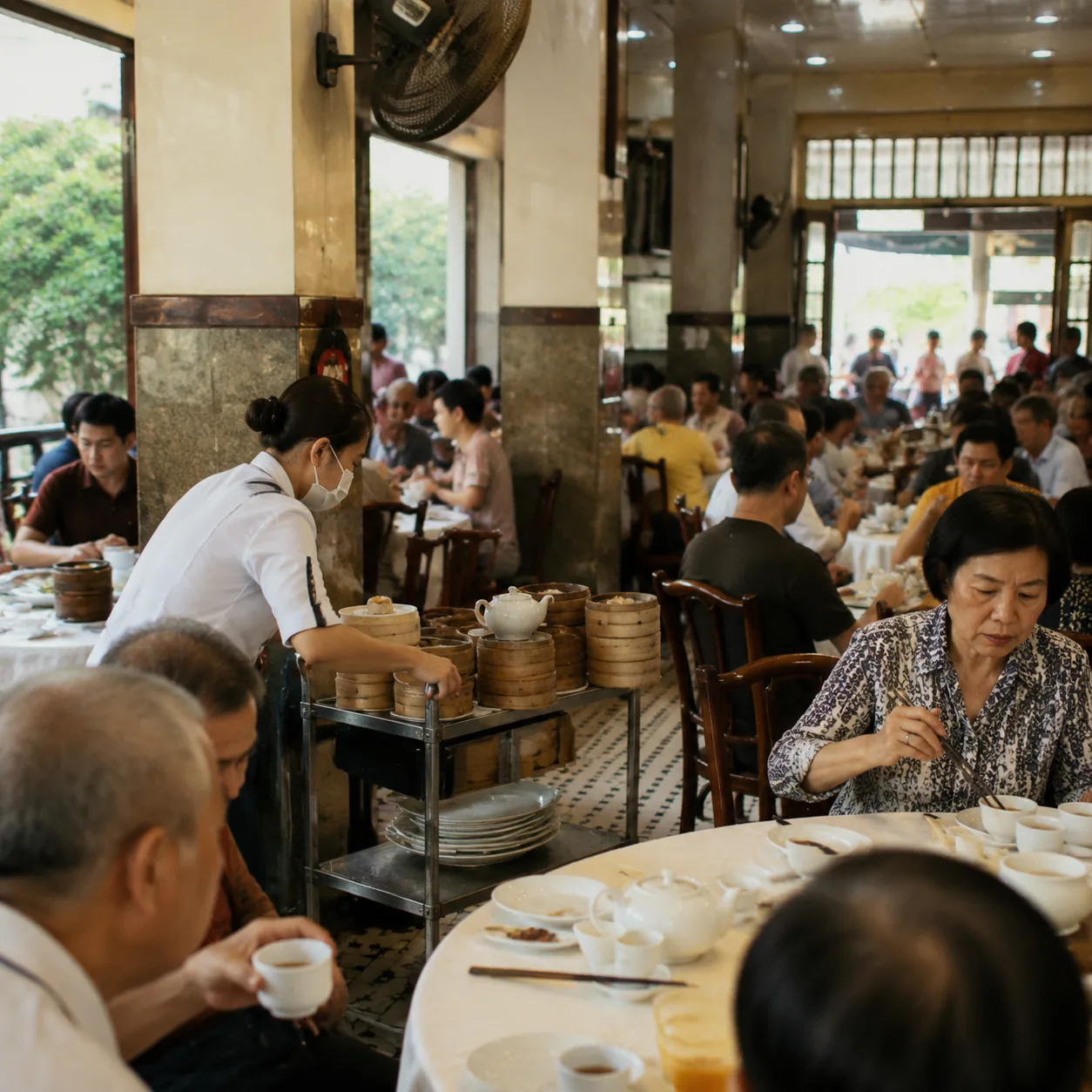
Before the tea was fully poured, the first dim sum cart arrived. It was not as theatrical as I had imagined, only a metal cart stacked with bamboo steamers, with small signs hanging from the side: shrimp dumplings, siu mai, pork ribs, chicken feet, beef tripe. Steam escaped through the cracks of the bamboo lids like white threads curling around the server’s wrist. The cart auntie stopped beside our table and lifted one lid for the uncle. He did not say, “I want this.” He simply raised two fingers, pointed to one steamer, and slid the dim sum card across the table. The auntie stamped it, exchanged the basket, and moved with the speed of someone who already knew everyone’s habits. Wanting to appear competent, I pointed at the shrimp dumplings and said, “One.” The cart auntie asked, “One basket?” I nodded. The auntie beside me laughed. “Not one dumpling. One basket, usually four pieces. If you are eating alone, do not rush. Order slowly.”
That phrase, “Order slowly,” changed the whole morning. I had arrived with a traveler’s anxiety: fear of missing the signature dishes, fear the menu would disappear, fear that not understanding the rules meant losing my chance. But the rhythm of Guangzhou morning tea did not encourage taking everything at once. The cart would return, the QR menu stayed at the corner of the table, and the waiter would not judge me for ordering only one basket of shrimp dumplings. The elderly diners moved like people practicing tai chi: a sip of tea, a page of newspaper, a small dish of soy sauce, a casual sentence, and only then the next steamer. When the shrimp dumplings arrived, their skins were translucent enough to reveal the pink shrimp inside. I gripped the first one too hard with my chopsticks, the wrapper split, and the juices slipped into the saucer. The grandmother finally looked up from behind her newspaper and said, “Hold it at the waist, not the top. The top breaks easily.” I tried again, and the second dumpling landed intact in my bowl, as if I had passed a very quiet exam.
I picked up my phone and scanned the QR code at the corner of the table. The screen opened into dense categories: steamed items, pan-fried and fried items, congee, noodles, desserts, snacks, specials. The photos were attractive, but they made me more confused. Every dish seemed to be saying, “Choose me,” while I had only one stomach. I recognized barbecue pork buns; I had heard of boat congee; I could not guess what “gold coin tripe” really meant. So I began watching how my tablemates ordered. The uncle chose pork ribs without chili; the auntie ordered turnip cake and asked for it to be pan-fried a little crisper; the grandmother ordered plain congee with salted lean pork. They were not chasing quantity. They were adjusting details: softer, hotter, less sauce, congee first, open the basket after everyone was ready. I suddenly realized that a real regular was not someone who knew every name, but someone who knew what their body wanted in the morning.
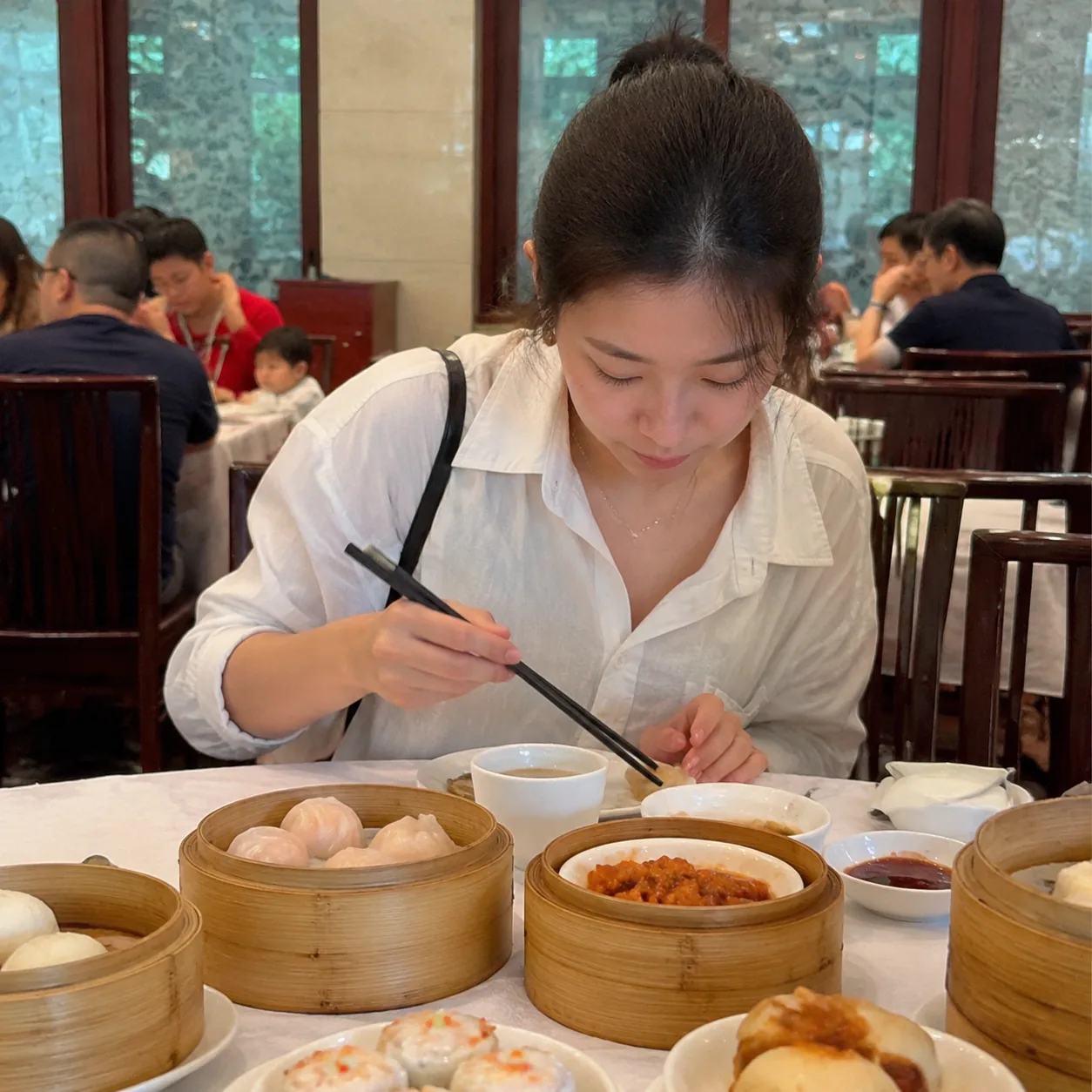
I tried making concrete small choices too. Instead of filling the screen like a tourist checklist, I ordered turnip cake, a bowl of boat congee, and one basket of pork ribs in black bean sauce. When the waiter came to confirm, I asked whether the turnip cake was sweet. She paused and smiled patiently. “It is not a sweet cake. It is made with radish, and it smells good when pan-fried. You can dip it in chili sauce, or not.” I then asked whether boat congee had anything to do with an actual boat. Her smile grew clearer, and the auntie beside me laughed too. They explained that it was historically related to people living on the water, but now it meant a congee with many ingredients: fish slices, peanuts, thin strips of fried dough, ginger. My questions were childish, but no one made me feel embarrassed. They turned correction into conversation, and my misunderstanding became a small warmth at the table.
When the turnip cake arrived, its edges were lightly browned, the surface glistening with oil. My chopsticks pressed through a crisp layer into softness. Inside, I could taste strands of radish and the salty fragrance of cured meat. I wanted to dip it deeply into chili sauce, but the auntie stopped me gently. Try it plain first, she suggested, then add a little. She was not commanding me; she simply pushed the sauce dish halfway toward me, leaving the choice open. I took a bite without sauce and understood her point. The sweetness of the radish was faint, not sugary, but like a little earth and winter carried in the steam. With a tiny touch of chili sauce, the aroma lifted without covering the cake itself. At that moment, I felt that knowing how to eat morning tea was not about adding boldly, but about knowing when to use less.
When the basket of pork ribs in black bean sauce opened, the fragrance of fermented black beans, garlic, and meat juices rushed out. The ribs were cut small, the bones small too, coated in a glossy sauce, with several pieces of taro tucked underneath. I assumed the taro was only garnish and reached first for the meat. The uncle noticed, used the serving chopsticks to take a piece of taro for himself, and said, “This is good. It absorbs flavor.” I quickly took a piece too. The taro had steamed until its edges loosened, soaking up the salty aroma of ribs and black beans, and it tasted gentler than the meat. The uncle saw me nod and returned to his tea with satisfaction. No long explanation, no cultural lecture, just a piece of taro pulling me away from the habit of looking only at the main attraction. At a dim sum table, the supporting roles are often what old Guangzhou diners take first.
The boat congee arrived in a white porcelain bowl with a thin rim, its surface scattered with scallions, peanuts, and fine strips of fried dough. Steam rose as I stirred with a spoon, and fish slices and ginger threads appeared between the softened grains of rice. It was not the watery rice soup I had imagined; the rice had been cooked until its edges almost disappeared, thick but not heavy. The grandmother told me to eat it while hot so the fish would stay tender, and not to soak all the fried dough until it went soft. I learned to drink one spoonful of plain congee first, then press the fried dough halfway down, letting part of it absorb the broth while part stayed crisp. It was a tiny movement, almost nothing, yet it made me feel less like an observer. I began to understand that the technique of Guangzhou morning tea hides in these half-seconds: when to lift a lid, when to pick something up, when to dip, when to wait.
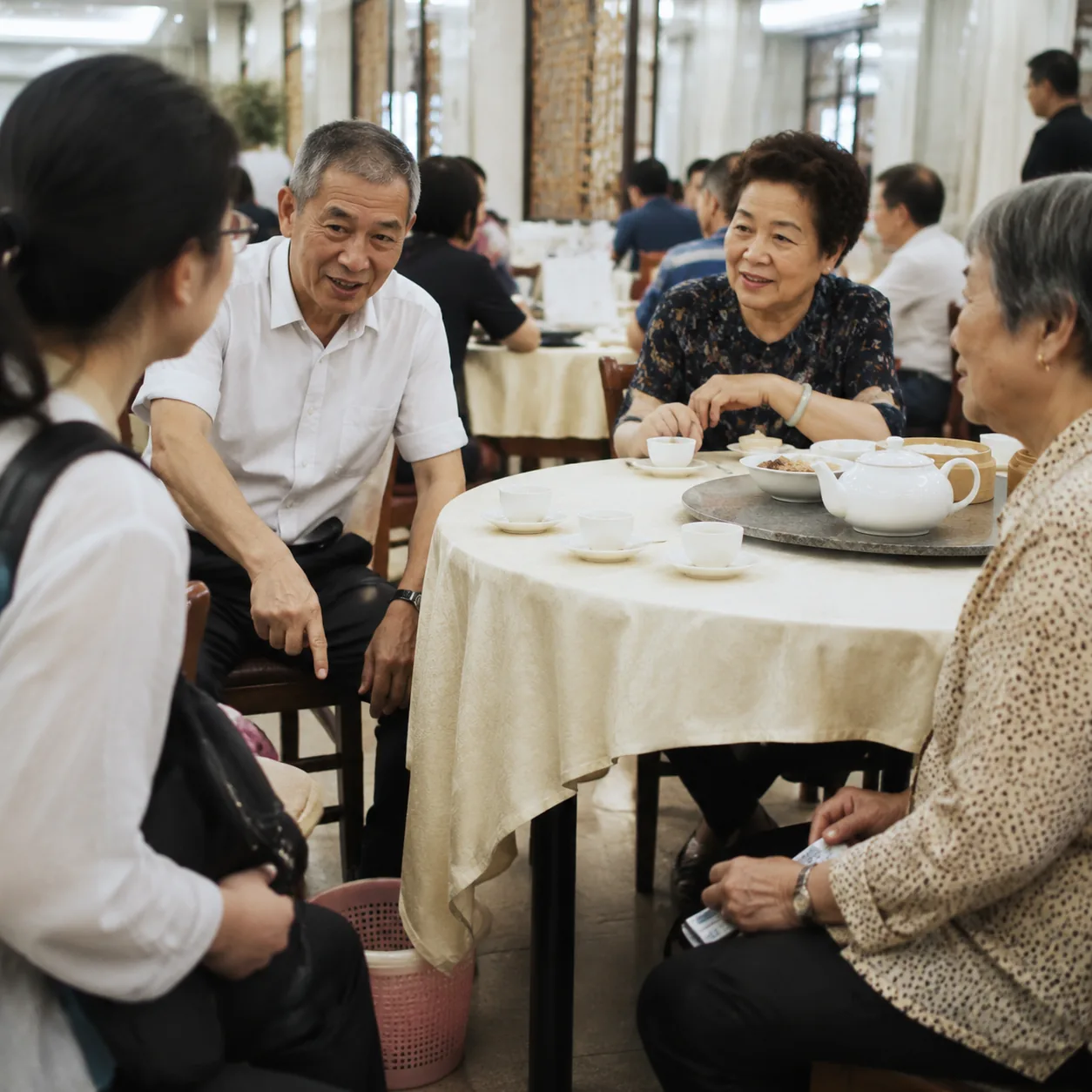
One table custom made me nervous: what should I do when someone poured tea for me? The first time the uncle picked up the teapot and refilled my cup, I quickly said thank you. He nodded, but the auntie tapped two fingers lightly on the table. I thought she was calling the waiter, but later she explained that this was the finger-tapping gesture used to thank someone for pouring tea, especially when your mouth was full or it was inconvenient to speak. I tried to learn it. The next time the auntie refilled my cup, I tapped the table gently with my index and middle fingers, the sound as small as raindrops on wood. She smiled and said, “That works.” Those two words pleased me more than any famous dish could have, because they did not mean I already understood; they meant I was allowed to keep learning.
Halfway through, I nearly made another mistake. When the cart auntie passed with a basket of chicken feet, glossy red and thick with sauce, I wanted to try them but was unsure whether I knew how to eat them. I reached out, hesitated, and pulled back. The cart auntie noticed and lifted the lid higher. “This is not about biting bones,” she said. “It is about slowly sucking the flavor.” Hearing the word “suck,” I suddenly understood that this was not efficient food. Chicken feet required time, cooperation between fingers and lips, and a willingness to get a little messy. Seeing that I still hesitated, she added, “You can order a small portion. If you are not used to it, no need to force yourself.” That sentence saved me. Travelers often fear not being “local enough,” as if every local dish must be loved. But at this table, authenticity did not mean forcing myself to perform bravery; it meant honestly trying a little.
I ordered the small portion of chicken feet. They were softer than I expected, the skin and tendons steamed almost to melting, the sauce carrying sweetness, salt, slight heat, and the deep flavor of black beans. My first bite was clumsy; I did not know which bone to spit out, and confusion must have been written across my face. The uncle did not laugh. He simply pushed the bone plate closer and said, “Put them here, not in your bowl.” Another concrete rule. The order of a shared table was not maintained by stern signs, but by these casual reminders: bones had a place, teacups had a place, phones should not occupy the lazy Susan, chopsticks should not lie across someone else’s path. I discovered that politeness was not abstract. On the table it had shape, direction, and distance.
Later I wanted barbecue pork buns because the name was familiar. On the QR menu there were honey-glazed barbecue pork buns and “snow mountain” barbecue pork buns, one shown as white and soft, the other with a crust-like top. I asked the waiter which was more traditional. She thought for a moment and said, “If you want the childhood kind, choose the honey-glazed one. If you want something more fragrant and sweeter, choose snow mountain.” The auntie added, “Snow mountain is tasty, but do not think all barbecue pork buns are like that.” I liked that reminder. It told me not to let one striking version replace a whole tradition. So I ordered the honey-glazed bun. When I split it open, the white dough opened like a cloud, revealing deep red pork filling that released a sweet aroma. I bit into it: soft dough, moist filling, sweetness balanced by meat fragrance. Familiar, but not the overly sweet version I had eaten in many overseas Chinese restaurants.
As time passed, the restaurant grew fuller. Queue numbers echoed from the entrance in waves, and waiters threaded through the gaps between tables carrying steamers, congee bowls, bills, and hot-water kettles. Some diners discussed stocks loudly; some talked about their grandchildren’s tutoring classes; some simply turned newspapers with crisp rustling sounds. My table kept changing too: the uncle’s friend arrived and pulled over a chair; the grandmother finished her congee and left first, leaving her newspaper for the auntie; a young mother sat down on the other side with her child, who stared at my foreign face. I smiled at him, and he hid behind his mother. The shared table was not an awkward compromise. It was like a temporary alleyway: people came and went, boundaries remained clear, yet brief intersections were allowed.
I began to notice the porcelain. The teacups were small, their walls thin, holding a restrained warmth in the hand; the saucers had pale blue patterns along the edges, brightened by steam; the congee bowl was steady and heavy, as if designed to settle the morning stomach. Each time a waiter added water, the tea leaves rose again in the pot, chrysanthemum petals floating on the dark liquor like small pieces of sunlight opening in water. I used to understand morning tea as “many small snacks,” but after sitting for a while, I realized that tea and porcelain connected those snacks into a meal. Without tea, the dim sum would feel too dense. Without slow sips from small cups, the steamers would become a hurried checklist. The table felt unhurried because everything on it reminded you: hot things need waiting, full things need sharing, good things need time.
Before paying, I scanned the QR code again and looked at the ordered items and total with a small sense of accomplishment. Not because I had ordered a lot, but because each item now had a story: shrimp dumplings taught me not to grip the top; turnip cake taught me to taste it plain first; taro under pork ribs taught me to notice supporting roles; boat congee taught me to keep a little crispness; chicken feet taught me not to pretend to be fearless; barbecue pork buns taught me not to let one version stand for all. The waiter brought the bill, and I wanted to pay for everyone to thank them for taking care of me. The auntie stopped me. Everyone should pay their own share, she said; sharing a table was not the same as hosting a guest. I insisted once, and she shook her head with a smile. “Next time bring your friends and teach them to tap the table.” That sentence felt more like a gift than accepting my money would have.
When I walked out of the restaurant, the Guangzhou morning had changed from damp to bright. Traffic sounded denser, the rustle of plastic bags from the market mixed with the splash of water at the fish stalls, and people hurried through the arcade shadows carrying takeaway dim sum. My stomach was full, but my mind felt even fuller: gestures, reminders, laughter, and corrections had come together to form my first morning tea map of the city. I had not suddenly become an expert, and one breakfast did not make me qualified to explain Guangzhou food culture with confidence. But I had learned to sit down and watch first, to order a little less, to ask more specifically, to leave room for others, and to give steam its time. For a foreigner, that was already a good beginning. The Guangzhou morning tea table did not demand that I understand it immediately. It simply pushed a warm cup toward me and let me drink slowly with everyone else.