Мы с ребёнком попали в Ханчжоу под майский мелкий дождь и поняли: Западное озеро не нужно обходить в спешке
“Mom, is this rain like West Lake’s own little spray machine today?” our child asked, tilting that small face upward near Broken Bridge, not long after the three of us had come out of the metro. The wind in Hangzhou’s May air carried moisture; the leaves along the lake flipped faintly in it, and although the drizzle was light, it coated the railings, stone steps, and umbrella tops with a soft sheen. My partner and I had carefully planned this family trip to be efficient: Broken Bridge first, then Bai Causeway, then a boat ride, lunch, Leifeng Pagoda, and hopefully an early return to the hotel. But the moment our child planted one foot into a shallow seam of rainwater by the road, splashed the tip of a sneaker, and laughed like a new continent had just been discovered, the rhythm we had planned cracked open.
To be honest, my first reaction was to frown. Adults on trips are especially prone to one bad habit: we mistake “careful planning” for care itself, and it gets even stronger when a child is involved. I was already doing calculations in my head—whether we could still finish the route on time, whether wet shoes might lead to a cold, whether lunch lines would be too exhausting. But our child had none of those stacked concerns. The attention was on the beads of water rolling down the lakeside railing, the threads of rain dripping from umbrella edges, and a gray little bird shaking water from its wings on a wet branch. That concentration made me feel a little ashamed. Because I suddenly realized that I was looking at “the schedule,” while the child was looking at “today.”
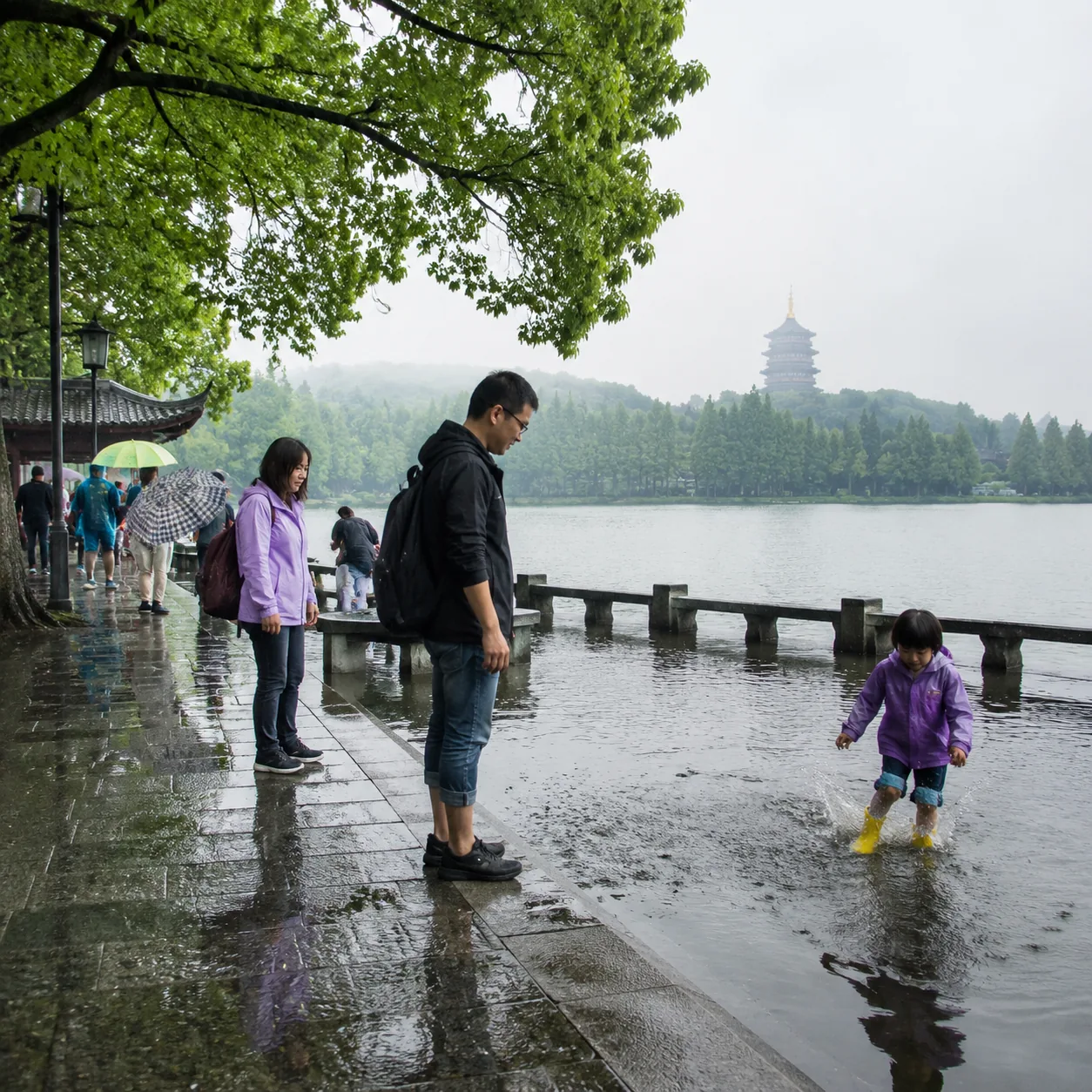
After that, we stopped trying to push forward and simply walked along Bai Causeway slowly. Every few steps the child would stop to ask why willow branches looked darker in the rain, or whether the mist over the lake was growing out of the water itself. My partner had started off reminding everyone not to get too wet, but little by little was drawn into the slower rhythm too, lowering the umbrella and crouching with the child by the stone railing to watch fish. I loved that image: under one large umbrella, three people with nowhere urgent to be, a little water at the edges of our shoes, damp cuffs, and the smell of earth and bark carried by the wind off the lake. It was not the kind of “best photo spot” a guidebook would point out, but it became the scene I most wanted to revisit in memory.
Around noon, we slipped into a lakeside shop that sold lotus-root starch drink and small snacks. The glass windows were fogged with a thin film, and our child pressed a finger to the surface and drew a little boat. The shop assistant laughed, handed over warm towels, and quietly added an extra spoonful of osmanthus syrup. In that moment, I felt very clearly that the most precious thing in family travel is not making sure every scenic spot gets covered, but leaving enough emotional space for everyone to remain comfortable. When the hot lotus drink arrived, the spoon made a soft note against the bowl, people outside kept pausing and moving again in the rain, and as I bent down to blow the steam away, the tight feeling of having to “complete the day” slowly drained out of me. I even thought of the way rain had softened the pace in 我在杭州学会先看公交站牌再上车, and of what 我在杭州菜市场学会了不装懂:真正的文化融入,常常从承认自己不会开始 suggested about Hangzhou never needing to be rushed. Sometimes the best route is not the fullest one.
After we finished eating, our child said we should go back and look at the rain by the lake again. So we really did. We went back without debating whether it was “worth it,” and without rushing to use adult efficiency to judge the desire away. I watched a small hand stretch out under the umbrella to catch falling drops while my partner cautioned against the slippery steps, and I suddenly felt that perhaps this is exactly what family travel is meant to be: one person keeping an eye on the distance, another noticing the details, and the rain kindly bringing us to the same speed. Years from now I may not remember how many kilometers we walked that day, but I will remember that line of childish wonder, that veil of mist over the lake, and the way the three of us learned to slow down together.
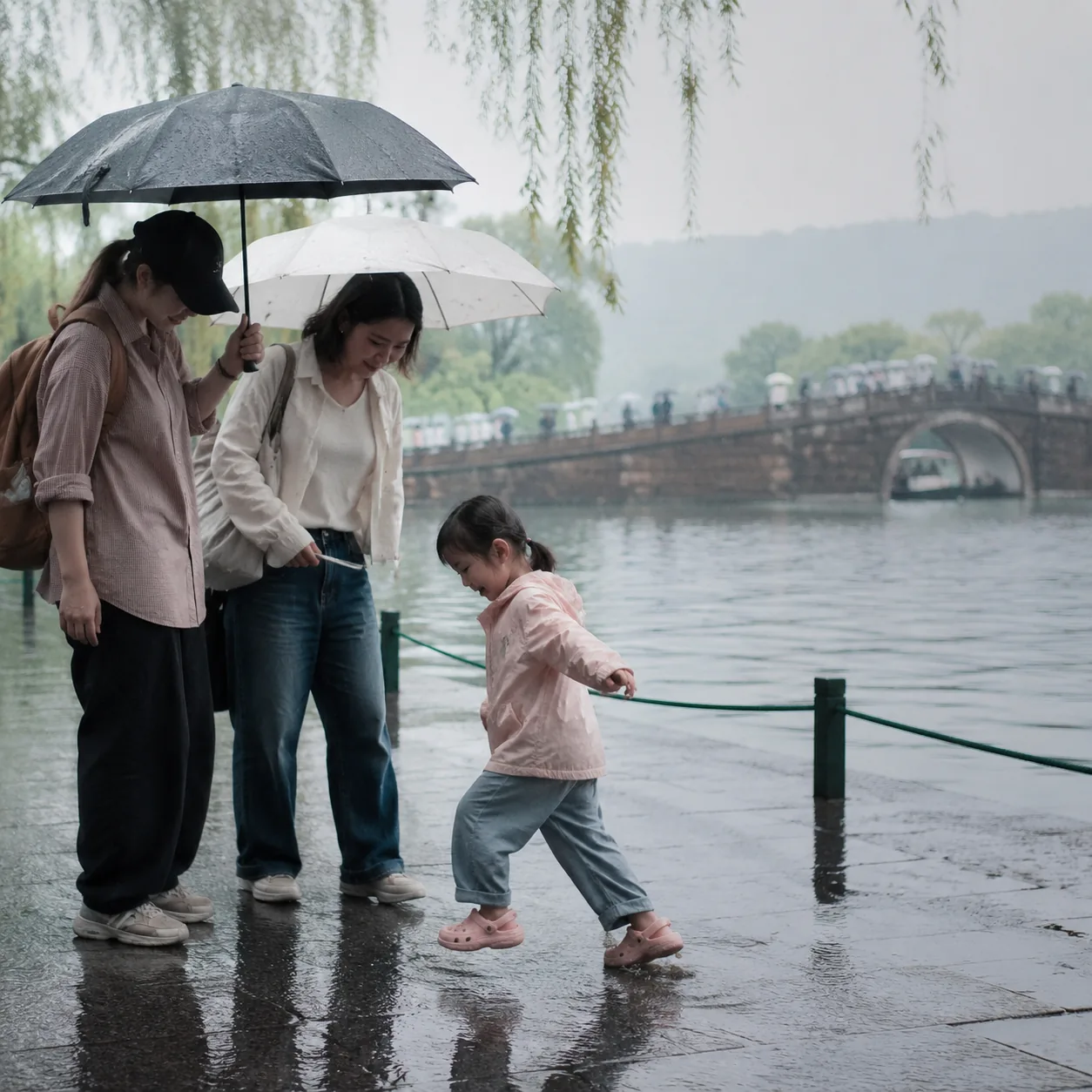
Before we left West Lake, our child turned back toward the water and said softly that today’s rain had not made us enjoy less—it had helped us see more. I could not help laughing when I heard that. Adults often think we are the ones introducing children to the world, but so often it is children who pull us out of overplanning and teach us again how to look at a sheet of water, listen to a passing wind, and enjoy a bowl of warm sweet soup. This fine May rain in Hangzhou did not help me complete a guidebook route, but it did make me understand the weight of companionship differently. It is not “taking a child to every place.” It is “staying well together in one place for a while.”