Та самая кастрюля у обочины — и есть правда города
No country in the world takes street food as seriously as China does.
This isn’t a pleasantry. A 2019 food survey across twelve Chinese cities found that 67% of respondents said their most memorable meal happened on a street corner, in a market, or at a night market — not in a restaurant. Street food isn’t a substitute for a real meal. It is the destination.
Winter in Xi’an, and dawn comes late. By six in the morning, Huajue Lane in the Muslim Quarter already has people at work. A man in a white cap squats before a clay oven, slapping flatbreads against the inner wall with a motion so practiced his arm seems to move on its own. At the stall beside him, a large pot of lamb simmers, white steam rising into the cold air and drifting the length of the alley.
Yang rou pao mo is Xi’an’s most iconic street food, but it has a rule outsiders often don’t know: you tear the bread yourself. The server brings a bowl and two hard flatbreads; you break them into soybean-sized pieces, fill the bowl, then hand it back to the cook. Fast people finish in ten minutes, slow ones take half an hour. Some say the time spent tearing bread is time for thinking.
Chengdu people invented a way to turn hot pot into street food: skewer hot pot, or chuan chuan xiang. Ingredients are pre-skewered on bamboo sticks; customers pull their own from a refrigerated case, drop them in the communal pot, and pay by the stick — fifty cents to one yuan each, counted at the end.
In a small alley near Yulin Road, a dozen skewer stalls set up in sequence starting at five in the evening, red plastic stools spilling onto the roadside. Office workers pass by on their way home, grab a few skewers, eat standing up, and keep walking. Others pull up a stool and stay for two hours, eating from dusk into dark. Skewer hot pot has no formal beginning or end — it flows through Chengdu daily life like water.
Guangdong’s street breakfast is a speed competition. The cheung fun master stands before the steam cabinet, one hand pouring rice batter, the other laying out fillings, two minutes of steaming, then scraping, rolling, saucing, handing over. The whole process takes under three minutes, and the people queued behind are already impatient.
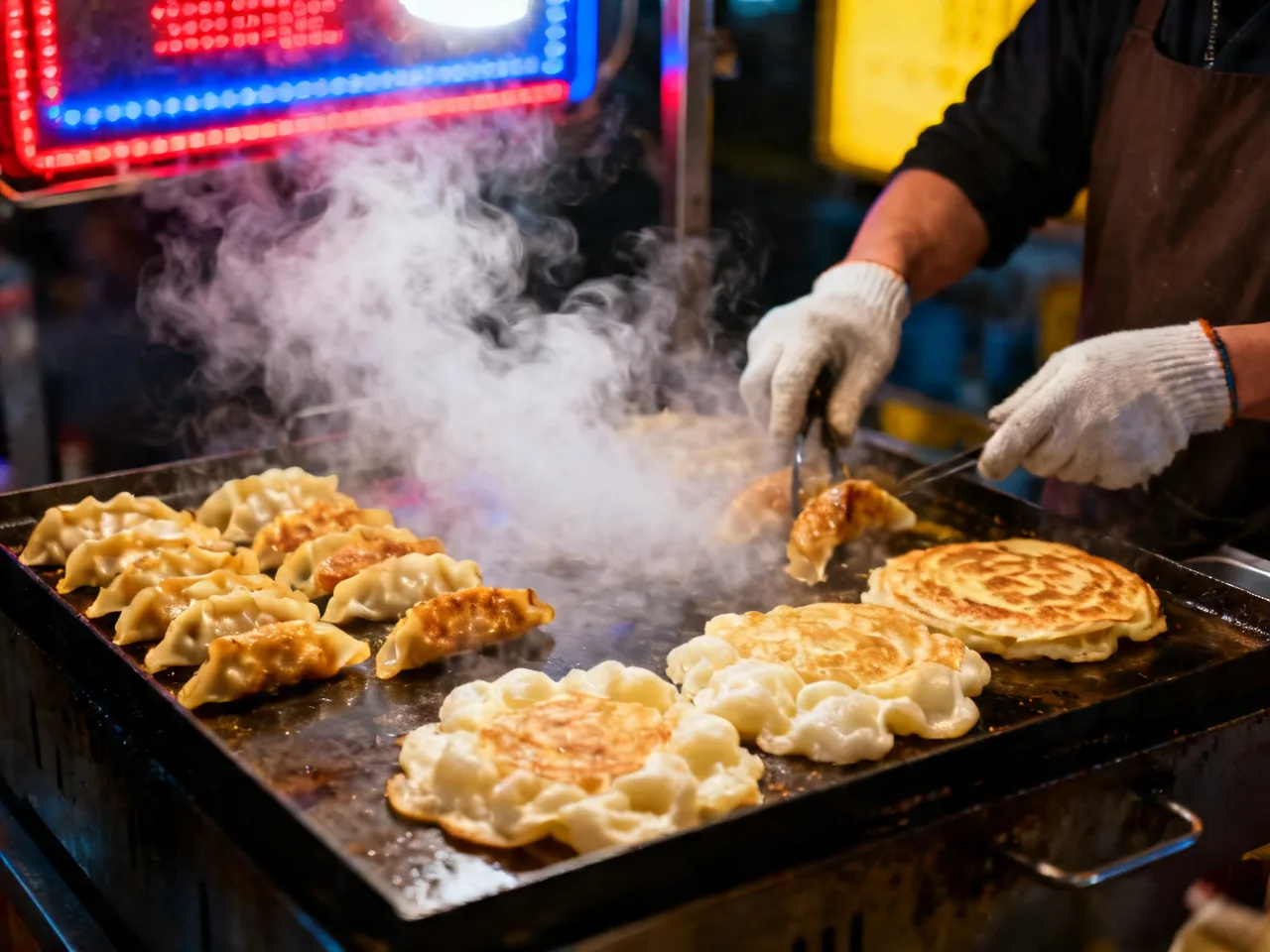
Shanghai’s pan-fried buns move at a different pace. The iron pan fills with buns, first fried on the bottom, then steamed with added water, finally scattered with sesame and scallion. The wait is longer than for Guangdong cheung fun, but it’s worth it — bite through the crisp base and broth surges out. Be careful: it will burn your mouth. Shanghai people call this sheng jian. Visitors call it a surprise.
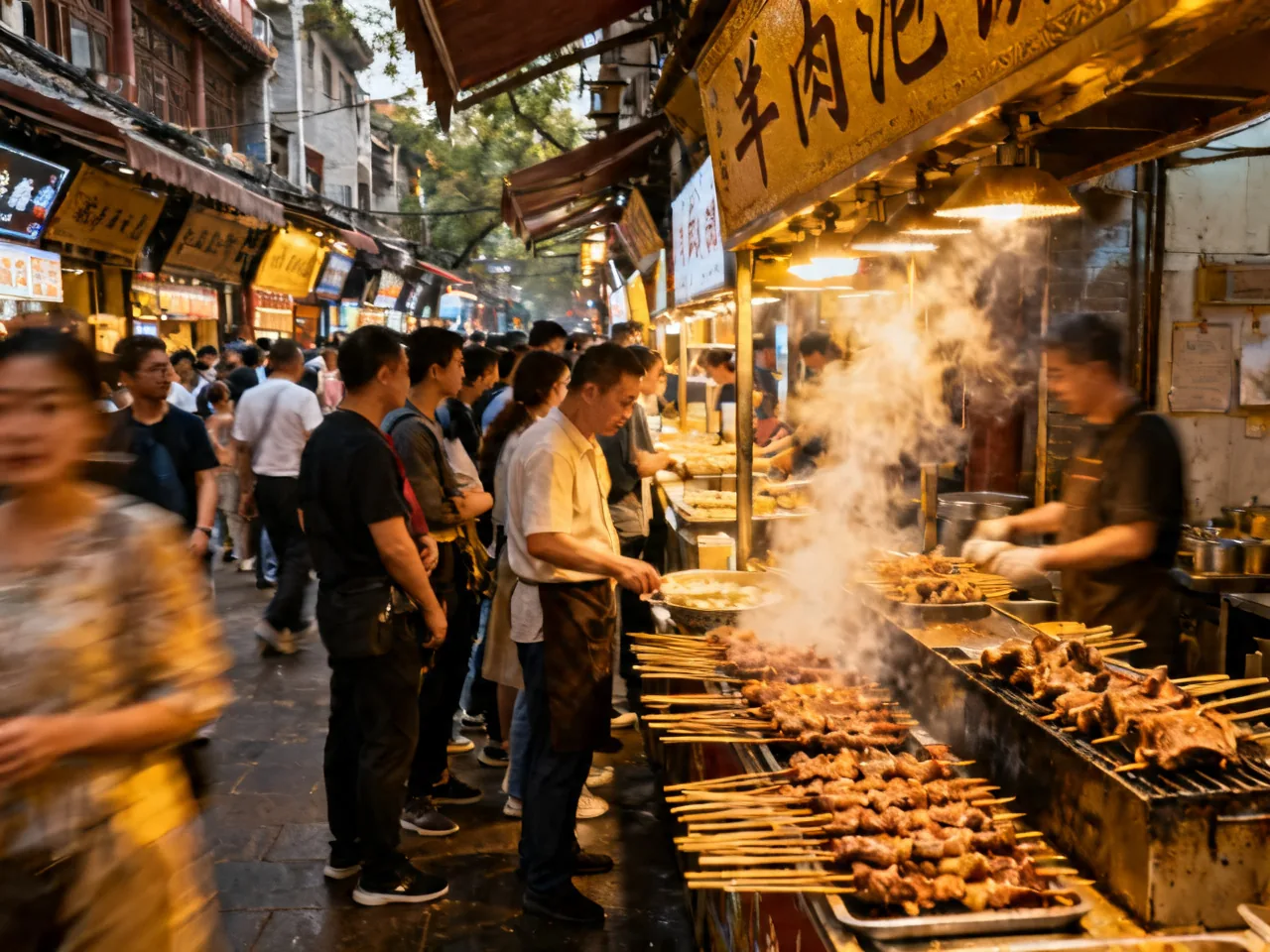
China’s night markets don’t truly come alive until after nine. Taiwan’s night market culture has influenced the mainland, but mainland night markets follow their own logic: bigger, louder, more chaotic, and more honest.
Changsha’s Wenheyou turned the night market into a four-story building, recreating 1980s Changsha streetscapes where stinky tofu, crayfish, and tang you ba ba coexist under one roof. It’s the museum version of a night market — refined but slightly self-conscious. The real night market lives in a city’s capillaries: Hubu Alley in Wuhan, Confucius Temple in Nanjing, the East City Night Market in Xining — places where the food is real and so are the people.
Street food is honest by nature. No décor, no service script, no plating. Whether the food is good, one bite tells you. If it isn’t, the vendor has no customers tomorrow. This naked market logic is precisely what drives Chinese street food to such high standards. Next time you arrive in an unfamiliar Chinese city, don’t rush to open a review app hunting for five-star restaurants. Walk the streets first. Follow the crowds, follow the smells, follow the people in line. They know the answer.
Related Reads
- The 8 Great Cuisines of China
- Spellbound at First Bite: A Stranger’s Descent into Chengdu’s Heat
- Street Steam: The Real Pulse of Chinese Cities
- The Peppercorn Dossier: Sichuan’s Flavor Map Through a Botanist’s Eyes
- 10-Day East China Five-City Loop