Немного наличных в кармане — и на станции маленького городка не паникуешь
I used to think carrying cash while traveling in China was slightly outdated. Mobile payment was too convenient: from city subways to fruit stalls, from cafés to taxis, almost everywhere accepted QR codes. My wallet grew thinner and thinner, holding only a copy of an ID document and a few receipts. Then one evening, while waiting at a small-town station in Guizhou, I finally understood that keeping a little cash was not nostalgia. It was giving myself a small cushion.
That day I had left a Miao village and planned to take a minibus back to the county town. The mountain road in the afternoon was wrapped in rain and mist, the stone path was slippery, and the stall selling glutinous rice cakes at the village entrance had already begun packing up. I checked the route on my phone, and the map showed one more bus, not too late. I felt relaxed, even bought a cup of hot soy milk, and stood under an eave watching mist settle over the terraced fields.
When I reached the station, I found that it was really just a small room and a concrete yard. A bus schedule hung under the eave, its characters blurred by rain and dust. Several locals sat on a long bench waiting, an old man keeping a bamboo basket by his feet with vegetables and two quiet chickens inside. Behind the window, a woman was eating sunflower seeds, with a handwritten register beside her.
I went to the window and asked whether the bus to the county town had left. The woman looked at the clock and said not yet; the driver had gone to eat, and the bus would leave when there were enough people. I asked whether I could scan a code to buy a ticket. She pointed to a QR code on the wall and said usually yes, but the network was unstable today, so I should ask the driver once on board. She said it casually, and I did not worry, because I had grown used to a life where “you can scan in a moment.”
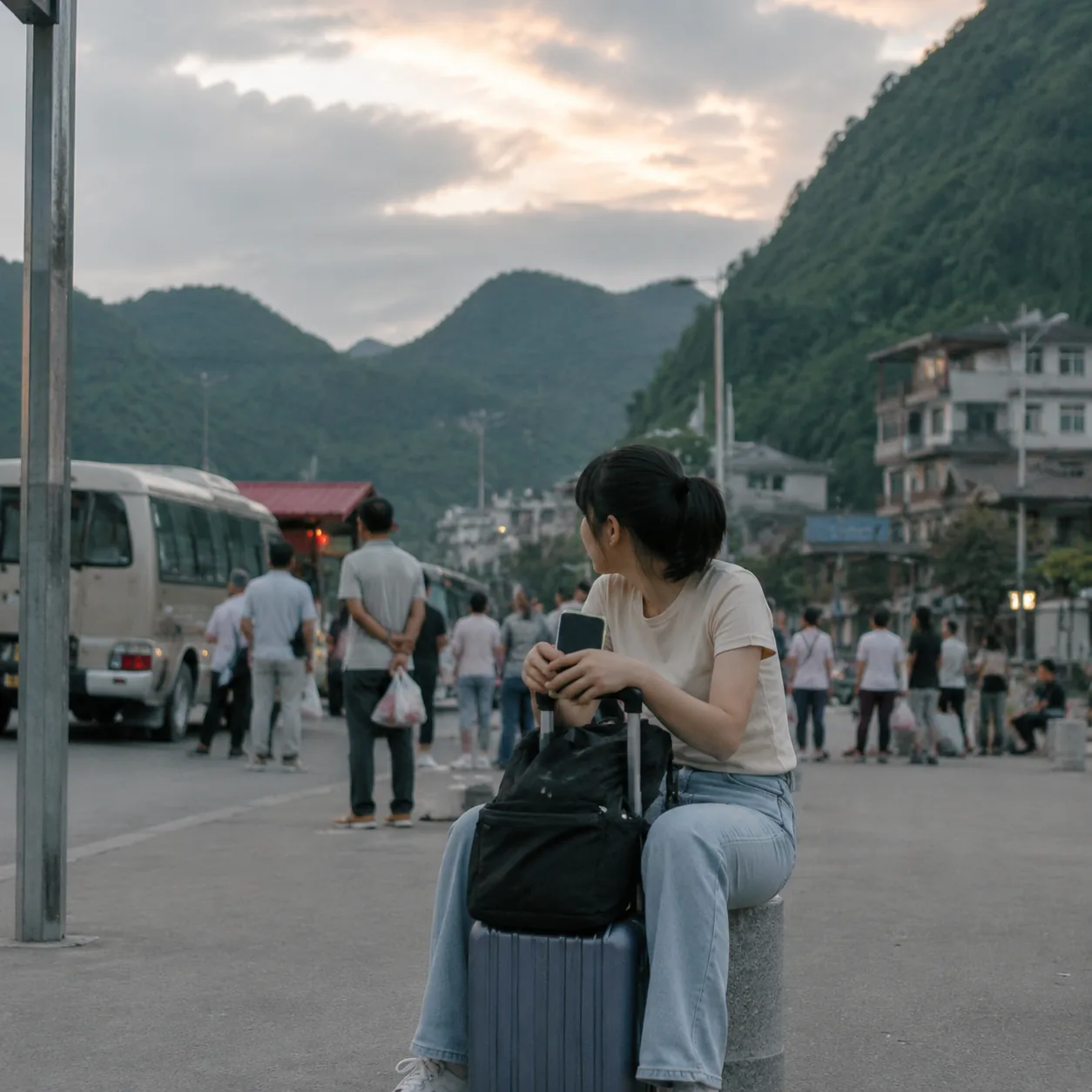
The sky slowly darkened, and the rain stopped and started again. My phone signal went from two bars to one, then back to two. There was no real station announcement, only people asking one another, “Are we leaving?” and “How many people now?” I began to feel slightly uneasy. I opened my payment app to test it, and the page spun for a long time before appearing. My balance and bank card were all inside the phone, but in that moment they felt separated from me by a layer of mist.
When the driver finally returned, everyone picked up their things and headed toward the bus. I followed the line and sat in the second-to-last row. The driver stood by the door collecting fares. Regular passengers simply named their destination, handed over a dozen yuan, and received change. When it was my turn, I asked whether I could scan. The driver glanced at my phone and said scanning sometimes did not work here, but we could try.
I scanned the code by the door, and the page loaded slowly. After I entered the amount, the circle kept spinning until the person behind me began shifting their feet. The driver did not hurry me; he only said the signal was bad and we could wait. Still, I felt my face grow warm. Behind me someone held a wet umbrella, someone carried a child, and the bus already smelled of chickens and vegetables. I suddenly realized that embarrassment does not always come from other people being impatient. It can also come from knowing I am unprepared.
Just as I was about to get off and look for a better signal outside, an auntie beside me asked whether I had cash. I said I might have a little, but was not sure if it was enough. She said the fare to the county town was fifteen yuan. I opened my wallet and found only one twenty-yuan note and a few one-yuan bills. That twenty-yuan note, usually forgotten, now felt like a small key. I handed it to the driver. He quickly gave back five yuan, and the problem ended just like that.
As the bus pulled away from the small station, my payment app was still stuck on a processing screen. The driver told me not to worry; if the money was actually deducted later, we could deal with it in the county town. I returned to my seat holding the five-yuan change, and my heartbeat gradually slowed. Outside the window, the mountain road shone wet, and the headlights revealed curves one section at a time. In that moment, my gratitude for that twenty-yuan note far exceeded its actual value.
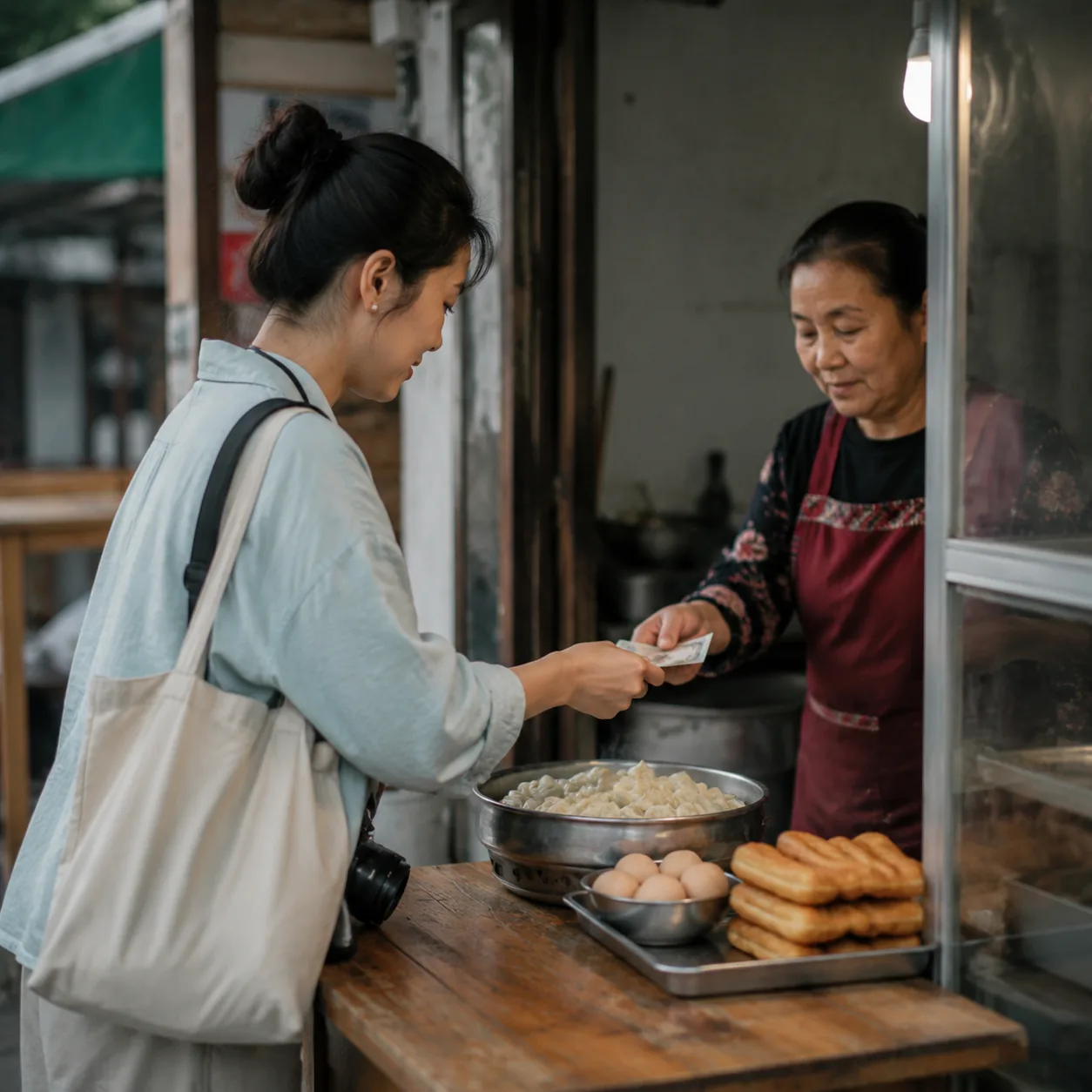
The auntie saw me exhale and smiled. “Keep a little cash when you go out, and your heart will not panic,” she said. Her tone was not scolding, but like sharing an old piece of experience. She said everyone used phones now, but in mountain areas, stations, markets, and temporary stalls, there would always be moments when the signal was poor or equipment failed. You did not need much cash—just enough for a simple meal, a short ride, or a bottle of water.
I asked how much she usually carried. She said it depended on where she was going. In the county town, a few dozen yuan might be enough; going into the mountains, she would keep a little more. But she never kept all her money in one place. Larger bills and documents stayed in her bag, while small bills went somewhere easy to reach. She also reminded me that small change was more useful than large notes, because stalls and buses might not be able to break big bills.
Throughout the ride, I kept touching the five-yuan note in my pocket. The paper was soft, its corners curled, completely different from the invisible numbers in my phone. Mobile payment was certainly faster and cleaner, and it avoided the trouble of change. But cash had a plain certainty: it did not need signal, battery power, a loading page, or proof to any app that I was currently on the road.
When we reached the county town, it was already dark. The bus stopped at a temporary drop-off point, and several small shops by the road glowed with white light. After getting off, I checked my phone first. The earlier scanned payment had failed, and no money had been deducted. I felt relieved, and also glad that I had not placed all my hope on that spinning loading icon. The driver waved and said next time I should prepare some small bills before taking the bus.
I found a rice noodle shop by the road for dinner. The shop accepted QR payment, and I paid smoothly. But this time, the successful payment did not make me feel modern or clever. Instead, it reminded me of that twenty-yuan note. Convenience should not make a person lose preparation, just as map apps should not make a person stop looking at road signs, and translation apps should not make a person avoid learning even one thank-you.

The next morning, I went to a small shop beside a bank to buy water and deliberately broke a hundred-yuan note into twenties, tens, and fives. The shopkeeper heard me ask for small bills and asked whether I was going to the countryside. I said yes. She nodded and said they could be useful for buses, markets, even public toilets sometimes. She tied the notes lightly with a rubber band and reminded me not to keep them too exposed.
Since then, I have given myself a simple travel rule: mobile payment is the main method, cash is the buffer. The buffer does not need to be thick. It only needs to help me avoid panic when a page will not open, a scanner has no power, or a driver says the signal is poor. It is not meant to replace the phone; it is meant to protect a few minutes of calm.
I also slowly learned how to carry this small amount. Do not stuff it all into a large wallet, because taking it out is too obvious. Do not keep it in the same pocket as your passport, because pulling out documents every time you buy water is unsafe. Do not carry only one large note, because the other person may not have change. A few small bills, divided between a coin purse and a deeper pocket in the bag, work better.
This rule helped me several more times later. At the gate of a temple in the north, I used cash to buy incense because the vendor’s QR code had been blurred by rain. At a morning market in Yunnan, I used ten yuan to buy two buns and a cup of soy milk because the owner’s phone was charging. After one late-night taxi ride, I used a paper bill to cover the difference when mobile payment lagged. None of these were major crises, but each time I avoided a little awkwardness.
I am not saying that travelers in China must carry a lot of cash. Too much cash is inconvenient and unsafe. What matters is a small sense of proportion: do not hand all your ability to one screen. The phone is the most convenient tool, but not the only tool. QR codes are the usual door, but not every door opens smoothly on a rainy night.
That small-town station changed how I think about preparation. Preparation does not mean stuffing luggage full, and it does not mean imagining every possible accident. Good preparation should be light, like a few flat notes at the bottom of a bag: almost unnoticed most of the time, but able to hold you up when needed. It keeps every small failure from becoming a large emotion.
Now before going out, I check my phone battery, power bank, identity documents, and small cash. The action takes only a few seconds, but it makes me feel more grounded for the day’s route. Especially when going to old towns, villages, mountain areas, morning markets, or long-distance stations, I prepare small bills in advance. Not because I do not trust China’s mobile payment, but because I deeply trust travel to produce all kinds of specific little situations.
If someone asks how much to carry, I will not give an absolute number. I will say: imagine your phone suddenly has no signal today. What do you still need to complete? A ride back to your lodging, a simple meal, a bottle of water, perhaps a public toilet or a storage locker. Add those together, then keep a little extra. That is enough. The point of a cash buffer is not abundance, but keeping the road from breaking.
I still like the speed of QR payment. It lets me carry fewer coins, calculate fewer exchange rates, and worry less about change. But I also like the quiet paper notes in my wallet. They do not glow, vibrate, or display a balance, yet at certain moments they are more direct than any app. They remind me that travel is not about proving how digital I am, but about keeping the ability to move in unfamiliar places.
On that night from the Guizhou small town back to the county seat, almost nothing was visible outside the window except rain and distant lights from village houses. I sat in the shaking minibus, holding five yuan in change, and slowly felt calm again. That small bill did not solve a grand problem. It simply let me board the bus, return to my lodging on time, and eat a hot bowl of noodles. But calmness in travel is often built from exactly these small moments of things going smoothly.
So now, besides a charger, translation app, and map, my travel checklist includes one very plain item: small cash. It does not feel high-tech and is not worth photographing for social media, but it is one of the things I most willingly recommend to first-time travelers in China. Because when the phone spins, the signal disappears, and the bus door is about to close, you will discover that the cash in your pocket is not a leftover from the past. It is a little confidence that lets you keep moving forward.