Письмо детям, только начинающим учить китайский: не спешите заучивать много иероглифов — сначала научитесь свободно говорить
Dear little learner, If you have just started learning Chinese, and every time you open your mouth you worry that your tones will slip, your word order will turn around, or your “thank you” will sound like a memorized line, I want to tell you something first: you do not need to rush. Really. Many people get stuck in a new language not because they are slow, but because they want to sound perfect too early.
I remember a child who had just arrived in China. On her first trial class at school, she held a card that said “你好” so tightly that the edge bent under her fingers. The teacher asked everyone to greet one another. She had practiced many times, but when her turn came, she suddenly went quiet. There was the soft sound of a pencil case tapping the desk, and outside the window a basketball hit the ground again and again. Her face slowly turned red, and in the end she whispered out a tiny “ni… hao.” And do you know what happened? Nobody laughed. A girl with a ponytail smiled at her first and said, “It’s okay. We’ll take it slowly.”
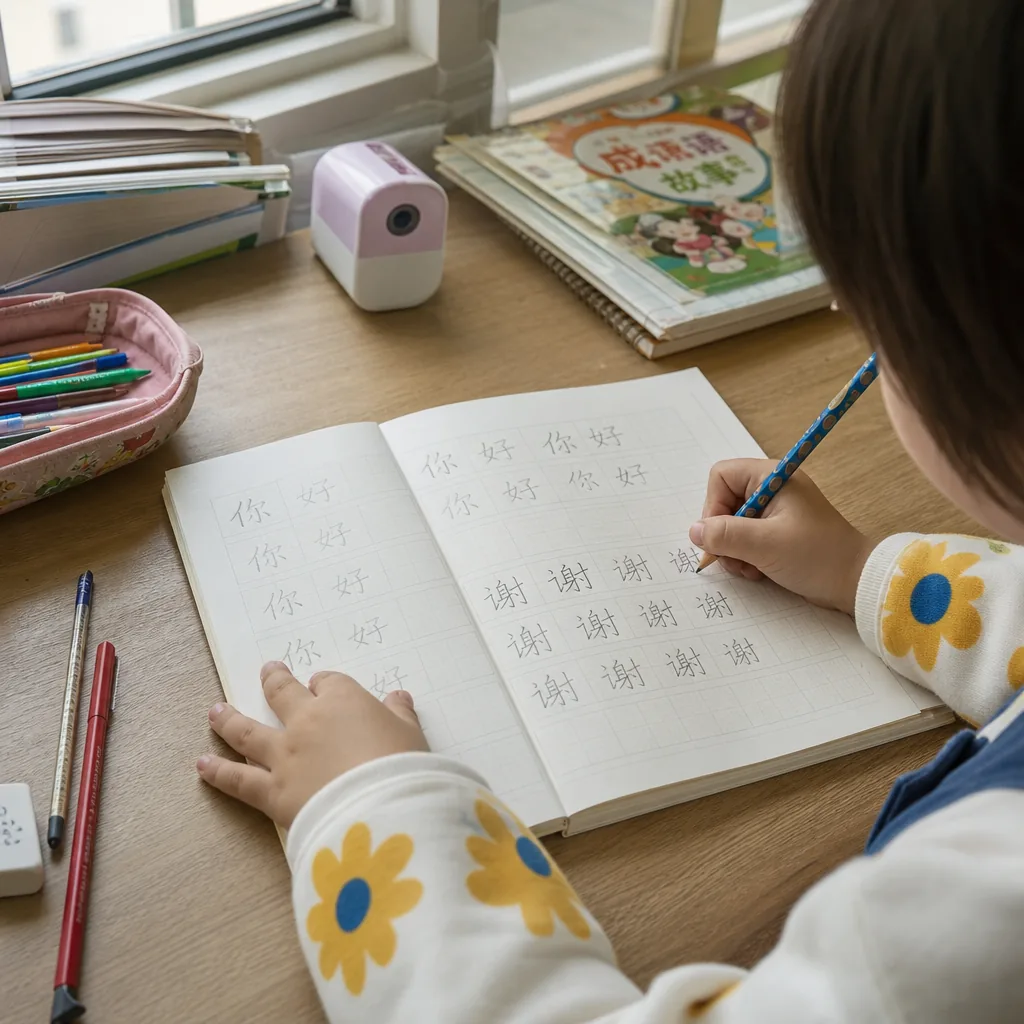
I love this little scene because it reminds me that language does not grow first in a dictionary. It grows first in whether you dare to speak it. When you begin learning Chinese, you do not need to know many characters at once, and you do not need to write every stroke like printed text. What you need more is to let your mouth get used to the rhythm of Chinese, let your ears recognize the most common expressions, and let your heart know that even if you freeze, the world will not end.
So this letter is not here to push you to memorize more. It is here to help you make speaking feel natural first. The methods below are not like test questions. They are like small actions you can do every day. Practice a little before breakfast, a little after school, a little while washing your hands, packing your schoolbag, or turning off the light before bed. Chinese does not come all at once. It is more like slowly walking a little path into shape.
Start with These Five Small Things
1. Make the shortest phrases smooth first
Do not challenge long sentences at the beginning. Make “hello,” “thank you,” “I’m here,” “I don’t know,” and “is it okay?” sound natural first. Natural is stronger than complicated.
2. Practice in front of a mirror, not to look pretty, but to stop panicking
Look at yourself, say one sentence in Chinese, pause, then say the second. A mirror does not rush you or interrupt you. It only helps you get used to the feeling that you are speaking Chinese.
3. Learn words from real objects, not only from flashcards
See a cup and say “water.” See a door and say “door.” Pick up an eraser and say “eraser.” Once words connect to things, Chinese stops being only marks on paper.
4. When you don’t know, learn one sentence that can hold the moment
For example: “Please say it again,” “I understand only a little,” and “Can you speak more slowly?” These sentences are like a small umbrella. They do not remove every problem, but they help you not get soaked.
5. Leave only one tiny goal for each day
Today, make “thank you” sound more natural. Tomorrow, say “hello, teacher” a little more clearly. The day after, finish saying “I want to try.” One small daily goal works better than dreaming of becoming amazing overnight.

Some adults will tell you that learning Chinese means recognizing many characters first. That is not wrong. But if you are a foreign child, I honestly suggest you do not scare yourself that way. Speaking first has one big advantage: you begin to feel the language living with you. In the cafeteria you can say, “This one.” When it rains, you can say, “I didn’t bring an umbrella.” When you see your teacher, you can say, “Good morning.” When you get a question wrong, you can say, “I’ll try again.” Once sentences like these come alive, Chinese characters stop feeling like a wall and start feeling like a room you will slowly walk into later.
I also want to tell you that messy pronunciation, mixed-up tones, and getting stuck halfway through a sentence are all normal. Truly normal. One wrong word does not turn you into someone who is bad at Chinese. In fact, each time you speak once more, understand one more sentence, or dare to open your mouth one more time in a classroom, a supermarket, or by the playground, you are moving quietly forward. Other people may not see it, but you will know that the road is already different from yesterday.
So if you remember only one sentence from this letter, let it be this: do not rush to memorize too many characters before you learn to speak naturally. A language is not a tree that appears all at once. It is more like a small plant on a windowsill that gets a little water every day. When you hear it growing, it may sound very small. But when you look back, a whole patch has already turned green.
I hope the next time you speak, you are not more perfect, but more brave.
If you want one more story about real Chinese around a school gate, you can also read school-gate Chinese story.