Трёхдневное автопутешествие из Чэнду в Западную Сычуань
At six in the morning, Chengdu’s alleyways were still wrapped in a thin mist. I’d already tossed my pack into the trunk, a scalding cup of soy milk in hand. The GPS said my destination — Siguniang Mountain Town — was 240 kilometers away, roughly four hours. But I’d learned that roads in western Sichuan never follow the script. The moment I turned the ignition, the city noise fell behind me, and three days of highland highway storytelling began.
Day 1: Chengdu to Siguniang Mountain
I took the Duwen Expressway and turned toward Wolong — a shorter route than looping through Ya’an, and the payoff is crossing Balang Mountain Pass, the first real climax of the trip. Past the Dujiangyan toll station, the roadside vegetation shifted fast: bamboo groves gave way to conifer forests, then nothing but scrubby bushes and bare rock. The altimeter jumped from 500 to 4,000 meters. My ears popped. I rolled down the window and let the sharp, cold air rush in, carrying the scent of wet grass and earth.
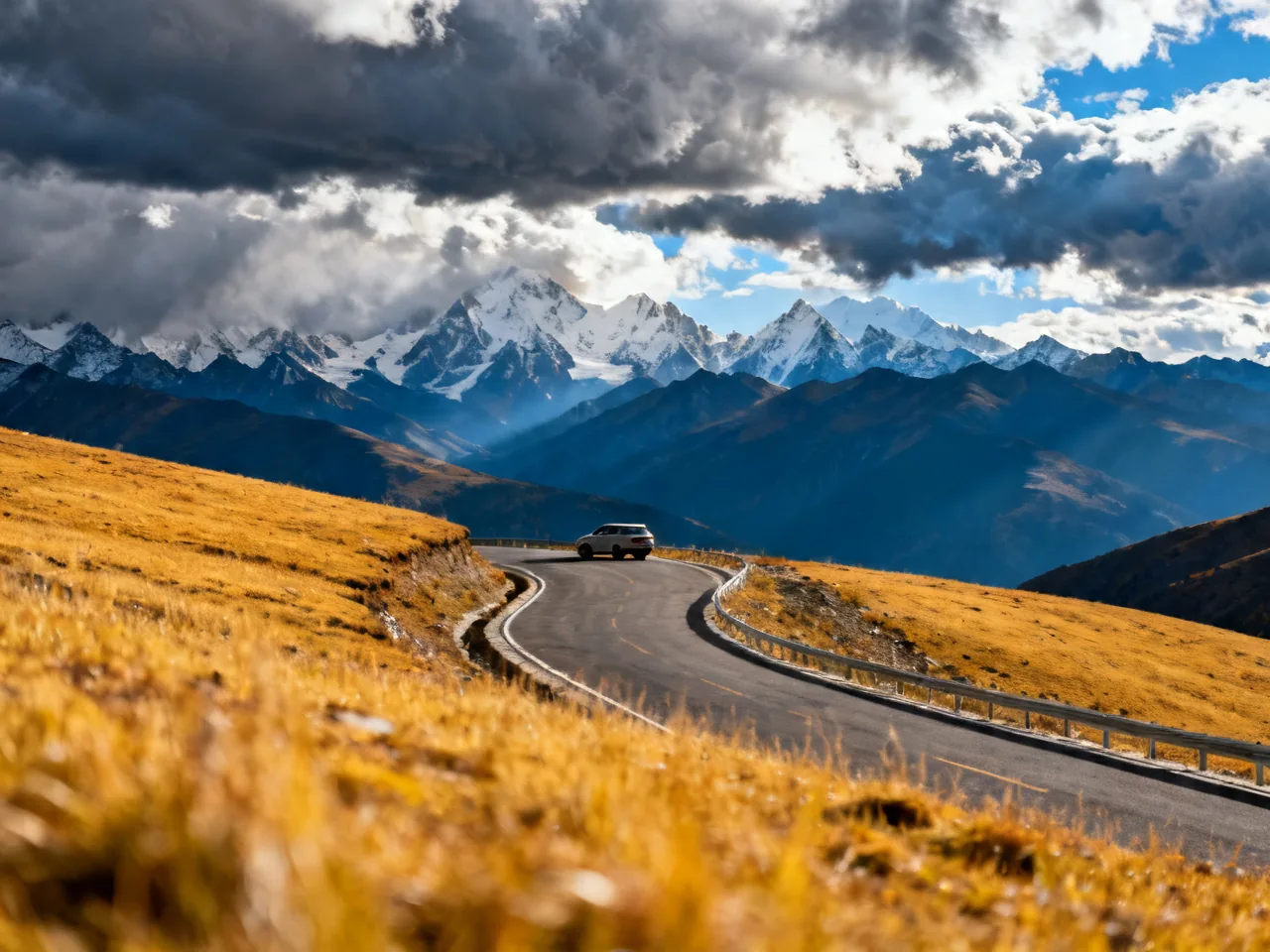
Balang Pass sits at 4,487 meters. In mid-October the wind was strong enough to knock you sideways. I parked at the overlook and my legs went a bit wobbly stepping out — not from fear, but from the thin air. Alpine meadows, already turned golden-brown, blanketed the slopes on both sides, and snow-capped peaks flickered in and out of cloud gaps on the horizon. A young guy on a touring motorcycle had also pulled over, helmet dangling from the handlebar, face sunburnt red. He flashed me a thumbs-up and shouted, “Brother, respect!” We snapped photos for each other, then went our separate ways. That wordless camaraderie on the road — only fellow road-trippers understand it.
I rolled into Siguniang Mountain Town — also called Rilong — around three in the afternoon. The town is wedged into a valley, its single main street lined with guesthouses and Sichuan restaurants. I picked a homestay with a view of Yaomei Peak, dropped my bags, and headed straight for Shuangqiao Valley. It’s the most accessible of the four valleys in the Siguniang scenic area: a shuttle bus takes you to the far end, and you walk back along boardwalks. The larch forests were in peak autumn color, the entire valley looking like someone had splashed it with liquid gold. I sat on the boardwalk for half an hour doing absolutely nothing, just listening to the wind thread through the treetops.
Day 2: Siguniang Mountain to Danba
I didn’t set an alarm on day two. Sunlight through the window woke me. Yaomei Peak glowed an almost unreal shade of pink in the early light, and I watched it from the windowsill, wrapped in my quilt, for a good ten minutes before getting up. Breakfast was a bowl of yak-meat noodles at a shop on the main street — rich broth, hearty chunks of meat, fifteen yuan, and it kept me full for hours.
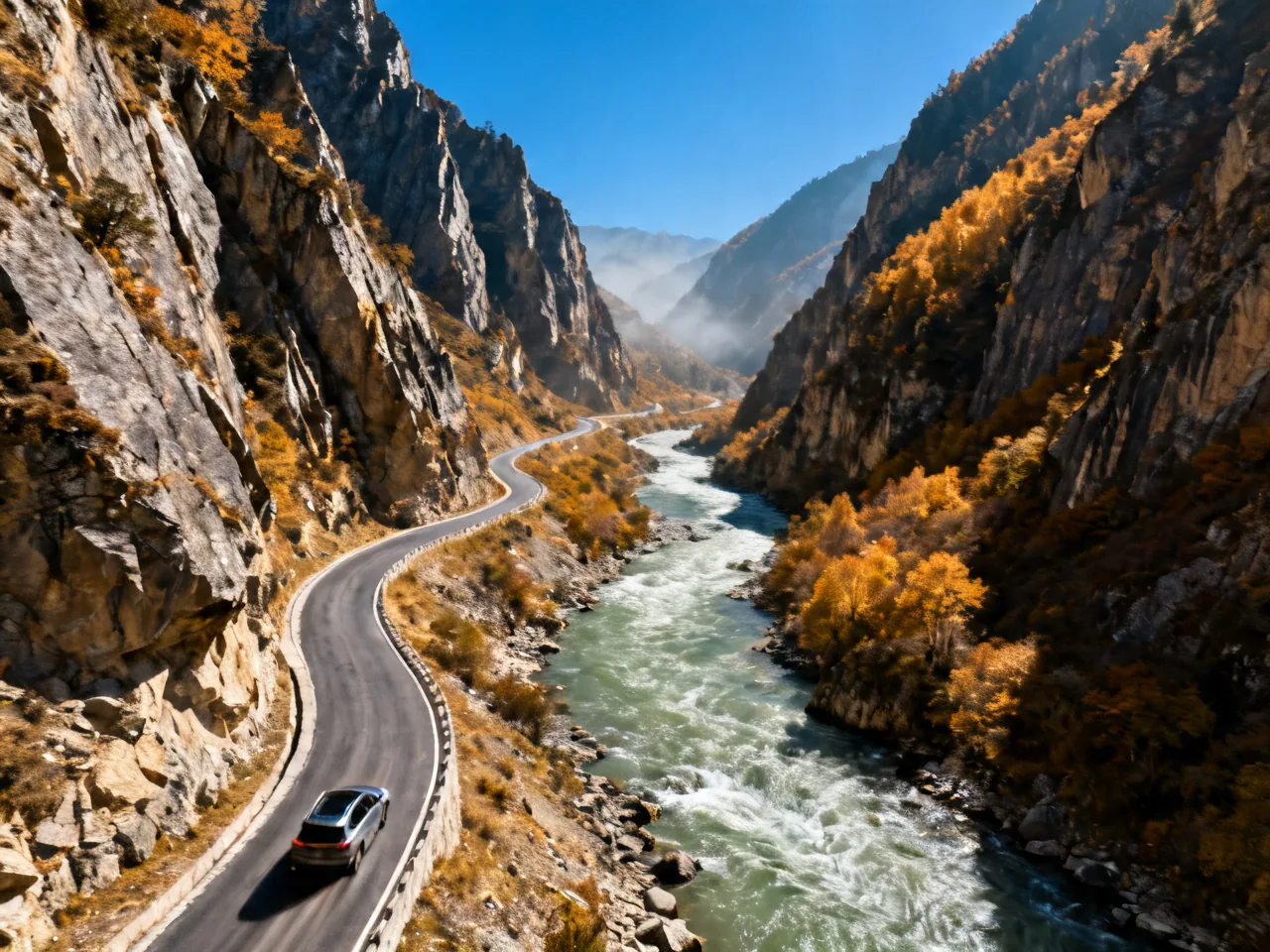
From Siguniang Mountain to Danba is about 110 kilometers via Xiaojin County. The road follows the Xiaojin River valley — the water a glacial grey-green — flanked by cliffs so sheer they look knife-cut. The asphalt was in good shape, but the curves were relentless and demanded full attention. I stopped in Xiaojin town to refuel and grab a few apples. Xiaojin apples are famous across Sichuan — crisp, explosively sweet and juicy, nothing like what you’d find in a supermarket.
I reached Danba in the afternoon and drove straight to Jiaju Tibetan Village. This is my single strongest recommendation from the entire trip — if your time is limited, you could skip everything else and come here alone. The village climbs the mountainside, white stone watchtowers scattered among terraced fields and fruit trees, colorful prayer flags fluttering from every rooftop corner. I checked into a homestay run by a Tibetan woman named Zhuoma. Her Mandarin carried a thick accent, but her smile needed no translation. For dinner she made butter tea, barley flatbread, and a huge plate of potato-and-yak stew. We ate in the courtyard. The night sky overhead was so dense with stars it looked like someone had flung a handful of crushed diamonds across it. Zhuoma pointed at lights on the opposite mountainside — her sister’s house, also a homestay now. “Life is good these days,” she said, her tone matter-of-fact, but her eyes bright.
Day 3: Danba via Bamei back to Chengdu
The final day had the longest drive and the most dramatic scenery. From Danba I crossed the Yak River valley to Bamei Town, then passed through Tagong Grassland and over Zheduo Mountain, before picking up the expressway at Kangding back to Chengdu. The full loop was roughly 400 kilometers and took close to ten hours.
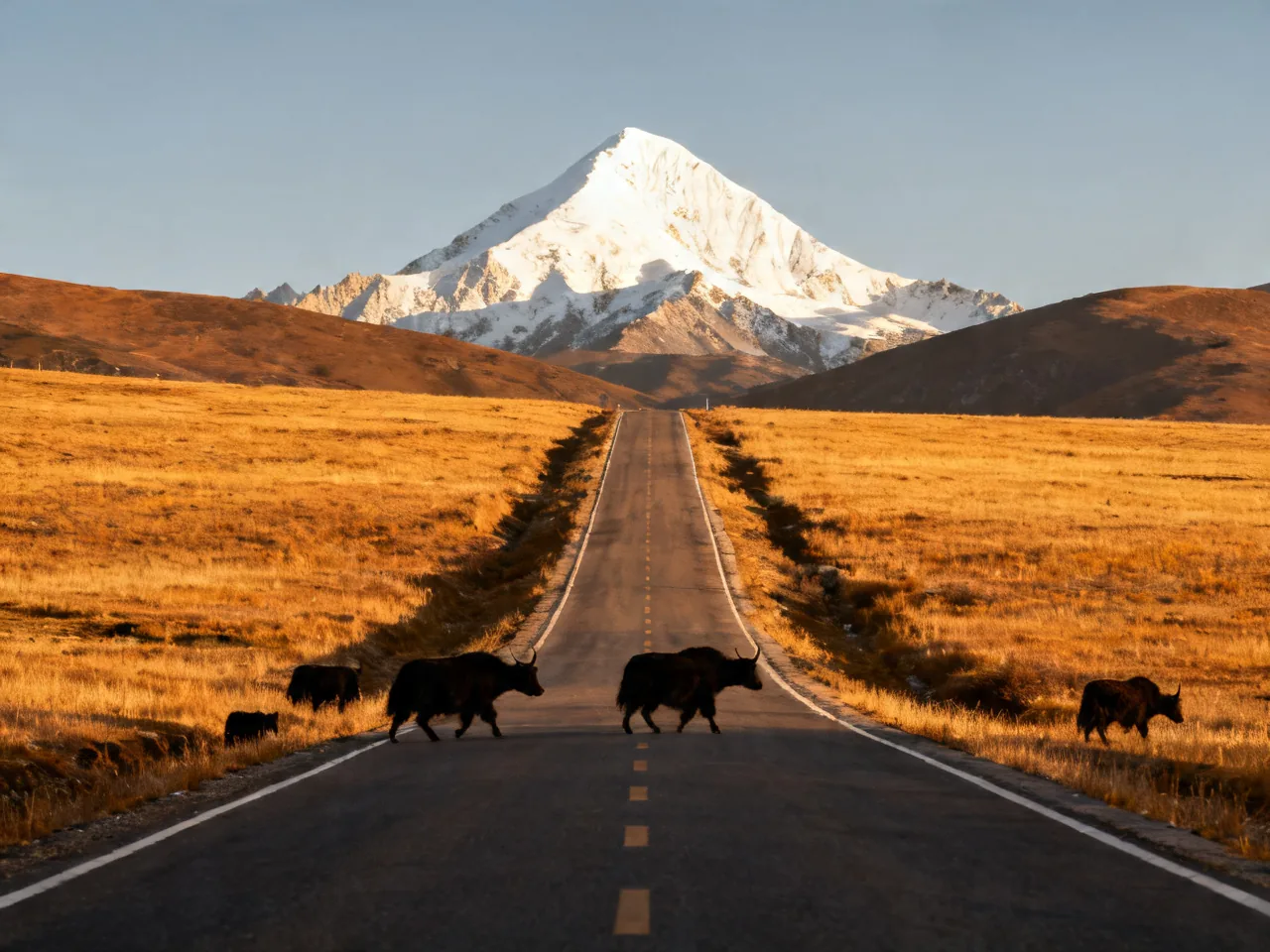
The stretch from Bamei to Tagong was where the landscape opened up completely. The highway cut straight across highland pasture, endless tawny grassland on both sides, the silhouette of Yala Snow Mountain sharp as a paper cutout against the sky. The golden roof of Tagong Monastery glinted in the sun. I didn’t go in — just pulled over for a few minutes and watched a herd of yaks amble across the road. A herder on a motorcycle trailed behind them, in no hurry at all. In western Sichuan, time runs on a different clock than in the city.
Zheduo Mountain is the dividing line of western Sichuan — cross it and you’ve officially left the Tibetan highlands for the Han lowlands. The pass tops out at 4,298 meters, the switchback road coiling around the mountain like a grey ribbon. Once I descended into Kangding, the air turned noticeably warmer and moister, and hotpot joints and milk-tea shops reappeared along the streets. I celebrated the end of the trip with a Kangding hotpot — bubbling red broth, tripe dunked seven times, an ice-cold beer downed in one go. Three days of fatigue and exhilaration dissolved together in the numbing, spicy steam.
Practical Tips
About the car: a regular sedan can handle the entire route, but an SUV gives you more confidence, especially on the climbs up Balang and Zheduo. If you go in October, pack snow chains just in case. Top up your tank whenever it hits half — gas stations are far apart in the mountains. Take altitude-sickness medicine in advance; Rhodiola or glucose tablets both work. And the most important tip: don’t rush. The beauty of western Sichuan is on the road itself, not at the destination.
At ten that night I pulled into my apartment garage in Chengdu and killed the engine. Sudden silence. Three days, over 800 kilometers, four snow mountains, one Tibetan village, countless switchbacks. The steering wheel still held the warmth of highland sun. I sat in the car for a while, staring at nothing, then picked up my phone and started looking up routes for the next trip.
Related Reads
- 10-Day East China Five-City Loop
- Lijiang Old Town: Naxi Culture & Snow Mountain Views
- Zhangjiajie Glass Bridge & Tianmen Mountain Guide
- Guilin Li River Scenic Tour Complete Guide
- Spring Bloom Map: China’s Most Beautiful Flower Fields