В тот вечер в Гуйлине одна фраза хозяйки «не ищи больше» помогла выбрать блюда лучше любого рейтинга
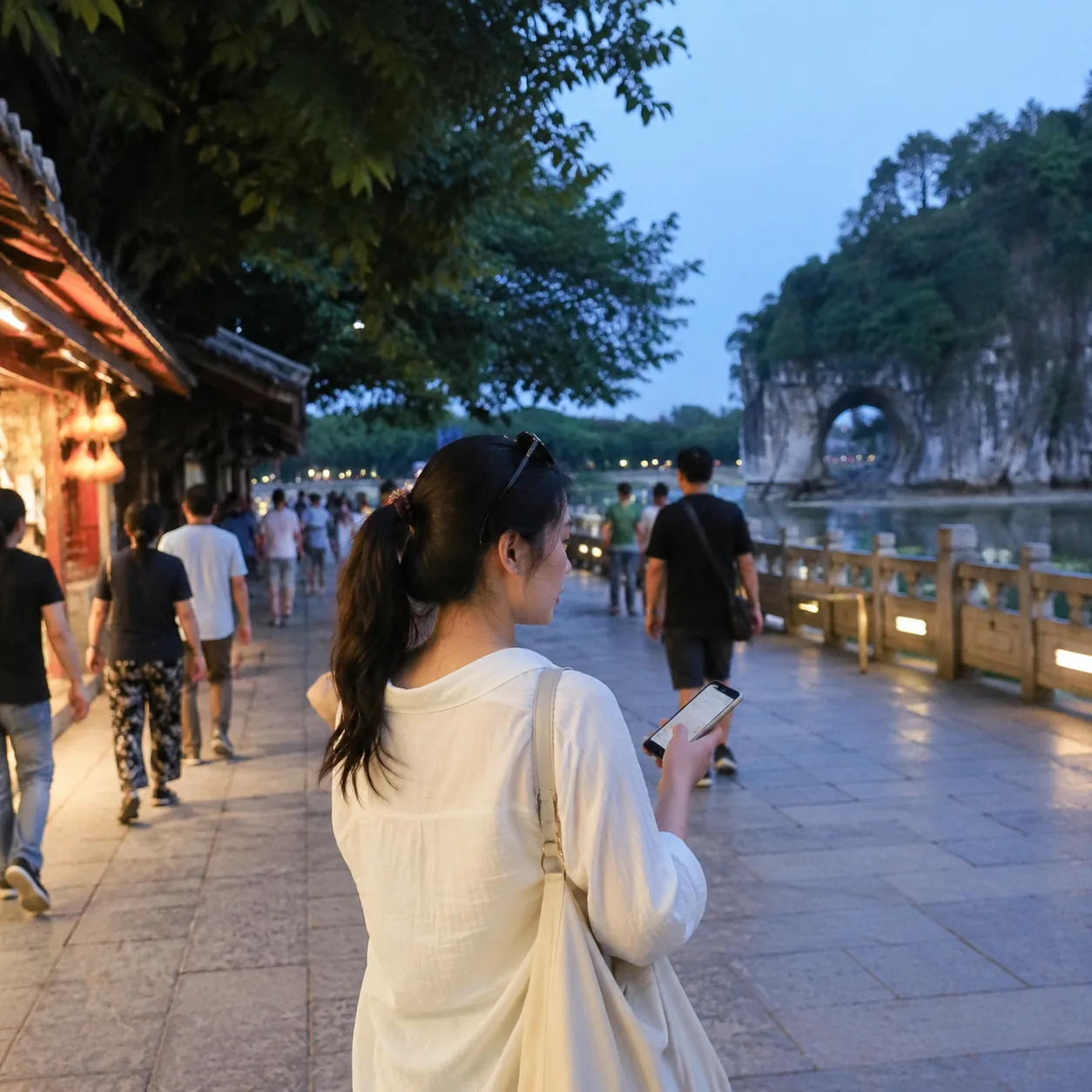
At 6:20 in the evening on September 12, 2024, I walked slowly back toward the riverside near Elephant Trunk Hill, my phone still open to a saved list. It held several Guilin rice noodle shops recommended again and again, along with a few beer-fish restaurants whose names sounded strongly local. But that evening I suddenly did not want to follow starred places anymore. The afternoon rain had just stopped, the stone path by the Li River was still wet, and streetlights trembled in puddles like broken gold. The air smelled of damp osmanthus, river water, and cooking smoke from small kitchens. I had come from France, and it was my first time in Guilin. I had assumed dinner would be the easiest item on the itinerary: find a restaurant with a large sign, order a few dishes mentioned in guides, take photos, finish eating, and tick the box. Yet when I reached the mouth of a narrow lane, I saw a small eatery with its door half open. There was no bright sign outside, only a blackboard reading “rice noodles, home-style dishes, stir-fried greens, river fish depending on the day.” The owner stood by the door peeling garlic. He looked up and said, “Here for dinner? Come in and sit. Stop looking at your phone; the more you look, the hungrier you get.” I laughed, turned off the screen, and felt that sentence was more like an invitation than any ranking list.
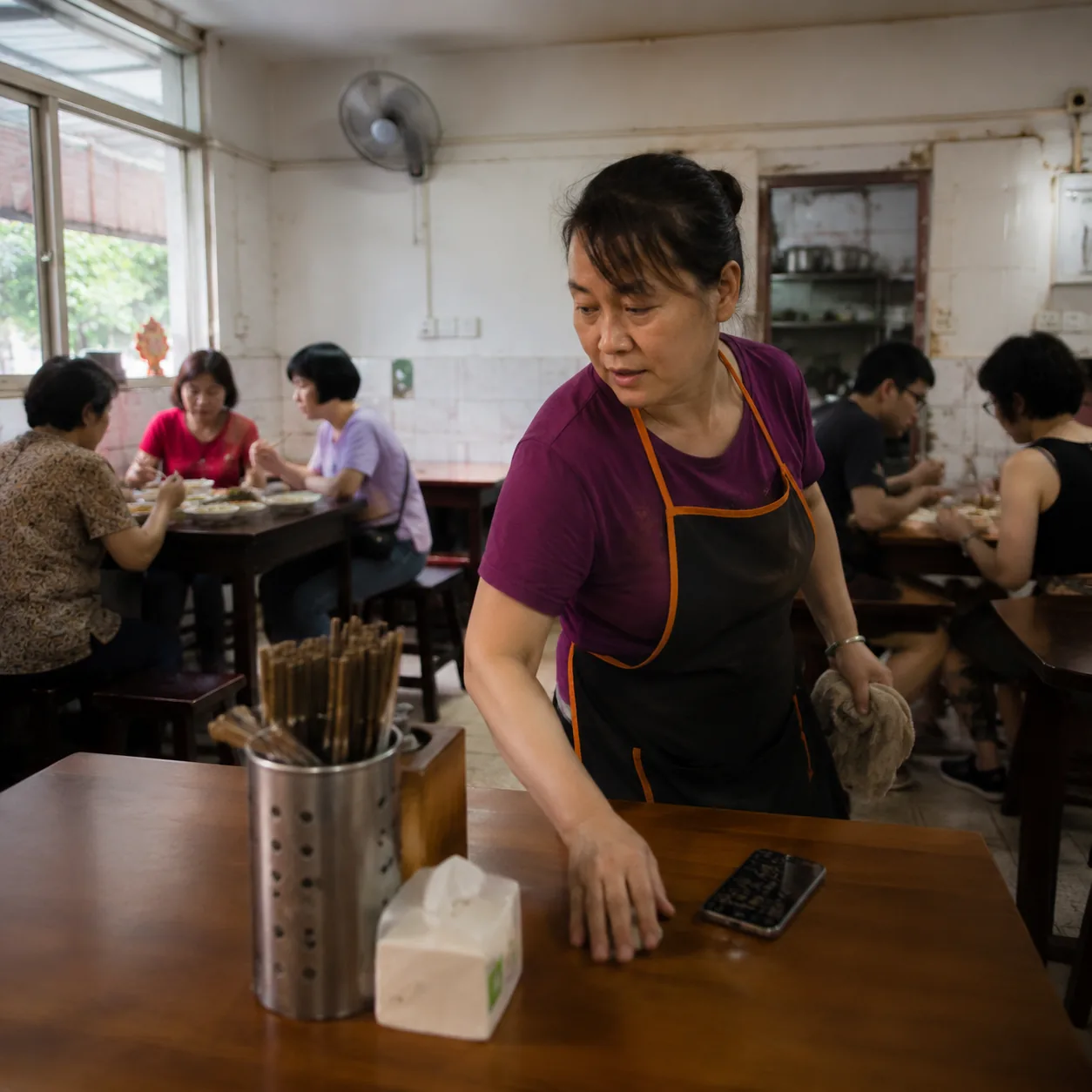
There were only seven or eight tables inside, and the two by the window were already occupied. At one sat three local aunties with rice noodles, cold cucumber, and a plate of stir-fried long beans in front of them. At another sat two young people who looked as if they had just finished work; their bags had not even been properly set down before they opened their chopsticks. A menu was pasted on the wall, not uniformly printed. Some dish names had small red check marks in front of them, and some prices had been covered with tape and written again. As soon as I sat down, the owner’s wife leaned out from the kitchen and asked whether I wanted noodles or rice. I said I had not decided. She came out, wiped her hands on her apron, saw my phone still on the table, and said, “Don’t search anymore. The fish today are not big. You can eat fish if you want, but for one person it is not worth it. If you want to taste Guilin, start with a bowl of rice noodles and add a small stir-fry of greens. That is enough.” It was not salesmanship; it felt more like she was saving me money. I had been ready to prove through my first dinner in Guilin that I knew how to order, but her sentence pulled me out of a tourist’s anxiety: there was no need to pretend to know; first, eat enough.

I ordered a bowl of rice noodles with braised toppings, then followed her suggestion and added garlic water spinach. When the owner brought the noodles over, the bowl was not large. White rice noodles lay in a pale sauce, topped with thin slices of braised beef, peanuts, pickled bamboo shoots, scallions, and a little red oil. Several small dishes sat beside it: chili, pickled long beans, vinegar, and diced radish, like a set of instruments waiting to be tuned by hand. I was hesitating over how much to add when an auntie at the next table looked up and said, “First time eating it, right? Don’t pour too much at the start. Guilin noodles need to be mixed open.” She gestured with her chopsticks in the air, telling me to turn the sauce from the bottom up first, then add a little pickled bamboo shoot and chili, taste, and add more if needed. Her tone was natural. She did not treat me as a foreigner to be watched, and she did not turn the rice noodles into a complicated cultural lecture. It was simply like reminding someone sitting the wrong way to turn the chair around.
I mixed it as she said, and the noodles immediately turned glossy. In the first bite, I tasted the savory depth of the braising sauce, then the sharpness of pickled bamboo shoots, the crunch of peanuts, and the smoothness of the rice noodles themselves. It was not as heavy as I had imagined, nor was it a flavor designed to astonish instantly. It felt more like Guilin’s evening air: damp, clear, and carrying a little coolness from between mountains and water. When the owner passed and saw me nod, he asked, “All right?” I said it was very good. He smiled and said, “With rice noodles, famous shop or small shop, the key is whether they go down easily. If you feel comfortable after eating, then it is right.” I suddenly felt that sentence mattered. In travel we often imagine “delicious” as a loud judgment, as if we must name the best, the most authentic, the unmissable. But in this little eatery, comfort was the standard. It did not need to defeat anything; it only needed to let me settle down on an unfamiliar evening.
The garlic water spinach came quickly too, still steaming on the plate. The stems were bright green, the leaves slightly collapsed, and minced garlic spread its fragrance through the sheen of oil. As the owner’s wife set it down, she said, “Eat this while it’s hot. Once cold, it releases water.” I picked up a chopstickful. The stems were cleanly crisp, and the garlic did not cover the greens’ own sweetness. Outside the window, someone rode an electric bike past, the tires making a soft water sound on the wet road. The television was not on. There was only the sound of a spatula touching a wok, bowls and chopsticks lightly clinking, and neighboring tables talking. The three aunties began discussing who would buy vegetables tomorrow, which stall had softer tofu, and which road was under repair. They did not avoid speaking in front of me, and they did not especially explain anything to me. I understood only part of it, but that part was already enough: the most stable taste of a city is not a dish name prepared for tourists, but the small daily matters locals mention casually at dinner.
Halfway through, the owner asked whether I wanted some soup. I thought the rice noodles were already a complete bowl, but he brought a small kettle and added a few spoonfuls of hot broth, saying that in Guilin some people liked them dry-mixed, while others liked a little soup at the end; it depended on habit. I lifted the bowl and tasted. The flavor had loosened in the hot broth. The braised fragrance spread out from its concentrated place and became rounder. One of the young men at the next table added, “Don’t listen to the internet saying there is only one way to eat it. Every family eats Guilin rice noodles differently. Some people eat them dry first, some add soup from the beginning, and some add terrifying amounts of chili.” After saying this, he added another spoonful of chili to his own bowl, and his friend laughed that his stomach would protest tomorrow. In that moment I relaxed toward the word “authentic.” Perhaps authenticity was not a fixed posture, but a city allowing many people to make the same food comfortable in their own way.
I had still thought of ordering beer fish, because before coming to Guilin almost every guide told me not to miss it. When the owner’s wife heard me ask, she walked to the freezer, looked inside, and said the fish were small today, the dish would not look good, and one person would leave too much. She suggested that if I truly wanted to taste fish, I could go to a busier riverside place tomorrow at noon for a smaller portion, or wait until I had friends with me. Then she added, “It’s not that you shouldn’t eat signature dishes. Just don’t stuff yourself for the sake of a signature.” I felt a little embarrassed, because I often treated travel as a checklist competition: afraid of missing something, afraid of having no story to tell, afraid that when people asked, I would not be able to name the most famous thing. But the owner’s wife did not care about my checklist. She saw only a person sitting in a damp evening who had already eaten a bowl of noodles and a plate of greens, and for whom another fish dish might only become a burden. She did not enlarge the business; she adjusted dinner to the right size.
At that moment an elderly man came in carrying a stainless-steel food container. He did not look at the menu; he simply told the owner, “The usual, a little less oil.” The owner nodded, called toward the kitchen, and nudged a small stool out beside a table for him. Seeing the rice noodles on my table, the elderly man asked whether I was traveling. I said yes. He said Guilin’s mountains and water should be viewed slowly, and meals should be eaten slowly too; otherwise the scenery would stay inside the phone while the mouth had no flavor. I laughed and said I had already been advised several times that day not to look at my phone. He laughed too and said, “A phone cannot smell wok breath for you.” The sentence was simple, but it immediately made me push my phone farther inside the table. The ratings, distances, and recommendation words on the screen suddenly became thin, like a sheet of glass between the food and me. The real steam was in front of me, and it did not require swiping to refresh.
After dinner slowed down, I began noticing details inside the eatery. A wet umbrella stood in the corner near the door, its tip still dripping. A pot of pothos sat beside the cashier counter, a little cooking smoke clinging to its leaves. A child’s certificate was taped near the kitchen door, its corners already curling. The owner put peeled garlic into a bowl, then casually poured tea for a regular customer. In the kitchen, the owner’s wife tossed the wok, and the fire briefly lit her face. None of these movements existed for display, yet together they formed a steady daily life. The little riverside eatery did not sell the Li River as a background. It simply stayed near the river, accepting dampness, tourists, locals, mosquitoes after rain, and people walking at night. Its presence was not like an attraction; it was more like a small lamp that knew who was hungry, who wanted food to go, and who did not want too much oil today.
When I paid, the owner’s wife tapped the calculator several times, and the price was much lower than I expected. I asked whether she had forgotten the greens. She checked the slip and said no, that was simply the price of the greens. The owner added from beside her, “Here we don’t make money by frightening people with big signs. We make it by making people want to come in next time.” I asked whether many tourists came. He said there were many in peak season and fewer in low season, but locals were always there. Tourists came and asked which dish was most famous; locals came and asked what was fresh today. After saying this, he handed me my change and asked where I was staying. He reminded me that the lights were pretty if I walked back along the river, but one section of stone was slippery, so I should not only focus on taking photos. I thanked him, and he waved it away. “If you’re full, walk slowly. Guilin evenings shouldn’t be rushed.” When I stepped outside, my stomach was not overfilled, but my heart felt full, as if a city had just received me in the most ordinary way.
The wind by the river was cooler than before dinner, and the dampness after rain clung to my skin. In the distance, sightseeing boats glowed with colored lights, and tourists onboard held up phones to photograph the mountain shadows along both banks. Nearby, beside the railing, several local people sat chatting. Someone slowly ate from a takeout box on their knees, someone walked a dog, and someone wiped a child’s hands. I did not return to the hotel immediately, but walked along the river for a while. The taste of pickled bamboo shoots from the rice noodles still remained in my mouth, and the clean fragrance of garlic water spinach had not completely disappeared. They made the Li River no longer only water in a postcard, nor merely the textbook phrase saying Guilin’s scenery is the finest under heaven. It became the wind touching my face after dinner, the road where the owner reminded me to watch the wet stones, and the gesture of the auntie teaching me how to mix the noodles. If mountains and water are only viewed from far away, they easily become pretty words; connected by an ordinary dinner, they finally gain human warmth.
The next morning, I still went to several famous rice noodle shops. Each had its own character: some had richer braising sauce, some had crisper pickled bamboo shoots, some had long lines, and many awards and articles were displayed at their entrances. I admitted they were good and understood why many people made special trips to eat there. Yet while standing in line, I kept thinking of the small eatery without a large sign from the night before. The famous shops felt like accurate check-ins, while the little eatery felt like being gently guided to sit down. The former showed me how refined Guilin rice noodles could be; the latter showed me how Guilin people placed rice noodles inside daily life: one person did not need to order too much, pickled bamboo shoots could be added slowly, greens should be eaten hot, and a phone could not smell wok breath for you. None of these were written on the menu, yet they stayed in my memory more firmly than the menu did.
On the day I left Guilin, while waiting at the railway station, I opened my saved list again and looked through the restaurants. In the past I would have seen unfinished items as regret, but now I felt there was no need to complete them all. Travel is not turning a city into a report card of meals, nor making every dinner into evidence that proves I was there. The dinner Guilin left me was not rich with fish and meat, and it had no honors hanging at the door. It was only a bowl of rice noodles, a plate of home-style greens, several suggestions pushed toward me by the owner and neighboring tables, and a riverside road walked slowly after eating. Yet precisely because it was ordinary, it did not rush to represent Guilin; instead it let me see how Guilin cared for people on an ordinary night. For me as a first-time visitor, that was more precious than finding any famous sign. A sign tells me where it is worth going; an ordinary dinner tells me how to sit down after arriving, how to listen to people speak, and how to let a strange city slowly become familiar through the stomach.