Чувство безопасности при первой ночной прогулке иностранца по китайскому городу
When I stepped out of the hotel lobby that night, my phone showed 9:47 p.m. The heat of the day had not completely left the pavement, and the cool air behind the glass doors felt like a thin sheet of water I had just walked through. Outside, the street was not empty in the way I had imagined. It was still breathing slowly: plane trees under pale green streetlights, delivery riders gliding past in the bike lane, a convenience store glowing at the corner, steam fogging the glass of a hot-food cabinet near the cashier. I had meant only to walk to the intersection and look around, but my feet kept moving, as if I were quietly testing the night limits of the city.
What calmed me first was not any grand impression but the density of small details. The sidewalk was not wide, and several tiles had been lifted by tree roots, so I had to look down from time to time. Yet every few dozen meters there was another light, and there were no deep dark gaps between them. Two people were waiting under a bus sign: a middle-aged man watching short videos, a young woman with one earbud removed as she replied to a message. Outside a tiny shop, the owner was carrying a case of bottled water inside. When he saw me pause at the doorway to check my map, he only nodded once, neither calling me in nor staring. That ordinary feeling of not being interrupted made me feel steadier than any warm welcome would have.
I walked north along the main road. On my left were apartment buildings with laundry still hanging from balconies, and now and then I could hear dishes tapping against a sink. On my right was a row of small businesses: a pharmacy, a noodle shop, a phone repair counter, a laundry. The noodle shop had passed its dinner rush, with only one customer slowly drinking soup. The pharmacy’s electronic sign kept scrolling temperature and humidity. A dryer was still turning inside the laundry. The night had not packed daily life away; it had only lowered the tempo. For a foreigner walking alone there for the first time, that continuing routine felt like an unobtrusive handrail.
I went into the convenience store for water, and the sense of safety changed shape again. Two students were choosing ice cream. A delivery worker in a uniform held his helmet in the crook of his arm while waiting for a meal in the microwave. The cashier asked whether I wanted a bag; when I failed to catch the sentence, she pointed to the bag, then to my bottle, and smiled. I paid by scanning a code slowly, and the person behind me did not rush me. He simply placed his items near the edge of the counter. The refrigerator door closed with a soft suction sound, and the sensor bell at the entrance kept ringing. There was no dramatic protection here, only clear procedure, bright light, and people who knew what they were doing next.
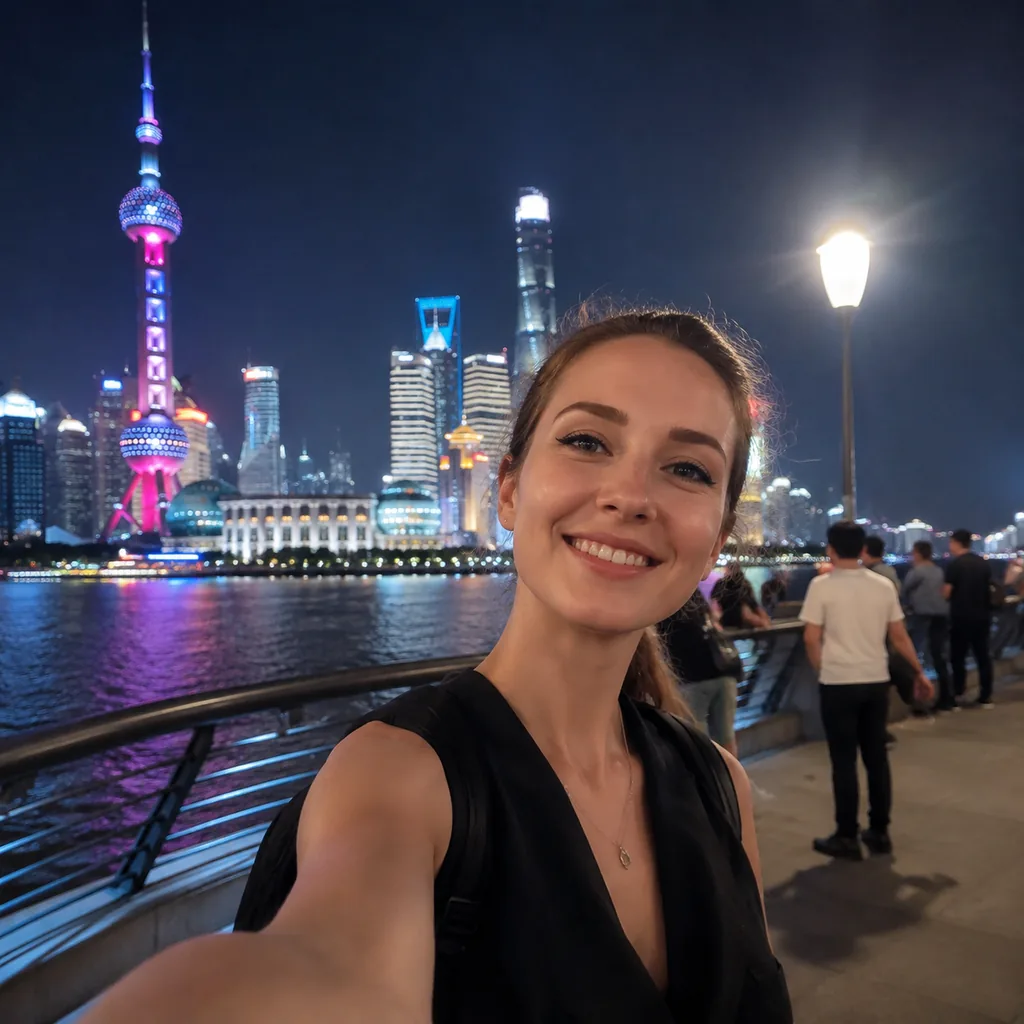
After leaving the store, I did not return to the hotel immediately. I turned into a narrower side street. The noise of the main road was blocked by apartment buildings, and the air smelled of osmanthus, barbecue charcoal, and damp soil after rain. The street was not empty. Shared bikes stood along the curb; a few cats slipped out from under electric scooters and disappeared into the shrubs as if I were of no concern. An older man walked a small dog that stopped at every tree. Two young women passed me from behind, one carrying milk tea, the other pressing a phone to her ear and saying, “I’m downstairs.” The sentence was brief, but it turned the night road into the final stretch of many people’s journey home.
In other cities, when I walked alone at night, I often planned my exits in advance: where I could call a car, which shop would still be open, which street looked best avoided. I kept that habit that night too, but it did not occupy my mind the whole time. I noticed the metro sign glowing in the distance, the small public-security booth near an intersection, and the cameras along the road. I also noticed that these things did not make the street feel tense. They were infrastructure in the background, not something that had to be announced repeatedly, but enough to tell a stranger he was not walking through a place entirely unattended.
By the time I reached the metro station, it was almost 10:30. People were still entering and leaving, and the escalator sent up a draft of cool air. The station hall was brighter than the street, its tiles reflecting the shapes of passengers. There was no long line at security; the staff sat upright, with plastic trays stacked neatly beside them. I placed my backpack on the machine, and when I picked it up again, the zipper looked exactly as it had before. At the gates, a father crouched to tie his child’s shoelace while a balloon string circled the child’s wrist. On the other side, an office worker tucked his ID badge into his bag as he walked. Late-night metro did not feel noisy, but it did not feel deserted either.
I rode only two stops, almost as a small experiment for myself. Inside the carriage, people occupied their own forms of silence: one person watched a drama against the handrail, another kept shopping bags beside their shoes, someone else closed their eyes without fully sleeping. Station names were announced in Chinese and English, and I checked my direction against the screen. When the doors opened, people did not shove or chat; they simply got off, got on, and found their balance in a familiar rhythm. That predictability mattered to me. What can frighten you most in an unfamiliar city is not distance, but the feeling that the next step might suddenly stop making sense.
After leaving the station, I decided to walk back to the hotel instead of transferring or calling a car. My map sent me through a commercial street. Many stores had closed, their metal shutters covered with posters for the next day’s discounts, but the street was not dead. A milk-tea shop was being cleaned, a worker pushing a mop from the entrance toward the back. A fruit seller was closing up and covering cut watermelon with plastic wrap. At the doorway of a twenty-four-hour pharmacy, someone was calling home to confirm which fever medicine to buy. The city before midnight felt like a machine slowly reducing its noise, but its buttons were still lit.
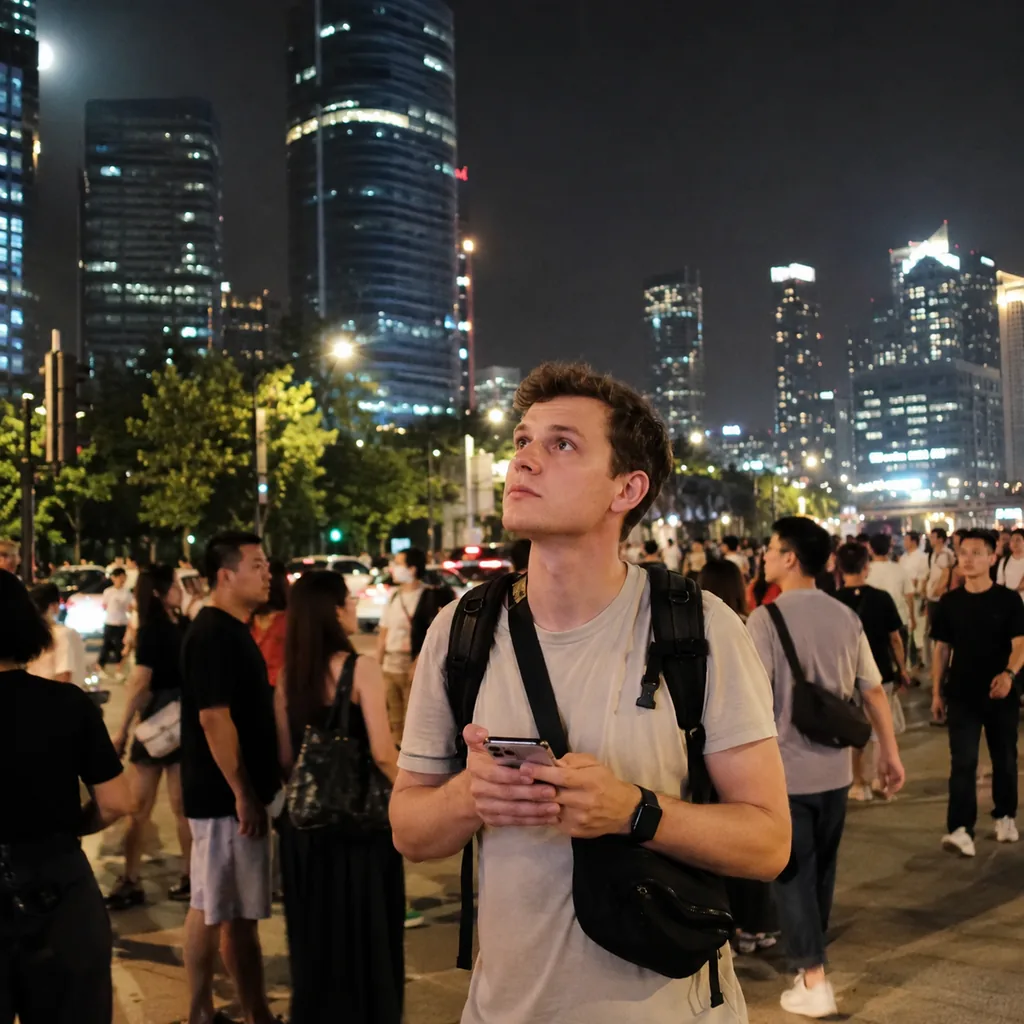
Delivery riders were the clearest moving coordinates of that night. They appeared at intersections, stopped at residential gates, checked their phones, and hung bags from the front of their scooters. One rider could not find a building number and asked the guard; the guard leaned out of the booth and pointed toward the second building inside. Another parked by the curb and sent a voice message to a customer: “I put it on the shelf. You can come down for it.” These exchanges were brief, even mechanical, but they filled the night with confirmation. Someone was delivering, someone was receiving, someone was waiting at a gate, someone was replying behind a screen. A person walking alone could see those back-and-forth movements and feel inside a network still connected.
I also met moments that required judgment. One section of road was under construction, and temporary barriers squeezed the sidewalk into a narrow passage. At the end of the passage, a light was broken and water had collected on the ground. I stopped for a few seconds, looked for other pedestrians ahead and behind, and chose to cross to the other side of the road. A sense of safety is not the blind belief that every place is equally fine. It is the environment giving you enough information to choose: where it is bright, where there are people, where you can leave, where you do not need to prove anything. What reassured me that night was not that I stopped thinking, but that my thinking had places to land.
At one intersection, the traffic lights were still cycling normally. There were not many cars, but pedestrians still waited for green. A young man on an electric scooter stopped before the crosswalk, one foot on the ground, a bouquet of flowers in his front basket. Beside him, an auntie pushed a shopping trolley with a bundle of greens and a pack of tissues showing inside. When the light changed, they crossed together, and no one rushed to be first. Standing behind them, I realized that order does not have to be solemn to be powerful. Sometimes it is simply a wait at a late-night crossing, with everyone treating those few dozen seconds as ordinary.
I passed the outer wall of a primary school, where children’s posters about traffic safety were displayed. The gate was locked, but the guardroom was lit and a television murmured inside. Farther on, there was a riverside path. Beyond the railing, the water reflected the lights of apartment towers. Fewer people were there, so I did not put on my earphones; I let myself hear my own steps, bicycle bells, and distant traffic. A runner came from the opposite direction with a reflective band on his arm. A couple pushed a stroller slowly, a thin blanket covering the child inside. Meeting people like that at night did not prove there was no risk. It reminded me that the road did not belong only to loneliness and caution; it also belonged to exercise, strolling, and easing a child to sleep.
I kept taking my phone out and putting it back in my pocket. The map gave me direction, payment apps gave me convenience, and translation software meant I could speak if I needed to. But what made me keep walking was not the phone itself; it was the world beyond the phone being ready to hold me. Street signs were clear, shop doors were visible, the metro was usable, the convenience store could sell me water, and passersby did not overreact to my presence. These small things stacked one by one into a very concrete sense of safety: not “nothing bad can happen to me,” but “if a small problem happens, I probably know how to handle it.”
Before returning to the hotel, I entered another convenience store. I did not need anything; I simply wanted to buy a cup of yogurt and end the walk with an ordinary action. Only one cashier and one shelf-stocking employee were inside, and the area near the freezer smelled faintly of cleaning fluid. I took the yogurt to the counter. The cashier scanned it and pushed the receipt toward me. I said thank you; my pronunciation was probably imperfect, but she answered naturally. Outside, a ride-hailing car stopped and then pulled away, its tail lights dragging red across the damp pavement.
The guard at the hotel entrance recognized me, or at least recognized the room card in my hand. He did not ask where I had been; he only slowed the revolving door for me. In the lobby, two travelers were checking in, their suitcase wheels tapping over the floor tiles. As the elevator rose, I saw myself in the mirror looking a little tired and a little relieved. That first night walk did not change my entire understanding of the city, but it changed my first reaction to night. I no longer saw it only as time to be shortened, but as space that could be used carefully.
The next morning, what I remembered most clearly was not a landmark or a famous street, but a chain of ordinary images: the countdown numbers on the convenience-store microwave, the child’s balloon in the metro station, the knotted plastic handles of a delivery bag, the puddle beside construction barriers, the reflective band on a runner’s arm by the river. Not one of them would be important enough to center a travel advertisement, yet together they explained why a stranger could walk a stretch of road at night and be willing to walk a little farther.
This sense of safety may be difficult to capture in a single photograph. It does not always appear in the brightest place, and it is not supplied only by uniforms, slogans, or cameras. It is more like a set of habits working together: shops opening and closing on schedule, traffic moving by lights, the metro continuing its announcements, deliveries arriving accurately, strangers keeping distance without becoming cold, staff offering a simple direction when needed. For someone walking at night for the first time, these habits file down the sharpness of an unfamiliar city and give each corner readable clues.
Of course, one night walk cannot represent every city, every district, or every hour. Safety should never be romanticized, and caution should never be mocked. Yet I am also willing to admit that what I felt that night was real: I could walk into a convenience store alone, ride the metro for two stops, avoid a construction section, hear other people returning home, and complete my own city walk without being singled out. It was not fearlessness. It was something steadier: knowing that even in an unfamiliar night, I could still judge, choose, and arrive.