Китайский красный: как один цвет определяет цивилизацию
It Begins with an Ancient Legend
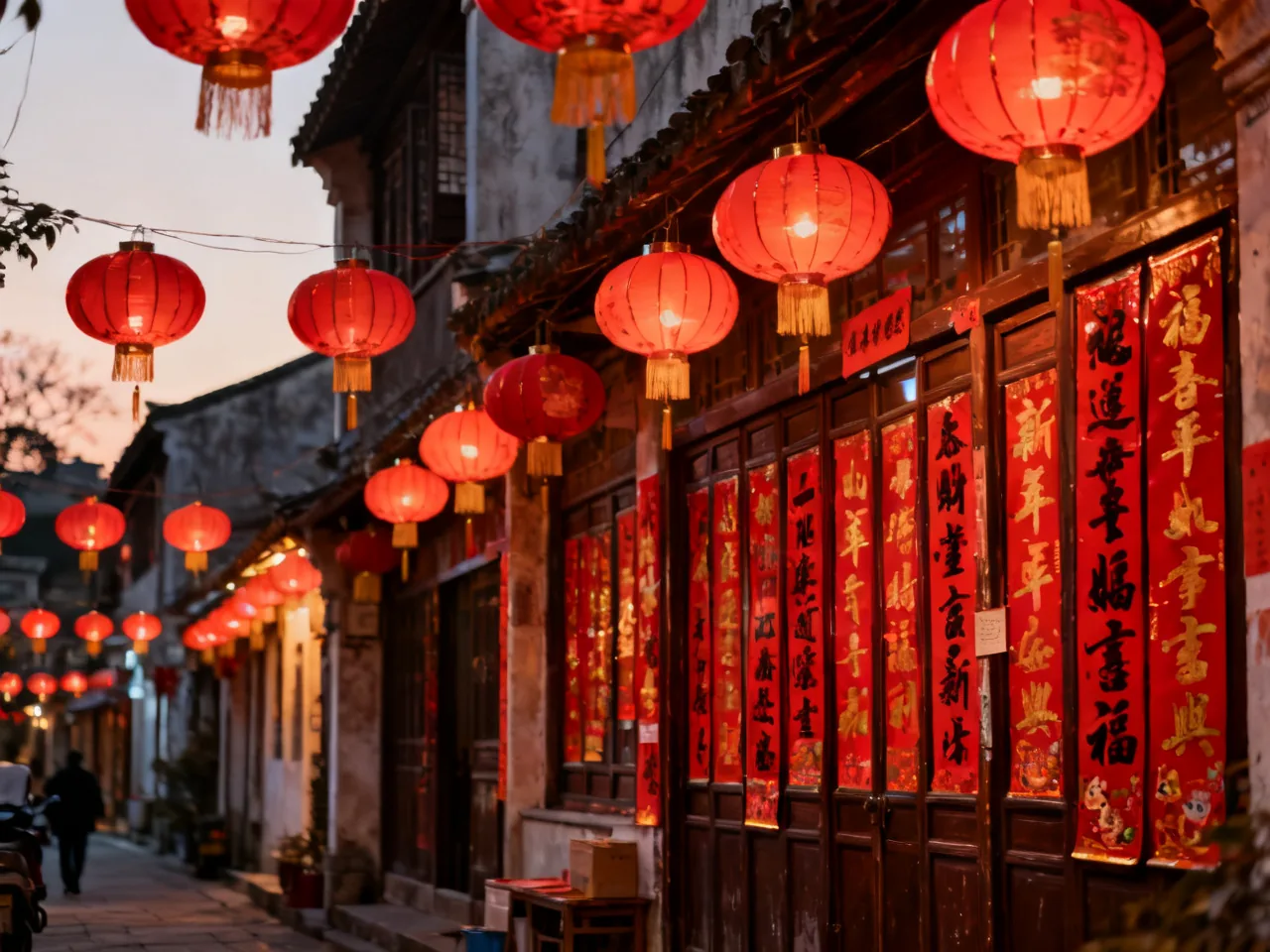
Every Lunar New Year’s Eve, as 1.4 billion Chinese people simultaneously light red lanterns, paste red spring couplets, and don red garments, they are reenacting a ritual thousands of years old. Legend tells of a ferocious beast called “Nian” that emerged from the deep sea at year’s end to devour livestock and harm villagers. The terrified people lived in dread until a white-haired elder revealed the creature’s secret — it feared the color red, firelight, and loud noises. From then on, every household pasted red paper on doorframes and set off red firecrackers, wielding this blazing hue to ward off evil. The Nian legend not only shaped the Spring Festival but encoded red into the very DNA of Chinese civilization.
IMAGE_PLACEHOLDER_1
Fire of Five Elements, Blood of the Shang
The exalted status of red in China is not rooted in folklore alone — it rests on deep philosophical and historical foundations. In Five Elements theory, fire corresponds to red, symbolizing passion, radiance, and vigorous vitality. Fire Virtue was considered a manifestation of the Mandate of Heaven: the Zhou Dynasty proclaimed itself ruler by Fire Virtue, and the Han Dynasty founded its legitimacy upon the same principle, with Liu Bang styling himself “Son of the Red Emperor.” This tradition linking red to political orthodoxy persisted throughout China’s imperial era.
The origins of red worship trace back even further to the Shang Dynasty. Archaeologists excavating the Yinxu ruins at Anyang discovered cinnabar traces on vast quantities of ritual objects. Shang people applied cinnabar to oracle bones, decorated bronze vessels with it, and lavishly covered the deceased in burial chambers, believing this mineral possessed mystical power to bridge heaven and earth and protect souls. Cinnabar — a natural mercury sulfide mineral — became China’s earliest “red pigment,” with a history of use exceeding three millennia. To Shang aristocrats, red was far more than a color; it was a symbol where royal and divine authority converged, carrying supreme power imagery much like the Chinese dragon totem.
The Red Code of the Forbidden City
If one were to search world architectural history for a complex utterly defined by red, the answer is unquestionably Beijing’s Forbidden City. This imperial palace, first constructed in the fourth year of the Yongle reign of the Ming Dynasty (1406 CE), is renowned for its iconic red walls and yellow glazed tiles. The palace walls use no ordinary red paint but a special coating of iron oxide powder blended with tung oil — a formula that has kept the walls vivid through more than six centuries of weathering.
Passing through the Meridian Gate, red saturates every sight: red colonnades, red doors and windows, red palace walls. This red is far from mere decoration — in traditional Chinese architectural hierarchy, red was the highest-rank color, permitted for large-scale use only in imperial buildings. Each red column before the Hall of Supreme Harmony was carved from a single phoebe zhennan tree trunk, lacquered and then painted red through an extraordinarily complex process. According to researchers at the Palace Museum, the Forbidden City contains 9,999 and a half rooms, the vast majority dominated by red. This systematic deployment of red is unique in the world. Notably, the palace’s most precious jade artifacts are largely carved from Hetian jade, their white luminescence contrasting against red walls to create the most classic color pairing in Chinese imperial aesthetics.
Bridal Gowns Like Fire: Red’s Wedding Narrative
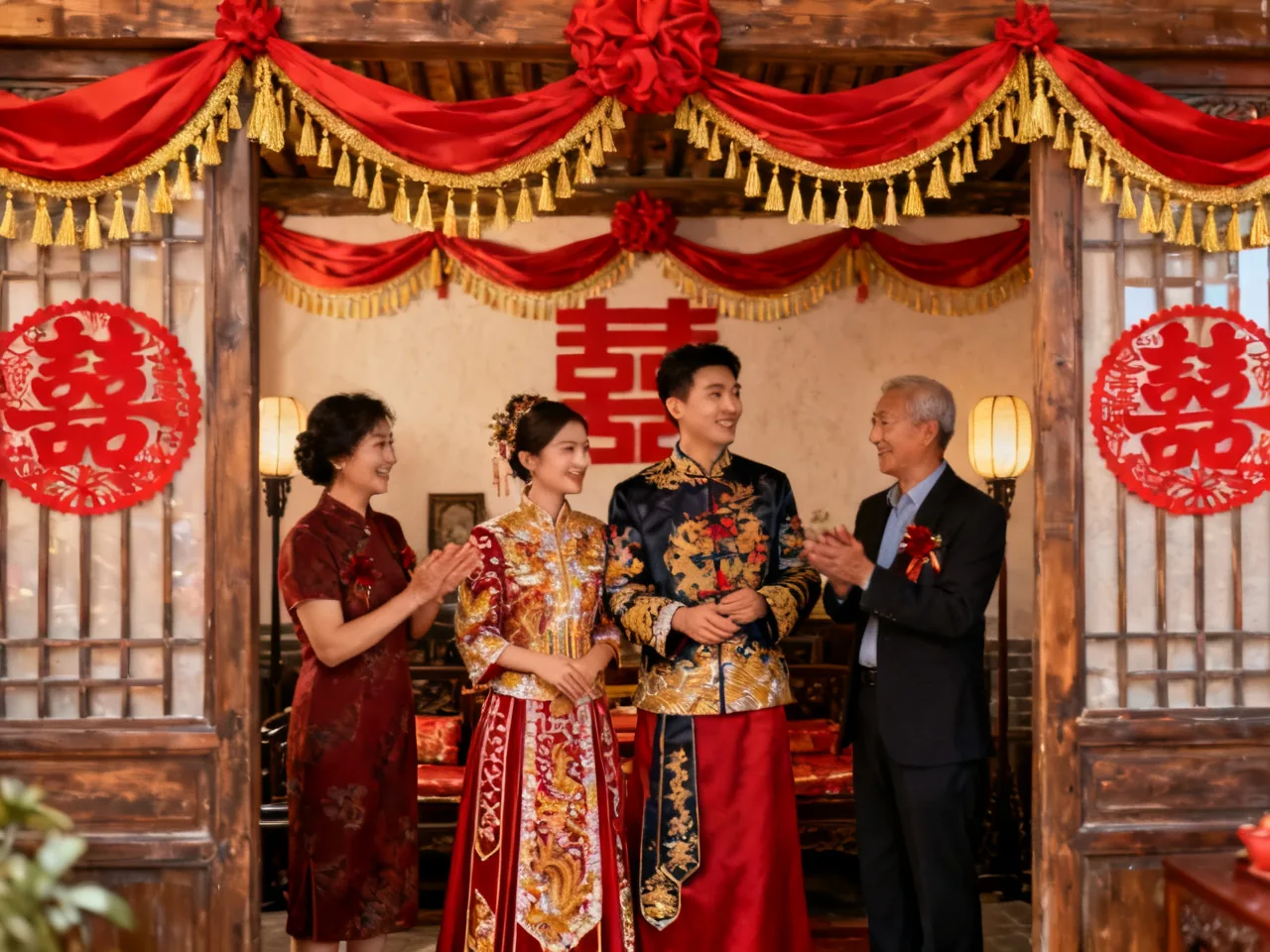
“Red trousseau” — the very term reveals the inseparable bond between red and Chinese weddings. In a traditional Chinese ceremony, the bride wears a red gown and red veil, rides in a red palanquin; the groom sports a red silk rosette; the bridal chamber is covered in red double-happiness characters; guests receive red invitations and present red cash envelopes. The entire wedding is swathed in red, for red signifies celebration, liveliness, and blessings for a prosperous future.
In the Minnan region of Fujian Province, traditional wedding customs are especially particular about red. Before the bride’s departure, her mother personally grooms her daughter, using red silk thread to perform “face-opening” (removing facial hair) — a ritual symbolizing the transition from maiden to married woman. Weddings around Quanzhou preserve the ancient custom of “treading the red felt”: after alighting from the palanquin, the bride’s feet must not touch bare ground but walk upon red felt all the way into the bridal chamber. In the Chaoshan region, wedding celebrations frequently feature spirited Yingge dance performances, with dancers wielding red wooden batons, leaping and spinning to drumbeats, driving the festive atmosphere to its peak.
Today, although Western white wedding gowns remain popular in cities, a growing number of young people are returning to Chinese-style ceremonies. On social media, the “Chinese wedding” topic has surpassed five billion views on Xiaohongshu, with many couples choosing traditional red garments such as xiuhe suits and dragon-phoenix jackets. Beijing designer Guo Pei’s haute couture red bridal gowns, each requiring thousands of labor hours and costing millions of yuan, remain perpetually in demand.
IMAGE_PLACEHOLDER_2
Red in the Fabric of Daily Life
Red does not merely attend life’s grand ceremonies; it permeates every facet of daily Chinese existence. In one’s benmingnian — the year when one’s birth zodiac animal returns in the twelve-year cycle — Chinese people don red underwear, red socks, and red belts to invite good fortune and navigate the year safely. Behind this custom lies an ancient belief: the benmingnian is considered a year of “offending Tai Sui,” with volatile fortunes, and red possesses the power to suppress evil and protect the body.
Hongbao (red envelope) culture is the most vibrant red tradition in Chinese life. During Spring Festival, elders distribute red paper packets containing “lucky money” to younger generations, symbolizing the suppression of evil spirits and blessings for safety. At weddings, guests offer red envelopes to express good wishes; at grand openings, partners present them as congratulations. In the mobile internet age, WeChat’s digital red envelopes have elevated this tradition to new heights. On New Year’s Eve 2015, WeChat red envelope transactions totaled 1.01 billion; the figure has climbed every year since. Today, WeChat red envelopes are not just holiday gifts but an everyday social currency for expressing gratitude between friends. During Spring Festival, companies distribute “lucky draw” red envelopes in WeChat groups, and the scramble to grab them has become a new-era festive custom.
In China’s commercial world, red dominates with equal force. Major state-owned banks like Bank of China and ICBC feature red logos; when Coca-Cola entered the Chinese market, its red packaging resonated naturally with Chinese aesthetic sensibilities; domestic brands like Li-Ning and Anta frequently deploy “Chinese Red” colorways in flagship lines to reinforce national identity. The “Chinese Red” chosen as the primary color of the 2008 Beijing Olympics brought this hue onto the world stage — as the colossal red scroll unfurled during the opening ceremony, billions of viewers worldwide witnessed the unparalleled weight of red in Chinese culture.
Taboo and Shadow: The Other Side of Red
Yet red is not solely auspicious in Chinese culture. A widely known taboo exists in Chinese society: one must never write another person’s name in red ink. This prohibition originates in ancient capital punishment — in feudal society, when the court executed criminals, officials used a red vermillion brush to circle or check off the convict’s name, marking the sentence as carried out. Thus, writing a person’s name in red is seen as a curse, implying the person has been condemned to death or is about to die. Even in modern China, teachers use red pens to grade homework but would never write a student’s name in red; when signing formal documents, a red pen is an absolute taboo.
In funerary rites, red must likewise be avoided. Wearing red clothing to a funeral is considered profoundly disrespectful to the deceased. There is, however, an exception — when the departed was an elderly person of advanced age (typically over eighty) who died of natural causes, the funeral may incorporate red elements, as this is termed a “joyful funeral,” signifying that the elder lived a full, meritorious life and passed peacefully, an occasion worthy of celebration. This nuanced discrimination in the use of red reveals the Chinese people’s profound understanding of color symbolism and their complex attitudes toward life and death.
Fashion and Guochao: Red’s Contemporary Renaissance
On the twenty-first-century fashion stage, “Chinese Red” is making a triumphant return in entirely new forms. Every Lunar New Year, international luxury brands release limited “Chinese Red” collections — from Louis Vuitton’s red handbags to Dior’s red lipsticks — the global fashion industry has come to regard “Chinese Red” as the golden key to the Chinese market. Meanwhile, Chinese designers are actively redefining the color’s contemporary significance. Beyond the aforementioned Guo Pei, Shanghai designer Chen Xuzhir presented red-themed collections at Paris Fashion Week, blending traditional qipao tailoring with modern minimalism to widespread acclaim from international fashion media.
The “Guochao” (national trend) movement has further propelled red into young consumers’ daily lives. The Palace Museum’s creative product line — red stationery, phone cases, and cosmetics — has repeatedly broken sales records on its Tmall flagship store. Domestic beauty brands like Perfect Diary and Florasis use Chinese Red as their core color for packaging design, successfully attracting hordes of young consumers seeking national cultural identity. In sneaker culture, Li-Ning’s “Way of Wade” Chinese Red colorway has been resold at multiples of its retail price on secondary markets, becoming a collector-grade item in streetwear circles. On streets everywhere, young people sporting red hoodies and red baseball caps are a common sight — red is no longer merely the lucky color spoken of by grandparents but the visual language through which a new generation of Chinese youth expresses cultural confidence and national pride.
Red Never Fades
From Shang Dynasty cinnabar to the palace walls of the Forbidden City, from the Nian beast legend to WeChat red envelopes, from bridal gowns to the Olympic color palette — red threads through every pivotal moment of Chinese civilization, ancient and modern. It is at once a protective talisman against evil and a symbol of power; a hallmark of celebration and a vessel for taboos of life and death. In contemporary China, red’s meanings continue to expand — it is the background of the national flag, the trending color in tech company logos, and a fashionable choice through which young people express cultural confidence.
Walking beside the corner towers of Beijing’s Forbidden City, under the neon lights of Shanghai’s Bund, through the red lantern corridors of Chengdu’s Wide and Narrow Alleys, before the red sandstone carvings of Guangzhou’s Chen Clan Ancestral Hall — no matter where in China one finds oneself, red silently tells the same story: this is a civilization ignited by red, and that flame will never be extinguished.