Сучжоуские сады — не для того, чтобы проскакивать их галопом; я десять минут простоял перед одним резным окном
On my second morning in Suzhou, I had arranged a route that looked almost like an exam sheet: Humble Administrator’s Garden, Lion Grove Garden, Pingjiang Road, Canglang Pavilion, and, if my legs still worked, Shantang Street at night. On paper every item made sense. The distances were short, the names were familiar, and the tickets had been booked. But once I truly stepped into a garden, I realized the biggest problem with the plan was not that it was too full. It assumed a classical garden could be checked off like an item on a list.
The sky that day was lightly gray, and the light was soft rather than sharp, a good kind of weather for looking at gardens. Many people gathered at the entrance. The line moved forward slowly, visitors checked reservations on phones, and tour-guide flags swayed above the crowd. I entered with everyone else, and my first impulse was to find the “most famous angle” quickly. I knew I had brought a kind of travel inertia with me: since I had come, I should see all the main sights, collect enough photos, and make time look efficiently used.
Humble Administrator’s Garden did not greet me with grandeur at first. It was not a place that spread the whole view out for you. Instead, it folded your sight with walls, doors, corridors, tree shadows, and water surfaces. After a few steps, the way ahead seemed blocked; after a small turn, a corner of pond appeared; just when I thought I had seen a pavilion, bamboo shadows covered half of it again. The garden was in no hurry to prove itself. It felt as if it were testing whether an outsider had patience.
At first I still walked quickly. When I saw a pavilion, I took a frontal photo. When I saw stones by the water, I took a horizontal shot. When I saw a patterned window in a wall, I moved closer to photograph the design. The photos looked fine, but none made me want to keep looking. They were like small labels torn from the garden: they could prove I had been there, but not that I had understood anything. Only when I stopped before one lattice window did my pace suddenly slow.
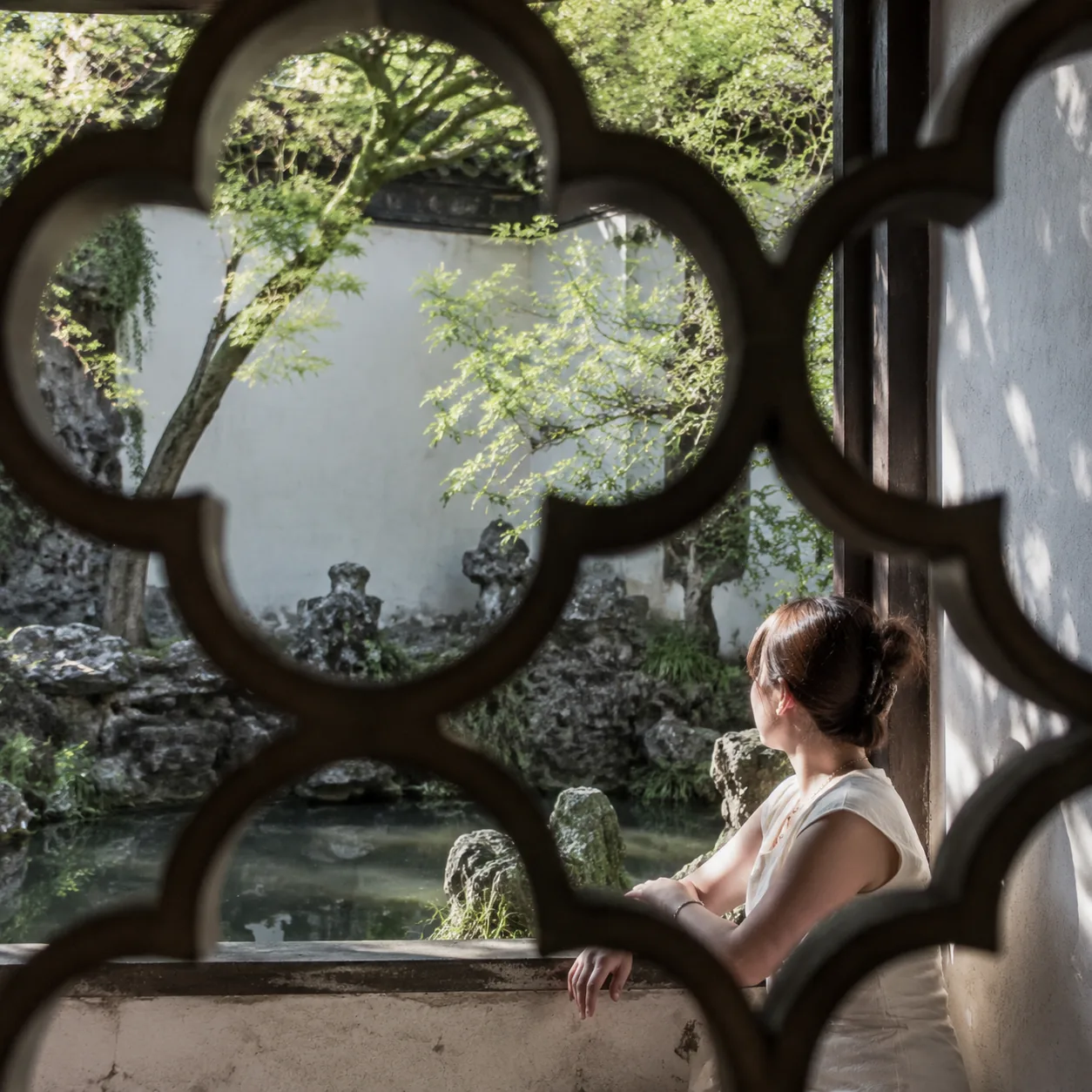
The window was not in the most crowded position. It was set into a white wall, not large, with a pattern like carefully combed branches or a quiet ripple of water. Through it I could see trees, rocks, and a small gray-green patch of pond behind. What was wonderful was that the window did not fully display the scenery. It deliberately left many obstructions. Only part of a trunk appeared, only the edge of a rockery showed, and the water flashed only briefly. It allowed me to see while reminding me that I could not see everything.
At first I stood there simply to wait for fewer people, hoping to take a photo without visitors in it. After two minutes, I realized I had forgotten to press the shutter. Wind came through the corridor, leaves moved gently behind the lattice, and the fixed pattern was disturbed by living shadows. The white wall was not merely a background; it was like paper, making the layers of the garden clearer. The lattice window was not merely decoration; it was like an eye blinking slowly, cutting the view into small pieces that could breathe.
Ten minutes sounds short, but inside a scenic area it can feel unusual. People kept passing by. Some stopped to take a photo and left immediately. Some said, “This is pretty,” then hurried to catch up with companions. Others did not notice it at all, treating it as just part of a wall beside the path. Standing there, I gradually realized that beauty in a garden does not always appear as a “sight.” Some beauty rises from details only after you stop searching for it.
Before leaving, I had read introductions that mentioned borrowed scenery, framed views, and changing scenes with each step. On a screen those terms felt familiar, like concepts one could memorize for an exam. But before the lattice window, they were no longer terms. They became bodily experience. A framed view was not simply a pretty frame for visitors; it told me that seeing needs boundaries. A changing scene did not merely mean walking a few more steps and taking more pictures; it reminded me that scenery changes with patience.
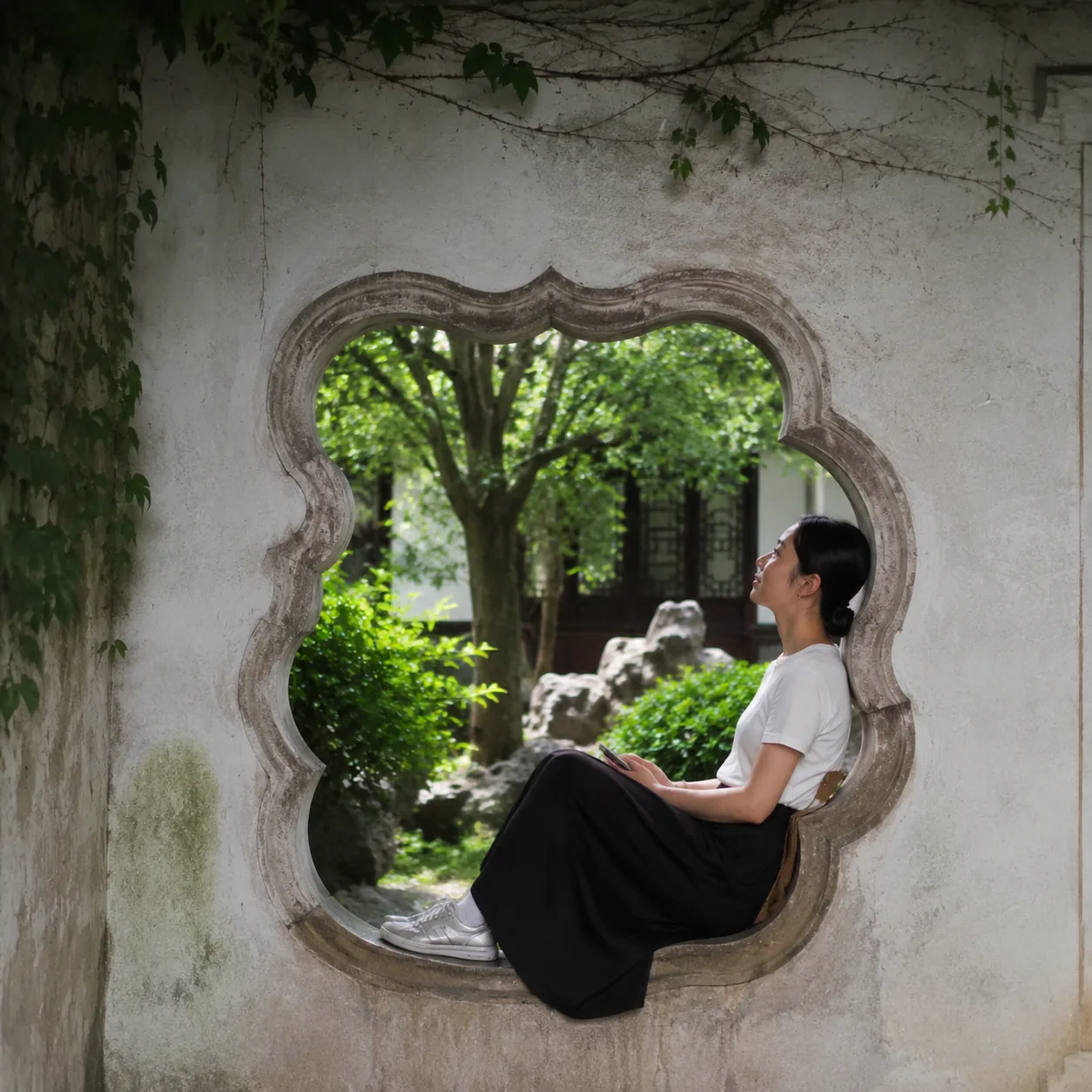
I stepped back half a step. Only half a step, and the tree shadows behind the window changed position; the pond became less visible, the rock more visible. When I moved slightly left, branches that had been divided by the lattice suddenly formed a diagonal line. The precision of the garden did not lie in designing one perfect angle. It lay in allowing many imperfect angles to work. It allowed me to be a little off-center, a little slow, a little still, and then handed me different relationships.
From that moment, I changed the day’s itinerary. I did not formally delete anything on my phone; I simply changed “finish seeing” into “look for a while” in my mind. I stopped rushing to find the next named place and stopped treating every pavilion or hall as evidence that had to be recorded. A garden is like tea at the right temperature: if you drink too fast, you only know it is not hot; if you slow down, you discover where the fragrance returns.
I walked along the corridor, and my steps naturally became lighter. The corridor columns divided the sight line into sections, and the shade under the eaves made the outside light softer. People walked toward me from the opposite direction, their voices partly absorbed by the wooden structure, sounding like conversations from far away. A corridor is not a simple passage. It stretches time. You think you are merely moving from one point to another, but you are practicing delayed arrival section by section.
The water worked in the same way. Water in Suzhou gardens does not win by vastness. It is often cut into irregular shapes by banks, bridges, trees, and buildings. Standing beside a pond, the water did not feel like a lake but like a small mirror repeatedly folded. It reflected a pavilion’s eaves and a shaking piece of sky; it reflected a visitor’s hem and the tiny moss on stone. Water placed unrelated things on the same layer and made the garden deeper.
There was a small bridge I almost failed to notice when stepping onto it. The bridge was short, the railing low, and if I were hurrying I could cross it in three seconds. But standing in the middle, the water on the two sides suddenly developed different characters. One side lay near buildings, with orderly reflections; the other lay near plants, with scattered patches of light. The bridge was not only for crossing water. It offered a stopping point from which comparison became possible. Suzhou gardens rarely explain loudly, but they keep arranging your eyes.
The rockery drew the largest crowd. Many people wanted to photograph a sense of winding depth among the stones, and I had wanted the same. But when I walked to the side, I found that its real interest was not whether it resembled a mountain. It was how it gave a small space a feeling of distance. Grass grew in cracks, openings darkened, and a turn revealed only a short piece of path. It did not try to copy a mountain. It extracted the uncertainty a mountain gives: not knowing what lies behind, not knowing whether the next step will open up.
Moving through the rockery, I had to lower my head, turn sideways, and slow down. Such bodily posture changes one’s mood. You cannot stride proudly through a narrow stone opening, and you cannot understand it at high speed. Sometimes the garden does not persuade you to slow down with words; it slows you through scale. A lower opening, a narrower turn, an unexpected step all change a visitor from observer into participant.
Later I sat on a quiet bench and watched the shadow of a tree fall on a wall. The tree itself was not unusual, and the wall was only white, but the shadow kept changing in the wind, as if someone were revising a painting again and again with pale ink. An elderly man beside me held a thermos and sat for a long time too. He took no photos, only raised his head now and then. I suddenly felt he might be seeing more completely than many people carrying professional cameras.
Perhaps the hardest thing to photograph in a Suzhou garden is exactly this change. A photo can keep the composition of one second, but not the process of waiting for that second. It can keep windows, bridges, pavilions, and trees, but not your own shift from haste to calm. Travel photos certainly matter. They help us remember places, weather, and the faces of companions. But in a garden, if photography becomes the only way of seeing, many truly delicate things slip away from the edge of the lens.
Around noon, there were more visitors, and the sounds in the garden grew brighter. A child asked where the fish were, a guide explained the history of a building, and someone discussed what to eat for lunch. I did not feel these sounds ruined the garden. Instead, they returned it to everyday life. A classical garden does not exist only when empty. Its quietness does not mean the absence of sound; it means that among many sounds there remains a gap where the mind can slow.
I came to a hall whose inscription I could not fully explain, though the strokes felt well matched with the space. The interior was restrained, the wood color steady, and the greenery outside was framed into small pictures. The building did not raise itself too high. It was willing to become a tool for looking. It provided shade, borders, and places to pause, making the trees and water outside appear more layered. This humility made it more memorable.
In the afternoon I did not rush to a second garden as planned. I slowly ate a bowl of noodles nearby and then walked along the streets outside. White walls and dark tiles extended from the scenic area into daily life. Shop signs, drying clothes, and electric scooter bells pulled “Suzhou” back from imagined elegance into reality. If a garden is treated only as a specimen of classical beauty, it becomes too light. Connected with lanes, waterways, and residents’ lives, it gains steadier weight.
Looking back on that day, what I remember most clearly is not the name of a pavilion or any angle introduced as a must-see. It is the ten minutes before that lattice window. It taught me that slow looking is not seeing less; it allows what is seen to form relationships. The tree behind the lattice became more tree-like because of the lattice. The pond felt farther away because only a corner showed. The white wall stopped being blank because shadows passed over it. The garden turned limitation into richness.
If you visit Suzhou gardens for the first time, I would suggest leaving the schedule loose. Do not hurry to pack too many gardens into one day, and do not turn every space into a photo assignment. Choose one main garden and give it a whole morning or afternoon. Stay longer before a window, on a bridge, or under a corridor. Allow yourself not to understand every historical reference at first; feel the light, wind, proportion, and concealment. A garden is not afraid of your limited knowledge. It is afraid of your speed.
When leaving, I passed near that white wall again. There were more people than in the morning, and I did not squeeze in for another photo. I only looked from a distance. The tree shadow behind the window had changed direction, and the pond had deepened in color. It was like the same sentence spoken in a different afternoon tone. I knew I had not “completed” the garden, and I did not need to. What it gave me was not a conclusion, but the ability to stay a little longer when looking at scenery in the future.