От Северного вокзала Гуйлиня до Западной улицы Яншо: я выбрал не самый дешёвый, а самый удобный неспешный маршрут
At 4:06 p.m., you step out of Guilin North Railway Station dragging your suitcase, the coolness of the high-speed train still clinging to your shoes while the damp heat of the square comes straight at your face. You could calculate the absolute cheapest option, but that day you want only one thing: to get to Yangshuo West Street steadily before dark, not to turn yourself into a constantly transferring, constantly hesitating route diagram.
The air in Guilin feels different from that in northern cities, like cloth soaked in water: the moment it touches your skin, it has weight. Traffic at the station sends up a faint smell of exhaust. Next door, the sealing machine in a milk-tea shop snaps again and again. The square’s paving stones still gleam dull from an afternoon shower. Your phone is in your left hand, your suitcase in your right, and a backpack with a camera and a light jacket is hanging from your shoulders. At that moment, any advice that says “walk another five hundred meters to save money” feels strangely inconsiderate. A route is not just math, especially when you have just gotten off a train and your body is still slowing down from speed.
If it is your first time doing this journey, the easiest mistake is not choosing the wrong vehicle. It is wanting a single perfect answer too quickly. On the map, you will see several combinations: bus first and then coach, into the city first and then transfer, or maybe some form of rideshare all the way. Each looks reasonable on paper. But once you include time, luggage, weather, walking in and out of the station, and the uncertainty of waiting, the cheapest option is not always the easiest, and the fastest is not always the most reliable. That day I helped a friend making the decision for his first Guangxi trip. His name was Acheng. He spoke calmly, but his judgment was sharp. He said just one thing: “Don’t turn a transfer into an adventure. Today, choose what feels easiest.”
So the first move on this “slow route” is not to rush. It is to pause. Do not hurry away from the station square. Stand somewhere out of the way and think through the next three spaces: after leaving Guilin North Station, how will you reach a stable boarding point; from the edge of Guilin’s urban area toward Yangshuo, how will you reduce explanations and transfers; and finally, once you arrive in Yangshuo, how will you finish the last kilometer to West Street while you still have energy left. When you break a route into spaces instead of prices, your mind gets quieter immediately.
This is the route I recommend when convenience matters most: use a simple, controllable short transfer from Guilin North Station to a more reliable point for onward buses or a proper ride-hailing car toward Yangshuo; make the middle section one larger move instead of several small ones; and once you get to Yangshuo, save your attention for the lanes themselves, not for bargaining. The idea does not sound magical, but it suits an evening arrival, luggage in hand, first-time visitors, and slightly tired companions remarkably well. Its advantage is not extreme savings. It is reducing variables and putting you back into a position where you can make clean decisions.
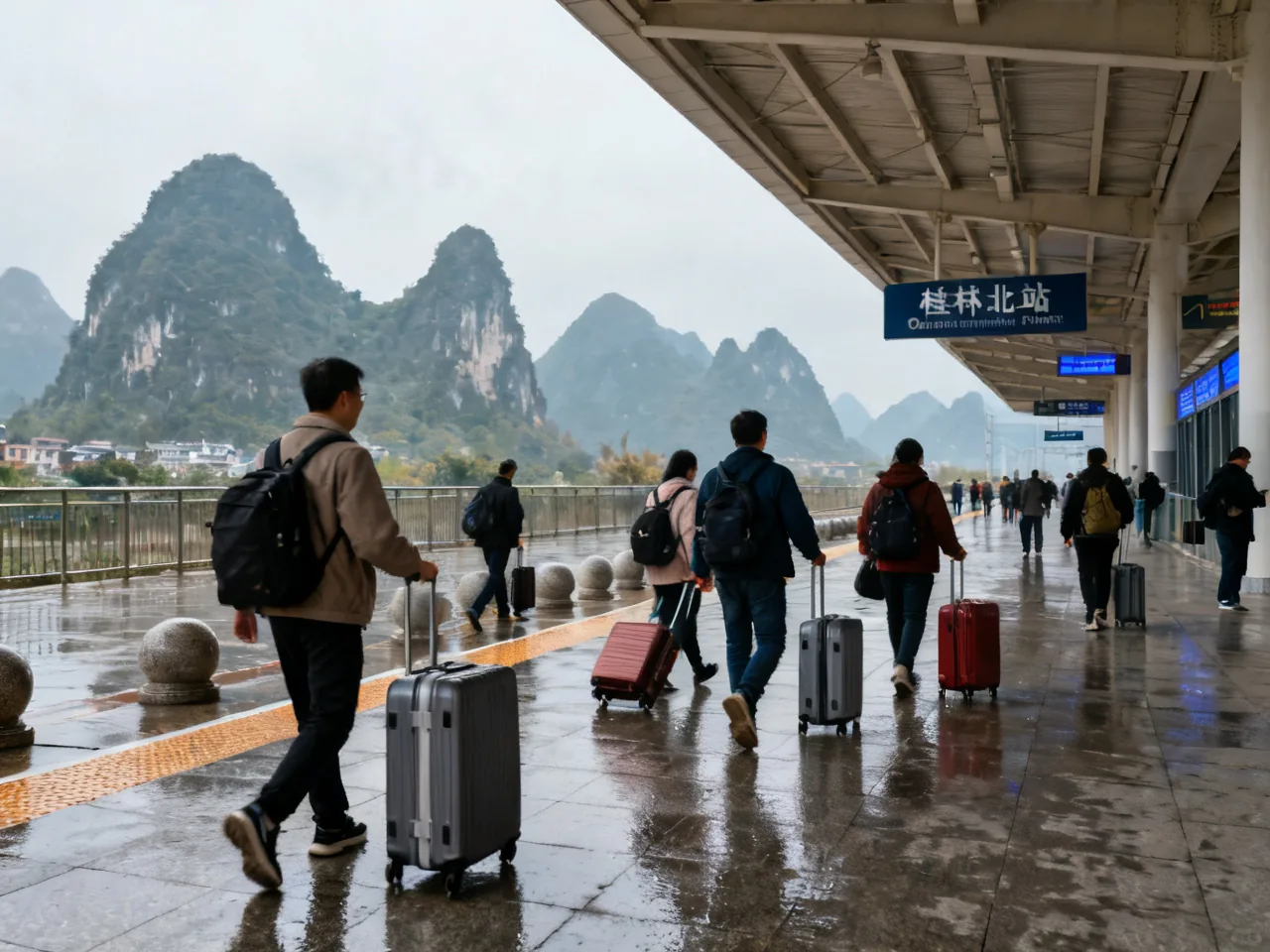
Now for the reality right outside the station. Guilin North is not especially confusing, but for someone who has just arrived, any station square can temporarily distort your sense of direction. What you see are rows of signs, calls from drivers, several vehicles that all seem possible, and map points that look close but actually require a long detour around barriers. At this moment, the most valuable thing is not leaving immediately. It is making sure that for the next ten minutes you do not have to make complicated decisions. If anyone in your group gets carsick easily, hates heat, or is hauling a heavy suitcase, this step matters even more.
I usually tell you to slow the tempo down to “sufficient” rather than “fastest.” Use the restroom, drink water, check your phone and power bank, and make sure you have the Chinese version of your destination name copied and ready. Many people who struggle on the road are not defeated by the route itself but by their condition: thirsty, rushed, low on battery, and afraid of missing something, so every small change tightens the whole mood. Whether a route feels smooth often begins in these five minutes before you are fully gone from the station. The core of a slow intercity route is not laziness. It is lowering friction at each node.
Why not break the middle part into too many small segments? Because on the Guilin-to-Yangshuo line, the most valuable thing is not demonstrating your flexibility across multiple transport modes. It is whether you can make the transition before the landscape opens up feel smooth. Once your plan becomes too fragmented, you start constantly checking signs, pickup points, departure times, and drop-off locations. Your entire mind gets spent on “don’t make a mistake.” A slightly more expensive option that completes a large section in one move often protects your energy for when you arrive. Travel cost is not just money. It is also attention.
This is exactly where Acheng stopped me that day. He saw me comparing several options that saved only a little money but clearly created more fragments and more transfers. He pressed my phone down slightly and said, “What you’re saving isn’t a few dozen yuan. What you’re saving is whether you still have the patience to walk West Street when you get to Yangshuo.” Then he went to buy two iced lemon teas. Tiny beads of water quickly formed on the outside of the plastic cups, cool against the hand. The gesture worked like a reminder: route design should serve the condition of the traveler, not force the traveler to satisfy the elegant logic of a route.
Once you are on that onward segment toward Yangshuo, allow yourself to stop measuring every minute. Outside the window, distant hills softened by humidity begin to appear, their colors not simply green but layered gray, blue-green, and ink-dark in the air. Small white-walled, dark-roofed buildings flash by on the roadside. The fields hold standing water that reflects the sky. The air-conditioning inside the vehicle feels a little heavy. Someone in the front speaks softly on the phone, and each turn gives the suspension a gentle sway. When you relax here, the route finally shifts from “completing transport” into “entering a place.”
That is also why I like a slow route: it gives the landscape a chance to grow inside you instead of flicking past tired eyes like a slideshow. Many first-time visitors to Yangshuo arrive already carrying a list of words in their head—West Street, beer fish, the Li River, cycling—but what actually drains them is the unnecessary circling and over-calculating before arrival. The earlier you define the route as “easy to handle,” the easier it is to preserve your curiosity for what comes after. The legacy route article titled Shanghai to Suzhou in Two Slow Days carries a similar feeling about why moving slower can be worth more than forcing speed. If you like practicing the idea of securing the big movement first and sorting out the details after arrival, the legacy cross-city piece titled Dunhuang to Turpan is also relevant.
The small problems usually happen in the final segment. Once you arrive in Yangshuo, your body relaxes instinctively and thinks the hard part is over. That is exactly when rushed decisions sneak in: getting into any vehicle, not confirming the drop-off point, or letting yourself be left somewhere that still requires too many turns to reach West Street. My advice is to become more specific, not less, for the final part. Do not simply say you are going to West Street. Show the hotel name, a nearby landmark, and ideally the Chinese text as well. Because “arriving in Yangshuo” and “arriving at the door where you can put your luggage down tonight” are still different things.
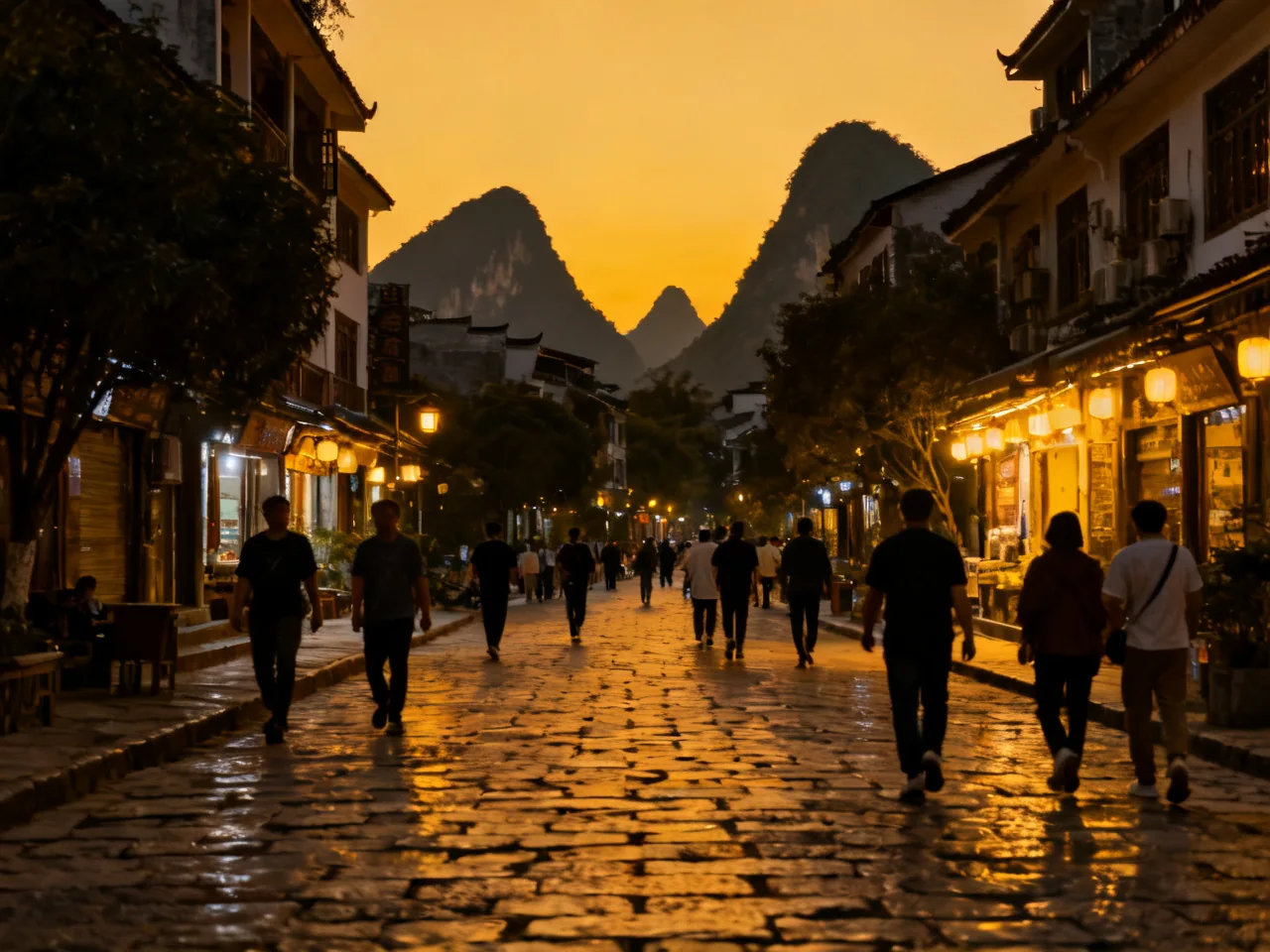
If you arrive at dusk, the sounds around West Street often reach you before the map does. Suitcase wheels knock sharply over stone paving. Kitchens send out wok heat and singing from inside. The smell of grilled meat, sweet local alcohol, and damp river air all mix together. There are often crowds near the entrance, and your rolling suitcase suddenly becomes clumsy at your feet while the phone’s navigation hesitates because you turned a few corners. Do not rush to decide whether the place is “too commercial.” Get yourself to where you are staying first, wash your face, drink some water, and come back out. A place deserves to be judged when you are not at your most bedraggled.
I later realized that what this route buys—though it is not the cheapest—is a feeling of entry. You are not shoved into Yangshuo. You approach it in stages: first by stepping down from the speed of the train, then by collecting yourself amid the noise outside the station, then by slowing your breathing during the road transition, and finally by entering West Street with a little reserve left. For a first-time visitor, that reserve matters immensely. It gives you the ability to tell the difference between a place’s tourist surface and the parts where you genuinely want to linger.
If you are willing to treat “easy to handle” as a serious travel criterion rather than an excuse for laziness, the journey from Guilin North Station to Yangshuo West Street will teach you something practical: a good route is not always the cheapest, and it is not always the one that shows off the most technique, but it delivers the whole person to the destination, not just the body. The little extra money spent on the way often gets quietly earned back in reduced fatigue, fewer bad calls, and fewer pointless arguments.
When you truly arrive at night, you will see a glowing sign at the entrance to West Street in the damp air. Nearby shopkeepers pull bamboo chairs inward, and raindrops still cling to the leaves of potted plants by the road. You stop, set your suitcase upright, and feel your shoulders finally lighten. Someone emerges from a side lane carrying a basin of freshly washed greens, while farther away a band’s soundcheck sends a low vibration through the street. You know this was not the cheapest way to get here. You also know you arrived with your mood intact.