В Ханчжоу я превратил прогулку по Западному озеру в неспешный фильм на целый день: от утреннего тумана до ночной лодки — без спешки
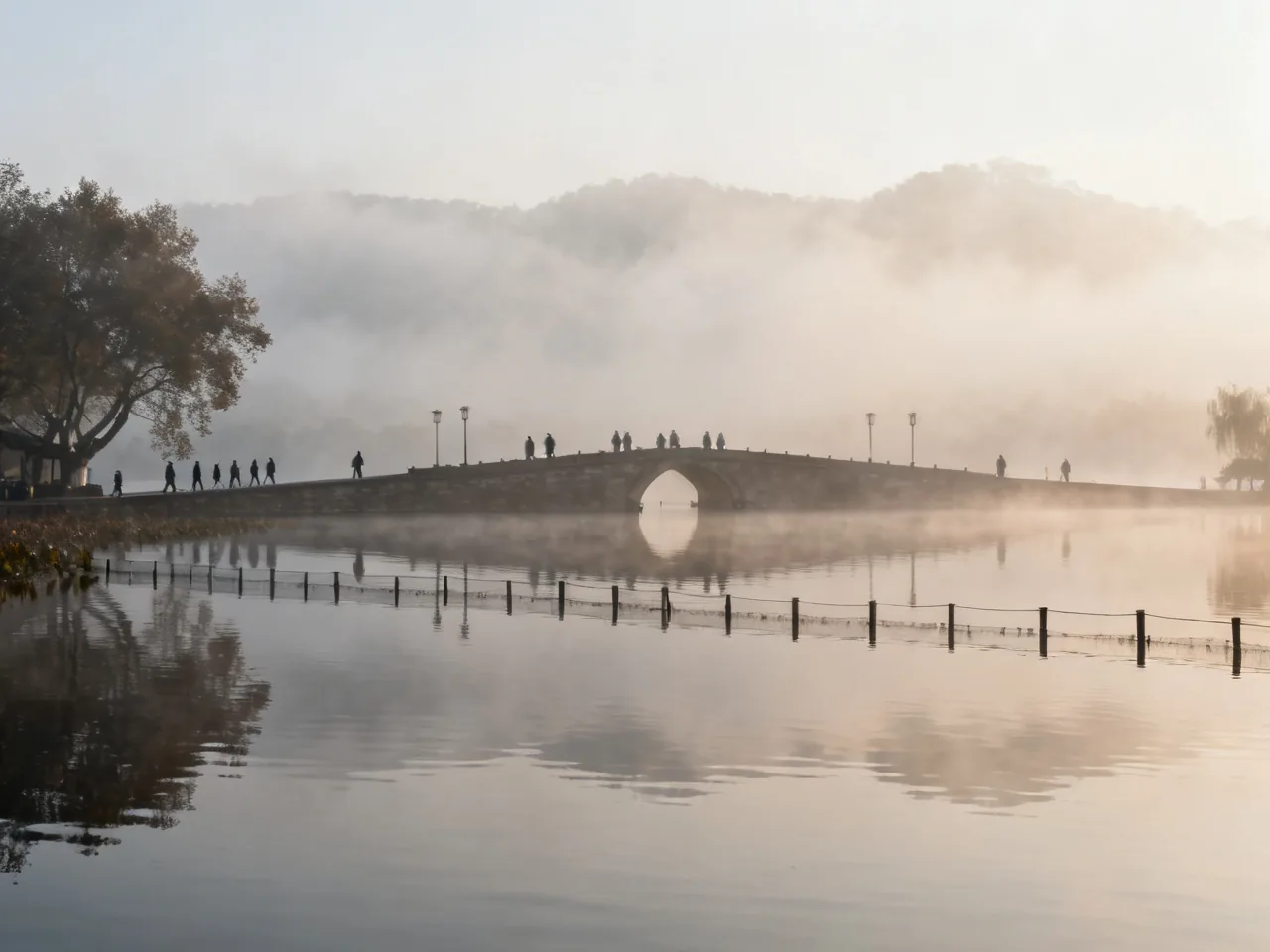
At 6:15 in the morning, Hangzhou was still holding the dampness left over from the night. I stood alone on Beishan Street by West Lake with a cup of soy milk warming my fingertips, watching a sanitation auntie sweep wet leaves into a neat line while the wind pushed the mist across the water toward Broken Bridge. I decided not to rush anything that day and to treat West Lake like a slow film, watching it frame by frame until the closing scene.
At the grayest hour, the people by the lake moved most lightly. The soles of runners tapped the stone pavement with a sound softened by the mist, as if wrapped in cotton; a breakfast cart lifted its steamer lid and a cloud of vapor burst out carrying the sweet scent of dough and chopped scallion; two black swans glided along the shore, their ripples opening only a narrow seam in the water. I walked onto Bai Causeway on purpose at a slower pace, as if I might crack the half-awake quiet underfoot.
Broken Bridge was not crowded, at least not in the morning. A young couple was shooting wedding photos there. The bride wore sneakers, and a strip of pink socks showed beneath her white dress. The photographer crouched and asked her to tilt her head a little more. I stopped to get out of the way, but he grinned at me and said, “Sir, stay there for a second—your silhouette is perfect as a passerby.” For a brief moment I became background scenery in someone else’s love story, standing by the railing, looking over the lake, crushing my empty soy milk cup in one hand.
West Lake rewards a slow walk more than a frantic checklist. When people ask me how to arrange a first trip to Hangzhou, I always think learning the rhythm matters more than memorizing every sight. If you have been jumping too quickly between cities, it helps to read Shanghai to Suzhou in Two Slow Days first; its way of turning transit itself into part of the experience fits West Lake very well.
After seven, the sky gradually brightened and the willows pulled green out of the gray. I turned past the area near Autumn Moon over the Calm Lake and saw several local uncles already practicing tai chi with a small speaker beside them, moving so slowly that they seemed to breathe with the water. Nearby a woman walking a corgi let the dog sniff along the ground until it stopped beside my shoe. She laughed and said, “It can tell who’s a visitor.” I asked how, and she answered, “Locals don’t spend that long looking up in the morning. Visitors do.”
That line relaxed me at once. A traveler does not need to look efficient; standing still and staring is a valid way to travel too. I sat on a bench for ten minutes doing nothing except watching the lake change from lead-gray to pale silver and then to a blue polished by the rising sun. Around me I heard bicycle bells, a distant low hum from a boat engine, and nearby the clean smell of bark soaked by night dew mixed with the aroma of freshly baked sesame flatbread.
At nine, I reached the foot of Solitary Hill. I had planned to continue toward a few tucked-away courtyards, but a small problem arrived at the fork in the path: a sudden drizzle. I had no umbrella. At first the rain only tested the air, but within minutes it darkened the shoulders of my shirt. Just as I was hesitating over whether to duck into the visitor center, a woman selling Longjing tea leaned out from her stall and waved me over. “Stand in here first,” she called. “Hangzhou rain doesn’t follow reason.” She rested an old umbrella by the counter and poured me half a paper cup of warm tea.
The tea carried a faint young chestnut aroma. It was not bitter, and when I swallowed it, my throat felt gently pressed smooth. The auntie told me she lived in Meijiawu and that heavy rain usually slowed business by the lake, leaving her time to chat with passersby. She asked whether it was my first time taking West Lake this slowly. I nodded. “Good,” she said. “Don’t rush onto a sightseeing car. You need your feet to learn the distances here, and your ears to know where the liveliness begins.” The line sounded like a film script, and I carried it with me all day.
The rain was light, but it washed the edges of the lake into sharper focus. By the time I moved slowly toward the Louwailou area beneath the umbrella she lent me, bright droplets had gathered on the lotus leaves by the shore, a short queue had formed at the boat pier, and several children reached into the rain with laughter springing high into the air. I did not chase any “must-see” stop. Instead I turned into the tree shadows and followed winding embankments and small slopes, studying moss at the foot of walls, cracks in the steps, and the grain of wood burnished by countless hands on the railings.
At noon I did not hunt for an internet-famous restaurant. I simply ducked into a small eatery near Yue Fei Temple and ordered a bowl of pian’er chuan. When it arrived, tiny circles of oil floated on the broth; the preserved mustard greens were salty and fragrant, the bamboo shoots crisp, and the slices of lean pork thin but deeply flavorful. The air-conditioning was modest, and the window glass had fogged white from the indoor-outdoor temperature difference. At the door people shook umbrellas and flicked muddy water from their shoes while bowls and chopsticks clinked sharply. Seeing me sitting alone by the window, the owner added a small dish of pickled radish and said, “Take your time. The sky will clear this afternoon.”
The afternoon version of West Lake did feel as if it had been re-edited. The wind pushed the cloud cover apart little by little, and sunlight spilled through the seams, brightening first one patch of water and then an entire sheet. Su Causeway grew busier. More people rented bikes, and more guide flags appeared. I still did not want to speed up, so I chose the clumsiest and most comfortable method of all: I kept walking. When I was tired, I leaned over the railing to watch fish. When I was thirsty, I bought a bottle of salty soda. When my feet ached, I sat under a patch of shade for five minutes.
If you want a little practical background beyond the walk itself—how to judge when to walk, take a bus, or call a car in a Chinese city—you can look at Chinese city commuting choices. And if you arrived in Hangzhou by high-speed rail and plan to string together other cities afterward, China high-speed rail end-to-end guide is useful too. But on this day, what I most wanted to remember was not efficiency. It was the pauses.
Before evening I finally boarded a boat—not to check off Three Pools Mirroring the Moon, but because my feet were hot from walking and I wanted a different speed. The boatman was a broad-voiced uncle with sun-reddened skin who reminded everyone to sit steady before departure. He noticed that I kept photographing the water instead of people and asked with a grin, “Are you here looking for quiet?” I said yes. He nudged the bow slightly farther out so the breeze from the center of the lake hit us more directly. “Then wait until it gets a little darker,” he said.
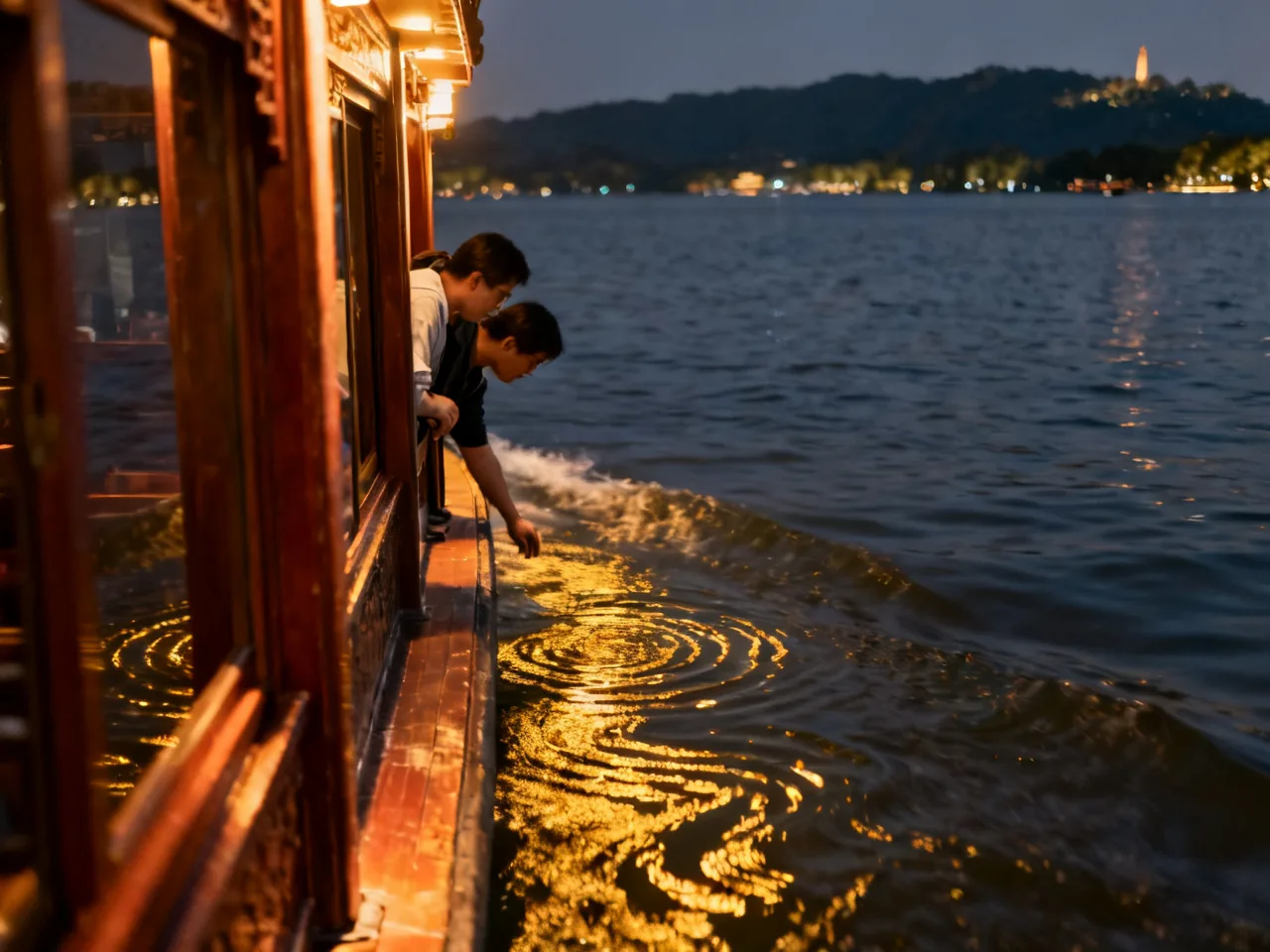
He was right. When the sky began to sink into evening, the trees, pagodas, and rooflines onshore softened into silhouettes. The clear colors of daytime folded away, leaving only layers of reflected light on the water. As the boat cut forward, I could hear a fine slapping sound against the hull, as if someone were repeatedly brushing silk with their fingertips. Leifeng Pagoda lit up in the distance—not glaring, just enough to announce that night had taken over the scenery. Even the tourists who had been speaking loudly one by one lowered their voices, as if whoever became quiet first would receive a larger share of the dark.
It was nearly eight when I came ashore. I returned the umbrella to the tea-selling auntie, who was packing up; a few wet dots still clung to the plastic cover over her stall. She recognized me and asked, “Finished the walk?” I said, “Not finished. But enough for today.” She nodded as if she understood completely. I did not hurry back to my hotel after that. I stood by the lake a while longer and watched a late boat leave the pier, its orange light dragging a thin line across the black water. Behind me, people spoke softly under osmanthus trees. In front of me, the wind pushed lake air against my face, cool in exactly the right way.