Чунцину фильтры не нужны: город, который заставляет киберпанк почувствовать свою неполноценность
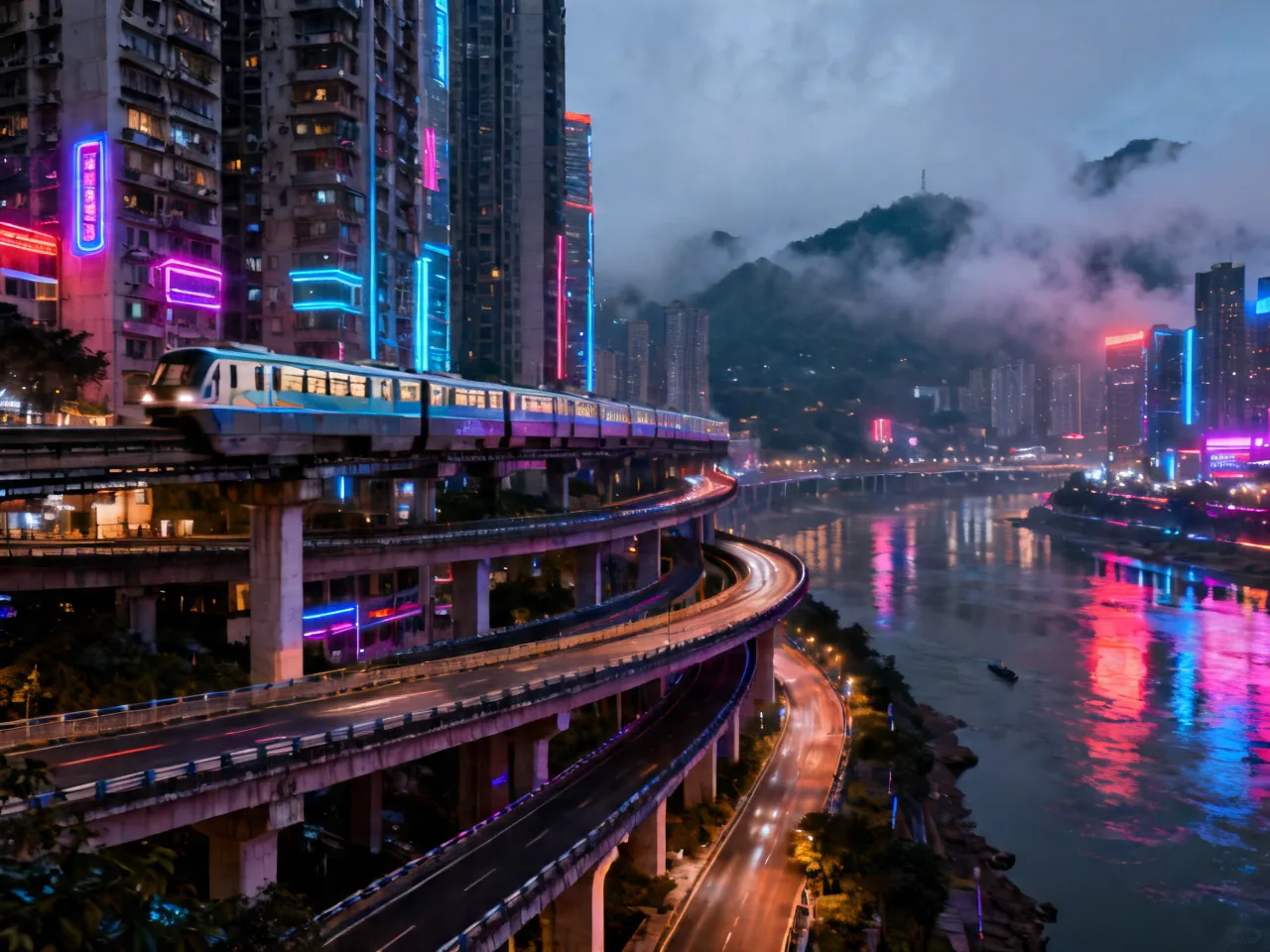
My first time in Chongqing was at 11 PM. Stepping out of Jiangbei Airport into a taxi, the driver wound along elevated highways for twenty minutes while I couldn’t figure out what level I was on. To the left, lights reflected off the river. To the right, apartment windows glowed halfway up a hillside. Above, a monorail thundered past. Below, another road. I thought: this city took a flat map, crumpled it into a ball, and built on top of it.
Why the Whole World Calls Chongqing Cyberpunk
It starts with terrain.
Chongqing’s urban core sits on mountains at the confluence of the Yangtze and Jialing rivers, with elevation differences exceeding 300 meters within the city. Other cities spread out horizontally. Chongqing stacks vertically — in the same building, both the 1st and 20th floors can be “ground level,” each connecting to streets at different heights. Navigation apps frequently crash here because GPS can’t distinguish whether you’re on a bridge or under it, in a tunnel or in the park above the tunnel.
Then there’s the fog. Historically, Chongqing has over 100 foggy days per year. Moisture from the rivers and temperature differentials across the mountain city create a natural “filter.” Neon lights soften and diffuse through the mist, skyscraper silhouettes fade in and out — you don’t need post-processing. This city comes with Blade Runner’s color palette built in.
Add to that over 14,000 bridges. Not a typo — Chongqing has more bridges than any city on Earth. Bridges here aren’t just for crossing rivers; they connect mountain peaks, neighborhoods, even building floors at different elevations. Standing at certain intersections, you can see five layers of traffic simultaneously: boats on the river, cars on the riverside road, the monorail, an overpass, and yet another bridge higher up. That kind of density would silence any sci-fi film’s production designer.
Hongya Cave: The Building Everyone Mistakes for Spirited Away
Hongya Cave isn’t a cave.
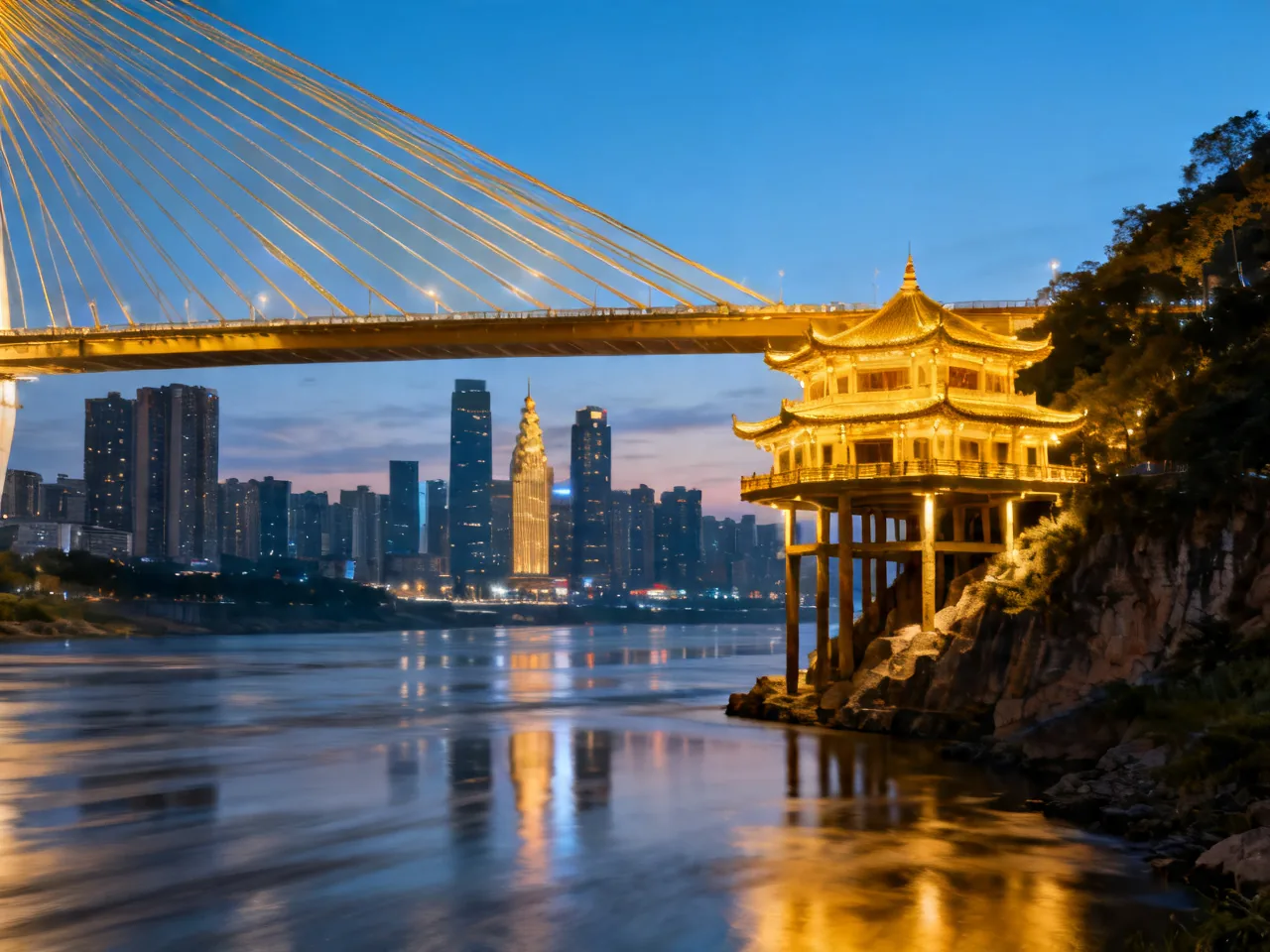
It’s an eleven-story stilted building complex (吊脚楼) embedded into a cliff face along the Jialing River. You walk in from Cangbai Road thinking you’re on the first floor — you’re actually on the eleventh. Take the elevator down to “floor one” and step out at river level. This kind of spatial disorientation is routine in Chongqing architecture, but Hongya Cave pushes it to the extreme.
At 7:30 PM, the lights come on. The entire structure transforms into a golden tower of light, reflected in the Jialing River. During the 2024 National Day holiday, over 2.3 million people came to see this building in seven days. 2.3 million. One building.
From the opposite bank at Jiangbeizui, Hongya Cave’s lights layer with the golden cables of Qiansi Gate Bridge, backed by the Yuzhong Peninsula’s skyscraper cluster — this scene needs no explanation. Your phone lifts itself.
Liziba: A Monorail Through a Building, Passengers Unfazed
Line 2 of the rail transit does something at Liziba Station that no other city would dare: it passes directly through floors 6 to 8 of a residential building.
The platform is on the 8th floor. Standing on the viewing deck below, you watch an orange monorail glide into the building, vanish into the wall, emerge from the other side seconds later, and continue along the elevated track beside the Jialing River. Residents have long since gotten used to it — the soundproofing is decent, and they say the vibration is less than a truck passing downstairs.
This scene went viral around 2018 and hasn’t cooled down since. The Chongqing municipal government built a dedicated viewing platform below the building because tourists kept standing in the middle of the road to take photos — too dangerous.
Baixiang Ju & Kuixing Tower: “Normal Housing” for Chongqing Locals
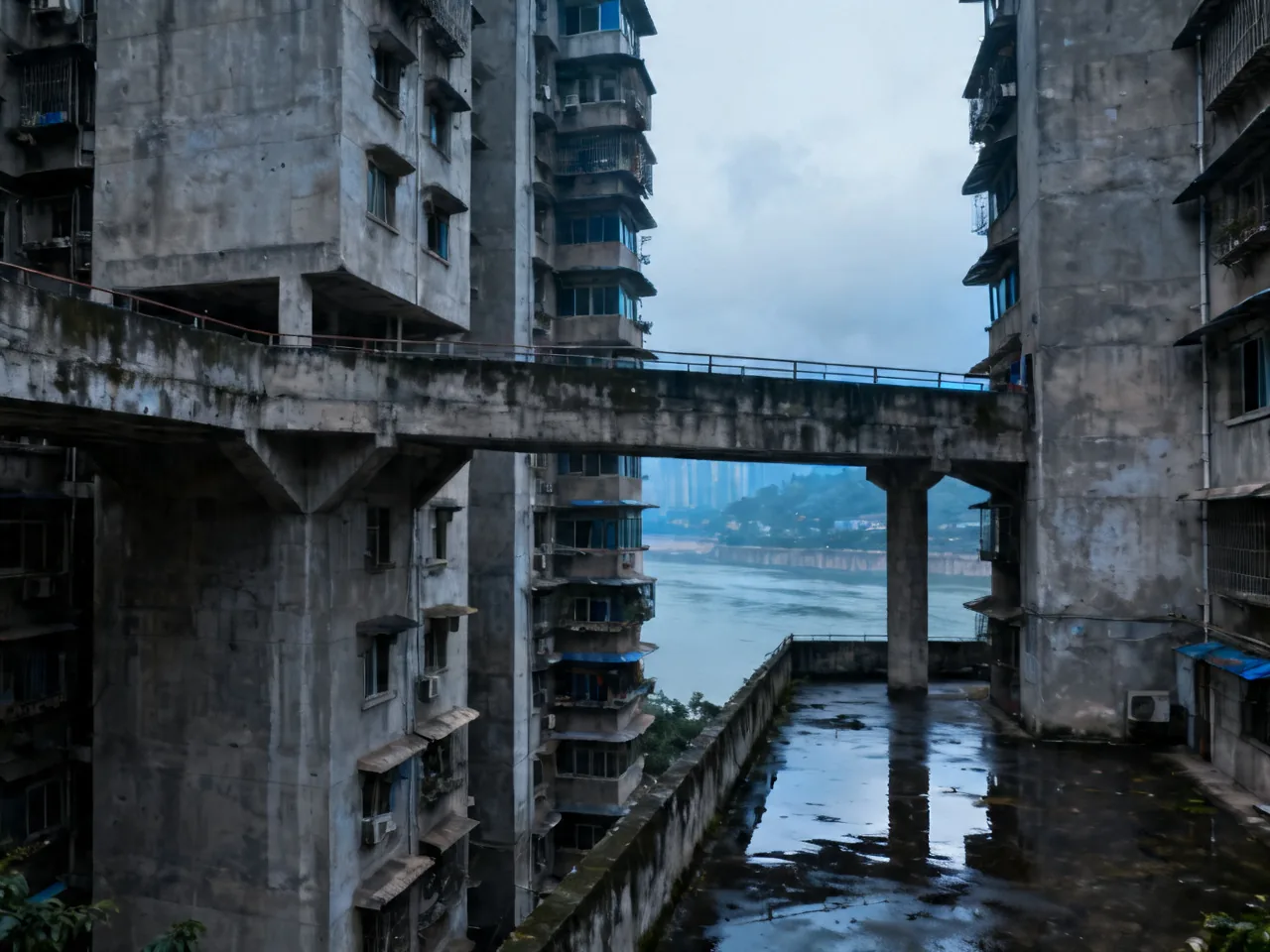
Baixiang Ju is a 1990s residential complex with three entrances — on floors 1, 10, and 15 — all connecting to “ground level,” just three different streets at three different heights. Elevated walkways link the buildings; walking across them, you look down at a drop of dozens of meters, with the Yangtze in the distance.
In 2024, this complex went completely viral on Douyin and Xiaohongshu. Photographers discovered its spatial structure was naturally perfect for cyberpunk-style shots — layered concrete, suspended corridors, distant river views and skyscrapers. But it’s still a residential area, and residents have posted “please keep quiet” signs. Photos are fine — just don’t disturb the neighbors.
Kuixing Tower is even more absurd. You walk in on the 1st floor, take the elevator to the 22nd floor, step out, and find yourself standing on ground level of a different street. Both sides are “first floor.” First-time visitors usually need a few seconds to process what just happened.
Night Route: Six Hours from Dusk to Midnight
If you only have one evening, this is the route I found most worthwhile after walking it myself:
A ten-minute walk from E’ling monorail station. This creative park converted from an old printing factory has a rooftop terrace overlooking the Yuzhong Peninsula. At dusk, the sun sets across the river, the city transitions from warm gold to deep blue, and lights flicker on one by one. This process takes about forty minutes — Chongqing’s finest “blue hour.”
Take Line 2 to Liziba, watch a monorail pass through the building from the viewing platform, then board one yourself and experience passing through the building from inside. The carriage goes quiet, the window suddenly darkens then brightens — the whole thing takes less than ten seconds.
Walk onto the bridge from the Hongya Cave side. The 720-meter bridge spans the Jialing River; walk to the middle, turn around, and Hongya Cave’s lights, the Yuzhong skyline, and river reflections all enter your frame simultaneously. This is the single most photographed angle in Chongqing, bar none.
Come down from the bridge and enter Hongya Cave. Eleven floors, each with different shops, but the point isn’t shopping — it’s experiencing the building’s spatial logic. Ride elevators up and down, wind through staircases, and you’ll repeatedly lose your sense of direction. That’s the point.
Walk to Jiefangbei, Chongqing’s commercial center. Neon lights, LED screens, crowds — this is the most “urban cyberpunk” zone. Then detour to Kuixing Tower for the “enter on floor 1, exit on floor 22” experience.
Take Line 2 to Lianglukou and spend 2 RMB on the Crown Escalator. Built in 1996, this 112-meter-long escalator with a 52.7-meter vertical drop connects Lianglukou to Chongqing Railway Station — one of Asia’s longest outdoor escalators. During the two-and-a-half-minute descent, you pass through a tunnel, see the stream of people ascending opposite you, hear the mechanical clank of escalator chains — this “infrastructure as spectacle” experience is uniquely Chongqing.
Then head to Jiaochangkou for hotpot or a bowl of xiaomian noodles. Chongqing’s streets past midnight — fog, lights, diners who haven’t called it a night — that’s the final brushstroke of cyberpunk.
Notes for Photographers
A few practical tips:
Bring a tripod. The essence of Chongqing night photography is long exposure — light trails through fog, silky river reflections, traffic light streaks all require a stable platform and at least two to three seconds of shutter. Phone night mode works, but the results are a magnitude apart.
A wide-angle lens (16-35mm) is practically standard. Chongqing’s spaces are too dense, too three-dimensional for normal focal lengths.
The best shooting window is 7:30 to 9:00 PM. All lights are on while the sky retains a trace of deep blue — this window lasts about forty minutes. After 9 PM the sky goes fully black, and images lose a layer of depth.
If you want panoramic shots from Nanshan One Tree viewing platform, tickets are 30 RMB; weekends are extremely crowded, weekdays recommended. The WFC 73rd floor and Raffles Crystal sky bridge also have observation decks, around 120 RMB each, good for rainy nights (indoor).
One Last Blunt Thought
Some people online say Chongqing’s cyberpunk vibe is “manufactured by marketing.” I disagree.
Marketing can create a viral attraction, but it can’t create a city’s terrain. Chongqing’s three-dimensionality, its fog, its bridges, its ability to turn infrastructure into spectacle — none of this was planned. It’s the result of centuries of humans negotiating with mountainous terrain. The sets that cyberpunk films spend hundreds of millions of dollars building? Chongqing residents walk through them on their daily commute.
So put the filters away. Chongqing doesn’t need them.
Related Reads
- 10-Day East China Five-City Loop
- Lijiang Old Town: Naxi Culture & Snow Mountain Views
- Zhangjiajie Glass Bridge & Tianmen Mountain Guide
- Guilin Li River Scenic Tour Complete Guide
- Spring Bloom Map: China’s Most Beautiful Flower Fields