暑くなる前に、長安の朝市はもう一日の味を並べていた
Before dawn had fully opened, I knocked the dust from my boots against the threshold of the inn. Chang’an was not completely awake yet, but the morning market beside the eastern quarter had already come alive. What arrived first at the street corner was steam, and only after that came sound: the crisp ring of a bronze ladle touching the rim of a pot, the low thud of dough slapped onto a board, the white burst that rose when a vendor lifted the lid from a clay oven. I am a spice merchant who came eastward from Persia, and I once believed the quickest way to judge the wealth of a city was to look at its walls and its offices. But after living in Chang’an for some time, I began to think differently. The first thing that truly shows how grand this city is is not the palace gate, but the first bowl of hot broth at the morning market.
The first time I entered this market with a local broker, I moved slowly, not because I feared the crowd, but because I did not want to miss the details. The stalls were not pressed together in confusion. Sellers of flatbread, porridge, steamed snacks, and pickled vegetables each kept a small, ordered space. Their stoves, wooden boards, bamboo steamers, and water buckets were arranged with a kind of discipline. Some men carried shoulder poles and sold while walking. Others had already settled into fixed positions, their faces lit on and off by the fire. The first impression of Chang’an’s morning market was not disorder. It was speed without panic. Everyone seemed to know exactly where to stand, which bowl to reach for, and at what moment to hand the first steaming food of the day to the first traveler hurrying past.
I had assumed the noisiest corner would be the one selling meat, but I soon learned that the first force that gathered people was often flour and fire. One vendor pressed flatbread against the inner wall of his oven. With a sweep of his palm, the dough clung to the hot clay, and the edges browned almost at once. Beside him, his young apprentice scattered sesame seeds with astonishing speed, as if the fragrance might escape if he hesitated. Nearby, another man sold noodle soup. Steam rolled out of a bronze pot, and when he lifted the noodles with chopsticks, a wet, rising aroma followed. Those rushing out of the city would eat standing up. Porters who had already unloaded their goods preferred to squat by the roadside, cradling wooden bowls in both hands and blowing at the surface slowly.
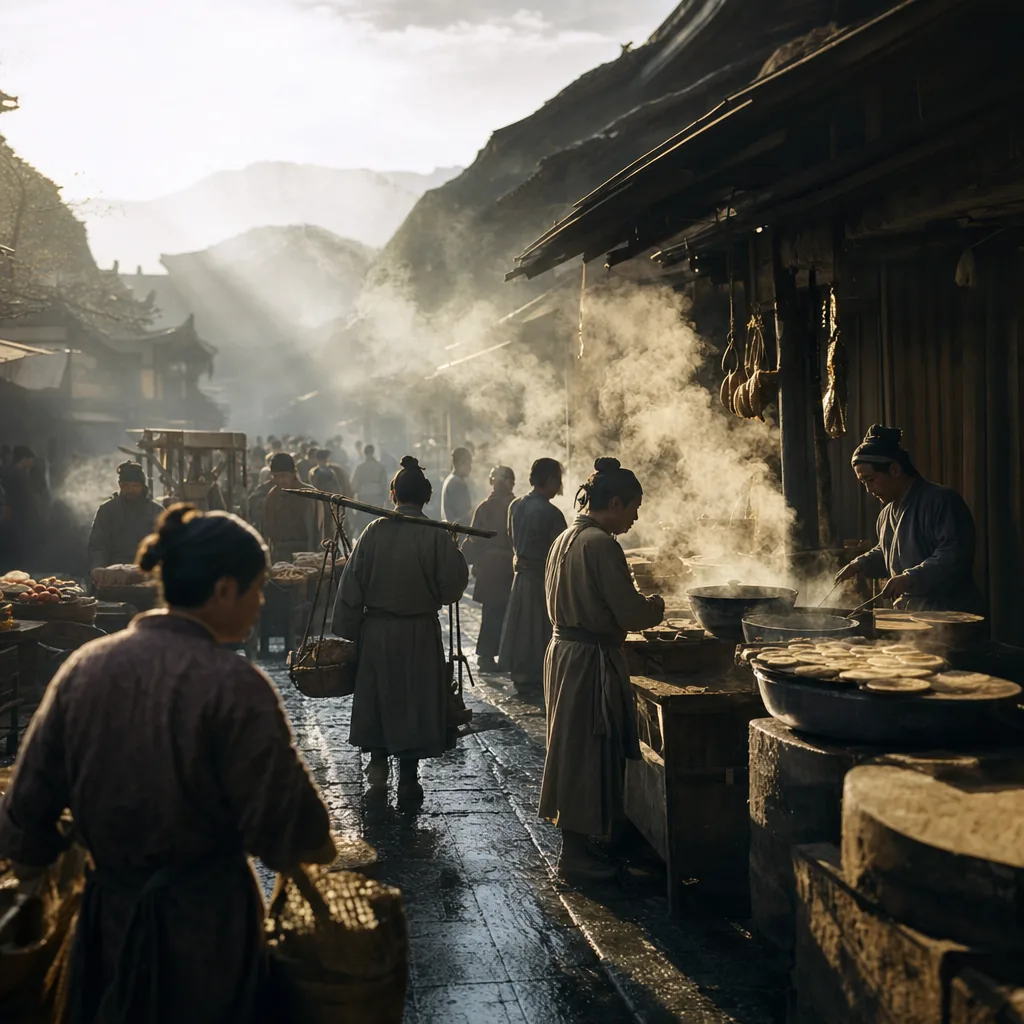
It would not be accurate enough to say only that Chang’an had a great deal of food. What truly astonished me was how, so early in the morning, the city could gather people from many different origins into the same cloud of aroma. Some wanted millet porridge because it warmed the stomach and filled the body. Others preferred flatbread because it was crisp, practical, and easy to carry while walking. Still others were willing to wait longer for a bowl of soup dotted with scallions and shimmering fat. As a spice merchant, I always listen first with my nose. In Chang’an’s morning market, there was not only the scent of grain and oil, but also scallion, garlic, lamb fat, fermented dough, charcoal, vinegar, and even the fresh coolness of recently cut fruit. These smells did not collapse into one blur. They pushed outward in layers, as though someone were arranging the city’s sense of taste one step at a time in the morning air.
Once I stood for a long time in front of a small stall selling steamed snacks. The vendor was a middle-aged woman whose knuckles were red from work. When she lifted the bamboo lid, a wave of steam struck her forehead, dampening the loose hairs by her temples. After noticing my attention, she smiled and asked whether I wanted to try a newly made bean-filled dumpling. I hesitated because I had to meet a local merchant later that morning and did not want my hands smelling too strongly of food. She set one gently onto a piece of paper and said that a traveler who eats one on the road will speak more smoothly afterward. I understood half the sentence and guessed the rest, but I took it anyway. When I bit into it, the bean filling was calm and deep, not urgently sweet, while the outer skin was so soft it felt as if it had just been taken from warm cloth. In that moment, I understood that people in Chang’an did not treat breakfast merely as a way to fill the stomach. It was a way of receiving a person out of the night and into the day.
There is another reason I admire Chang’an’s morning market. For a short while, it narrows the visible distance between ranks. Of course, one can still tell differences by what people eat, where they stand, and what vessels they use. Yet during the busiest moments of the morning, you can see porters, travelers, clerks, schoolchildren, shop assistants, and even monks who have risen early, all squinting through the same steam on the same street. Some bargain. Some hurry. Some are already planning their midday meal. But between the first spoonful of hot porridge and the first piece of bread, they are all first of all people who need to be warmed awake. For a great capital, that kind of morning order feels truer than any boast.
What Exactly Made Chang’an’s Morning Market Special
If we summarize Tang Chang’an’s food culture with the word “prosperous” alone, we actually make its most valuable feature sound smaller than it is. What made Chang’an’s morning market special was not only the number of foods available, but the way it tied together the city’s rhythm, movement, crowds, and eating habits into one connected system. If you have only imagined ancient Chinese cities through walls, ward gates, and offices, you may also glance at another article on this site: Budget Buckets for China Trips: A Practical Money System. It is about modern travel, but its logic about how city rhythm shapes human choices also makes surprising sense when we look backward.
- First, it served people living by different clocks. Those leaving the city, beginning work, preparing for examinations, or carrying loads could all find food that matched their pace at daybreak.
- Second, it allowed noodles, steamed foods, porridge, and portable foods to exist side by side, showing that urban eating habits had already grown sophisticated rather than leaning on one single staple.
- Third, its liveliness was not disorderly crowding but division of labor, position, and shared rhythm, which reflected the organizational strength of a major city.
I later spoke about this with a local friend who could write Chinese beautifully. He told me that Tang people cared not only about what they ate, but also when they ate, with whom they ate, and where they ate. The more I thought about it, the more right he seemed. The importance of the morning market lies in the fact that it is not a banquet. It has none of the decorative layer of display, and for that very reason it reveals a city’s true appetite most clearly. If you see what it sells first thing in the morning, you can almost tell what the people of that city reach for first after waking: warmth, speed, fullness, convenience, or perhaps some small fragrance that quietly comforts them. If you are interested in how ancient China organized large spaces, you may also compare it with this article on the site: In China I Learned to Use Geography to Understand History Instead of Memorizing Names. Read together, the two pieces make it easier to see the link between food and urban structure.
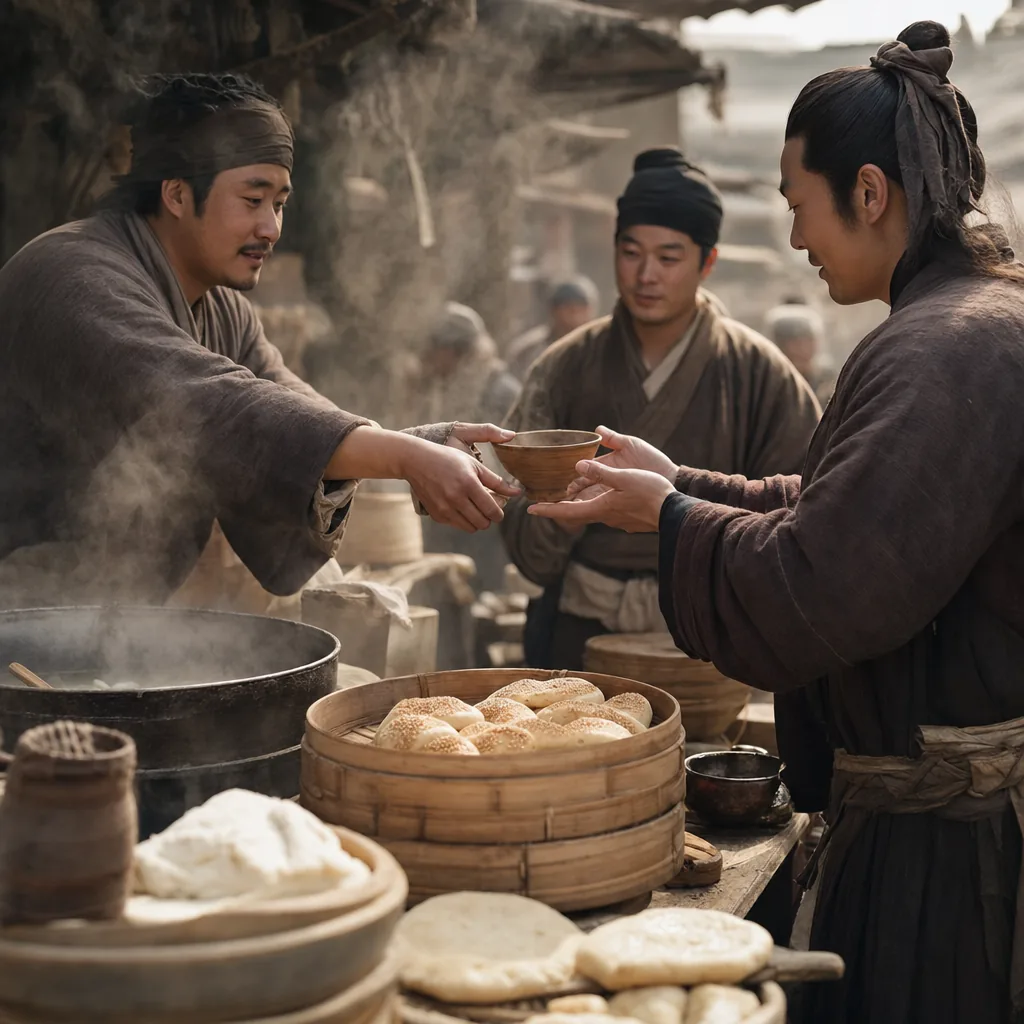
If someone asked me today whether the most worthwhile sights of Tang Chang’an were its palaces, gates, and broad avenues, I would still say yes. But if that person looked only at those, they would miss another, more intimate kind of splendor. What made me remember Chang’an was not only a high wall flashing under the sun, but a vendor wiping sweat with the back of a hand, a schoolchild hunching over a hot bowl and blowing at it, a cart driver breaking half a flatbread for his companion with effortless familiarity. The greatness of a city can be seen by lifting your eyes. The depth of a city is known by the heat that rises beside your mouth.
When I left the market that day, the sun had not yet climbed high, but the street no longer felt as cold as it had at first light. Some people were carrying empty poles back home. Others were already pressing a second round of dough onto wooden boards. The glow in the stoves had steadied. I looked back once and suddenly felt that I had not merely eaten breakfast, but had just read one of the most concrete annotations to Tang urban life. The fullness of Chang’an lives not only in the history books, but also along the edge of a flatbread, in the mist above a bowl of soup, and in those few minutes when an entire street wakes up together.