大理で風がやんだ瞬間、私はようやく洱海のほとりのリズムに気づいた
On my first day in Dali, I thought I had come for the blue of Erhai, the ridgeline of Cangshan, and the signs in the old town that travelers keep photographing. What actually stopped me was a gust of wind after four in the afternoon. It came across the water, circled the eucalyptus trees, lifted blue cloth outside a Bai courtyard, and then suddenly rested as if it had made up its mind. In that pause, the scooters sounded farther away, the gulls stopped hurrying their calls, and I understood that travel beside Erhai should not be packed too tightly.
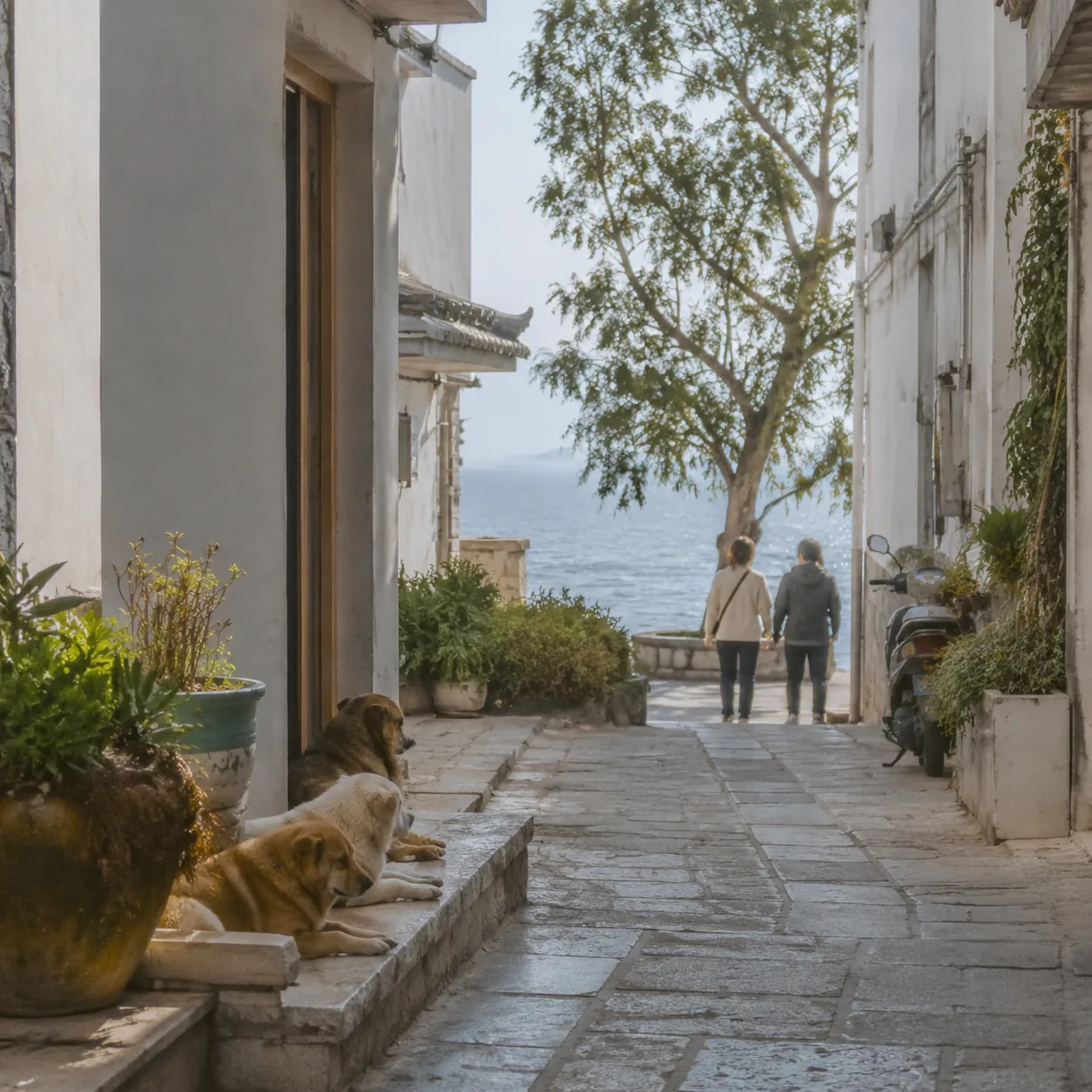
I stayed near Caicun, in a guesthouse whose courtyard gate was only a short walk from the lake. In the morning, the stone lane still held the coolness of night, and a few dogs lay by doorsteps as if they understood local time better than I did. The owner handed me a cup of hot water and said the wind would be gentle, good for walking slowly. She did not recommend a route or open a map. She simply pointed toward the water, as if the real advice lived in that gesture: do not rush; let your feet discover the way first.
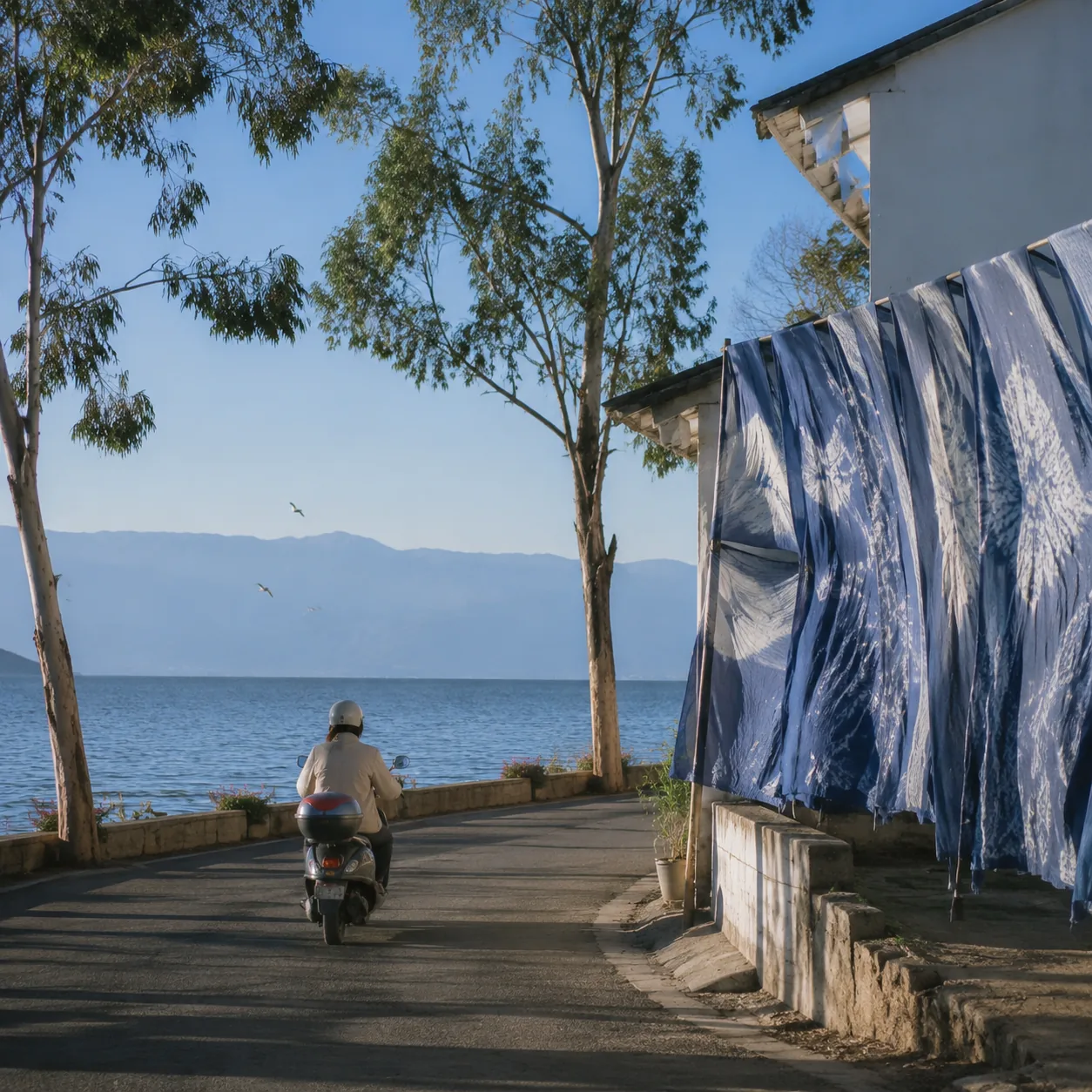
I followed the ecological corridor, and at first I still behaved like someone chasing an itinerary. When I saw a viewing deck, I wanted a photo; when I saw a bike stand, I wanted a price; when I saw a café, I compared which one would look better in pictures. After twenty minutes, my gallery already held a dozen nearly identical views of the lake. Yet Erhai did not become more complete because I photographed it more. In the lens, it became pieces of blue cut apart. Only after putting my phone away did I notice that the water kept changing: green nearby, silver in the distance, darker when a cloud passed over.
Caicun in the morning felt light. The stall selling roasted rushan had not fully become busy. The vendor tended the charcoal carefully, and the milk fan puffed slightly as it warmed, its edges carrying a soft toasted smell. I bought one and ate under the shade of a tree. The sweetness was modest, and the milky flavor did not hurry to announce itself; it settled slowly on the tongue. An older man pushed a bicycle past me with vegetables and a small bunch of wildflowers in the basket. He did not look at the lake, yet seemed to carry it with him.
The hardest part of slow travel around Erhai is not the lack of sights; it is accepting that you may see less. In the past, I believed that a distant trip should include every named spot and every angle worth photographing, otherwise it would feel incomplete. Here, that standard loosened. Sitting on a bench, watching a leaf blown to my feet and then carried away by another breath of wind, somehow became part of the journey. It offered no achievement, but it released my body from its constant tightness.
At noon, I skipped the busiest restaurants and entered a small place near the village entrance. The menu was written on a whiteboard: clay-pot fish, fried lake greens, cold tree flower salad, pork with carved plum. There were only three tables, and the seat by the window showed a narrow strip of water. I ordered the fish and a bowl of rice. When the owner brought the pot over, the soup was still bubbling. The fish was not delicate, but it was fresh. A bright sourness held down the richness, while mint and scallions floated on top like a window opened into the warm afternoon.
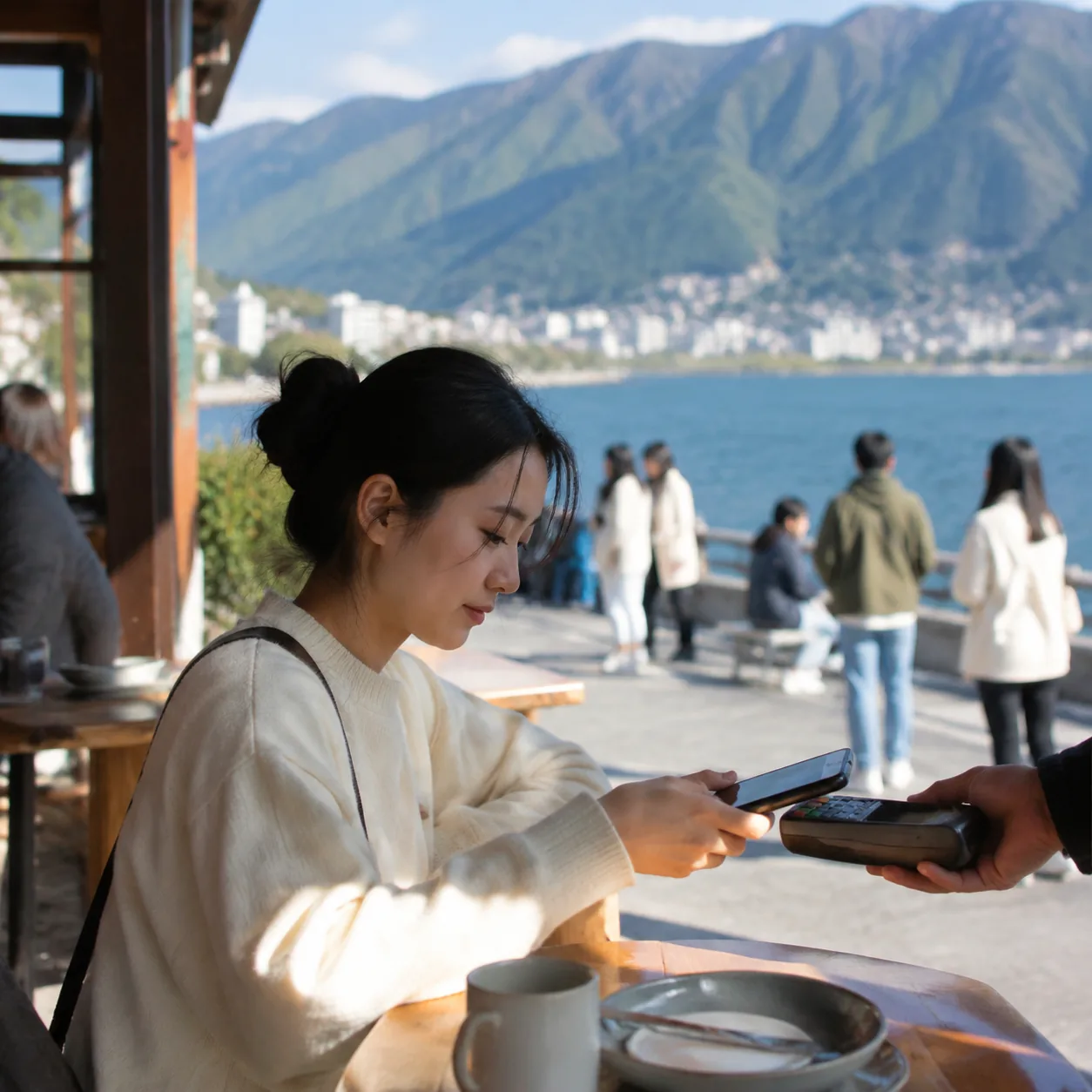
While eating, I heard two locals at the next table discussing this year’s rain. They said that on certain days the clouds hung so low that Erhai looked covered by gray cloth, and even the boats seemed unwilling to go out. I could not understand every word of the dialect, but I understood the intimacy in their tone. For them, weather was not background; it was something specific that shaped mood, vegetable prices, and whether laundry could dry. For the first time, I felt that scenery becomes thicker inside local sentences.
In the afternoon, I rented a bicycle without deciding where I had to reach. The shop owner reminded me that some sections were better walked than ridden, and that I should not compete with other people’s speed. I nodded, though a little tourist-like competitiveness remained in me. I still thought riding farther meant doing the trip properly. Once on the road, however, the rhythm by the lake slowly wore that idea down. Passing reeds, I stopped to hear them rub together; passing a low stone wall, I stopped to touch its sun-warmed surface; passing a cat asleep in the shade, I did not have the heart to ring my bell.
One stretch ran close to the water, and the side wind forced me to slow down. It was not an obstacle; it felt more like a reminder. The wind returned my body to the present: my arms working, the backpack pressing my shoulders, sweat on my forehead, the pedals turning again and again under my feet. In the city, I often become only a head, switching quickly between screens and tasks. The wind beside Erhai put me back together as a whole person, making fatigue, thirst, comfort, and quiet all worth noticing.
I stopped for a long time at a small pier. There was no elaborate decoration, only a few wooden boats, several ropes, and posts darkened by water. A child crouched by the shore watching tiny fish, while his mother adjusted her hat nearby. They barely spoke. Water tapped the stones with a small sound, repeating itself patiently. I suddenly understood that slow travel is not wasting time; it is returning time to details that usually go unseen.
Before evening, I reached an open stretch of view. Cangshan showed several dark folds behind the clouds, and Erhai looked like a mirror that was breathing. Many people stopped at the same angle to take photos. I took one too, but I did not check it immediately. In that moment, the photo mattered less. What mattered was knowing why I stood there: not to prove that I had arrived, but to briefly learn not to interrupt the conversation among wind, light, and water.
After dinner, I returned to the guesthouse, where the courtyard lights came on one by one. Someone wrote postcards at the shared table, someone hung damp clothes on bamboo poles, and someone quietly discussed whether to visit Xizhou the next day. I made tea and sat by the door, listening as the wind gathered again. The afternoon’s stillness had not disappeared. It had simply changed shape, hiding in the steam at the rim of the cup, a distant dog bark, and the soft opening and closing of the wooden gate.
The next day, I went to Xizhou. Many people first think of rice fields, old corner buildings, and local baba pancakes, but what I remembered was a shoe repair stall. The repairman sat in a narrow strip of shade, his hands steady, the awl making a tiny sound as it passed through a sole. Groups of travelers moved past, phones raised as they searched for photogenic doorways. He did not look up, nor did he seem disturbed. I envied that steadiness, as if he did not need the gaze of visitors to confirm the worth of his life.
By the rice fields in the afternoon, the wind paused again. The rice leaves stopped moving, and the white walls in the distance looked freshly washed by stillness. I stood beside the ridge and heard my own breathing. There was no drama in that moment, no grand revelation, only a plain lightness: travel did not have to make me a more impressive person. It could simply allow me, for a while, to stop arguing with myself.
Before leaving Dali, I returned to the shore of Erhai for a while. The morning water was brighter than it had been on previous days, and fewer people passed by. I did not write a summary or define the trip. I simply tied my shoes, finished the last half bottle of water, and watched a bird fly low over the surface. It flew close to the water, yet with certainty, as if it fully trusted its direction. In that moment, I felt that what I carried away from Erhai was not scenery, but the courage to slow down.
On the train afterward, I looked through my photos and realized that my favorites were not the most polished ones: a lake view partly blocked by branches, a blurred cat, white steam rising from the clay-pot fish, the leaf that the wind pushed away beside the bench. They did not look like postcards, but they felt like time I had actually inhabited. Dali did not solve anything for me. It simply showed me that life may hold another rhythm, one not driven by urgency, but slowly revealed in the spaces where the wind rests.