顔譜描き体験:台詞より先に顔が語る理由を初めて理解した
- Folk Art
Before coming to China, I had of course seen images of Peking opera face painting. The strong reds, blacks, whites, and blues, combined with symmetrical and exaggerated designs, create immediate visual impact even for someone who does not understand opera. But to be honest, I used to think of it mostly as a kind of theatrical makeup whose main purpose was to look striking from far away. Only when I actually joined a face-painting workshop and applied color bit by bit over a prepared outline did I realize that face painting is much more than making a face look beautiful or imposing. Its real fascination lies in this: before a character even speaks, the audience has already been guided by the face toward a sense of personality, moral position, and dramatic presence.
At the start of the class, the instructor did not rush us into painting. Instead, she placed several face-painting designs of different character types in front of us and explained the impressions traditionally associated with red, black, and white, and why certain lines had to be drawn with such decisiveness and symmetry. Her explanation was not rigid. It felt more like a reminder that these designs are not decorative patterns invented at random, but a visual language that audiences have learned to read over a long time. Every curve and every patch of color carries dramatic logic. Hearing this, I immediately realized that I had been looking at opera face painting far too superficially.
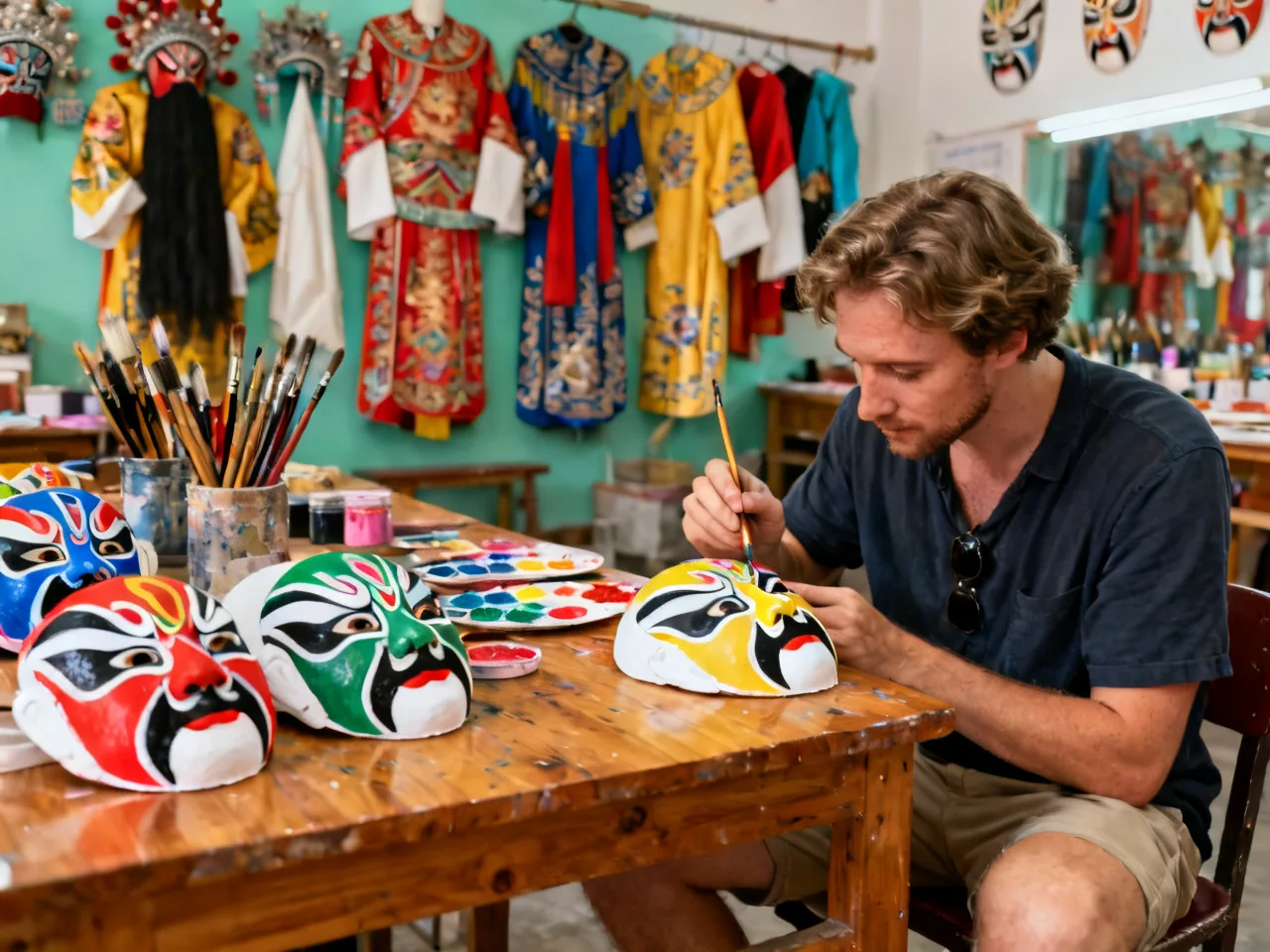
I painted a relatively classic face outline, beginning with the base color and then defining the forehead, eye sockets, nose bridge, and cheeks. When I watched the teacher demonstrate, it did not look especially complicated. But when it was my turn, my hand instantly became tense. This was different from ordinary painting, because it demanded not only correct color, but lines that carried character. If the edges trembled, the whole face looked weak. If the left and right sides lost balance, the force of the image disappeared at once. I rarely become so focused over such a small brush in a travel activity, but that day I found myself holding my breath again and again.
The most interesting part was that as the pattern gradually became complete, I could clearly feel the face taking shape. At first it was only areas of color. Then the gaze emerged, the forehead pattern fixed the character’s force, and the lines around the nose and mouth added a sense of decisiveness. In other words, the face painting does not suddenly gain life only at the end. Its theatricality grows during the process itself. For someone like me, who is not deeply familiar with the full system of Chinese opera, this was incredibly helpful, because for the first time I understood character recognition not through written explanation, but through my own hands.
This also made me think of traditional visual culture in Mexico. As someone from Mexico, I naturally think of festival masks, symbolic figures in religious processions, and the painted imagery associated with Día de los Muertos. We too are used to using a face, a mask, or a group of colors to establish emotion before a figure even fully appears. But Chinese opera face painting feels more regulated and more systematic to me. Many Mexican festive visual symbols emphasize emotional intensity, vitality, and public celebration, while Chinese opera face painting functions more like a highly coded theatrical reading system. When the audience sees this face, they do not only feel excitement; they are guided toward expectations about the role type and dramatic position.
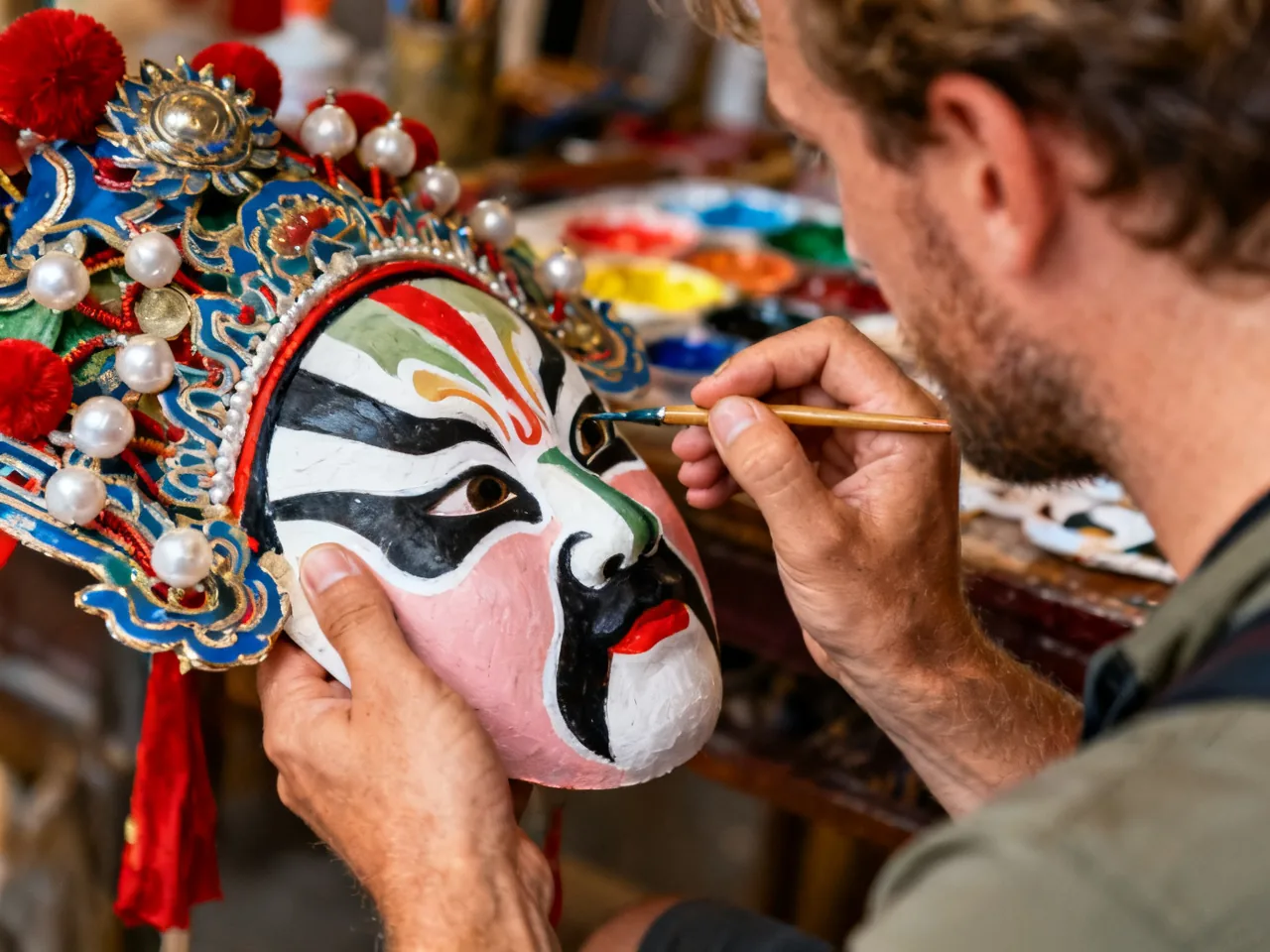
Later, the instructor asked us to compare several finished and unfinished designs together. Seen up close, I finally understood how important symmetry is in this art. It is not about making both sides mechanically identical, but about stabilizing the overall force of the face. Some traces of the hand can remain, but the central axis, the power around the eyes, and the relationship among color blocks must be clear. She also explained that a real painted face on a performer is not exactly the same as a workshop version on a board, because stage performance must also consider the actor’s features, lighting, and movement. That only made me admire the system more. It is not static decoration; it is living visual design in service of performance.
When the workshop ended, I looked at the face painting I had finished and felt more and more that it was not a light tourist souvenir. It was more like a key. The next time I encounter Chinese opera characters, I will not simply think, “the colors are bright.” I will start asking: what is this face trying to tell me first? Where does its force come from? Why must this line move in exactly this way? For me, that is what a good cultural experience does. It is not one-time consumption, but training that changes how you look from then on.
If a foreign friend visiting China for the first time asked me which folk-art experience most quickly conveys the weight of the phrase “visual language,” I would strongly recommend opera face painting. It has an appearance vivid enough to attract anyone instantly, yet it also has rules deep enough to make you humble the longer you paint. As someone from Mexico, where festive imagery is often intense and exuberant, I thought I would read this strong style easily. Instead, Chinese face painting taught me something else: truly mature exaggeration is never a chaotic pile of elements. Every line knows exactly why it exists.