刺繍体験:『静けさ』にもこんなに強い存在感があると初めて知った
- Folk Art
Before this, my impression of embroidery had been somewhat superficial. As a foreigner from India, I already knew how spectacular needlework decoration could be: metallic threads, mirrors, bright colors, and dense patterns on festive clothing can create a powerful presence from a distance. So when I first heard in China that I could join an embroidery workshop, I simply thought, this should be beautiful. But once I actually sat in front of an embroidery frame and watched the instructor separate a fine silk thread, thread the needle, lower it, and gently pull it through, I realized that what first captures you in Chinese embroidery is not spectacle, but a remarkably restrained and steady quietness. Its beauty does not rush toward you. It asks you to come closer and slow down before it reveals itself.
Once I sat down, I realized that fineness is not the hardest part of this craft
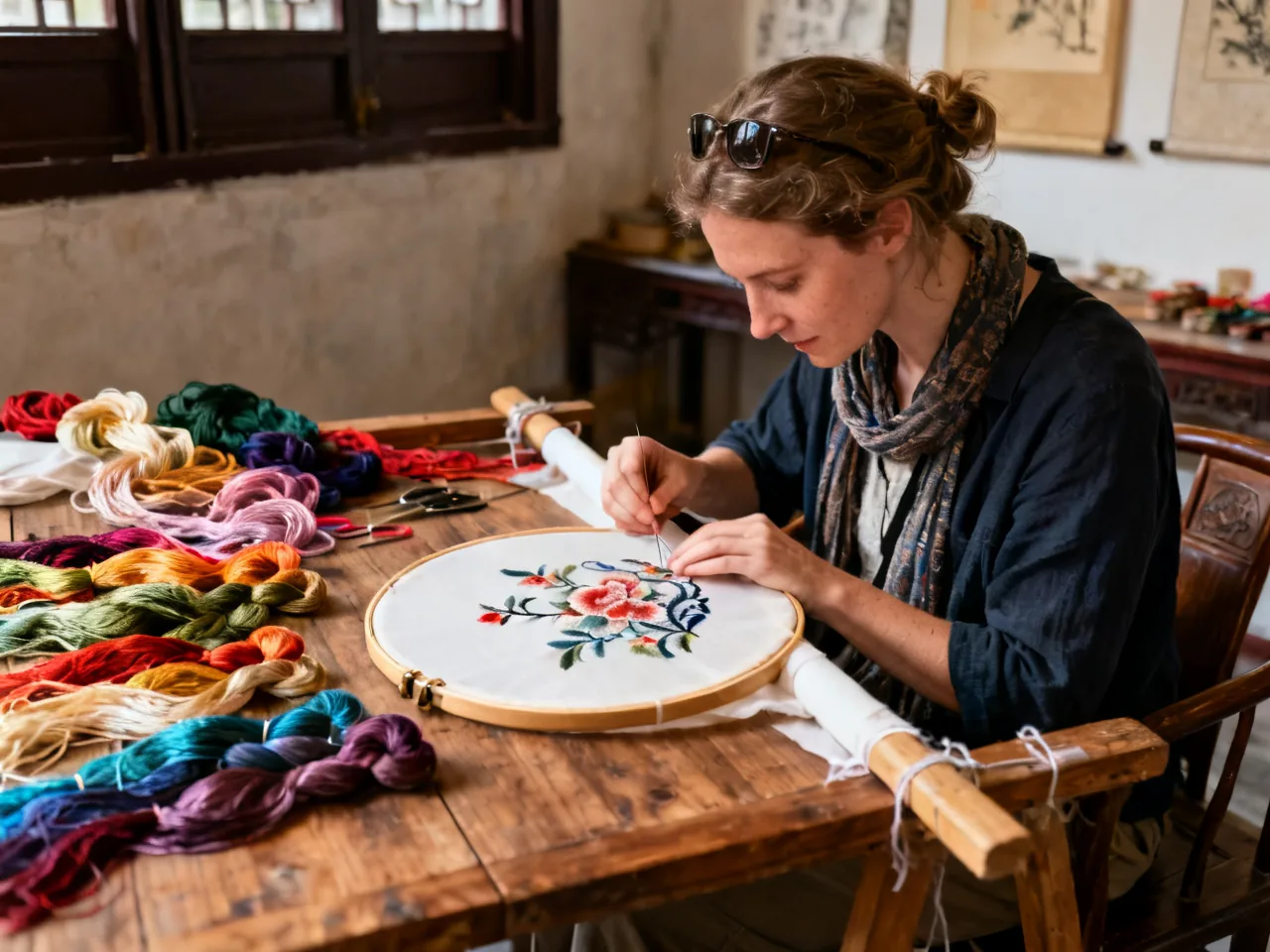
On the table were hoops, base fabric, pattern guides, tiny scissors, and bundles of silk threads in colors so close to each other that I could barely distinguish them. The instructor did not ask me to start stitching petals immediately. Instead, she showed me a small finished sample and asked me to study it. She told me to look from the side, not only to judge whether the motif was recognizable, but to notice the direction of the threads, the shifting sheen, whether the edges felt hard, and whether the colors broke too suddenly. Those few minutes mattered a lot to me, because for the first time I understood that embroidery is not simply about sewing a pattern onto cloth. It is more like rearranging light on a surface, letting thread replace paint in order to express shade, layering, and air.
When I finally began, frustration arrived faster than I expected. The instructor chose a relatively basic floral-and-leaf motif for me. It was not large, and the stitch technique was not the most complex, yet the moment I placed my first stitch I knew I was in trouble. If I pulled the thread too tight, the fabric puckered. If I left it too loose, it floated. If the stitch was slightly longer, the surface looked rough. If it was shorter, I lost my sense of direction. What was even harder was that embroidery does not allow the kind of broad correction that painting sometimes does. It demands that your patience be valid in every single stitch. The feeling was unusual, as if I were not making an image but negotiating with time.
What impressed me most was the way it makes color feel as natural as breathing
When the instructor demonstrated the leaf section, I became quiet almost immediately. She did not complete it with a single green thread. Instead, she took out several shades, some darker, some lighter, some cooler, some warmer, and layered them gradually into one another. From a distance the leaf was not dramatic. In fact, it looked rather restrained. But once I leaned closer, I saw that it was not flat at all. It had turning points, moisture, and the faint undulation of something just touched by wind. At that moment I suddenly understood why people often say Chinese embroidery has a quality close to painting. It is not painting, of course, but it can produce something like gradation and wash through needle and thread, while also carrying the unique sheen of silk.
I also noticed something else that fascinated me: this craft does not hurry to show off. Many folk arts release their force at first glance through strong color, dramatic shape, or obvious festive atmosphere. Embroidery often does the opposite. It asks you to pause first and then discover slowly. You see the whole motif, then begin to notice the direction of the stitches, and only later recognize the nearly silent transitions between one color and another. It feels a bit like a sentence spoken softly. The voice is not loud, but that is precisely why you listen more carefully.
It reminded me of Indian embroidery, yet the direction of beauty feels very different
Because I come from India, I naturally compare Chinese embroidery with traditions I know from home. In many forms of Indian embroidery, the first impression is warmth and exuberance. Whether in clothing, ceremonial textiles, or regional needlework traditions, there is often a greater willingness to use high-contrast colors, repeated and full-bodied motifs, and even metallic threads, sequins, or mirrors so that the fabric speaks actively in the light. That beauty is direct and festive. It is often tied to movement of the body, wedding scenes, public celebrations, and communal atmosphere.
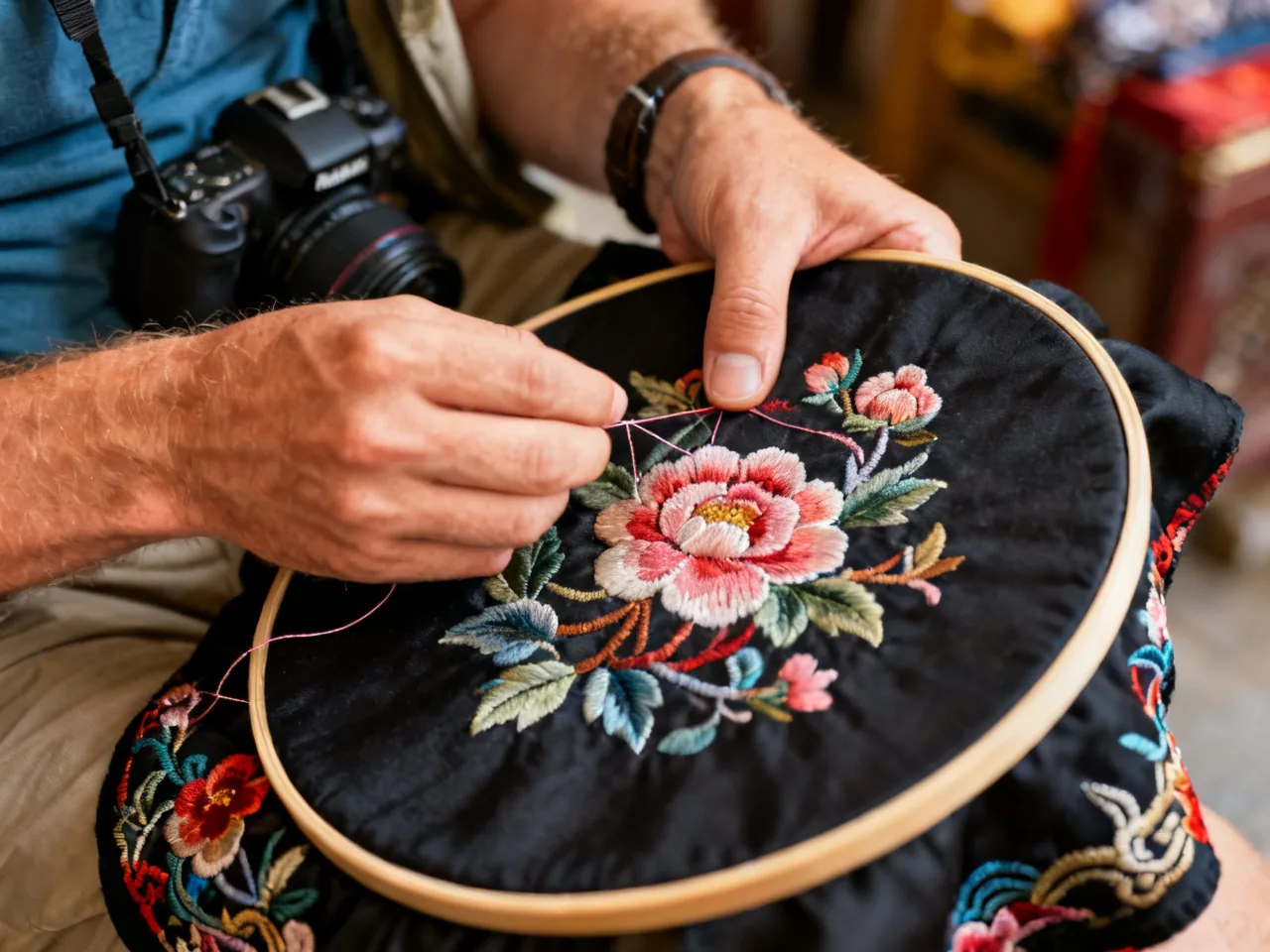
Chinese embroidery, by contrast, feels more inward to me. It can certainly be sumptuous, but its richness often does not expand outward. Instead, it sinks into detail. You notice how the edge of a petal gradually becomes lighter, how the direction of stitches makes a bird’s feathers feel soft, or how water appears calm because the threads are laid in a particular order. In other words, Indian embroidery often makes me feel enthusiasm first, while Chinese embroidery more readily makes me feel measure. Both are moving, but one resembles music in a celebration, while the other feels more like a leaf by a window touched by light.
If you encounter embroidery while traveling, I strongly recommend finding a way to see it up close
Many people make a very natural mistake when looking at embroidery: they stand too far away and admire it only as a finished image. But the strongest lesson I took from this workshop is that embroidery must not be seen only from a distance. You should come closer, perhaps shift your angle, and let the silk catch the light. Only then do you realize that what looked like a small shadow may actually be the result of many stitch directions working together, and what seemed like a naturally melting color transition may hide meticulous layered stitching underneath. If you can watch an instructor make even a few stitches in person, the effect becomes even clearer, because you immediately understand that this quietness was not achieved easily.
If you have the chance to try it yourself, I would strongly recommend it. Even if you finish only a tiny leaf, and even if your stitches remain a bit crooked, you will immediately understand why this craft deserves respect. When we travel, we are often drawn to things that are large: great buildings, major performances, grand festivals. Embroidery reminded me that culture also contains a different kind of force, one that comes from extremely small acts of control. It does not make noise, yet it stays with you for a very long time.
Why this embroidery experience will stay in my travel memory
When I left the workshop, what I carried away was not only a small practice cloth. I felt that I was carrying a new way of looking. I realized that fineness is not merely a technical adjective. It can also be an aesthetic attitude, a quiet resistance to speed, and a way of placing thought slowly into surface. For someone like me, coming from India and more accustomed to vivid and festive needlework traditions, the most precious thing about Chinese embroidery was precisely this: it showed me another kind of beauty that can fully exist—one that relies not on density or noise, but on patience, restraint, and a light that only appears when you come close.