デジタル人民元がやってきた、外国人観光客は結局どう使う?
You’ve probably heard the term “e-CNY” (digital yuan) floating around, but once you’re actually in China, staring at your phone — WeChat Pay works, Alipay works, so what exactly is this e-CNY thing? How is it different? Do you even need it?
Don’t worry — let me sort it out for you.
First Things First: E-CNY Is Not “Another Alipay”
A lot of people assume e-CNY is just another payment app. It’s not. It’s a legal digital currency issued by the People’s Bank of China, carrying the same status as the paper cash in your wallet — just in digital form.
What does that mean in practice? Merchants cannot legally refuse it. In theory, any place that accepts RMB should accept e-CNY. WeChat Pay and Alipay, on the other hand, are private company products — a merchant can say “sorry, we don’t support that” and it’s perfectly legal.
Your Questions, Answered One by One
Honestly, if you’ve already linked an international credit card to WeChat or Alipay, that covers most daily spending. But there are two scenarios where you’ll be glad you set up e-CNY:
Scenario 1: Metro top-up machines, certain vending machines, government service counters — these sometimes only accept e-CNY and cash, not third-party payment apps. By late 2025, all Beijing metro gates support e-CNY QR code entry, so you don’t even need to buy a transit card.
Scenario 2: Your Visa or Mastercard occasionally gets “swallowed” by Alipay — payment failures, risk control blocks, or hitting the spending cap. That’s when your e-CNY wallet becomes your Plan B, since it runs on a completely different clearing channel.
No Chinese bank card needed. This is the single most tourist-friendly thing about e-CNY.
You need exactly three things:
- A phone with internet access (iOS or Android both work)
- Your passport
- A foreign bank card (Visa, Mastercard, or JCB)
The whole process takes about five minutes:
Download the “数字人民币” app (search “e-CNY” in the China App Store or Android stores) → select “Foreign User Registration” → scan your passport → link your foreign bank card → top up → done.
One gotcha to watch out for: don’t just randomly pick the operating bank during registration. Choose Bank of China or BoCom (Bank of Communications) — these two have the best compatibility with foreign cards. Pick another bank and you might get repeated errors when linking your card.
Don’t load too much at once. An unverified e-CNY wallet (which is most likely what you’ll have) has limits: max 2,000 yuan per transaction, 10,000 yuan wallet balance cap, and 5,000 yuan daily cumulative limit.
For a trip of about a week, loading 1,000–2,000 yuan is a comfortable range. Top up again when you run out — it’s instant.
What about leftover money? Before you leave, just tap “withdraw to foreign bank card” in the app — it takes 2–3 business days. No need to queue at the airport currency exchange counter.
Same as WeChat and Alipay — show your payment QR code, let the merchant scan you.
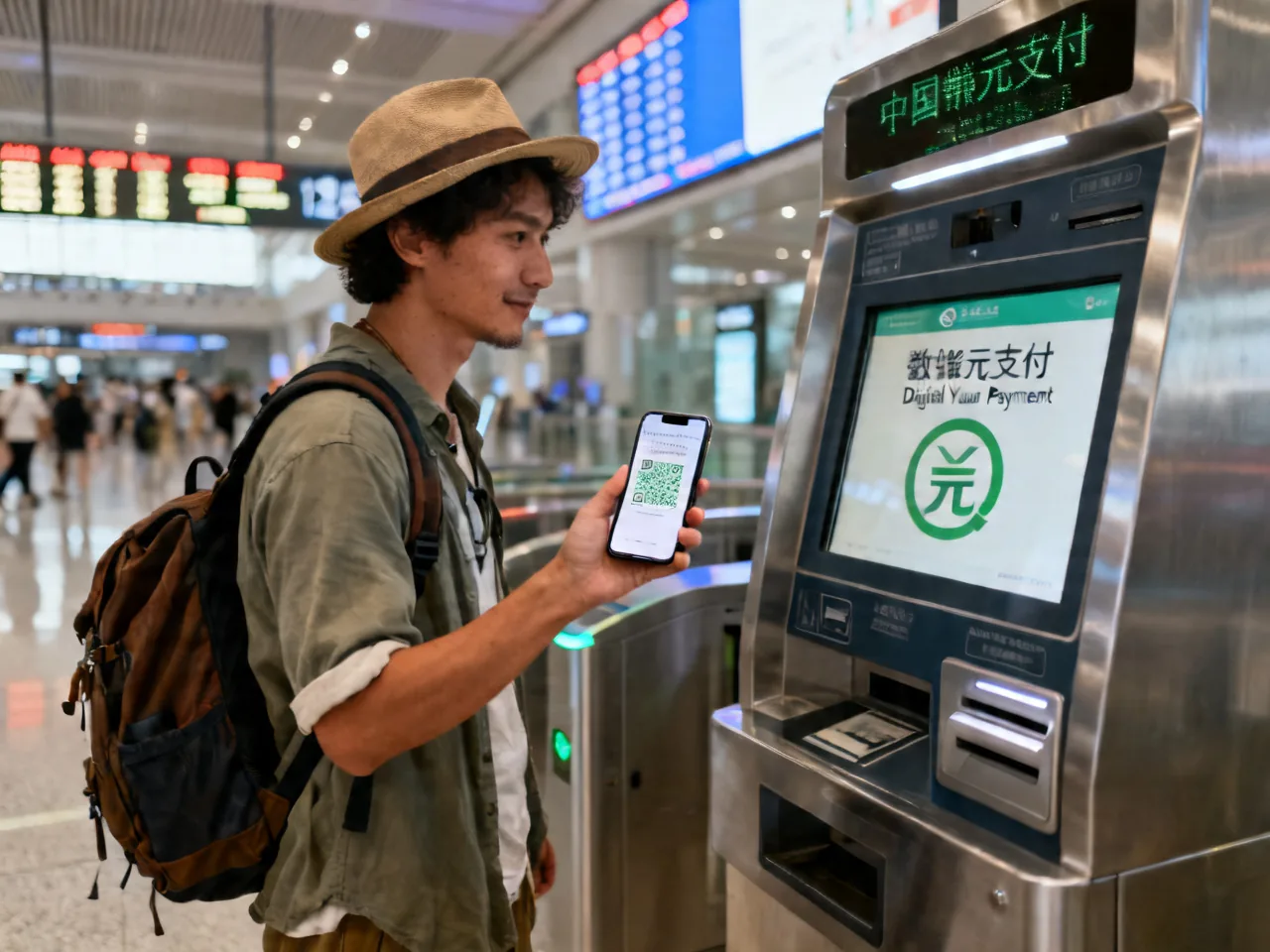
Or the other way around — you scan the merchant’s QR code. On the e-CNY app home screen, swipe up for your payment code, swipe down for the scanner. Dead simple.
One handy feature most people don’t know about: dual offline payment. Even when neither you nor the merchant has internet, you can tap phones (NFC) to complete a transaction. The list of supported phone models is still limited, but if you’re using a Huawei or certain Xiaomi models, this is a lifesaver at scenic spots with poor signal.
How Does It Work Alongside WeChat and Alipay? No Conflicts
You can absolutely have all three installed.
In fact, both WeChat and Alipay now have e-CNY payment options built in. When paying via WeChat, select “Digital RMB” and the money comes from your e-CNY wallet instead of your WeChat balance or linked bank card. This means you don’t even need to open the e-CNY app — you can spend your e-CNY right from the WeChat interface.
So the best strategy is: use WeChat/Alipay as your primary (widest merchant coverage), keep e-CNY as your backup and for special scenarios.
Real Pitfalls — Know Them Before You Go
Exchange rate fluctuation: The rate for each top-up is quoted in real-time by the operating bank, and it differs from the mid-market rate you see on Google. Avoid frequent small top-ups — loading more each time is actually more economical since each transaction has a spread.
App language: The e-CNY app has an English interface, but translation quality is inconsistent — some sub-pages randomly revert to Chinese. Don’t panic; the core functions (top-up, pay, receive) are accurately translated.
Customer service: If something goes wrong, in-app support is essentially Chinese-only. Your best bet is to visit a physical Bank of China branch — they usually have English-speaking staff who can help.
One last thing: don’t stress about payments when visiting China. WeChat/Alipay + e-CNY + a bit of cash — with these three legs, you’ll almost never hit a “can’t pay” situation. E-CNY isn’t mandatory, but it’s the ace up your sleeve that keeps you relaxed.
Related Reads
- Alipay & WeChat Pay Guide for Foreign Visitors
- WeChat Pay Setup for Foreign Visitors
- Alipay Foreign Card Binding Walkthrough
- Daily Mobile Payment Tips in China
- 10-Day East China Five-City Loop