外国人が中国で現金を拒否されたらどうする?
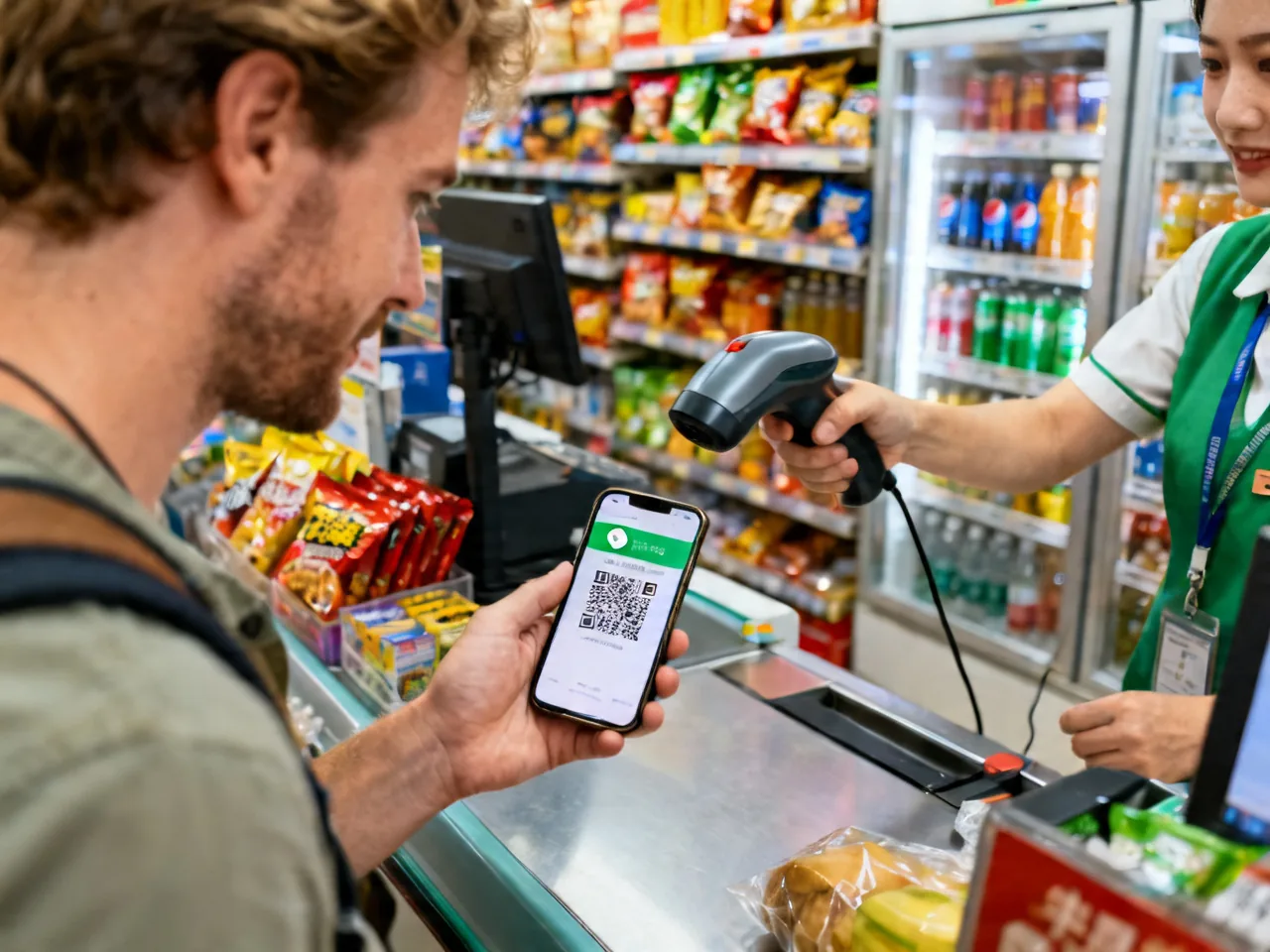
You’re standing at a convenience store counter, holding out a crisp 100 yuan note for a bottle of water. The cashier waves you off and points at a QR code. “Scan,” she says. You stare at the note in your hand, then back at her. This is real money — legal tender — and she won’t take it. Welcome to China’s mobile payment reality. It’s not personal, but it is incredibly frustrating when you’re jet-lagged, thirsty, and cashless in the digital sense.
Let’s get one thing straight: Chinese law says cash is legal tender and no business can refuse it. The People’s Bank of China has reinforced this rule multiple times since 2023. But reality on the ground is different. Many shops haven’t handled paper money in years. Their cash drawers are empty. The staff genuinely might not have change for your 100 yuan note. Arguing about the law won’t get you that bottle of water — practical solutions will.
Scenario 1: The Convenience Store
You grab snacks at a FamilyMart, 7-Eleven, or Meiyijia and get told “no cash.” This is the most common scenario and, fortunately, the easiest to fix.
Option 1: Pay with WeChat Pay or Alipay linked to your foreign card. If you haven’t set this up yet, do it now. In WeChat, go to Me → Services → Wallet → Bank Cards → Add Bank Card → International Card. You can link Visa, Mastercard, or JCB credit cards. For Alipay, tap Me → Bank Cards → Add Card and select your international card. Once linked, you scan QR codes like a local. The fee is roughly 3%, but that’s a small price for convenience.
Option 2: Break your big bills first. If you’re carrying 100 yuan notes, pop into a nearby bank — Bank of China and ICBC branches are everywhere — and ask to break them into 10s and 20s. Small shops are far more willing to accept cash when they don’t need to make change. Just say “wǒ xiǎng huàn líng qián” (我想换零钱) at the counter.
Option 3: Politely insist. Show the cashier this phrase on your phone’s translator: “根据中国法律,商家不能拒收人民币现金” (According to Chinese law, businesses cannot refuse RMB cash). In most cases, a manager will be called over and they’ll find a way to accept your money. It’s not the smoothest move, but it works.
Scenario 2: The Taxi Driver Who Only Wants a Scan
You land at the airport, grab a taxi, arrive at your hotel, and the meter reads 58 yuan. You hand over 100 yuan. The driver frowns and says he has no change. This happens a lot on late-night arrivals.
Best move: Book a ride-hailing car instead. Download DiDi (滴滴出行), register with your international phone number, and link your foreign card. DiDi accepts Visa and Mastercard, charges your card automatically, and is usually cheaper than a metered taxi. At the airport, follow signs to the ride-hailing pickup zone (网约车上车点).
Backup plan: If you’re already in the cab and the driver genuinely can’t make change, suggest stopping at a convenience store so you can break your 100 yuan note with a small purchase. Or if you’re traveling with someone who has WeChat Pay, have them scan and pay the driver while you reimburse them in cash. It’s a clunky workaround, but it gets the job done.
Scenario 3: The Street Food Vendor
You smell malatang on a Chengdu side street and approach the vendor. She points at a faded QR code sign. A bowl costs 15 yuan. You hold out a 20 yuan note. She shakes her head. This is the most heartbreaking scenario because street food is exactly what you came for, and street vendors are often the most reluctant to handle cash.
Pro tip: The fix here is simple — have exact change ready. If you hand over a 10 and a 5 for that 15 yuan bowl, most vendors will take it without hesitation. They’re not refusing cash itself; they’re refusing the hassle of making change. Also, most snack streets have small shops nearby where you can break a big note by buying fruit or drinks first, then hit the food stalls with your pockets full of small bills.

A Few More Things You Should Know
About e-CNY (Digital Yuan): This is China’s central bank digital currency, now available in many major cities. Download the e-CNY app (数字人民币), register with your passport, and load it with cash at participating bank ATMs. The big advantage? Zero transaction fees, and it’s accepted almost everywhere WeChat Pay and Alipay work. If you’re in Beijing, Shanghai, Shenzhen, Chengdu, or Suzhou, it’s worth setting up.
About tapping your Visa or Mastercard directly: Big malls, chain hotels, and Starbucks usually have POS terminals that accept foreign cards for tap-to-pay. But small shops and street stalls? Don’t count on it. Treat contactless card payments as a backup for larger establishments, not your primary strategy.
What if nothing works? Find a young person nearby and ask for help. Most young Chinese people speak some English and are genuinely happy to help foreign visitors. Ask them to pay via WeChat on your behalf, and hand them the equivalent cash. This might sound awkward, but in China, this kind of mutual help is completely normal and most people will assist you with a smile.
Quick-Reference Cheat Sheet
| Situation | Best Fix | Backup |
|---|---|---|
| Store refuses cash | WeChat/Alipay with foreign card | Break bills first |
| Taxi has no change | Use DiDi app | Break bills at nearby store |
| Street vendor won’t take cash | Have exact change | Ask someone to pay for you |
| Shopping at malls | Tap foreign card | WeChat/Alipay |
Must-Have Apps:
- Payment + messaging + translation
- Payment + transit + services
- Ride-hailing
- Zero-fee payments
Emergency Phrases:
- “可以收现金吗?” — Kěyǐ shōu xiànjīn ma? — Can you accept cash?
- “我想换零钱” — Wǒ xiǎng huàn líng qián — I’d like to get change
- “能帮我扫一下吗?” — Néng bāng wǒ sǎo yíxià ma? — Can you help me scan?
Related Reads
- Alipay & WeChat Pay Guide for Foreign Visitors
- WeChat Pay Setup for Foreign Visitors
- Alipay Foreign Card Binding Walkthrough
- Daily Mobile Payment Tips in China
- 10-Day East China Five-City Loop