配車アプリを呼ぶ前に乗車地点をもう一度確認すれば、無駄に歩かずに済む
On a rainy Friday evening in November 2024, I stood under the canopy of the west square at Hangzhou East Railway Station with a light gray suitcase in one hand and my phone in the other, keeping my passport pouch pressed inside my coat pocket. Rainwater fell from the roof edge in thin lines, and the ground shone like a cracked mirror under people’s shoes. I had just arrived by high-speed rail from Shanghai and was heading to meet my friend Ajie near Hubin. The ride-hailing app already showed that the driver was 1.2 kilometers away, yet I felt uneasy because I was near the west entrance while the app had automatically placed the pickup point at the east square ride-hailing temporary stopping area.
In Europe I had been used to the simple idea of standing by a curb and calling a car, but in China I learned that roads around high-speed railway stations and large malls cannot always be used for casual stopping. Taxis, app-based cars, buses, private cars, delivery scooters, and pedestrian routes each have their own lanes, and rain makes everyone’s patience thinner. My first instinct was to drag the location pin to where I stood, but the dense labels on the screen confused me: west square, east square, north arrivals, south entrance, P3 parking lot, ride-hailing area A, temporary stopping gate B. I thought that if the driver came nearby, we would eventually see each other, but that assumption soon cost me almost twenty extra minutes of walking.
The driver, Mr. Chen, sounded as if his words were being chopped apart by windshield wipers and horns. He asked, “Are you at the east square ride-hailing pickup point? I can only enter that side; cars can’t stop at the west square.” I looked down at my suitcase, and rain had already run down the handle onto the back of my hand. I asked whether he could circle around. He paused for two seconds and said, “If I circle over there, I have to queue again, and security may ask me to move. Check whether the app has pickup details; following the station signs to the east square may be faster.” I understood most of his Chinese, but the phrase “pickup details” took me a moment to process.
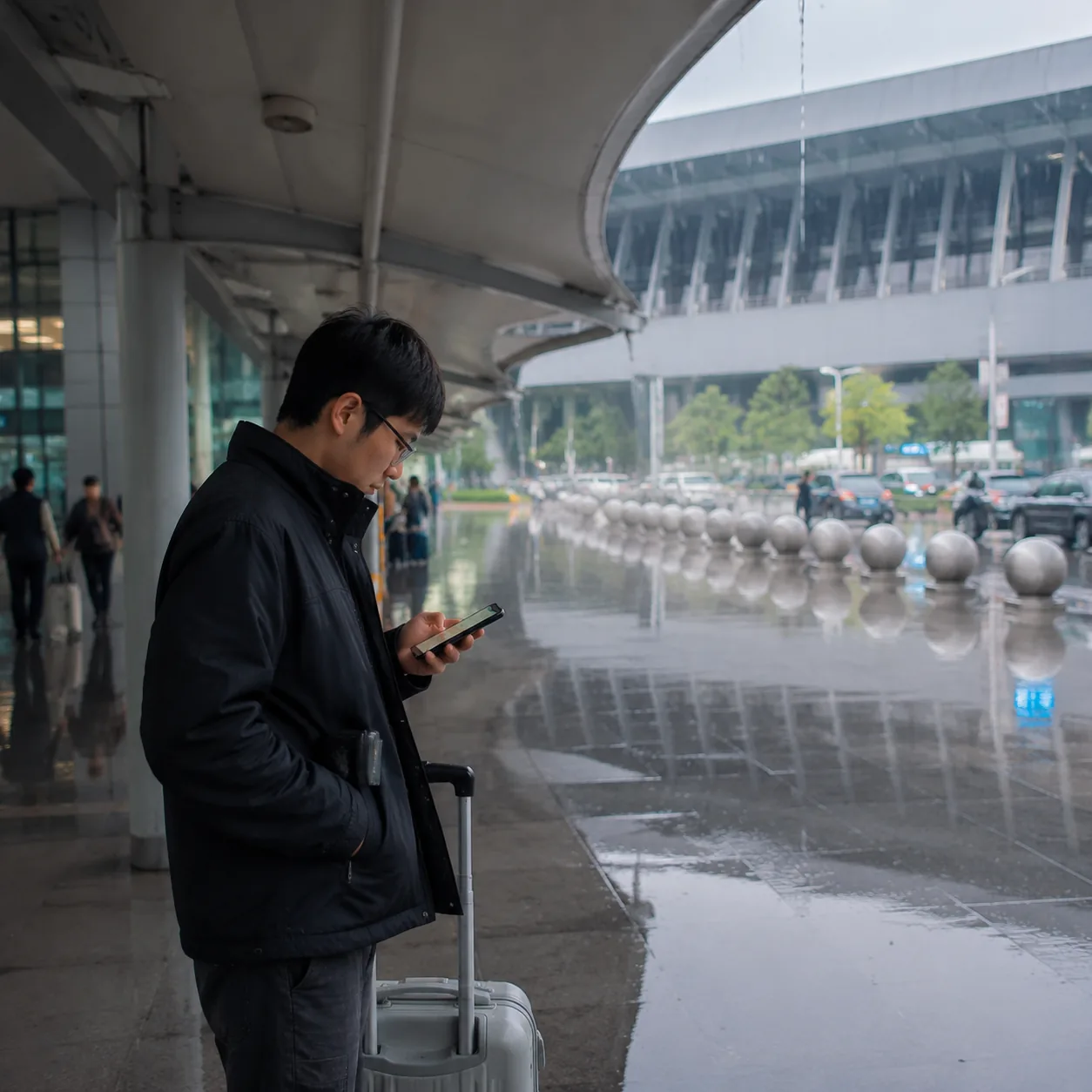
I opened the page and finally saw a small line under the pickup point: “Please follow the signs from the arrivals level to the east square ride-hailing area.” I had only watched the moving car icon and my blue dot without opening that instruction. Hangzhou East Railway Station felt like a folded sheet of paper, with ground level, underground passages, arrivals, and departures overlapping on the phone screen. Two points could look close on the map while the real route was separated by escalators, gates, railings, and driveways. I followed the crowd inside, passed a small hot-drink shop whose glass door was covered with mist, and reached a passage where a security guard in a fluorescent raincoat saw my hesitation. He pointed at the overhead sign and said, “Ride-hailing cars go forward and down the elevator to the east square. Don’t walk along the vehicle lane.”
That sentence saved me from a mistake. If I had walked in the straight-line direction shown on the map, I might have ended up beside a vehicle lane, blocked by railings, and then had to drag my suitcase back. The guard added, “There are many cars on rainy days. Drivers can’t stop for long, so confirm the exit number first.” Only then did I understand that hailing a ride is not just about confirming the destination; it is also about confirming the pickup level, exit, and whether a car can legally stop there. I sent Mr. Chen the app’s “East Square Ride-Hailing Area A” label and also sent a photo of the sign above me. He replied quickly, “Yes, go to row 3 in Area A. My plate ends in 62. Don’t rush into the lane when you see me; wait until the car stops.”
The walk toward the east square was not complicated, but rain, luggage, an unfamiliar language, and time pressure made every small choice feel heavier. The elevator entrance was crowded with passengers from high-speed trains: someone held flowers, someone pushed a stroller, and someone played voice messages through a phone speaker. When the elevator doors opened, the smell of wet umbrellas mixed with the steam from convenience-store snacks. I kept my suitcase close to my feet and checked my phone battery again while the driver’s car icon circled around. At that moment I realized that in Chinese cities, “very close to me” does not always mean “I can get into the car immediately,” especially near railway stations, airports, hospitals, and shopping malls where people and vehicles gather densely.
When I reached the ride-hailing area, the first things I saw were rows of yellow floor markings and railings, with “stop briefly and go” written on the ground. Several guards under the canopy reminded passengers not to cross the line while drivers moved forward slowly, their headlights stretching into long streaks in the rain. I stood at row 3 in Area A and sent Mr. Chen another location screenshot. An older woman beside me noticed me searching for license plates and said, “Don’t look only at the car color. There are too many white cars. Check the last four digits of the plate and the driver’s name.” She spoke casually, but it made me nervous because I had indeed remembered only “white sedan.” I opened the order again and read the plate, model, and driver’s surname before putting my phone back in my pocket.
When Mr. Chen’s car finally reached the canopy edge, I did not rush out immediately. I waited until he pulled within the yellow line, confirmed the final digits of the plate, and got in through the rear door. The car smelled faintly of lemon, with a packet of tissues and a small safety charm on the dashboard. After sitting down, I apologized for standing at the wrong square. He smiled and said, “It’s normal for visitors the first time. Even locals sometimes get it wrong. When you look at the map, check three things: whether the location is accurate, whether the level is correct, and whether the exit allows cars to stop.” That sentence was more practical than any travel tip because it came from a driver who worked daily in rain and traffic.
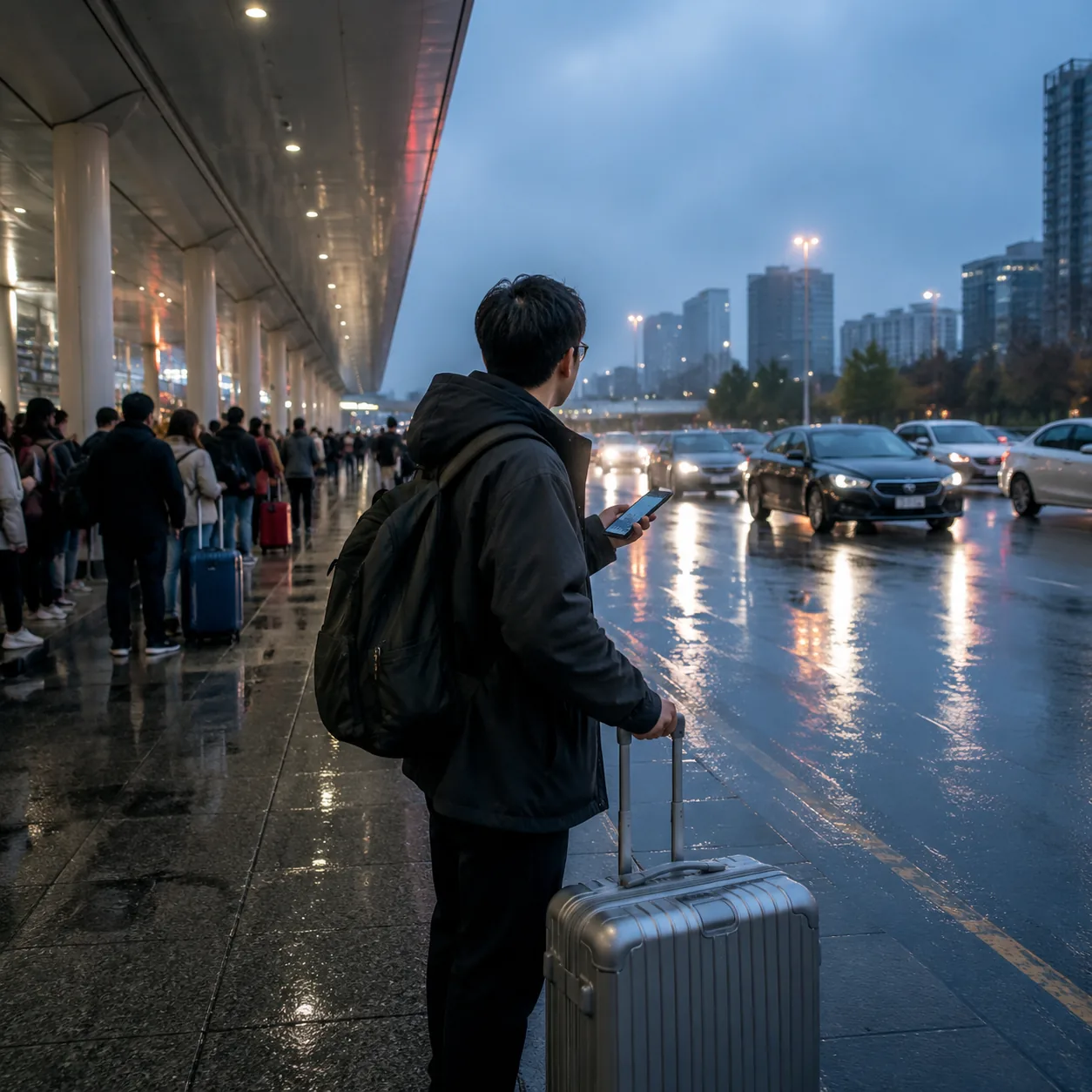
Traffic moved slowly, and the wipers kept clearing the windshield in steady strokes. Mr. Chen pointed toward the elevated road ahead and explained that many intersections near the station did not allow temporary stopping. If drivers pulled over casually, they could block traffic or be recorded by cameras. He was not complaining about passengers; he was explaining the reality behind the rules. A pickup spot that seems convenient may actually be a bus lane, a fire access road, a taxi queue, or the exit of an underground garage. If passengers focus only on saving themselves a few steps, drivers may face being moved on, having to circle, or even violating traffic rules. At that moment, “checking the pickup point once more” became concrete to me: it was not about troubling others, but about making the ride smoother for both sides.
Two weeks later, I encountered a similar situation in Hangzhou, this time at a lakeside shopping mall. That evening, I finished hotpot on the sixth floor with Ajie and his colleague Xiaotang. The rain outside was heavier than before, and the mall announcement reminded customers to watch for slippery floors. When we left the restaurant, the corridor was full of people holding umbrellas or waiting for cars. Ajie said, “Don’t place the order too quickly. This mall has three entrances, and drivers usually pick people up only at the north gate temporary stopping area.” I had already taken out my phone to enter the destination, but I paused when I heard him. Xiaotang added, “Also, there are two elevator groups from the sixth floor. One goes to the basement garage, and one goes to the outside plaza. If you choose the wrong one, you’ll make a long detour.”
This time I did not let the app decide automatically. I first stopped in front of the mall floor directory and checked the positions of the north gate, basement garage, metro corridor, and ride-hailing temporary stopping point. A security guard beside the directory was pushing pooled water away from the entrance with a mop. I asked in Chinese which gate was best for app-based rides. He did not simply say “downstairs”; he answered very specifically: “Take the escalator to the first floor, exit beside Uniqlo, turn right, and you’ll reach the north gate canopy. Drivers cannot enter the basement for app pickup. The north gate is safest.” I wrote those key points into my notes: first floor, beside Uniqlo, turn right, north gate canopy.
When I placed the order, I manually selected “North Gate Ride-Hailing Temporary Stopping Area” and added a note: “I am under the north gate canopy, near the Uniqlo exit.” Ajie nodded when he saw it and said this was clearer than sending only a map pin, because GPS inside malls often drifts and the blue dot may jump to the next street, an upstairs restaurant, or the underground parking lot. Xiaotang said she passed this mall every day on her commute, and the most common rainy-day problem was not failing to get a car. It was that both passenger and driver thought the other person was at “the gate,” while one was at the indoor entrance, one on the outer plaza, and one at the garage exit. Nobody was exactly wrong, yet they still could not meet.
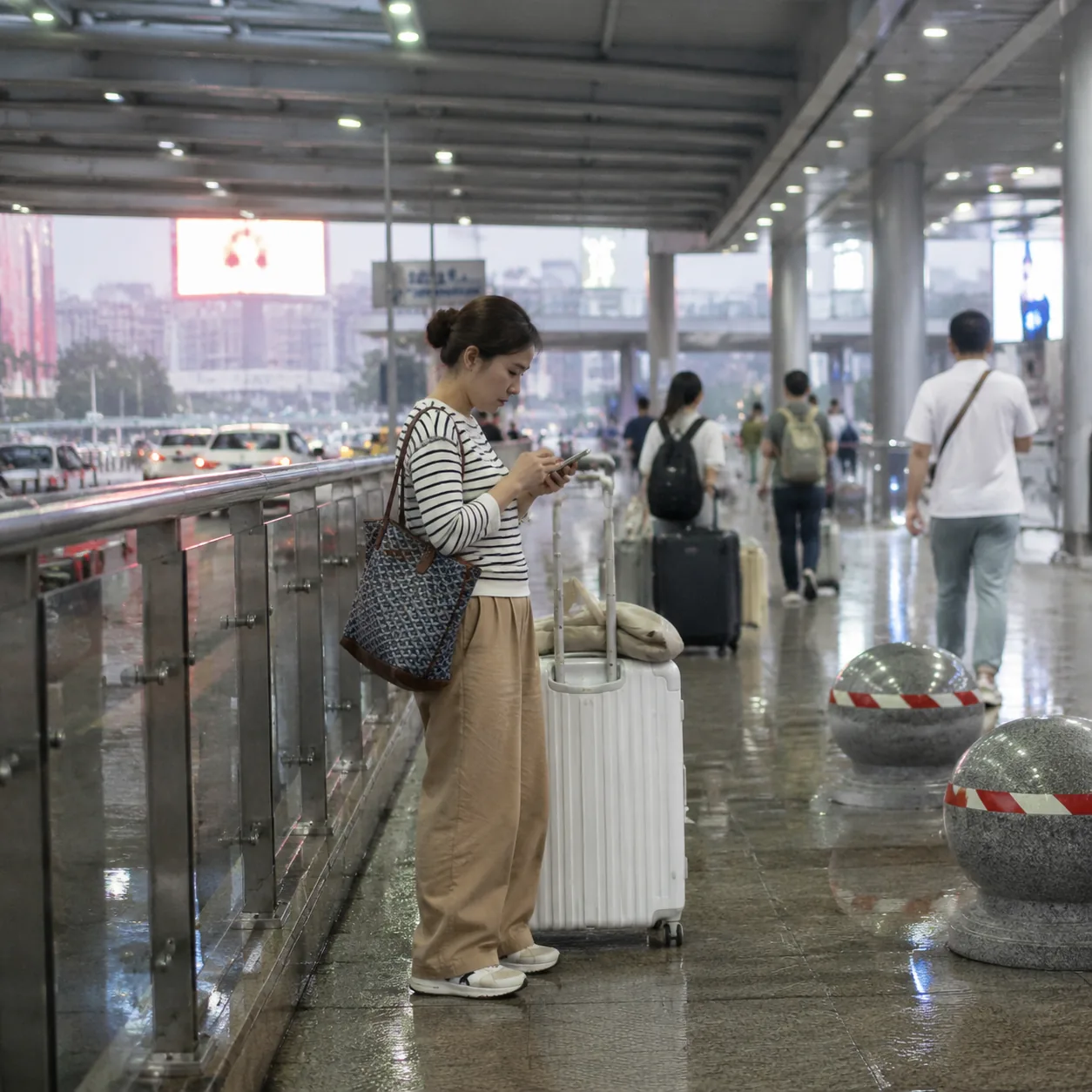
When we reached the north gate, more than a dozen people were already standing under the canopy. Some used shopping bags to keep items off the wet ground, some held newly bought teddy bears, and some watched license plates while protecting children. A mall guard gestured for everyone to stand behind the pillars and not crowd the curb. A yellow line marked the ground, and beyond it was the vehicle stopping zone. As soon as a car stopped, the car behind it would often honk. I suddenly remembered Mr. Chen’s advice to wait until the car had stopped, so I stepped farther back from the curb. When my car arrived, the driver lowered the window to confirm my name, and I checked the plate and driver profile before putting my luggage into the trunk.
On the way back that night, I organized the experience into my own sequence of checks. It is fine to look at the destination first, but before placing the order, it is more important to check whether the pickup point is realistically reachable. Then check the level, especially at stations, malls, hospitals, and office towers, because aboveground and underground routes may be completely different. Next check the exit name, and do not merely say “I’m at the gate.” Then check temporary stopping rules, because whether a car can approach matters more than straight-line distance on the map. Finally, check safety: on rainy days do not stand beside a traffic lane, do not cross railings to save seconds, and do not approach the door before the driver has fully stopped. These steps sound numerous, but after practice they take only a few dozen seconds.
I also gradually learned to use fewer vague words when communicating with drivers. In the past I would say “I’m here,” “I’m at the gate,” or “I’ll be there soon.” Those words made sense to me, but they gave the driver little location value. Now I say, “I’m at row 3 in East Square Area A,” “I’m under the north gate canopy near a certain brand’s exit,” or “I’m coming down from arrivals and need three more minutes.” If I do not know the route well, I take a photo that includes an exit number or sign, rather than a picture of my shoes and the ground. If the photo contains text, pillar numbers, store names, or a clearly colored entrance, the driver can judge much faster whether I am in the right place.
Ajie once joked that I had become more local than he was because before every ride I asked whether the car could stop there. I told him it was not excessive caution; it was a sense of urban space that I had learned as a foreigner in China. Many public buildings in Chinese cities are large in scale. A single station or mall may include several squares, multiple traffic lanes, layered passages, and separate management zones. The app is convenient, but it is not my legs, and it cannot judge for me which door is under construction, which road is flooded, or which exit has been temporarily blocked. Smooth travel comes from combining the app, on-site signs, security reminders, driver experience, and my own observation.
I also noticed that rainy weather magnifies every small mistake. A wet phone screen becomes less responsive, the driver’s voice is hard to hear through earphones, umbrellas block vision, suitcase wheels feel heavy in puddles, and emotions become impatient. The more this happens, the less I should rush forward by instinct. I first stand somewhere that does not block others, steady my umbrella, and then read the pickup details on the order page. If friends are with me, one person checks the directory, one contacts the driver, and one watches the luggage. Once the group divides tasks, a messy situation quickly becomes manageable.
For foreign friends who have just arrived in China, I use my own experience to remind them not to be afraid of asking security guards and not to feel embarrassed about sending detailed information to drivers. Most guards handle the same problem every day, so they know where cars can pick up passengers, where stopping is not allowed, and which passage has the least standing water on rainy days. Most drivers also want passengers to state their positions clearly because their time in a stopping zone is short, and circling around may take another ten minutes or more. Polite and specific communication reduces misunderstanding, such as: “Hello, I’m beside pillar 2 at the south gate, wearing a blue coat. I’ll wait until your car stops before getting in.” This is much more useful than repeatedly sending question marks.
When I think back to that rainy night at Hangzhou East Railway Station, what stays with me most is not how far I walked, but how several strangers’ reminders gradually broke the problem into smaller pieces. Mr. Chen reminded me to check the level and exit, the guard reminded me not to walk along the vehicle lane, the woman in the queue reminded me to check the plate, and my friends reminded me to confirm the mall entrance first. These reminders were not grand lessons, but they made my travel in China safer and less stressful. Since then, I have had far fewer awkward moments of being very close to a car but unable to find it, because I now treat the pickup point as part of the trip rather than a minor detail to handle after ordering.
To make the matter more specific, I understand “checking once more before hailing a ride” as five actions. Check the location to confirm that the blue dot is actually near you and not distorted by tall buildings or underground space. Check the level to know whether you are at arrivals, departures, the first floor, the basement, or a pedestrian bridge. Check the exit to replace “the gate” with a clear name or number. Check the stopping zone to judge whether the driver can stop legally, safely, and briefly. Check the people and the car by confirming the plate, driver information, and surrounding environment before getting in. These five actions require no special knowledge, only the willingness to pause for half a minute.
I enjoy the speed of Chinese cities, and I appreciate how mobile apps make many things easier, but the faster things move, the more valuable a little confirmation becomes. On rainy days, hailing a ride at a mall or high-speed railway station may seem like only a short walk from indoors to a car, but it actually connects building routes, traffic rules, site management, and personal safety. That night, when I finally sat inside the car with my wet suitcase and soaked shoe tips, I felt calm. I knew that the next time I faced rain, traffic, and complicated exits, I would not simply chase the little car icon on the map. I would first look up and check the real pickup point.