Пар у входа в супную в старом городе удержал меня раньше, чем ночные огни Лояна
01
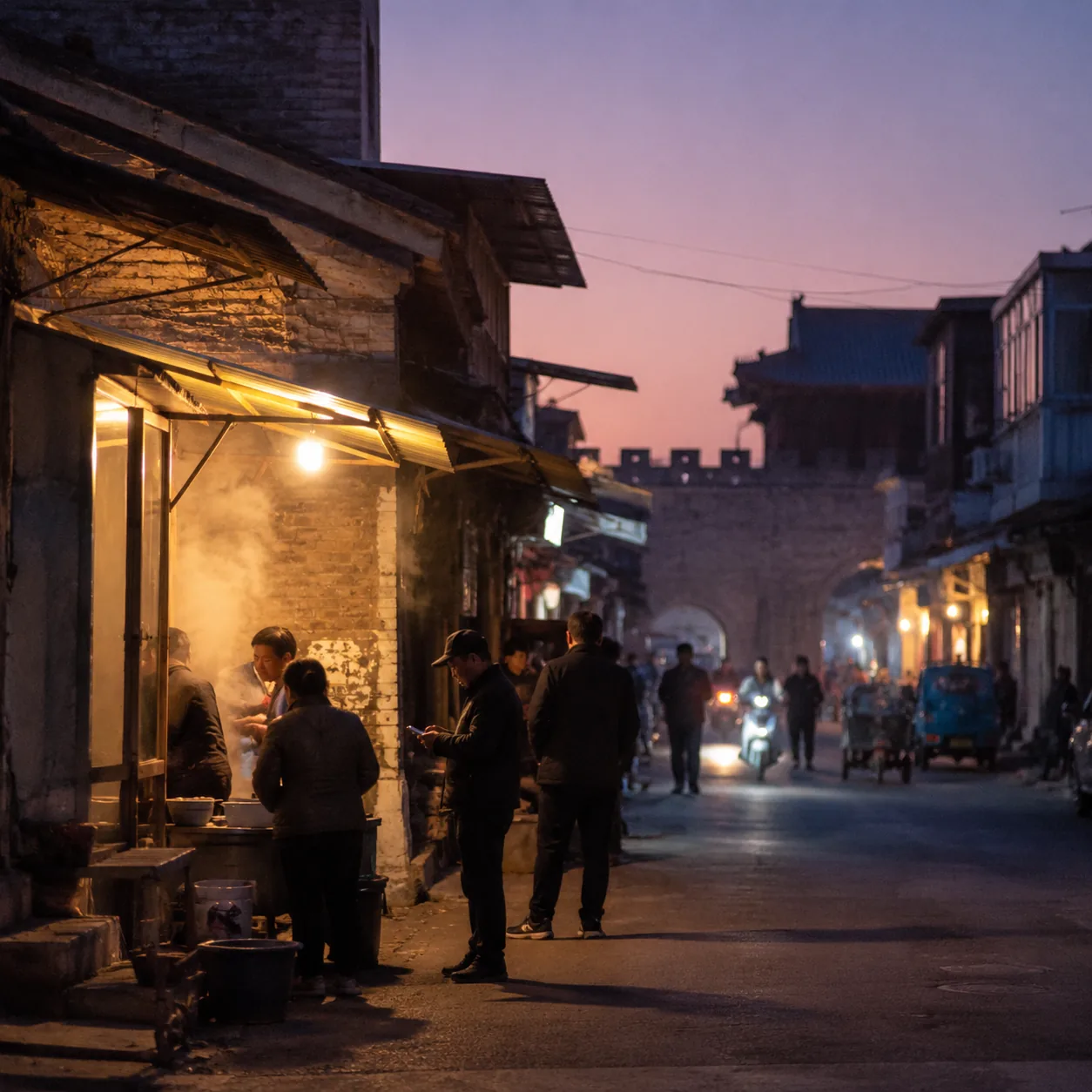
When night arrives in Luoyang’s old city, it does not fall all at once. It first seeps from the cracks at the foot of the city wall, spreads from the shadowed backs of old gateways, and slowly coats the signboards, the wires under the eaves, and the tin edges of food carts with a warm gray. When I reached the lamp on the old street, I realized the whole evening was lit piece by piece: first the incandescent bulb at the soup shop, bright like a porcelain bowl just filled with broth; then the red-and-yellow characters on a water banquet restaurant sign, festive as something taken from an old family album; finally the softer light leaking from apartment windows, faint but most reassuring. The night of Luoyang’s old street does not win by grand scenery. It wins by one lamp, one bowl of soup, and one half-open door, pulling a person back inside ordinary life.
02
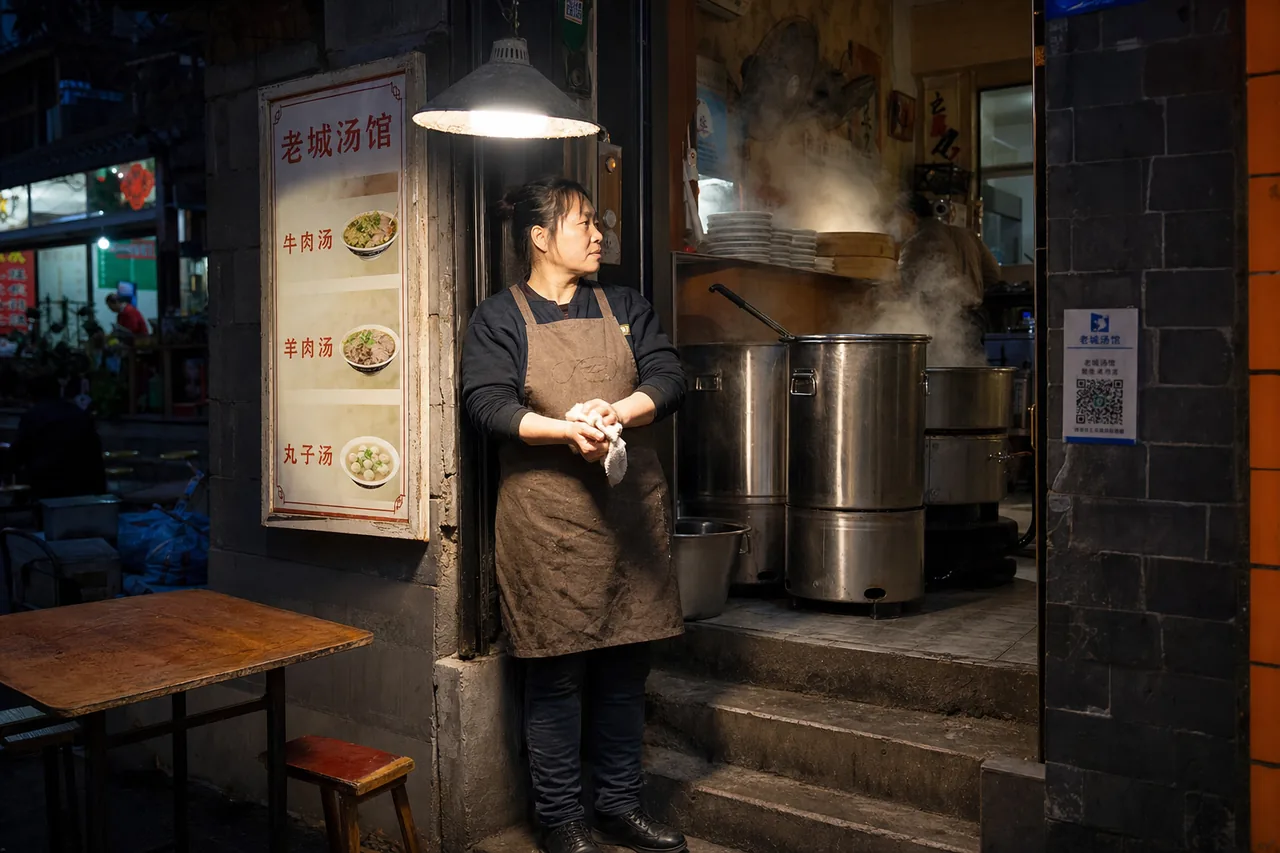
The lamp hung in front of a small soup shop. Its shade was old, its rim touched by soot and dust. It was not antique-style decoration, nor a check-in installation designed for tourists, but a lamp with a practical job: lighting the step, the menu, and the latecomers trying to see what remained in the pot. Under it stood the proprietress, her apron marked by water stains, a rag in her hand, her movements unhurried. She wiped an empty table, pushed a stool inward, and seemed to be tidying her own living room. Beside her the pot kept steaming. The aromas of beef soup, mutton soup, and meatball soup mingled together, carrying pepper, chopped scallions, and the heavy sweetness of bones simmered for a long time. Someone at the door asked, “Do you still have bufan soup?” She looked up and said, “Yes, sit down.” The words were light, but they sounded like the old city’s simplest invitation at night.
03
Luoyang’s water banquet has a special presence at night. In the daytime, when people mention it, they may think of formal meals, famous dishes, peony-shaped yan cai, sliced pork in broth, bowls arriving one after another, and the weight of local tradition. But when you walk through the old street at night, the water banquet turns from a “city calling card” back into “dinner.” Three or four tables are occupied inside: some by visitors from elsewhere, others by residents whose speech carries the local ending tones. Tourists first lift their phones to photograph the soup surface, the steam floating with ginger shreds and cilantro; locals are more direct, chopsticks out, spoons back, settling the stomach first. The “water” in the banquet is not an abstract cultural symbol here, but the sound of hot soup moving continuously: spoon against bowl rim, servers calling dish names, iron ladles scraping the bottom of pots, someone at the doorway telling a child not to run too far. It lowers the banquet until it sits between the street and the belly.
04
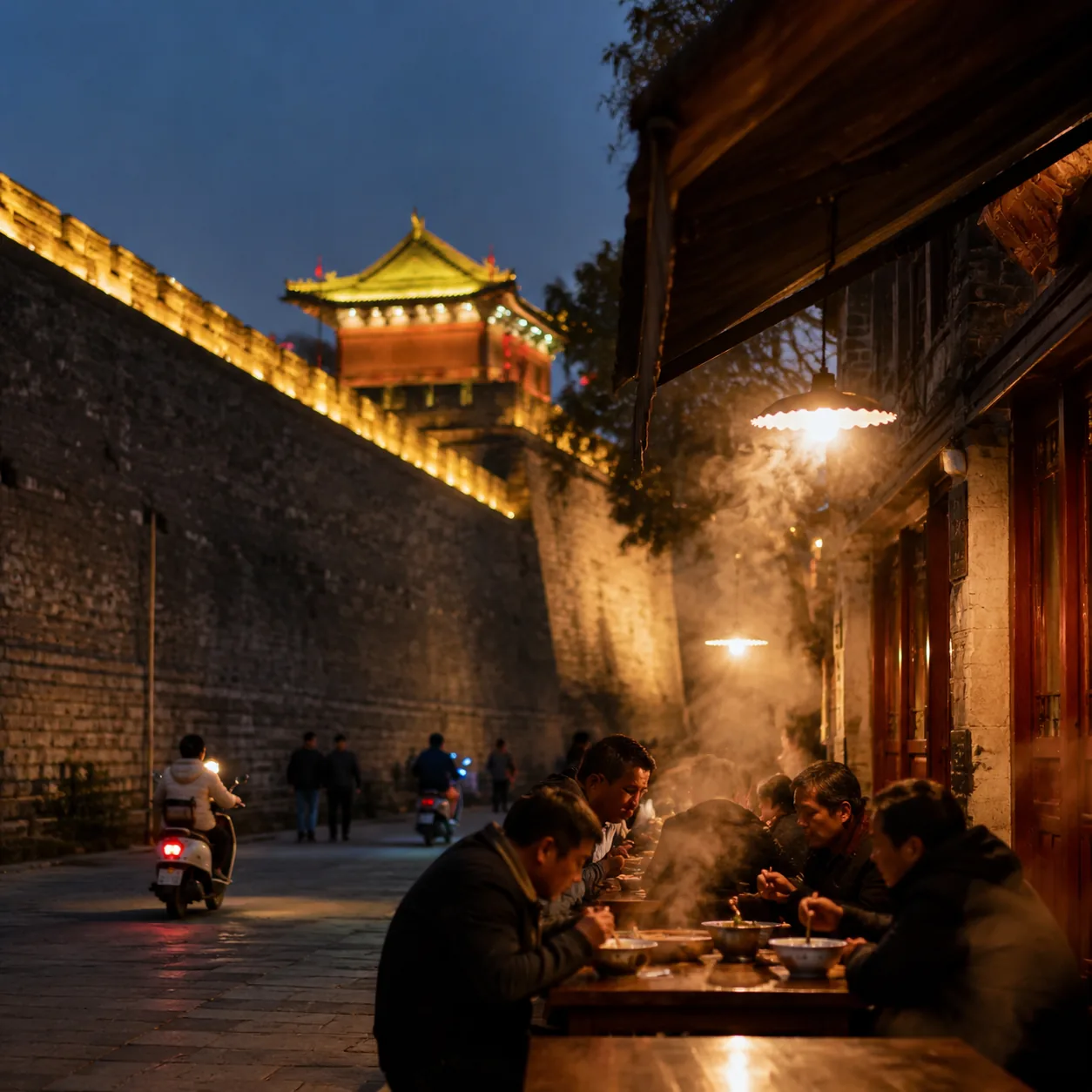
I sat under the lamp for a while and ordered a bowl of soup and a small side dish. The tabletop bore traces of repeated wiping, and a little dampness seemed hidden in the wood grain. At the next table sat an elderly couple. The man tore flatbread into pieces and soaked them in the soup; the woman thought his pieces were too large, took half from his hand, and broke it again. They did not speak much. There was only this small correction of each other, a tacit understanding polished by years of living together. At another table sat several young people, clearly just off work, their ID badges still hanging from their necks. They talked about which road had been jammed, which restaurant had raised prices, whose child was taking extra classes again. Then someone suddenly shifted to the Longmen Grottoes, saying that when friends from other cities came, they still had to be taken there. The old city’s night is like this: history and daily life are not separated. Grottoes, peonies, water banquets, rent, and traffic can all appear in the steam of the same bowl of soup.
05
The sounds of the old street have layers. The outermost layer is made of tourists’ footsteps and camera clicks. They come from the direction of Lijing Gate, looking up at lanterns, down at navigation apps, and discussing which alley resembles the photos in travel guides. The middle layer belongs to shops: soup pots boiling, oil pans crackling softly, payment speakers announcing receipts, servers calling from the doorway that there are seats inside. The innermost layer is the sound of residents: keys striking doors, electric-bike stands dropping to the ground, someone upstairs shouting, “Take the trash down,” children chasing each other at the alley mouth, elders sitting by doorways watching people pass. These sounds overlap without fully disturbing one another. Visitors think they have entered scenery, while residents continue living inside that scenery. What the lamp reveals is precisely the parallel movement of two kinds of time: brief stopping on one side, long dwelling on the other.
06
I walked deeper into the street, and the lights became less orderly. Near the main street, signboards were bright, glass doors reflected light, and shop assistants wore matching aprons. Farther in, the lights scattered: some hung above door lintels, some came from kitchen windows, and some were only tiny red dots at electric-bike charging spots. The old city’s sense of truth often hides in this disorder. Walls have been patched in different brick colors; cardboard boxes, gas cylinders, and clothes poles stand by doors; a cat crouches on a step watching people, its tail sweeping across fallen vegetable leaves. From one courtyard gate comes the smell of garlic sprouts frying; from another window comes the sound of television news. This is not an ancient street restored completely into a sample display. It is still a place that leaks wind, cooks meals, quarrels, and stores cabbages for winter. Tourism lights it up; life keeps it here.
07
After nine, the flow of people in the soup shop slowed. The owner took a stack of bowls from the sterilizing cabinet, and bowl striking bowl made a clear sound. The young cook beside the stove began cleaning the counter, moving quickly, water loud, as if closing the day. Under the lamp at the doorway, two delivery riders stopped briefly, one checking his phone, the other drinking half a bowl of free hot water. They did not come in to eat; they only borrowed a little warmth at the edge of the light. The old street’s night does not belong only to people strolling slowly. It also belongs to those always in motion: delivering food, closing stalls, cleaning floors, catching the last bus. They may not appear in travel photos, but they decide whether the night runs smoothly. The lamp shines on tourists’ faces, but also on the dust on riders’ gloves and the tiredness revealed when a shop worker bends to mop the floor.
08
What I like about Luoyang’s old street is not that it tells the ancient capital story in a grand way, but that it is willing to place grandeur very low. Lijing Gate can be tall, the city wall thick, the plaques upright, but once you turn around, the most powerful things are a soup ladle and a doorway lamp. An ancient capital, if left only with inscriptions and legends, becomes distant from people. Luoyang still puts its past into present bowls. The water banquet is not an exhibit in a museum; the soup shop is not a nostalgic set; residents are not background figures in a neighborhood narrative. They buy vegetables, light stoves, take payments, return home, scold children, wait for someone, and turn off lights every day. It is precisely these repeated small actions that make “old city” not a word for consumption, but a relationship still continuing.
09
When I left, I looked back at the lamp. It was not bright enough to illuminate far; it only lit a few steps at the doorway, one table, and the white steam rising beside the pot. But its scale suited the old street exactly. A light too bright would drive away the night and make people’s expressions look like displays; a light too dim would make the street feel distant. This lamp remained in between, giving people a little safety while leaving life a little shadow. In the shadow were unfinished words, the dampness of old houses, the parts residents did not want photographed, and the true wrinkles of the city. Travel often wants to see a place clearly, but some places do not need to be seen completely. The virtue of Luoyang’s old street is that it lets you see enough, while reminding you that more still belongs to the people who live here.
10
Later I remembered that night as “one lamp,” not because Luoyang lacks larger images, but because the lamp gathered those large images into itself. It held the ancient capital’s weight and the water banquet’s bustle; it held tourists’ curiosity and residents’ fatigue; it held the smoky warmth of alleys and the air slowly quieting after night deepened. Some moments in travel are not responsible for providing conclusions. They simply place you in the right position and let you understand “seeing” again. On Luoyang’s old street, what I saw was not packaged antiquity, but people continuing to live under a lamp: the soup still hot, the tables wiped again and again, the door not fully closed, the upstairs window still lit. Such night, more than any grand explanation, proves that a city is still alive.