Один пластиковый табурет на ночном рынке Гуйяна заставил меня отбросить туристическую отстранённость
When I arrived in Guiyang that evening, the rain had just stopped. The road looked freshly wiped, and neon lights broke into red, green, and orange fragments in the puddles. I had planned only to visit a night market, eat a few things recommended online, take some lively photos, and return to the hotel. What changed my route was not a famous snack, but a low plastic stool. It stood beside a stall with mud specks on its legs and a faded color, yet it pulled me out of the position of an observer and into the warmth of Guiyang’s night.
The entrance to the night market was not mysterious; it was almost crowded to the point of confusion. Electric scooters edged through gaps between people, rain still dripped from awning corners, and vendors arranged oil pans, bamboo skewers, seasoning bowls, and small tables in tight spaces. The air carried sour soup, charred grilled meat, sweet sticky rice, and the sharp lift of chili powder touched by hot oil. My first reaction was still that of a tourist: stand back, observe, decide which stall looked safer, more famous, and more worth a queue.
I hesitated in front of a griddle stall. Potato slices and pork belly sizzled together on the iron plate, tofu edges slowly firmed, and the vendor pushed ingredients apart and gathered them again with a spatula, as if tuning the night. Several local young people had already sat down nearby, plastic stools forming a half circle, their knees almost touching the table. They spoke quickly and laughed quickly. Hands passed dipping sauce across the tabletop, leaving no comfortable distance for a tourist to watch from.
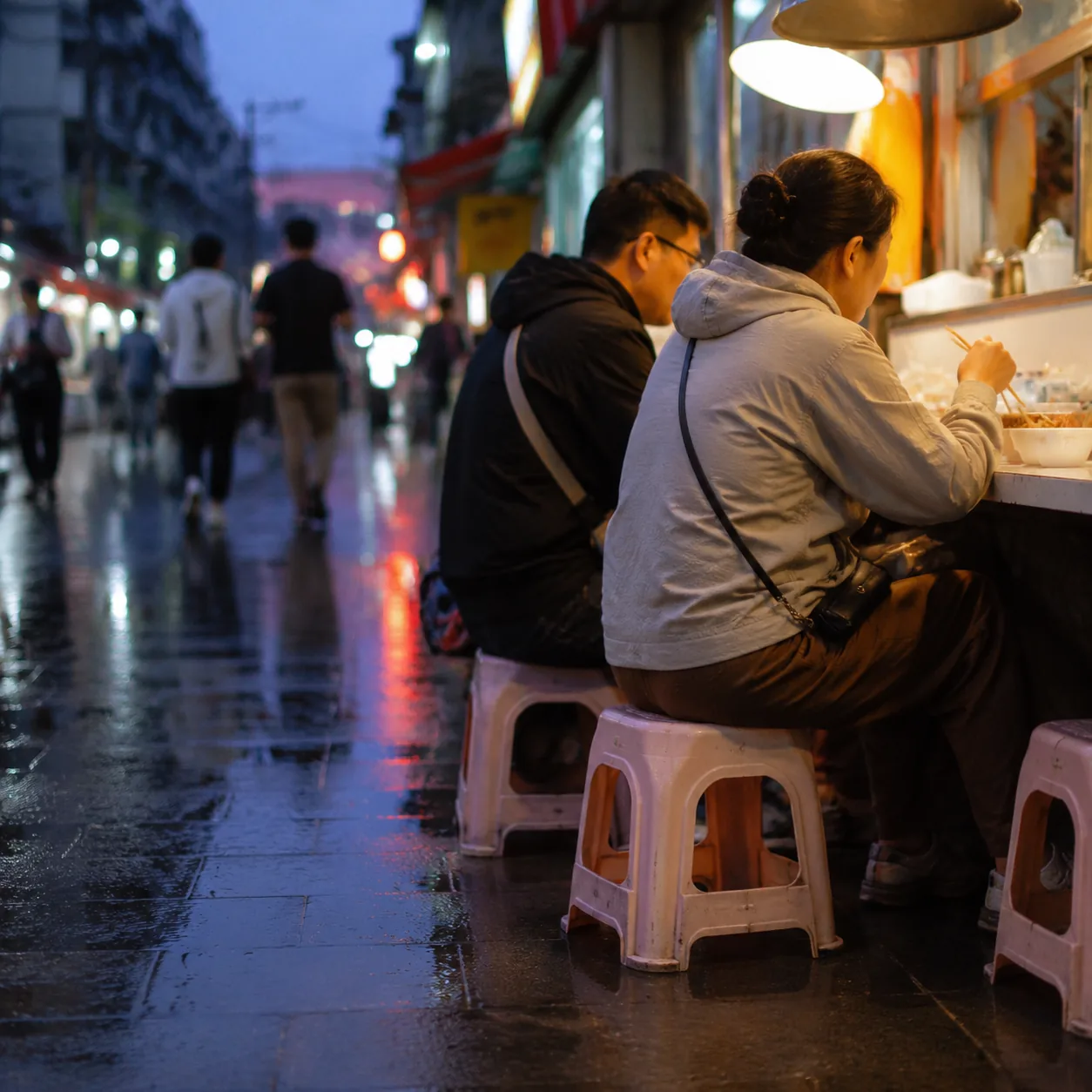
The vendor noticed that I had been standing too long and asked if I was alone, telling me to sit. My instinct was to say I would look around first, but she had already pulled out a stool and nudged it toward the table with her foot. The gesture was too natural. It was neither eager salesmanship nor pressure, only the filling of a place for someone who had arrived late. When I sat down, I still held my backpack against my chest, my body stiff, as if what sat on the stool was not me but my caution toward an unfamiliar city.
The griddle quickly softened that stiffness. Potato slices went first into a chili dip with fish mint, and sourness, heat, crunch, and fragrance rushed up together, leaving no time for composure. When the pork belly edges browned, fat fell onto the iron plate and the sound grew denser. The young man beside me saw me reaching for tofu too early and told me to wait until the outside turned crisp. He said it casually, as if we had known each other already. I laughed and pulled back my chopsticks, feeling for the first time that I was not consuming a place, but being corrected by it.
The liveliness of a Guiyang night market is not orderly liveliness. It is not a stage arranged for cameras, but many pieces of life temporarily fitted together: office workers filling their stomachs, students pouring the emotions of the day into a bowl of ice jelly, vendors calling home during brief pauses, older people slowly choosing braised snacks with plastic bags in hand. Everyone has a purpose, yet everyone is wrapped in the same heat. Sitting on the low stool, my eye level dropped. I no longer saw only signs, but water stains near my feet, tissues under the table, and chili powder dried at the edge of the pan.
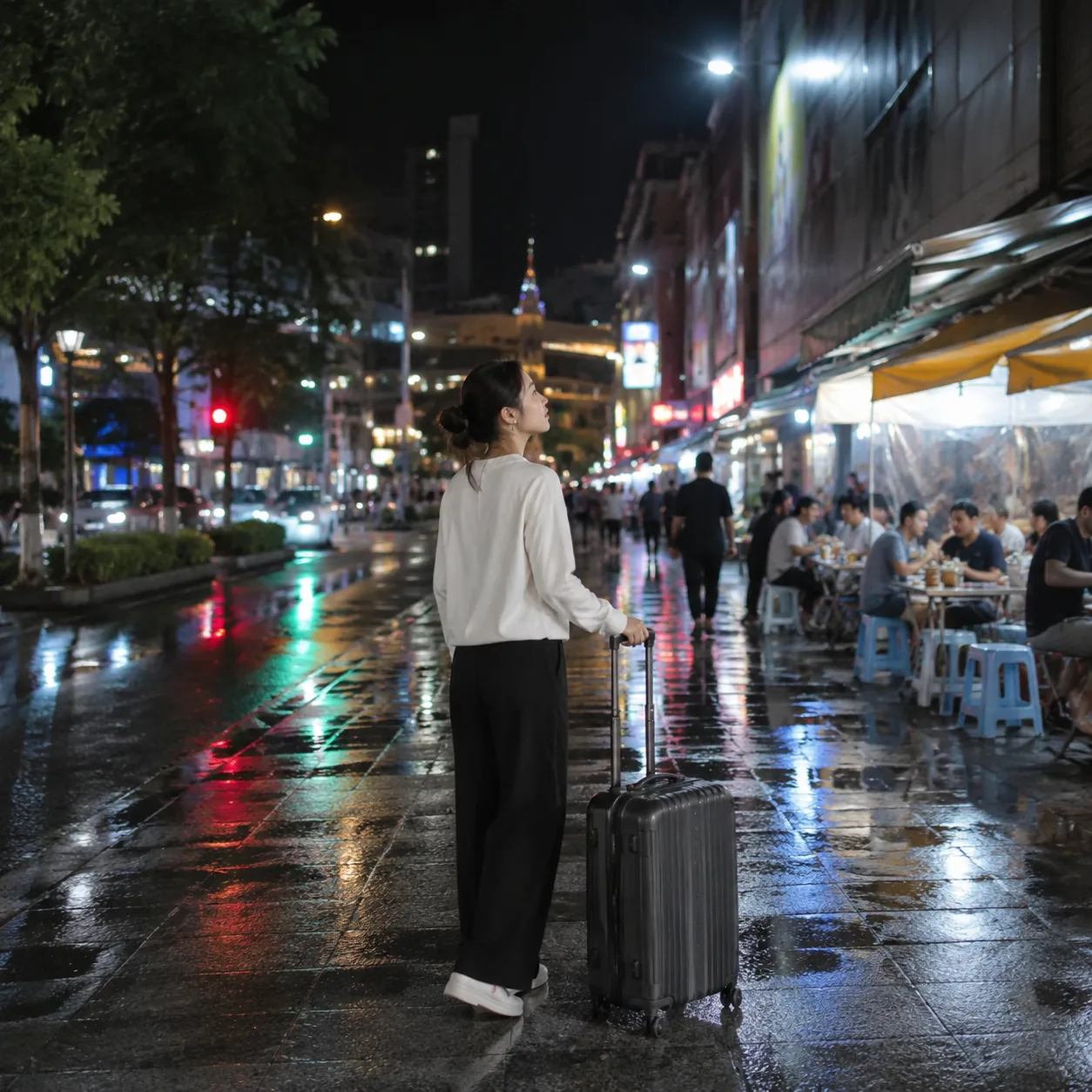
After finishing the griddle food, I did not leave immediately. The vendor scraped the iron plate clean, the next table began a finger-guessing game, and a fine rain returned outside the awning. Someone pulled a stool inward to clear a path; someone stood eating a bowl of siwawa soup; someone, defeated by the heat of the chili, laughed while asking for bottled water. The intimacy here did not gently invite me in. It placed me in a slightly cramped position and made me adjust: tuck in my legs, slow my chopsticks, speak less, listen more.
I walked deeper into the market and saw a stall selling changwang noodles. Red oil floated on the surface of the bowl, crisp pork bits were scattered generously, and the noodles shone when lifted from the broth. The owner moved fast: taking money, boiling noodles, ladling soup, calling numbers, the whole process practiced into the body. I ordered a small bowl and waited nearby. A woman in front of me noticed me staring at the seasoning table and told me not to add too much chili at once, to taste the soup first. After saying it, she carried away her own bowl without waiting for thanks.
That bowl of noodles taught me that Guiyang’s chili is not simply about stimulation. It has layers, moisture, and patience. Red oil gives the first heat, sourness wakes the tongue afterward, crisp pork bits add a clean fragrance, and the softness of the blood curd catches everything together. I sat at a small roadside table, sharing it with two girls who had just finished work. They discussed who had to wake early for a meeting, whose umbrella had been lost again, and who was thinking about changing jobs. The night tasted strong, but the content of life was not exaggerated.
I had planned to look for a viral shop, but at that moment I gave up the idea. Not because such shops are bad, but because I no longer wanted a guide to decide my next bite. The night market had handed the choice back to me: stop where the smoke from a pot catches you, turn where a vendor’s call reaches you, sit where a stool opens up. This kind of choice is not efficient, but it has body heat. It asks you to judge slowly on site, and it permits you to be wrong.
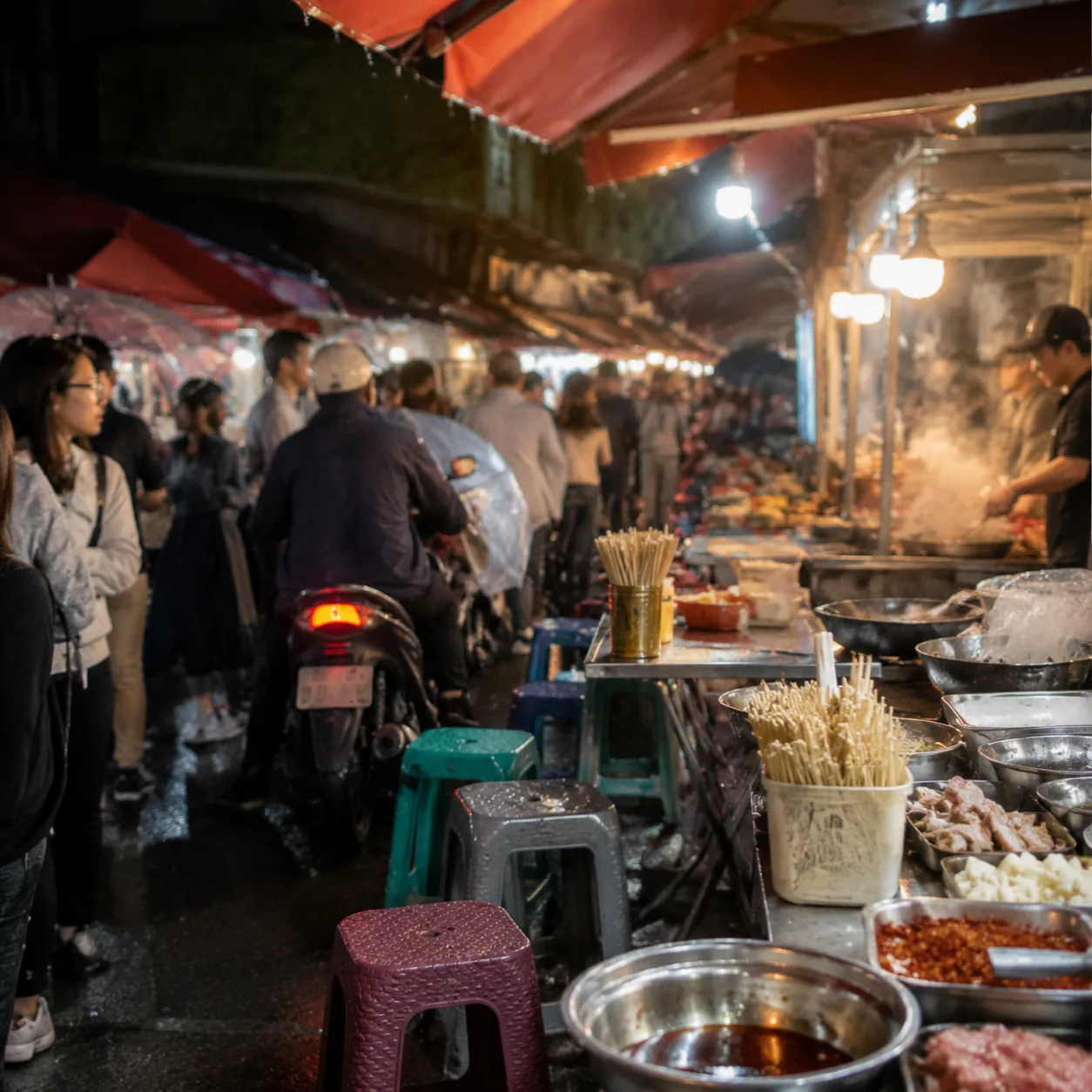
At a tofu ball stall, I misjudged once. I thought it would taste like ordinary fried tofu, but when I bit into it, the inside was soft almost to the point of lightness, while the dipping sauce had a strong temper. Sour heat lifted the bean fragrance immediately. The vendor saw my expression change and smiled, saying visitors often react that way the first time. She did not treat me as a tourist who needed instruction. She simply accepted my surprise as part of the stall’s ordinary day. Her ease made me ease up too.
As the night deepened, more sounds appeared in the market. Beer bottles touched together, spatulas struck iron plates, a child cried for a grilled sausage, and young people complained about each other’s faces while taking photos. Guiyang at night does not chase a clean romance. It has oil smoke, damp air, sudden laughter, and a vendor’s impatient reminder when business gets busy. Yet those irregular parts made me feel that I was not touching a city postcard, but the pulse of a city in motion.
I bought a bowl of iced dessert next. Crushed ice, sticky rice, peanuts, brown sugar syrup, and fruit mixed together; the first sensation was cold, followed by a plain sweetness. Eating on the steps outside a convenience store, I saw the plastic stool from earlier moved to another position. A new customer sat on it with the same cautious posture I had worn at first. Before long, someone beside him reminded him that the meat on the pan could be turned. The small cycle made me smile: the night market does not know us, yet it has ways to make each stranger loosen slowly.
I used to think blending in meant learning many rules: knowing which shop was most authentic, how locals order, and what not to say wrong. But on this night in Guiyang, I found that belonging, even briefly, does not have to be so complicated. It may simply mean being willing to sit down, accept advice handed across a table, admit not knowing, and let the rhythm of a meal override the original plan. When I stopped trying to prove that I understood, the people and food around me seemed more willing to come close.
By nearly ten o’clock, the rain had fully stopped. Water on the ground was slowly scattered by footsteps and wheels, while heat from the market continued to rise. I walked back along the route I had taken in, passing the flickering lamp near the entrance, and the distance I had carried at the beginning was gone. My backpack was still on my shoulder, and there were photos on my phone, but they were no longer the main relationship between me and the city. What stayed was the low height of the stool, a stranger’s casual reminder, and the moment when chili made careful facial control impossible.
Back at the hotel, I wiped water from my soles, and distant traffic could still be heard outside the window. I did not rush to organize photos or give the night a pretty title. What the Guiyang night market gave me was not a perfect experience ready to display, but the feeling of being caught by ordinary life. When arriving alone in an unfamiliar city, one often wants to stay composed, appear calm, and hide awkwardness. That plastic stool told me that many places cannot be understood from a careful distance. You have to sit inside them, a little squeezed, a little warm, a little messy, before you know how they truly breathe.
The next morning, I smelled a trace of oil smoke still clinging to my clothes in the elevator, and unexpectedly I did not want to wash it away immediately. It felt like a small stamp from the night market, reminding me that I had truly sat among those pans, lights, voices, and the dampness after rain. Travel sometimes makes people work hard to remain polished, but Guiyang let me accept another state: chili on the chopsticks, a stool slightly too low, trouser cuffs damp from rain, and no sheet of glass left between my heart and the place.