Научившись плести китайские узлы, я наконец понял, почему «благополучие» можно держать в руках
Before coming to China, my impression of Chinese knots was somewhat superficial. I knew they were often red, hung by doors, in cars, or on gifts, and I knew many foreign visitors bought them home as distinctly “Chinese” souvenirs. But only when I actually sat down and tried tying a few basic knots did I realize that the reason Chinese knotting remains present in everyday life is not simply that it looks beautiful. It is because it weaves order, symbolism, and handmade patience into one small structure.
At the beginning of the lesson, the instructor did not rush us into tying. Instead, she placed several common knot forms on the table for us to examine. Some were symmetrical and upright, some interlocked in layers, and some ended in tassels, looking both orderly and flexible. She said that one of the most fascinating things about Chinese knotting is that a single cord can be turned, threaded, looped, and secured again and again until it forms a complete pattern. The moment I heard that, I was captivated. The beauty of this craft comes not from expensive materials, but from the intelligence of the path itself.
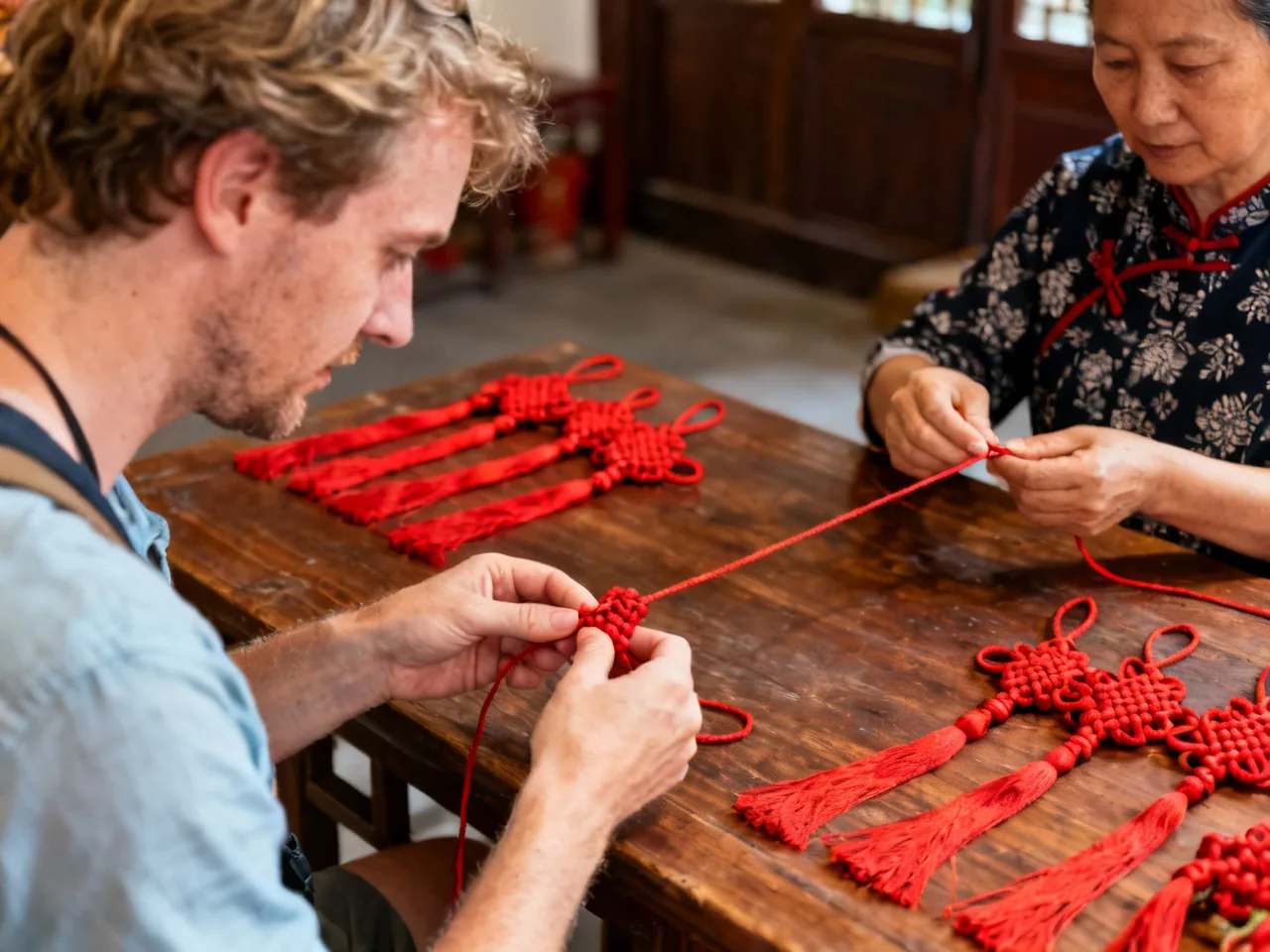
Once I actually began learning, I discovered that I had underestimated the importance of the path. When the instructor demonstrated, the cord seemed obedient, looping one way and threading back another, every step appearing perfectly natural. But in my own hands, problems came immediately: the direction reversed, the wrong loop was pressed down, the upper and lower order became confused, and with one small mistake the whole structure twisted out of shape. What interested me most was that this is not a craft in which more force leads to better results. If you pull too quickly, the knot deforms. If you tighten unevenly, the two sides lose balance. The first lesson Chinese knotting taught me was not speed, but restraint.
I made a basic knot with a small tassel attached. It was not complicated, yet it was already enough to let me feel the personality of this craft. It requires you to hold an image in the mind, maintain sensitivity in the hand, and remain willing to adjust repeatedly. Before the knot is tightened, it often looks messy, even doubtful, as if it may never become beautiful at all. But once each loop is gradually straightened and each section of cord is guided back into place, the structure suddenly holds. The moment it comes together is deeply satisfying, like watching disorder finally discover its own order.
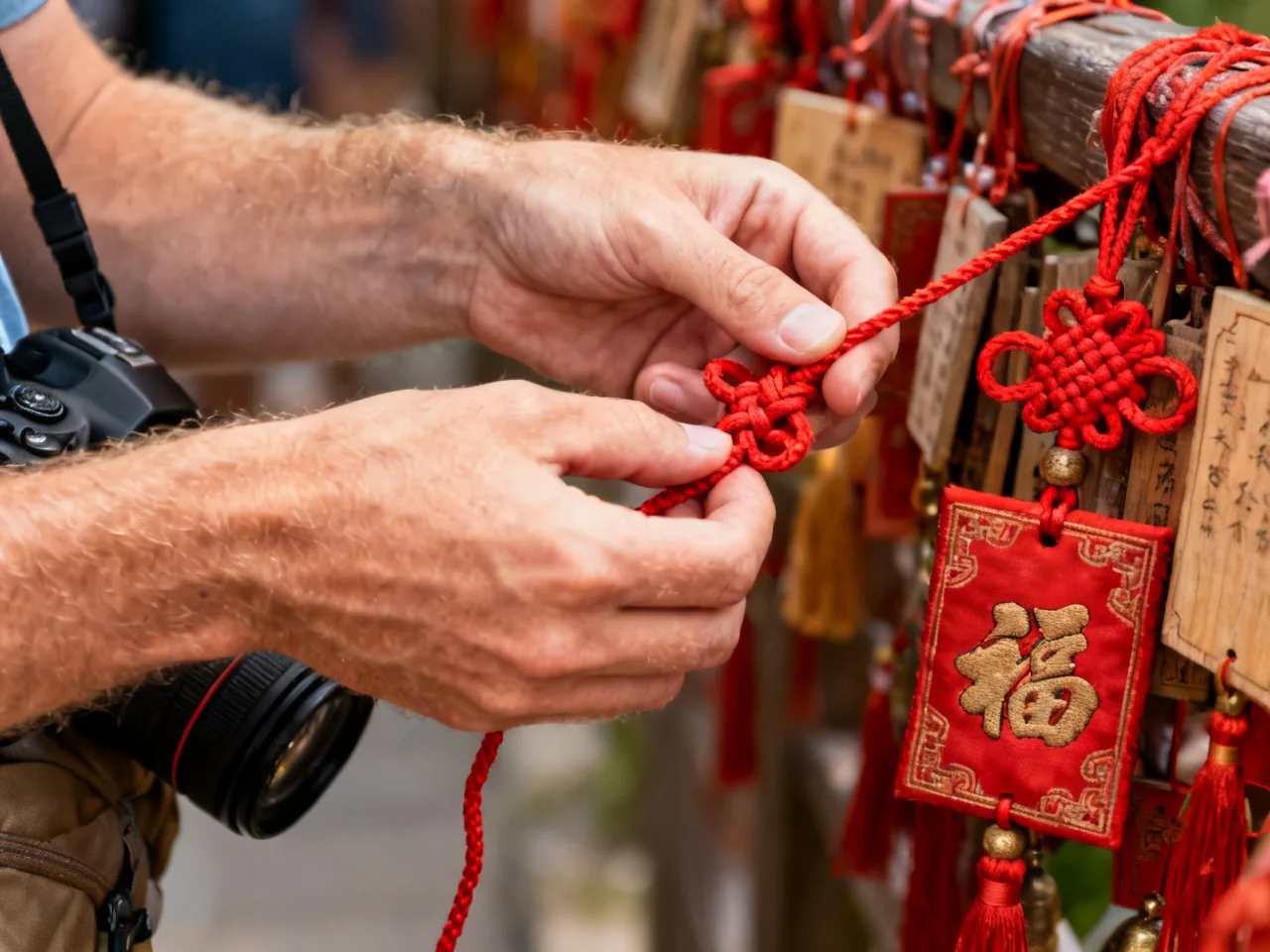
Later the instructor explained why Chinese knots are so often associated with auspicious meaning. Red itself carries festive significance, and different knot forms, combinations, and hanging contexts often appear in weddings, New Year celebrations, birthdays, and housewarmings. In other words, a Chinese knot is not simply a knot. It is a small visual language that can enter the rituals of life. I liked this very much, because it shows that folk craft in China has not retreated entirely into museums. It can still hang naturally in everyday spaces and continue to carry wishes forward.
Because I come from Ireland, I naturally thought of Celtic knot patterns. Irish culture also has a famous knot tradition, with many motifs that emphasize continuity, looping, interweaving, and line that seems to have no obvious ending. I grew up familiar with that endless turning quality and with the way such patterns connect to history, belief, and identity. So the first time I seriously learned Chinese knotting, I felt an immediate sense of closeness. Different cultures, I realized, both understand that if a line is organized well enough, it can carry meaning by itself.
But the two traditions still feel different to me. Celtic knotwork more often appears in flat design, stone carving, manuscript ornament, and symbolic systems, where the emphasis is often on seeing the endless interweaving. Chinese knotting is more three-dimensional, touchable, and hangable. It is not only seen, but held in the hand, given to others, and placed into homes and festive settings. One feels more like a symbolic world of pattern, while the other feels more like a structural handcraft that enters real life. I find that distinction deeply fascinating.
If foreign friends asked me today which Chinese folk craft is best for reminding yourself to slow down, I would recommend Chinese knotting. It looks small, but once you begin, it forces you to take every direction and every tightening seriously. When I finally placed my imperfect little knot in my palm, I suddenly understood why so many people love it. It is not an exaggerated monumental art, nor a distant relic from the past. It is a sense of order that can be held, hung, and given away. For me, the most valuable thing I gained from learning Chinese knotting was not simply the method for making a souvenir. It was finally understanding that in China, auspicious meaning really can be braided slowly from a single cord and then held steadily in the hand.