南京のあの雨のあと、プラタナスの下で旅の予定表をゆっくり置いた
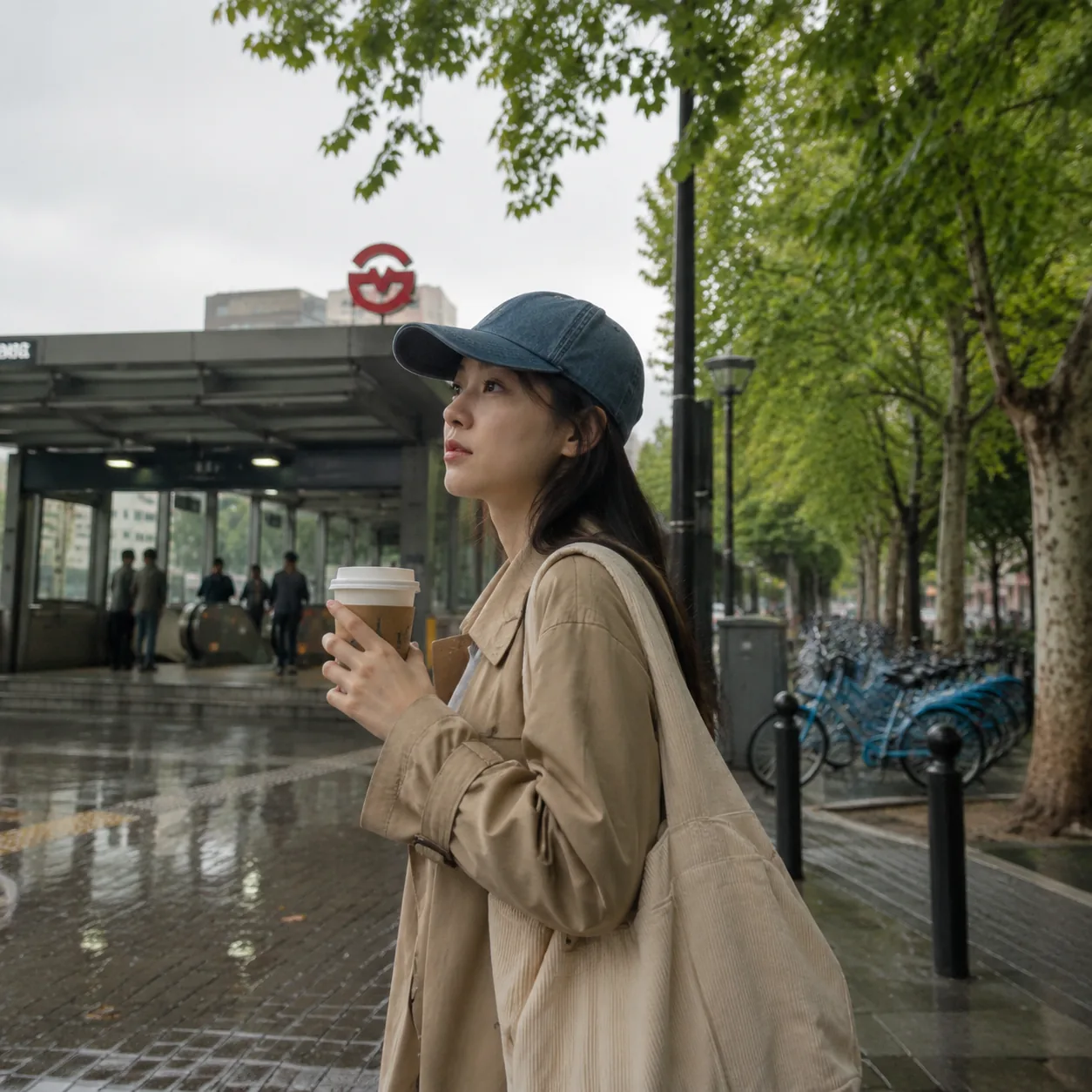
At 4:17 in the afternoon on April 12, 2025, I stood outside the Shanghai Road metro exit in Nanjing, my shoes pressing against bricks freshly washed by rain, while I held a cup of hot soy milk I had not yet managed to drink. The rain had stopped suddenly, as if someone had tightened a tap in the sky, but drops were still falling one by one from the plane tree leaves. My companion, Lin Ran, folded her umbrella and wiped her glasses with the back of her hand. She told me not to hurry to the next place, because Nanjing after rain had to be walked slowly to be seen. At that moment I had already opened the map on my phone, preparing to rush from Shanghai Road to Laomendong, then from Laomendong to the Qinhuai River, as if cutting the city into several points that had to be completed. Hearing her words, I did not answer right away. I only looked at a small puddle beside the metro steps, where the gray-blue sky and a swaying plane tree branch were reflected.
The day’s original plan was packed. We would visit a museum in the morning, go to Librairie Avant-Garde in the afternoon, reach the Qinhuai River by evening to see the lights, and then find a bowl of duck blood vermicelli soup at night. As a foreigner seriously exploring Nanjing for the first time, I felt that skipping one place would be like failing to hand in part of an assignment. But the rain broke the itinerary apart. We stayed in the bookstore an extra hour, and by the time we came out, the reservation time no longer fit. Every route on the map turned red because of evening traffic. Watching the estimated times change on my screen, I began to grow anxious. Lin Ran noticed. She did not take my phone away or criticize my plan. She simply pointed toward a row of wet plane trees by the road and said that if I kept looking at the map, I would miss how those trees looked just after being washed by rain.
I looked up and only then realized that the entire street seemed polished. The plane tree trunks showed different shades of gray and brown, and the wet edges of the bark curled like the corners of old book pages. A thin layer of water rested on bicycle seats along the road, and the wheels of a delivery rider made a light sound as he passed. A shop assistant wearing a blue apron came out of a café, straightened two chairs by the door, and wiped rain from the tabletops with a cloth. Seeing us hesitate by the roadside, he smiled and said that it had just rained, so we should not walk too fast because the brick seams ahead were a little slippery. The sentence was ordinary, yet it felt as if the city had used his voice to remind me again. I zoomed out on the map, for the first time not to find the fastest route, but to see which nearby lanes we could walk through slowly.
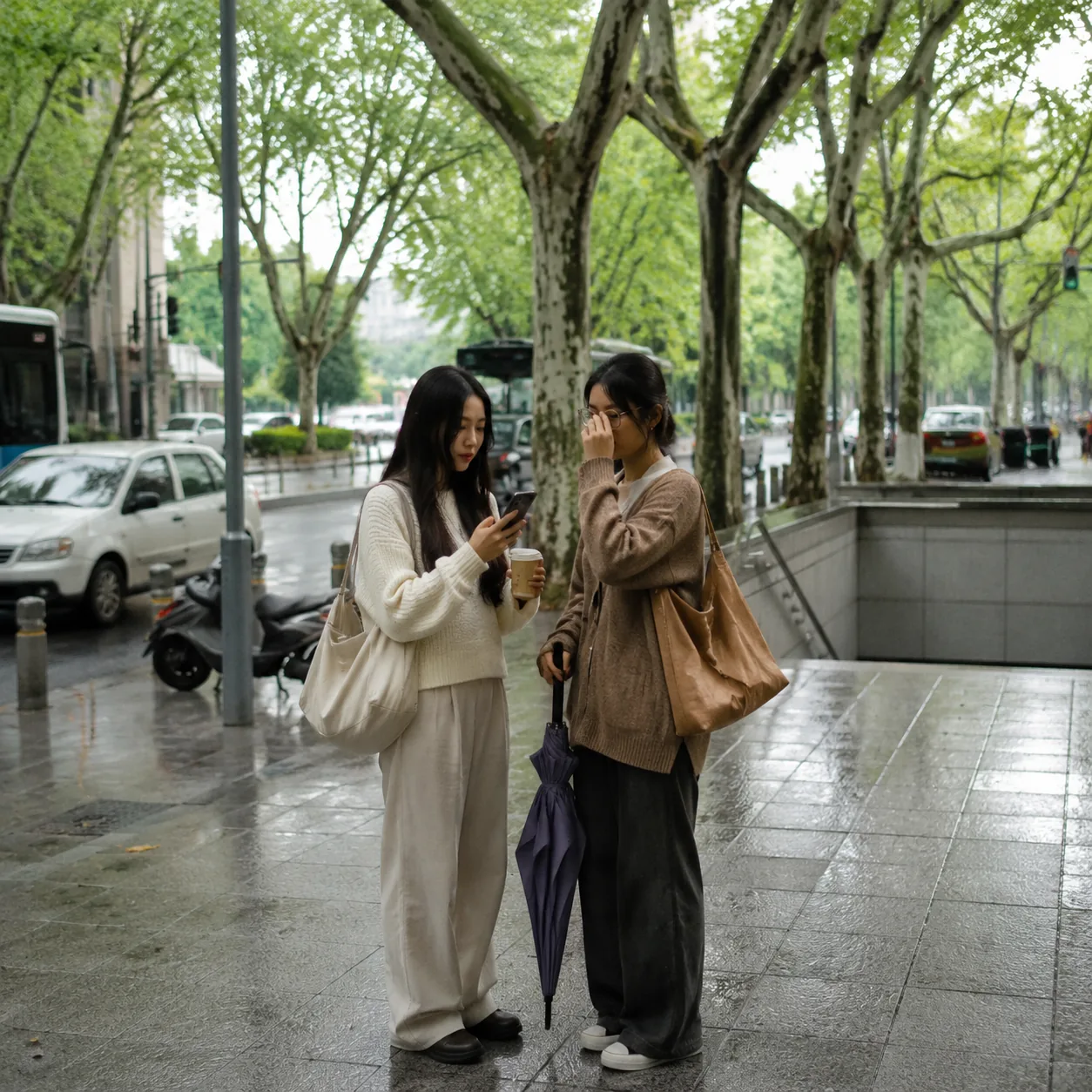
We did not go to Laomendong immediately. Instead, we followed Shanghai Road and turned into a small lane. At the entrance stood a shoe repair shop with its curtain half rolled up. Inside, the craftsman was examining a pair of black leather shoes under a lamp, their surface giving off a dark shine from the dampness. In the neighboring shop, a steamer lid had just been lifted, and white vapor surged out, briefly covering the red lantern beneath the sign. The air after rain mixed the smells of soil, fried dough, coffee, and old walls. This kind of blended scent is hard to write into travel introductions, yet it pulled me into Nanjing’s daily life faster than any landmark. Lin Ran said Nanjing sometimes does not move people through one attraction, but through the moment you slow beneath the plane trees and suddenly hear bicycle bells, wok spatulas, and elderly voices overlapping.
At a small intersection, the sole of my shoe slipped slightly on the wet bricks. Lin Ran reached out to steady me and laughed, saying, “See, the city is already using the road surface to tell you not to hurry.” I laughed too, but my heart truly relaxed. We changed the rest of the route, keeping only one destination for the evening and no longer trying to squeeze every point into the same day. The map on my phone changed from a command into a reference. We followed quieter streets, stepping around puddles and pausing when water dripped from eaves. An elderly man by the roadside carried a folding stool back inside, while a radio played a voice that sounded like traditional storytelling. I could not understand every word, but I could hear the unhurried rhythm after rain. My steps began to lighten according to that rhythm.
Nanjing’s plane trees have a special presence after rain. On dry days, they seem like the background of city roads; after rain, they suddenly become the main characters. Their leaves hang a little lower under the weight of water, branches stretch toward the middle of the road, and when wind passes, drops fall onto pedestrians’ shoulders. The streetlights were not yet on, but the sky had already dimmed, and pale patches showed through the crowns. We passed a school gate where several students ran out with uniform jackets over their heads, while the gate guard called after them to be careful because the ground was slippery. One girl stopped halfway, looked down to find her shoelace undone, and crouched beneath a tree to tie it again. Plane leaves shook behind her, and I suddenly felt that if I passed such a scene at the speed of rushing, it would become only a blur of green.
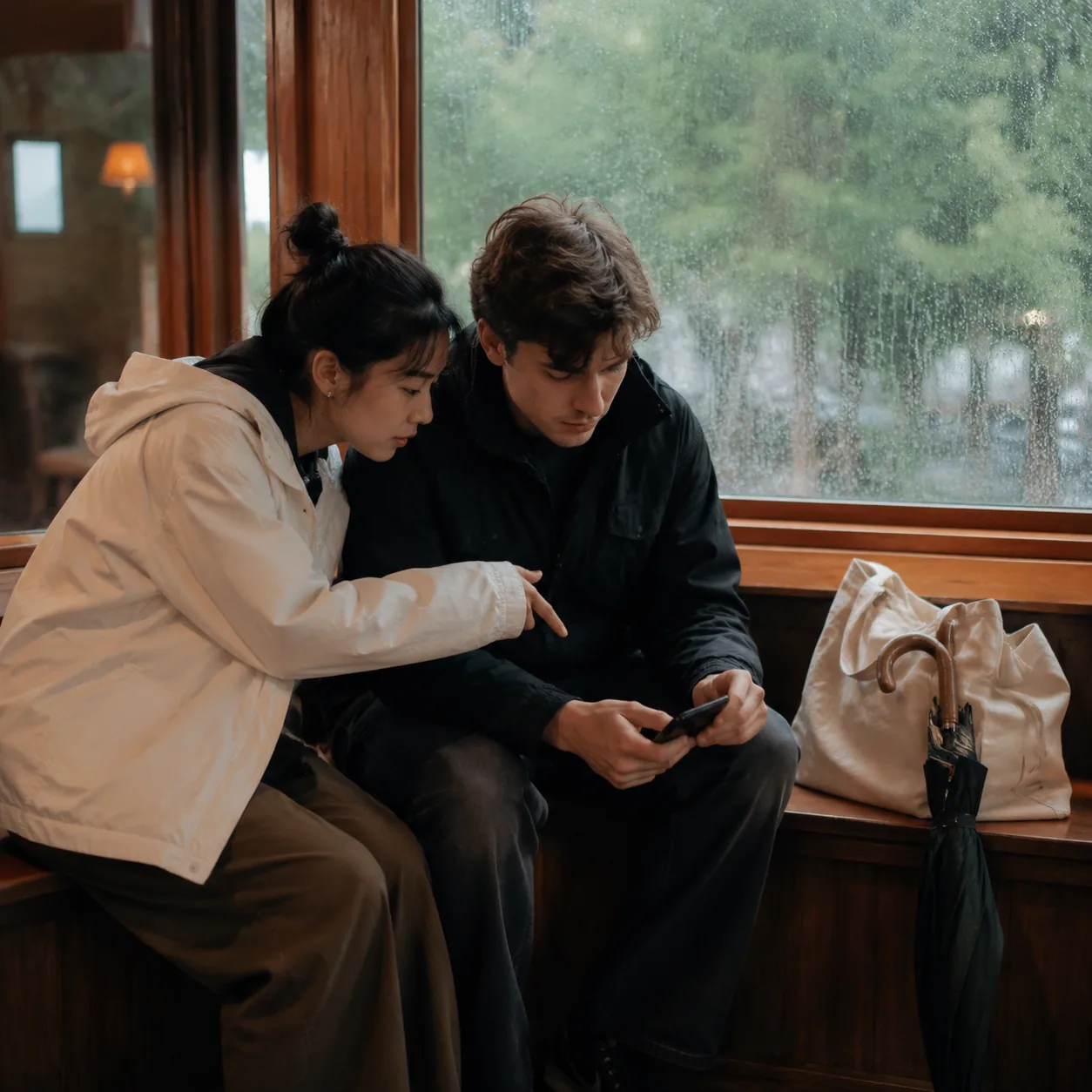
We stopped at a small noodle shop with a narrow storefront and rain marks still on the glass. The owner was a middle-aged woman who spoke quickly. Seeing us stand at the door reading the menu, she invited us in to escape the damp air. Lin Ran ordered pork skin noodles, and I ordered a small bowl of wontons. When the owner brought the bowls, she asked whether I was a tourist. I nodded, and she said that after rain in Nanjing, I should not hurry to the riverbank. I should eat something hot first, then walk slowly, because the lights would still be beautiful later. Her advice was more specific than any travel app, because she knew where the road became slippery after rain, where the wind blew, and where crowds gathered at night. The wonton soup was hot, chopped scallions floated on the surface, and as I gently pushed them aside with my spoon, steam covered my glasses with a white mist. In that moment, I no longer felt that changing the route was a failure.
When we came out after eating, the sky had turned deep blue. We did not call a car. Instead, we walked to the nearest metro station, planning to ride two stops and then continue on foot. The crowd at the entrance was larger than when the rain first stopped; umbrellas brushed against one another, and trails of water marked the ground. A station worker used a mop to push water away from the edge of the steps while reminding everyone to hold the handrail. Lin Ran said this was another kind of slowness in Nanjing: not making the city stop, but making people know when to slow down before wet steps. We stood outside the entrance and waited for one group to descend first. I saw a father lift his child’s schoolbag with one hand and protect the child’s back with the other. Nobody photographed it, and nobody paused for long, yet these movements formed the true texture of the city after rain.
On the metro, I opened the original itinerary on my phone and saw that three places were still listed. They suddenly looked unfamiliar, like a checklist left by another, more anxious version of myself. I deleted two of them and kept only the walk along the Qinhuai River. As the train passed through the tunnel, the window reflected our tired but relaxed faces. Across from us sat an auntie carrying groceries, with a bundle of greens and a block of tofu visible through a plastic bag. Seeing me look at the route map, she told us which station would be closer and added that after getting off, we should not hurry with the crowd, but take the smaller road because it would be more comfortable. After speaking, she lowered her head to her phone, as if she had simply handed a small umbrella to strangers in passing. I saved her advice in the map notes, this time not to chase time but to avoid the crowded road.
After leaving the station, the wind carried moisture from the river. The stone railing after rain felt cold to the touch, and shop lights along the street came on one by one, shining on the wet ground with a more scattered glow than on clear days. There were many people beside the Qinhuai River, but because the ground was damp, everyone walked more slowly than usual. Some supported elderly relatives, some held umbrellas sideways to shield companions from water falling from trees, and some took photos on the bridge but quickly gave up their spot. We did not squeeze beneath the brightest lights. Instead, we followed the river toward a quieter direction. Lin Ran said Nanjing’s best moments are often just beside the popular places, not far away, but with less force. Watching the reflections of lights stretch across the rippled water, I felt that her words were meant especially for me that day.
We stopped for a long time beside a small bridge. A tour boat passed beneath it, and the guide’s voice on board was broken into fragments by the water and night wind. A short queue stood outside a sweet taro soup shop on the bank, and a warm sugary scent drifted from the pot. A shop assistant moved a freshly wiped wooden bench under the eaves and invited customers to sit farther inside so water would not drip on them from the trees. Seeing me stare at the bridge, she smiled and said this place was brighter after rain because the ground reflected light too. She spoke softly, but her words made me look down again. Sure enough, the lights were not only in the river; they were also on every wet stone slab. Scenery is not found only in the distance. It is also wherever you are willing to lower your head and look.
That night I did not complete the original plan, yet I remembered more details. The puddle outside the Shanghai Road metro exit, the café worker’s hand wiping chairs, the leather shoes under the lamp in the repair shop, the hot soup carried by the noodle shop owner, the mop pushing water at the metro entrance, the route advice from the grocery-carrying auntie, and the raindrops on wooden benches beside the Qinhuai River. None of these would be printed on the cover of a travel brochure, yet together they became my clearest memory of Nanjing. When rushing, I was only collecting locations. When walking slowly, I began collecting people’s movements, the smell of the air, and the small care the city offered. They did not make me see less of Nanjing; they helped me see a more complete Nanjing.
On the way back to the hotel, Lin Ran asked whether I would still pack the schedule so tightly if it rained again the next day. I thought for a while and said no, but that did not mean I would stop planning entirely. I would check the weather first, then the metro distance, separate indoor and outdoor places, and leave time in each segment for stopping. She nodded and said walking slowly does not mean lacking direction; it means giving direction a little room to breathe. I liked that way of putting it. I used to think travel efficiency came from filling time completely. Now I know some cities are not suited to being filled completely, and Nanjing is especially like that. Its history, tree shadows, rain, and sounds of daily life all need gaps. If you press every minute too tightly, they have no room to enter.
The next morning, the rain did not return, and sunlight came through the gap in the curtains. I opened the map again and reduced the destinations to two, leaving an unnamed walking period between them. At a breakfast shop, the auntie packed duck-oil sesame pastries into a paper bag and reminded me to eat them while hot, because they would lose fragrance when cold. I stood at the door, took a bite, and the smell of sesame and oil spread together. The plane tree leaves along the street were already half dry, though a few drops still hung from their tips. I did not hurry toward the next attraction. I walked slowly along the sidewalk and finished eating. The lesson from the rainy day remained in my body, telling me that a city is not a checklist to tick off quickly, but a text to read slowly with one’s steps.
When I later visited other Chinese cities, I often remembered that changed route after rain in Nanjing. In Chengdu, a light rain made me sit in a teahouse for half an hour longer. In Guangzhou, I gave up rushing to a third market and watched shop owners close up beneath arcade buildings. In Qingdao, I did not chase the sunset but walked slowly down a slippery slope. Nanjing did not give me advice that applied only to Nanjing. It gave me a way of judging: when weather, road surface, crowds, and your own body all tell you to slow down, it is better to listen. A travel plan can be a skeleton, but real experience grows between the bones. Those few minutes of temporary stopping often have more life than a place reached by force.
If a friend visiting Nanjing for the first time asks how to arrange a rainy day, I would tell him to wear shoes that can handle damp ground, not to calculate metro transfers too tightly, and to leave extra time for streets lined with plane trees. After the rain stops, do not rush into a car. Look at the trees, steps, eaves, and small roadside shops. If a shop assistant or companion reminds you to slow down, truly slow down. Laomendong, the Qinhuai River, museums, and bookstores are all worth visiting, but they do not need to be completed on the same day. Nanjing’s goodness is sometimes on the way to these places: in the white steam above a bowl of hot soup, in a station worker’s warning to be careful, and in a little light reflected by rain-wet stone. Only when you slow down will you discover that these are not accessories.
That rainy Nanjing afternoon did not give me the most perfect photos. The sky was not blue enough, my coat hem was damp, my soles carried mud, and several blanks remained on the original itinerary. But it gave me a more reliable way to travel: when the city slows because of rain, I slow with it; when people by the road hand me experience through an ordinary reminder, I receive it seriously; when the route on the map conflicts with the lanes before my eyes, I allow myself to choose what is before me. Back at the hotel that night, I deleted the original schedule and kept only a few short notes. The first read: After rain on Shanghai Road, the plane trees were bright. The second read: Do not hurry; the road surface will tell you the speed.
Now, whenever I smell plane leaves and wet bricks after rain, I remember the metro exit at 4:17 that afternoon. A foreign traveler stood there holding still-warm soy milk, eager to turn Nanjing into several coordinates. A friend folded her umbrella and told him to slow down. A shop assistant warned that the brick seams were slippery. A city did not welcome him in a grand way; it simply placed water drops, tree shadows, hot soup, and lamplight along the road little by little. That is exactly why I remember Nanjing. Not because I visited the most places, but because after the rain stopped, I finally changed rushing into slow walking, giving the city a chance to come closer to me.