香包づくり:香りも一針一針縫い合わせられるものだと初めて気づいた
As someone from France, I had always assumed that scent belonged naturally in bottles. My understanding of fragrance came from perfume, soap, scented candles, or small herb sachets tucked into wardrobes. They were usually finished products: you bought them, opened them, smelled them, and used them. You rarely stopped to ask how fragrance might become a handmade object. But the first time I sat down in China to make a scented sachet, I realized that the imagination surrounding scent here is very different. Fragrance is not sealed in glass. It is sewn into cloth, wrapped inside a tiny pouch, and transformed through color, pattern, stitching, and cords into a folk craft that can be worn, gifted, and filled with wishes.
I realized for the first time that a sachet is far more than a small fragrant pouch
On the workshop table were floral fabrics, plain cloth, silk thread, needles, tassels, tiny beads, and small dishes filled with pre-mixed herbs and aromatics. The instructor asked us to smell everything first instead of rushing into sewing. Some people preferred the sharp freshness of mugwort. Others liked the softer sweetness of osmanthus mixed with dried citrus peel. Some blends had a distinct medicinal quality that did not smell like perfume at all, yet somehow felt calming. The instructor explained that in China, a sachet is often not made simply to smell pleasant. It is tied to seasons, protection, warding off impurity, and blessing. Around the Dragon Boat Festival in particular, many places have traditions of wearing sachets. At that moment I understood that this object was not the same as the fragrant pouches I knew from France.
France also has its own sachet tradition, especially lavender bags associated with home interiors and textile storage. They are practical and elegant, often emphasizing the layered quality of scent itself or a certain lifestyle aesthetic. What moved me in the Chinese sachet, however, was the way fragrance and symbolism were stitched together. The sachet can take the shape of a gourd, a zongzi, an ingot, a flower, or even a tiger head, an auspicious knot, or a rounded ornament carrying clear good-luck meanings. When you pick one up, you usually notice the color and form first, and only then does the fragrance slowly emerge. In other words, it is not simply a container made for scent. It is first created as a handcrafted object with cultural expression, and then fragrance is invited to live inside it.
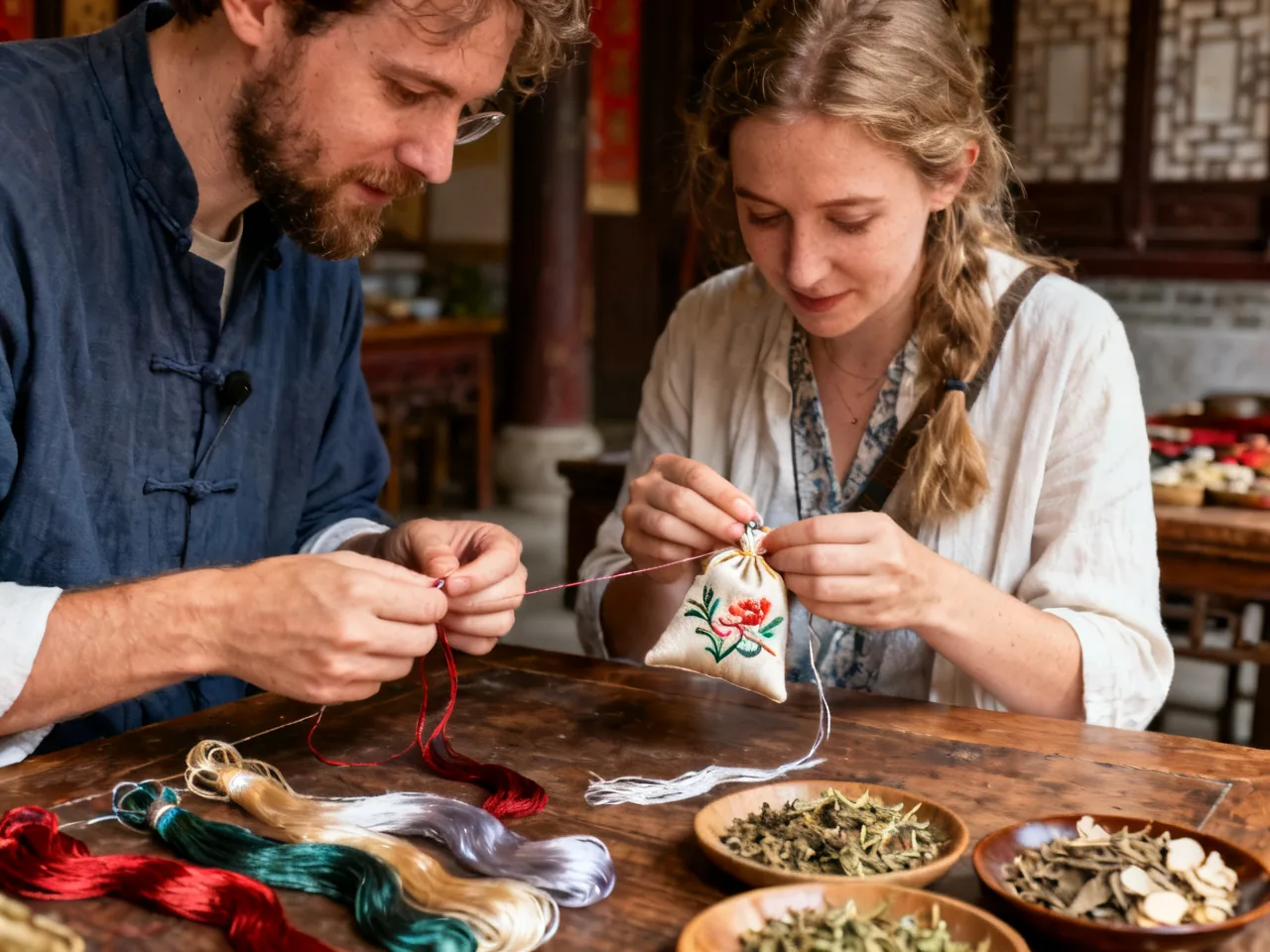
Once I began making one, I understood why small objects demand the most patience
The instructor chose a relatively simple design for me: two symmetrical fabric pieces sewn together, a small opening left for the aromatic filling, and then a tassel and cord added at the end. It sounded easy, yet it was not easy at all. The fabric pieces were small, the edges curved, and if my stitches were too large they looked clumsy. If they were too small, I slowed down too much and the thread kept tangling. I had always assumed that larger crafts were necessarily harder, but making a sachet changed that idea. The smaller the object, the less room there is for error. If the stitches tilt even slightly, the edges lose neatness. If the cotton or herbs are unevenly packed, the shape bulges awkwardly. If the tassel sits in the wrong place, the whole balance is disturbed.
The most interesting step was filling the sachet with aromatics. The instructor did not let me stuff everything in randomly. Instead, she asked me to think first about what kind of personality I wanted the scent to have. I loved that phrase. Apparently, a sachet has personality too. Some people prefer something cooling, others something gentle. Some want a distinctly seasonal herbal scent, while others want something closer to floral sweetness. This reminded me of the French attention to top notes, middle notes, and lingering accords. Yet the logic of the Chinese sachet felt much more closely tied to daily life and bodily comfort. It does not always pursue complexity. It values a plain, intimate, reassuring relationship with smell.
What impressed me most was how it combines use, decoration, and blessing in such a tiny form
When I finished mine and held it in my palm, my first thought was how small it really was. Yet precisely because it was small, it felt intensely condensed. Within it I could see fabric choice, neat stitching, fragrance selection, symbolic shape, and the method of wearing or hanging it. Many folk crafts let you feel beauty first and function later. The sachet intertwines beauty and use from the very beginning. It can be smelled and seen. It can sit on a child’s clothing, hang from a bag, rest in a room, or become part of a seasonal gift. Unlike some decorative objects that exist mainly for display, this one is meant to enter life, to travel with the body, and to be sensed physically.
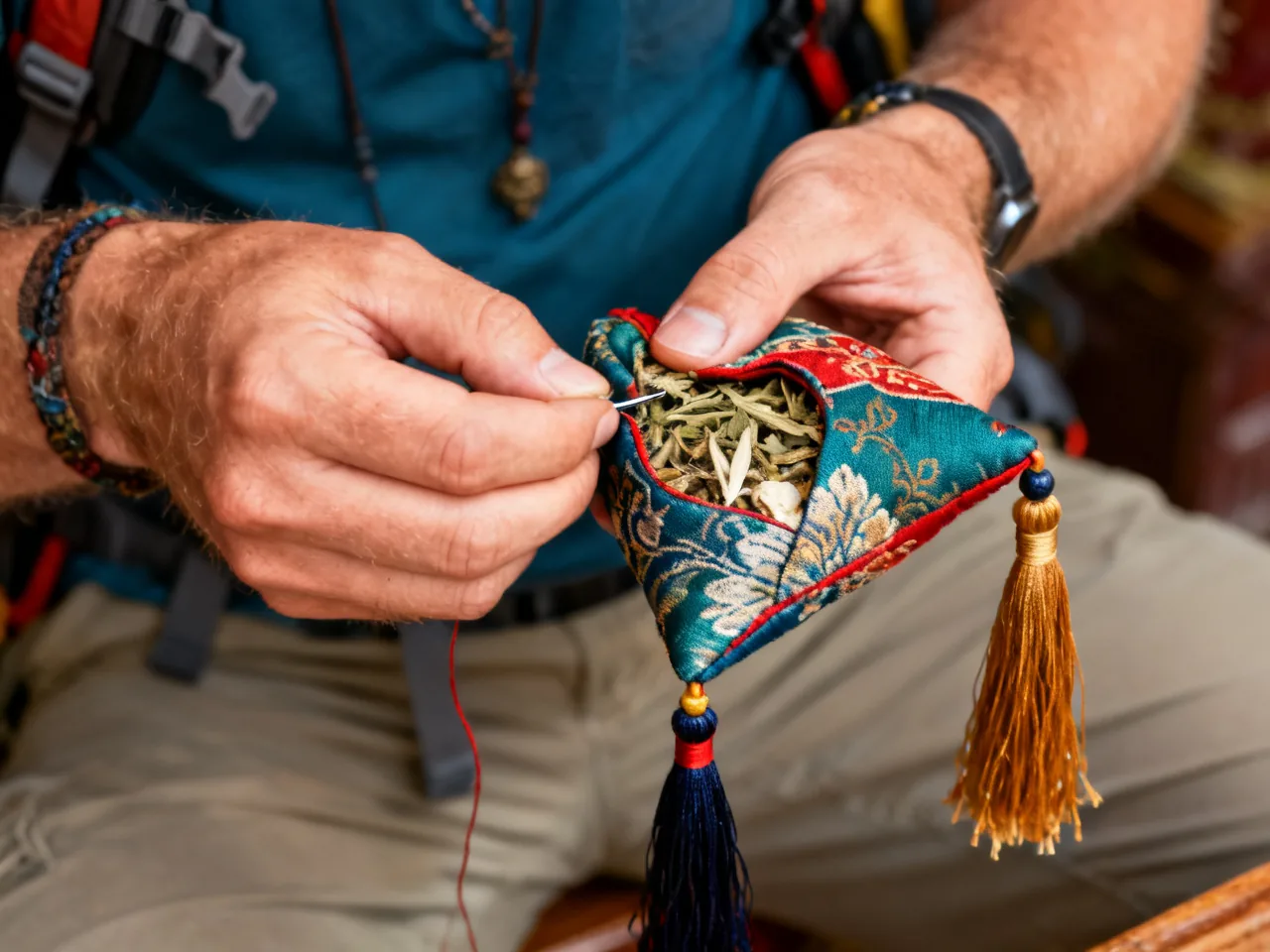
The instructor also showed us more complex sachets: some were shaped like little animals, some had layered petal structures, and some were covered with very intricate embroidery. At that point I understood even more clearly that although the craft is small in scale, it is not simple. Behind it stand women’s needlework traditions, seasonal customs, children’s adornment culture, auspicious imagery, and generations of herbal knowledge. A traveler can certainly pick one up at a market and think it is charming. But once you have sewn one yourself, you understand that the charm is being held up by a great deal of patience.
Compared with French sachets, it feels more outward and more narrative
If I had to compare it to something from home, I would say French sachets are often quieter. They tend to stay in drawers, wardrobes, near the bed, or elsewhere in interior space, serving mainly to scent, protect, or soften everyday life. They can certainly be beautiful, but that beauty is often restrained. Chinese sachets, by contrast, are more willing to show themselves. They often use strong color contrast, tassels, knots, and symbolic shapes meant to be recognized at a glance. They are made to be hung, worn, and given. This outwardness is not excessive. It is a distinctly folk way of expression: making blessing visible and turning feeling into something concrete.
Perhaps that is exactly why I think Chinese sachets are so rewarding for travelers. They do not overwhelm you the way a massive building or a spectacular performance might. But once you sit down and make one, you quickly realize that Chinese folk culture has a remarkable ability to turn abstract things—fragrance, season, safety, blessing—into small intimate objects that can be carried on the body. For me, that means much more than buying a souvenir. It reveals how tradition actually enters daily life.
If you encounter sachets while traveling in China, do not just smell them and move on
Now, when I see sachets again in markets or folk museums, I no longer treat them simply as nice-smelling little ornaments. I first look at the shape and guess what blessing it might express. Then I study the stitching and color choices and imagine how much time went into making it. Only after that do I lean in to smell it and sense whether the filling is cooling, gentle, or distinctly festive. This craft taught me something important: the most moving folk arts are not necessarily those made from expensive materials or those built on a grand scale. Often they are the ones that use simple means to make everyday life feel a little more meaningful.