中国最美の高速鉄道路線トップ5:車窓がそのまま風景
In China, a high-speed rail ticket is more than just a ride — it’s a front-row seat to some of the most dramatic landscapes on Earth. Trains slicing through karst pinnacles at 350 km/h, gliding past alpine lakes, and threading through mist-shrouded gorges: every route tells a geological story millions of years in the making. We’ve ridden them all and distilled the experience into five routes worth traveling for, complete with train numbers, fares, and the exact seats to book for the best views.
Hangzhou–Huangshan HSR
The Hangzhou–Huangshan line packs three UNESCO-tier landscapes into 265 km and 86 minutes. Departing Hangzhou East, the skyline dissolves into terraced tea plantations within minutes. After Jiande, Qiandao Lake explodes into view — 1,078 emerald islands scattered across 573 square kilometers of impossibly blue water. Then comes a staccato rhythm of tunnels through southern Anhui’s mountains, each exit revealing a new postcard: seas of cloud, bamboo forests, whitewashed Huizhou villages glowing in slanted light. The finale is Huangshan North, gateway to the granite dreamscape that has inspired Chinese painters for a thousand years.
Practical Info: Take G7401 (Hangzhou East 07:10→Huangshan North 08:36), 2nd class ¥130, 1st class ¥207. Best seat: D (right window) — Qiandao Lake views are on the right side. Best seasons: March–April rapeseed bloom, November autumn foliage.
Guiyang–Guangzhou HSR
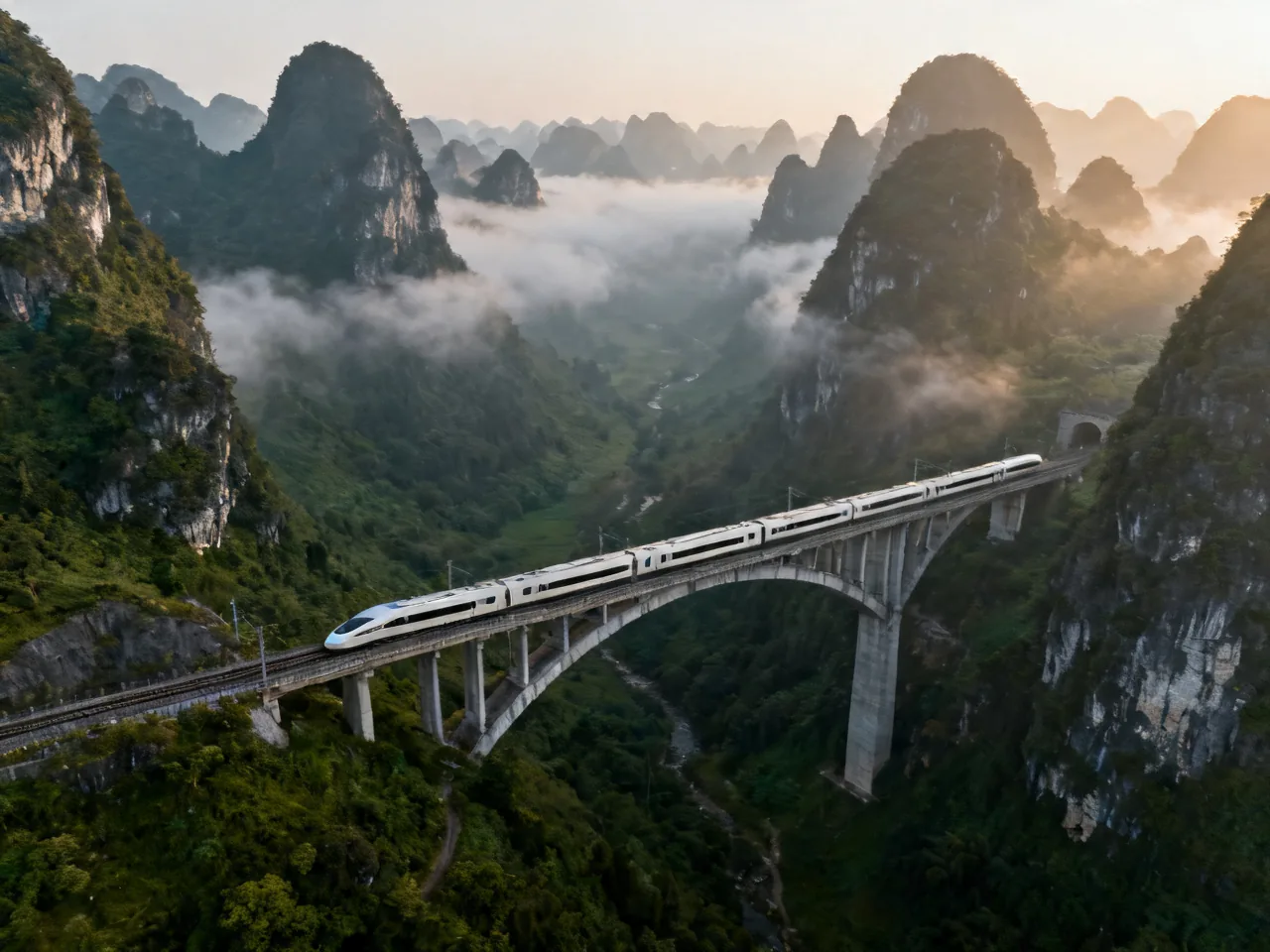
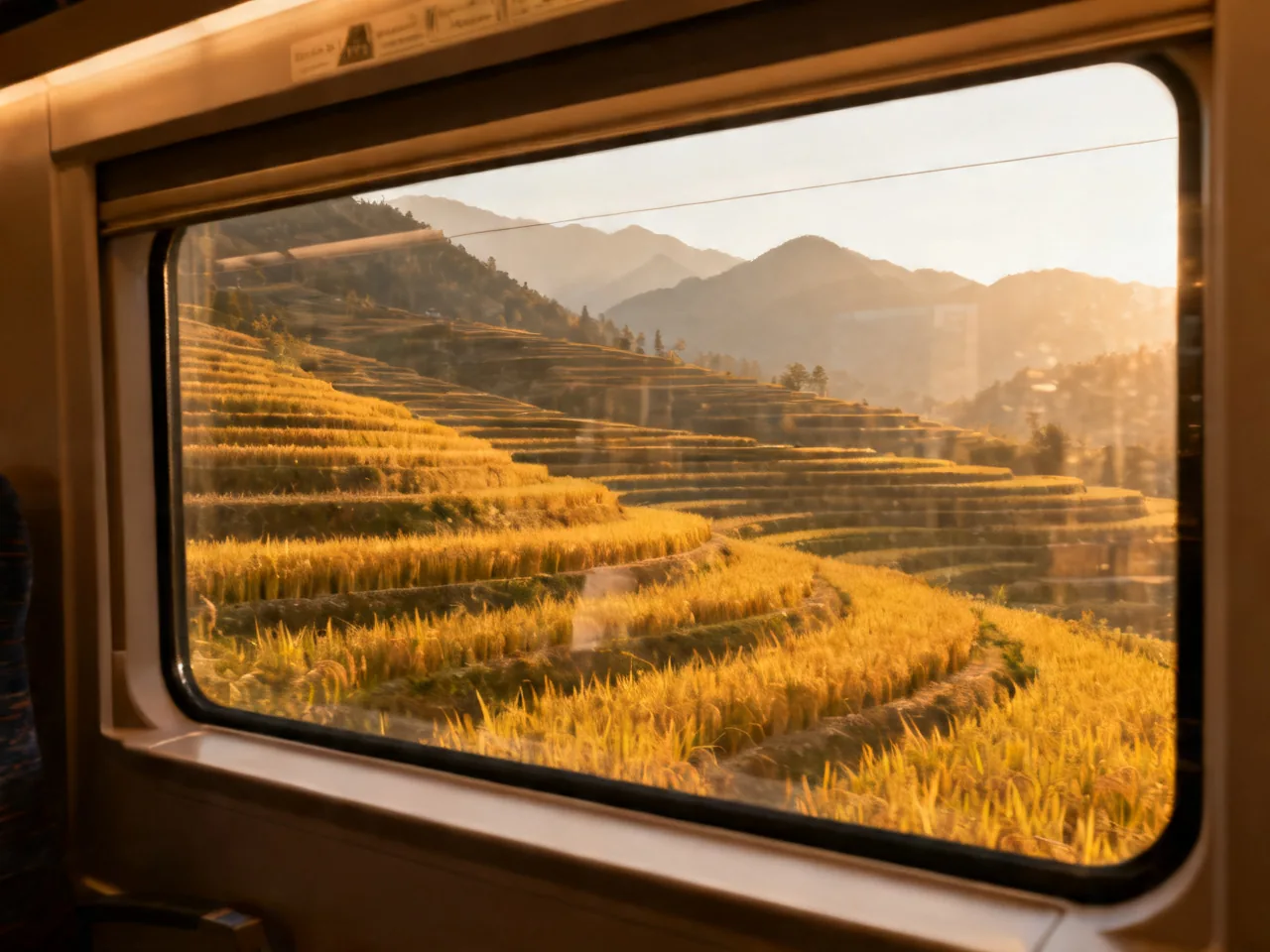
If the Hangzhou–Huangshan line is a silk scroll, the Guiyang–Guangzhou HSR is a geological assault on the senses. Across 857 km and roughly 4 hours, the train plunges from the Yunnan-Guizhou Plateau to the Pearl River Delta, dropping over 1,000 meters in elevation. The engineering alone is staggering: 238 tunnels and 510 bridges, an 83% tunnel-and-bridge ratio that makes it feel like threading through the Earth’s ribcage. Each tunnel exit is a dramatic reveal — cone-shaped karst peaks, sinkholes, terraced rice paddies cascading down to Miao minority villages. By Yangshuo station, you’re deep inside the Guilin karst landscape — those peaks on the back of China’s ¥20 banknote are right outside your window.
Practical Info: Take D2807 (Guiyang North 08:10→Guangzhou South 12:22), 2nd class ¥267, 1st class ¥321. Best seat: A (left window) — karst peaks are mainly on the left. Best seasons: April–June terraced field flooding, September–October golden rice waves.
Chengdu–Guiyang HSR
The Chengdu–Guiyang HSR is China’s most underrated scenic ride. Over 648 km and about 3 hours, the train departs the Sichuan Basin, climbs over the Wumeng Mountains, and traverses the northern edge of the Yunnan-Guizhou Plateau. The showstopper is the Yibin–Bijie section: the train skirts the Jinsha River valley at 250 km/h, passing sheer gorges hundreds of meters deep, red sandstone cliffs glowing like embers in the sun. After Weixin station, alpine meadows and rhododendron seas drift in and out of cloud. The heart-stopping moment comes crossing the Yachi River Bridge — the deck sits roughly 300 meters above the water, the train suspended between vertical limestone walls. It may be the most dramatic five seconds on any railway in China.
Practical Info: Take G2981 (Chengdu East 08:00→Guiyang North 11:13), 2nd class ~¥260, 1st class ~¥416. Best seat: D (right window) — Jinsha River gorge views on the right. Best seasons: May rhododendron bloom, October–November autumn leaves.
Lanzhou–Urumqi HSR
The Lanzhou–Urumqi HSR stretches 1,776 km — the world’s longest single-build high-speed line and the only bullet train through the Gobi Desert. The 8-hour journey is a time-lapse of China’s geological autobiography: loess plateau ravines give way to the Hexi Corridor’s oasis cities, then to the austere grandeur of the Gobi, culminating in the snow-crowned Tian Shan. Past Zhangye West, the Qilian Mountains run parallel to the south — an unbroken wall of glaciated peaks above remnants of rainbow Danxia landforms. Through Jiayuguan, civilization’s edge hits you viscerally: the westernmost watchtower of the Great Wall flickers past, then nothing but wind-sculpted yardang formations and gravel desert for hundreds of kilometers. This is not just a train ride — it’s a 2,000-year Silk Road conversation compressed into a single afternoon.
Practical Info: Take D2711 (Lanzhou West 08:05→Urumqi 16:18), 2nd class ~¥530, 1st class ~¥850. Best seat: A (left window) — Qilian snow peaks on the south side. Best season: June–September for maximum contrast between snow mountains and oasis greenery.
Hefei–Fuzhou HSR
The Hefei–Fuzhou HSR covers 852 km in about 3.5 hours and has been crowned “China’s most beautiful HSR” by photographers for good reason. Departing Hefei South, the train threads through three mountain ranges spanning southern Anhui, northeast Jiangxi, and northern Fujian — the densest UNESCO heritage corridor in eastern China. Huangshan, Sanqing Mountain, Wuyi Mountain, and the ancient villages of Wuyuan line up along the route like pearls on a string. Soaring over Wuyuan’s rapeseed fields, whitewashed villages dot a sea of gold below; plunging into the Wuyi Mountains, the Nine Bends River winds emerald-green through Danxia gorges. In 2025, China Railway added seasonal “flower-viewing specials” during rapeseed season, letting passengers hop off at Wuyuan and continue south the same day.
Practical Info: Take G355 (Hefei South 07:41→Fuzhou 11:15), 2nd class ~¥340, 1st class ~¥545. Best seat: either A or D — scenery alternates between both sides. Best seasons: mid-March to April for Wuyuan rapeseed, October–November for autumn foliage. Book at 12306 official booking site.
A Final Word
China’s HSR network now exceeds 45,000 km, spanning nearly every landform from tropical rainforest to permafrost tundra. Next time you book a train, don’t just look at the destination — look out the window. Sometimes the best scenery isn’t where you’re going; it’s how you get there. Our suggestion: link at least two of these five routes into a “scenic rail loop.” Start in Hangzhou, ride the Hangzhou–Huangshan line to the Yellow Mountains, then switch to the Hefei–Fuzhou HSR down to Fujian — Qiandao Lake, Huizhou villages, and Wuyi Mountains in a single, unforgettable arc.