陶芸教室での半日——なぜひと塊の泥にも「火を経たあとの性格」があるのか、初めて知った
- Folk Art
I had always assumed that the charm of pottery lay mainly in the finished object. As a foreigner from Japan, I grew up surrounded by ceramic ware: rice bowls, teacups, little plates, and trips to kiln towns or craft exhibitions were never unfamiliar to me. We are used to discussing vessel shape, glaze color, and hand feel, and it feels natural to compare whether one cup is better suited to tea than another. But the first time I truly sat down in a pottery workshop in China and pressed both hands into a lump of wet clay, I realized that the real fascination of ceramics is not only how beautiful the final piece looks. It lies in how earth, hands, rotation, and fire gradually turn a thing into a personality.
Once I sat at the wheel, I understood why roundness is so difficult
The instructor first demonstrated wheel throwing. She slapped the clay onto the center of the wheel, steadied it with her palms, adjusted the speed with her foot, and the lump that had looked heavy and stubborn suddenly became calm, almost obedient. She centered it, lifted it upward, then opened the middle, and the shape of a small bowl seemed to grow almost by itself out of the rotation. Watching from the side, I briefly made the mistake of thinking pottery might be more intuitive than I had imagined. But the moment I sat down myself and touched the clay, I immediately understood that it was nothing like that.
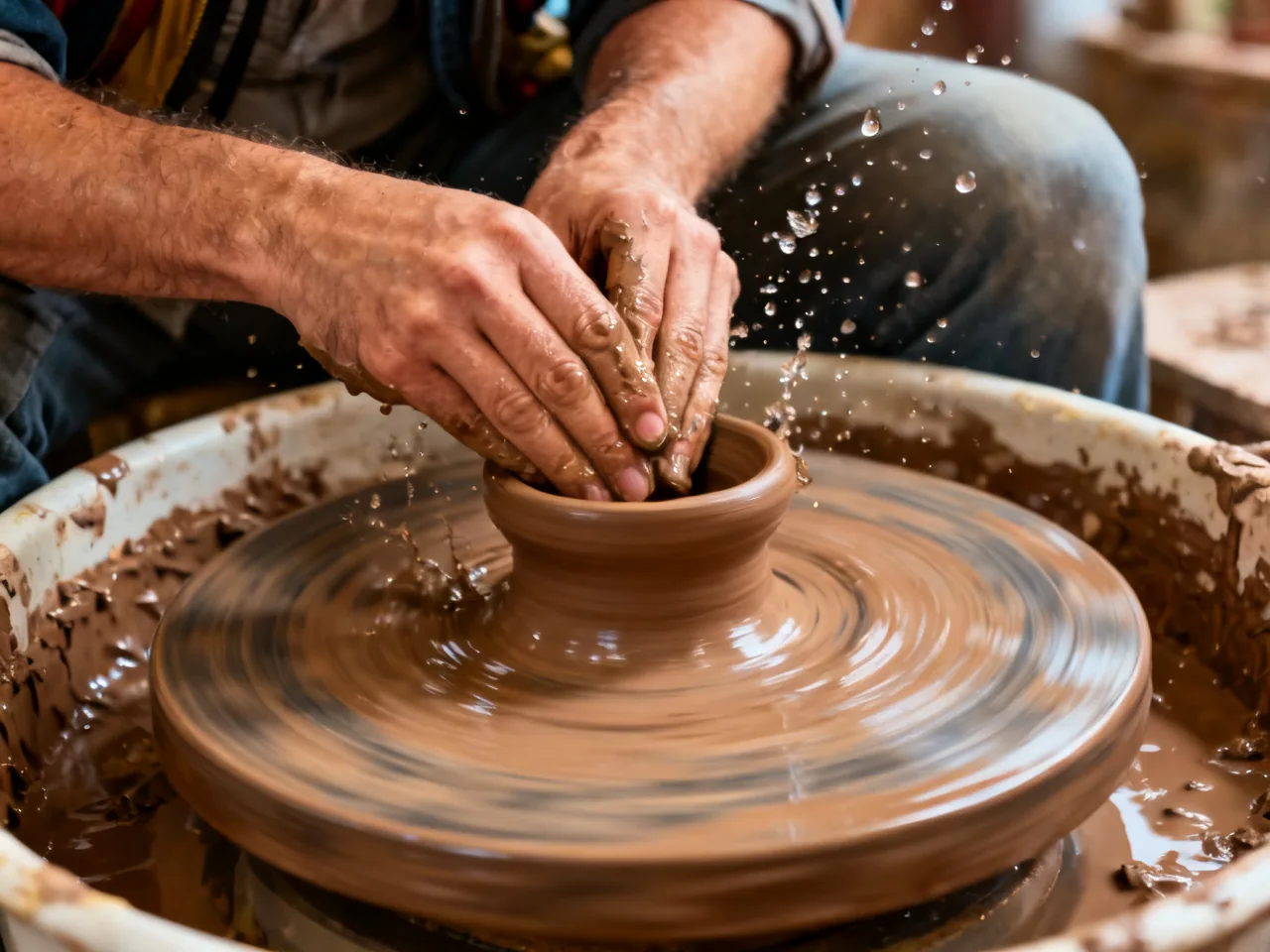
If the clay was even slightly off center, it began to wobble. If the pressure in my hands became uneven, the wall thickness changed immediately. I had intended to make a small cup, but the opening grew wider and wider until it nearly became a crooked bowl. What made me especially nervous was that pottery does not let you pause and reconsider in the same way drawing sometimes does. The wheel moves, the clay moves, and your hands must remain stable within that movement. For those few minutes, I felt less like I was making something and more like I was negotiating with a force that had not yet agreed to become a form.
What impressed me most was how often the instructor said, “Don’t fight the clay”
Seeing my hands grow stiffer and stiffer, the instructor smiled and reminded me not to fight the clay, but to let it settle first inside my hands. I kept remembering that sentence afterward. Many traditional crafts can make outsiders assume that technique means controlling material with more force, more precision, and more speed. Pottery felt like the opposite. If the clay is too soft, you cannot rush it. If the wall has already become thin, you cannot force it further. If the rim starts collapsing slightly, sometimes the best decision is not to keep correcting it, but to accept that it is already moving in another direction. In other words, this craft does not reward brute force. It rewards judgment and restraint.
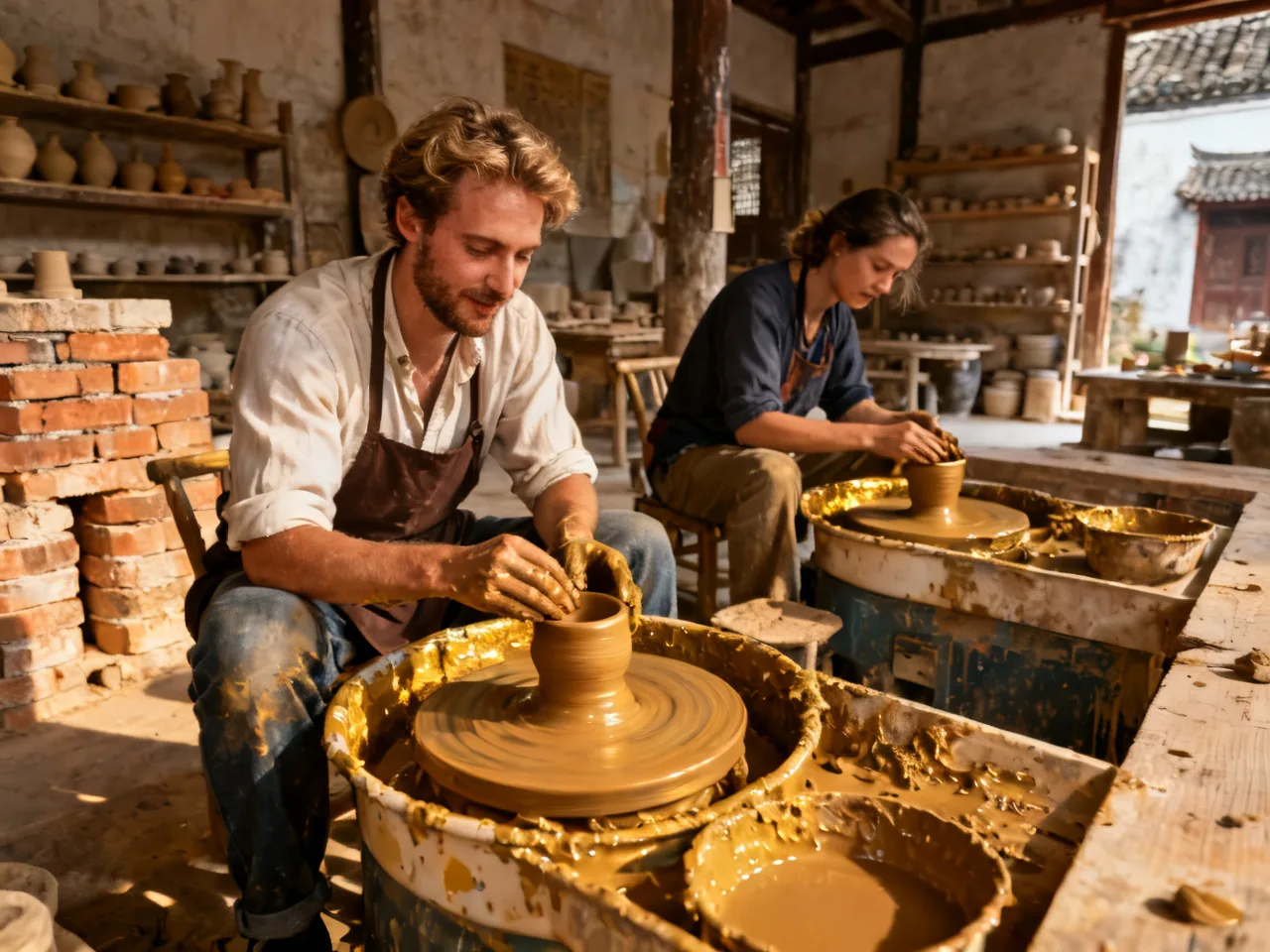
When I tried making a second piece, my attitude had clearly changed. I stopped trying so hard to force the shape into some ideal standard and paid more attention to the clay’s moisture, the speed of rotation, and the exact position of my fingers. The result was still far from perfect, but the lines of that second cup felt much more natural than those of the first. In that moment I suddenly understood why people often say pottery makes a person calmer. It is not mystical, and it is not performative therapy. It is simply that the moment you become impatient, the clay exposes your impatience immediately.
What moved me most in Chinese pottery was how closely it remains tied to use
The workshop displayed not only practice pieces but also many fired objects: bowls, teapots, cups, plates, and small jars, some with glaze variation and marks left by the kiln fire. They did not carry that overly self-conscious attitude of wanting to prove themselves “refined.” Instead, they made it easy for me to imagine them actually sitting on a dining table, a tea setting, or in a kitchen corner. What I especially love about Chinese pottery is that it rarely pushes itself completely into a distant zone of pure contemplation. Even when a vessel is beautiful, it often still preserves a sense of invitation, as if it were saying: please pick me up and use me.
The instructor also let us handle sample pieces made from different clay bodies and finished with different glazes. Rougher clay felt more grounded in the hand. Finer pieces made the rim feel lighter. Some glazes did not look dramatic at first glance, yet gradually revealed layers under the light. That made me realize that the beauty of pottery is not always strongest in the first instant. Very often, it is more like a relationship that grows through use. On the first day you merely find a vessel comfortable to hold. A few days later you begin to like its weight. And after some time, you may even become attached to it precisely because of a small imperfection.
It reminded me of Japanese ceramics, but the quietness of the two traditions is not exactly the same
Because I come from Japan, I naturally compared this experience with the ceramic culture I know from home. Japan also places great value on the relationship between pottery and daily life. Many vessels similarly emphasize hand feel, seasonality, and the changes that emerge through use. We too are accustomed to appreciating forms that are not fully symmetrical, and we often regard traces of the hand as part of an object’s life. So before entering this pottery classroom in China, I assumed I was already fairly familiar with this kind of material.
But after real contact, I still felt a clear difference. Japanese ceramics often make me think first of a more inward, restrained, and individually felt quietness. Chinese pottery, at least in this workshop and in the vessels I saw there, felt closer to a quietness in which life is actively happening. It is not a silence withdrawn far from the world, but a composure that still carries food, tea, domestic warmth, and hospitality. In other words, Japanese pottery can sometimes feel as if emotion has been gathered inward into the vessel, while Chinese pottery feels more as if the vessel remains at the center of life and yet stays steady.
This is not a matter of one being better than the other. In fact, it made me appreciate both traditions more. They both value use, respect material, and accept that fire produces changes no one can fully control, yet the character that emerges at the end is different. One more readily makes me think of seasonality and emptiness; the other more readily makes me think of the dining table, the tea table, and exchanges among people. That is why Chinese pottery felt not foreign to me, yet still entirely fresh.
Once the pieces were headed for the kiln, I seriously understood why firing matters so much
The most frustrating and also the most fascinating part of the workshop was precisely that I could not see the ending immediately. The instructor explained that the real transformation often happens after the piece enters the kiln: the clay shrinks, the color changes, the glaze flows, and a form that looked ordinary before firing may suddenly become vivid, while the piece you considered safest may produce an unexpected result because of temperature and placement. Hearing her explain this, I felt that pottery differs from many other crafts. You can participate in the first half, but you cannot completely control the second. The final object is completed not only by the hand, but also by fire.
That idea fascinated me. It means that pottery does not simply press the maker’s will entirely onto the material. It always leaves a final space in which one must wait to see how the fire answers. As a traveler, I rarely feel so clearly in a short cultural activity that the result does not belong entirely to me. Yet that is exactly what makes pottery feel more truthful. It makes a person humble, and it teaches a person to wait.
If you encounter pottery while traveling in China, I strongly recommend touching the clay yourself
If a foreign friend asked me which Chinese folk art most easily leads a person from looking at an object to understanding a craft, I would happily recommend pottery. It is simply too direct. The moment you touch the clay, you understand why it is difficult. The moment the wheel turns, you understand why roundness is hard. The moment a form collapses, you understand why restraint matters more than stubborn force. More importantly, pottery changes the way you look at the most ordinary objects in life—a bowl, a cup, a teapot. Their quietness is not the result of simplicity, but of countless judgments already made behind that calm appearance.
For me, as someone from Japan who had mistakenly thought I already knew ceramics well, the most precious part of Chinese pottery was not that it introduced me to a completely unfamiliar material. It was that it made me rediscover familiar clay. The same earth, in different cultures, can be guided toward different tones of life; the same fire can produce different forms of composure. When I left the classroom, a little half-dried clay still clung to my hands, and I kept thinking that perhaps the most memorable thing was not the finished cup that would come later, but the fact that for the first time I understood why a vessel only truly begins to possess its own character after fire.