雨に洗われて明るくなった呼和浩特では、焼売店の門口の白い湯気までゆっくり見る価値がある
After the rain, Hohhot feels as if a gentle hand has polished it again. The morning clouds have not fully broken apart, and a gray-blue sky hangs low over buildings, treetops, and the slowly rising streets in the distance. The pavement remains damp; small puddles hold the color of the sky and the sound of passing footsteps. Walking slowly through the city alone, one begins to notice details that speed usually erases: raindrops left on the bus-stop sign, white steam rising from breakfast baskets, the curve made by an electric bike tire through shallow water, and the soft trembling light on poplar leaves by the roadside. Rain has not silenced the city. Instead, it has softened its voice. A passing car is no longer merely the roar of an engine, but a low line drawn across wet paper; even people’s conversations seem wrapped by the air, and a few short greetings carry a quiet warmth.
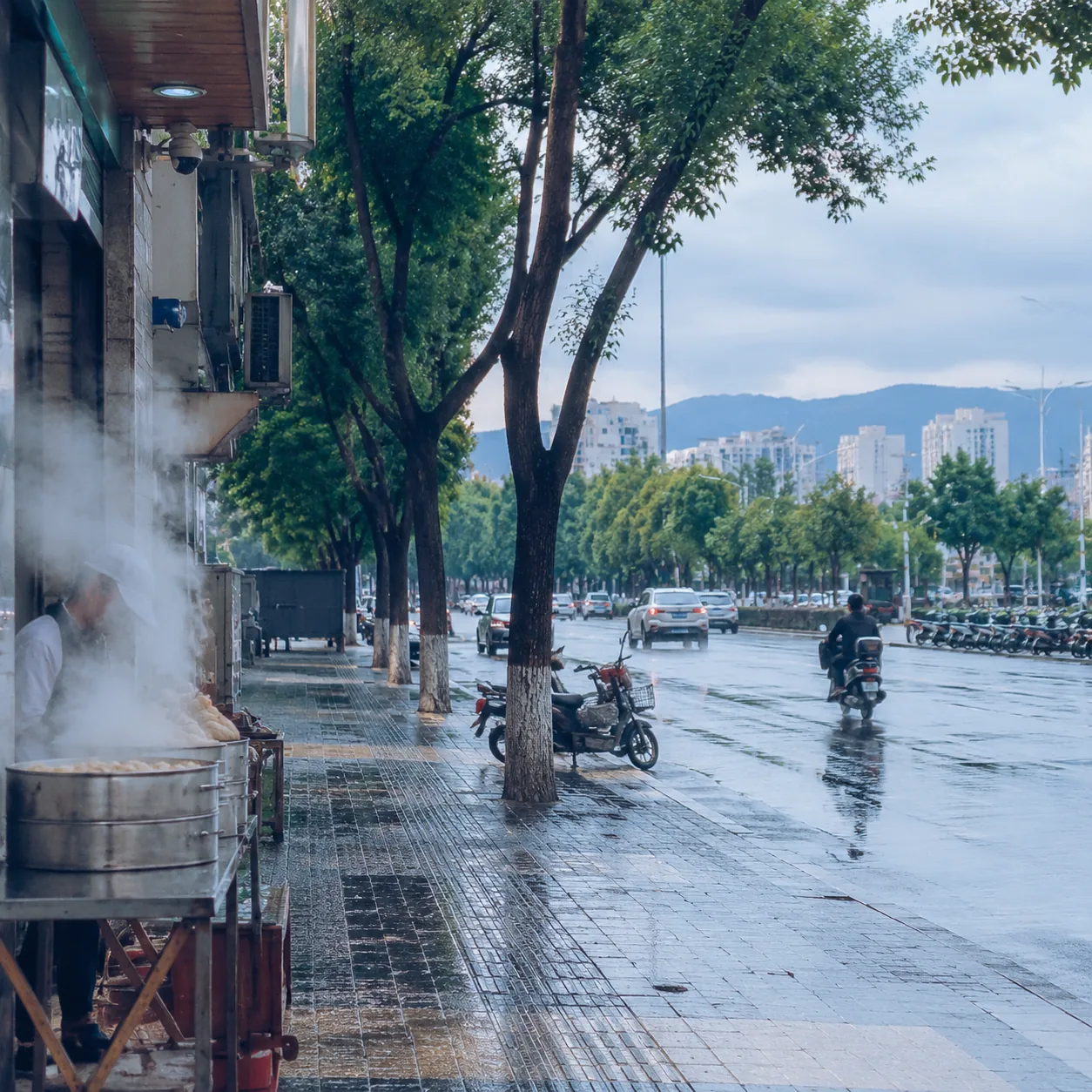
I begin on a street that is not very wide. Shops along the road open one after another, and the rolling shutters make a crisp sound as they are lifted, unusually clear in the wet morning. The shaomai shop becomes lively first. People wait at the entrance with phones or paper bags in their hands, yet their eyes often drift toward the rising steam. After rain, Hohhot has a plain and honest fragrance, like flour, hot tea, soil, grass, and wind from the distant grassland mixed together. It is not a strong scent; it appears only when one approaches slowly. The slower I walk, the more clearly each layer separates itself: freshly baked bread has a toasted aroma, milk tea has a salty richness, damp bark carries a faint bitterness, and the newly turned soil beside the road holds a coolness from deeper below.
The advantage of slow walking is that the feet are not rushing toward a destination. The city after rain is not in a hurry either. Traffic lights change patiently at intersections. Pedestrians carry half-dry umbrellas or fold them under their arms. Some roll up their trouser legs slightly to avoid puddles; others step through them, bringing up a small splash of sound under their soles. A young mother holds her child’s hand, and the child is always drawn to puddles, wanting to stop and see whether the buildings reflected inside belong to another city. An elderly person walks out of a residential gate with a vegetable basket, steady in pace, as if already familiar with the temper of every brick after rain. Everyone is moving through life, but the rain slows them down and allows the city to reveal a shape closer to itself.
Farther along the road, Qingcheng Park in the distance is wrapped in vapor. The trees are greener than usual, as if freshly washed out of memory. At the park gate, people practice tai chi, their movements slow and circular, like pushing aside an invisible layer of water in the moist air. On a nearby bench, two elderly people sit without hurrying to speak, simply watching drops fall one by one from the leaves. The quiet after rain is not empty. It is filled with tiny activities: birds shaking their feathers on branches, a sanitation worker sweeping fallen leaves into a pile, a bicycle bell arriving from the end of a path and being quickly absorbed by the trees. In such moments, the city feels like more than roads, buildings, and vehicles. It has breath, texture, and a patience brought back to the surface by rain.
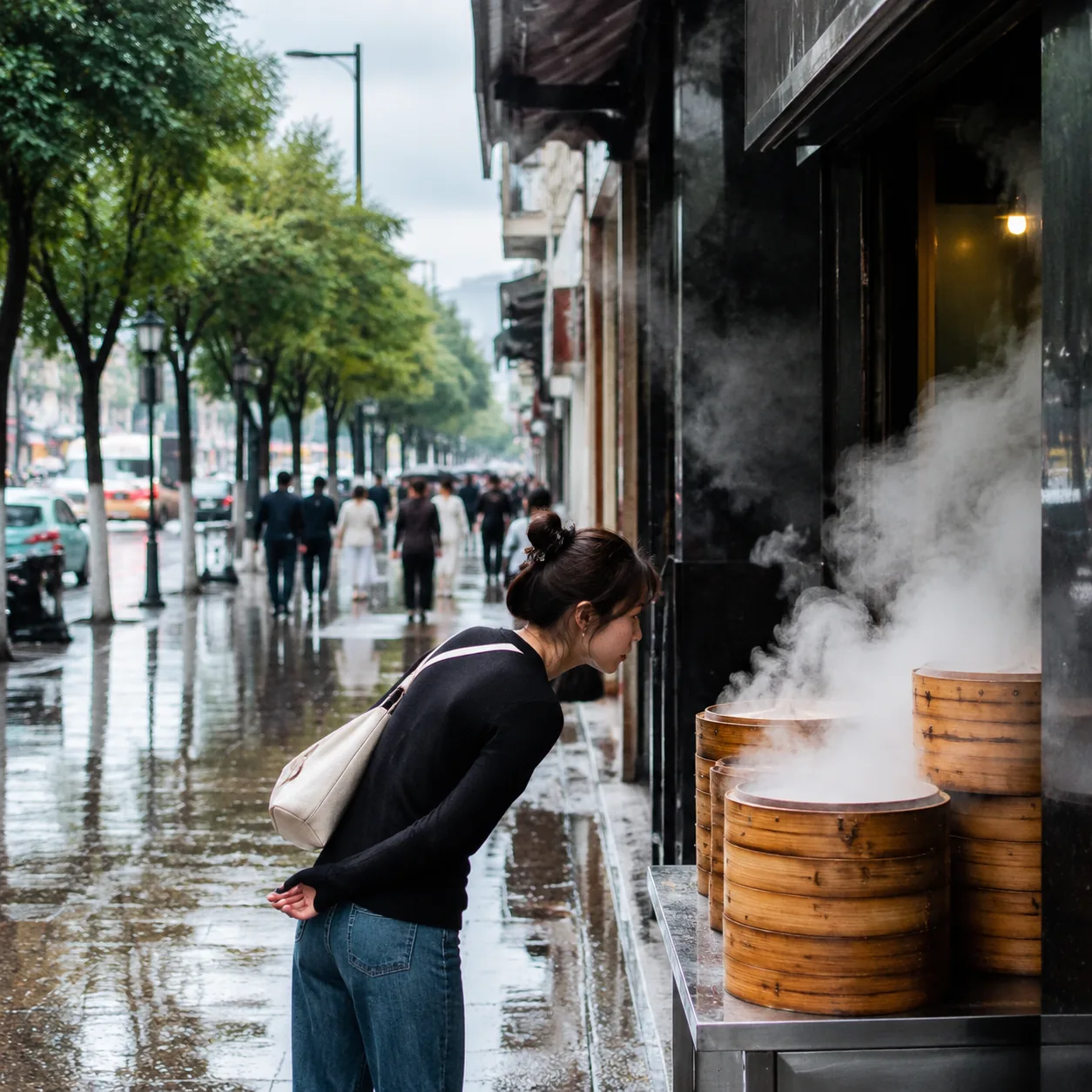
I keep walking slowly and pass a row of low shops. Rain marks still hang on the glass windows, making the figures inside slightly blurred. The light in a barbershop is on, and the owner is shaking out the doormat at the entrance. In front of a small supermarket, newly arrived fruit has been set out; apples, pears, and grapes all shine with water, as if delivered from a farther morning. A flower vendor moves bouquets outward, and the colors of roses and lilies are not harsh under the cloudy sky but calm and steady. Looking at flowers after rain, one feels that they do not bloom for excitement, but to remind people that delicate things are still worth approaching. Even a passerby can receive brief comfort from that little patch of color.
The streets of Hohhot often suggest vastness. Even in the urban center, surrounded by buildings and traffic, one may suddenly feel space opening at an intersection. Perhaps wind comes from the north, perhaps the clouds retreat into the distance, or perhaps a wider piece of sky appears at the end of the road. After rain, this sense of openness becomes clearer. The air is washed clean, distant outlines are less vague, and the city’s edges seem to stretch gently outward. A slow walker finds balance in this stretching: on one side is the concrete life nearby—breakfast, buses, shops, umbrellas, muddy water; on the other side is the larger background—grassland, sky, seasons, and wind. They do not conflict. They answer each other within the same pace.
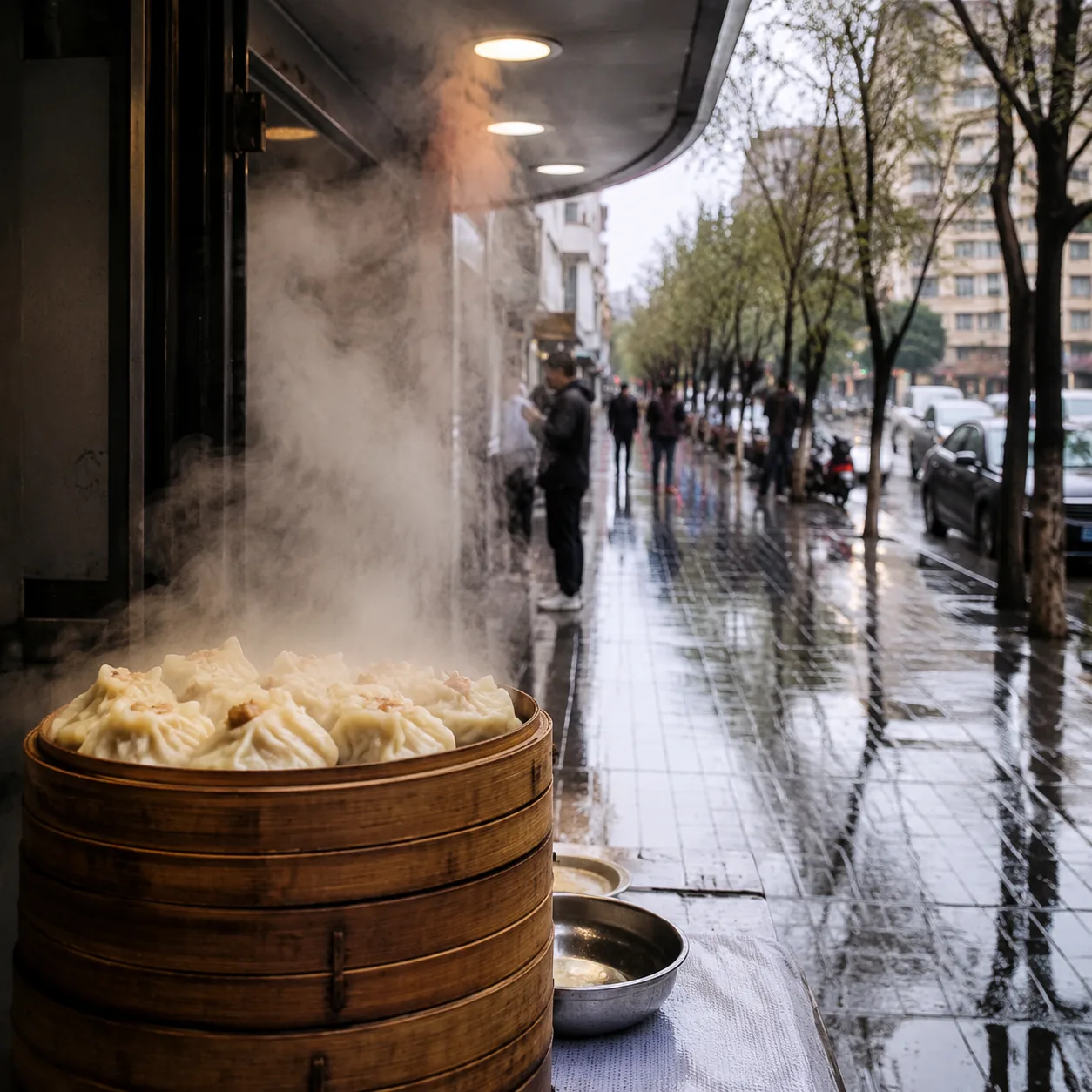
Stopping on a pedestrian bridge, I watch traffic passing below. Rainwater makes car roofs and windshields reflect a pale light, like a slowly flowing river. On the sidewalk, several students walk by with backpacks, their shoes occasionally touching drops of water. Office workers look down at the time, but their steps are a little slower than on sunny days. Tiny beads of water cling to the bridge railing, and a finger brushed across it gathers a bit of coolness. Distant buildings have no sharp edges, softened by the air after rain. From above, the city no longer appears as a fixed structure, but as a constantly moving relationship: people moving within it, cars passing through it, cloud shadows changing on glass, rainwater dripping from eaves to the ground and then being carried away by new footsteps.
Before noon, the light gradually brightens and gaps appear in the clouds. Puddles by the street begin to shrink, though they have not completely vanished. The slow walk after rain enters another stage: first coolness and quiet, then scents and colors, and finally the brief pause before life speeds up again. Many people have folded their umbrellas, the sounds inside shops grow louder, and waiting at intersections seems shorter. The city will soon return to its usual rhythm, but anyone who has walked through this period knows it once existed in another way. Rain temporarily gives every wall, every leaf, and every paving stone a clearer expression, and slow walking gives those expressions a chance to be seen.
I think a slow walk after rain is not merely a combination of weather and pace. It is more like a way of seeing a city. Usually we hurry from one place to another, and the city becomes background; after rain, when we slow down, the background steps forward and becomes something we can speak with. In such moments, Hohhot reveals its generous side: unshowy, unhurried, carrying the breadth of a northern city and the fineness of daily life. It allows wind to pass through streets, clouds to rest above rooftops, and people to recover their own rhythm between a bowl of hot milk tea and a damp stretch of road. As I walk, my heart seems washed like the pavement. Dust will settle again, of course, but for this moment it is clear.
By noon, the sun finally shows a little from behind the clouds. It does not brighten the whole city at once, but places a few highlights on building corners, car windows, and the edges of leaves. Rainwater slowly evaporates, and a slight warmth enters the air. Someone by the street moves damp cardboard boxes into a patch of sunlight; children pass after school, their laughter pushing the earlier quiet farther away. My steps remain unhurried, because Hohhot after rain has not completely left the morning. It is like a song whose resonance still lingers, the final notes falling onto water and spreading gently. Looking back at the road I have walked, the puddles, tree shadows, steam, and human voices have become an invisible line, reminding me that slowing down is not a waste of time, but a way of returning time to the senses.
When I think of this walk again in the evening, what remains in memory is not a single clear landmark, but a series of damp fragments. They have no grand plot, yet they leave a long aftertaste: a shopkeeper bending to wipe the threshold, a child staring into a puddle, a sparrow lifting from a signboard, a bus stopping and splashing tiny drops. The beauty of a city is sometimes not far away or high above, but within ordinary moments slowed by rain. A slow walk through Hohhot after rain makes one believe that life does not always need to be chased. Often, if one is willing to slow down, a familiar street will unfold again, like a book just opened by rain, every page holding a new light.