福建土楼と海岸線7日間の旅
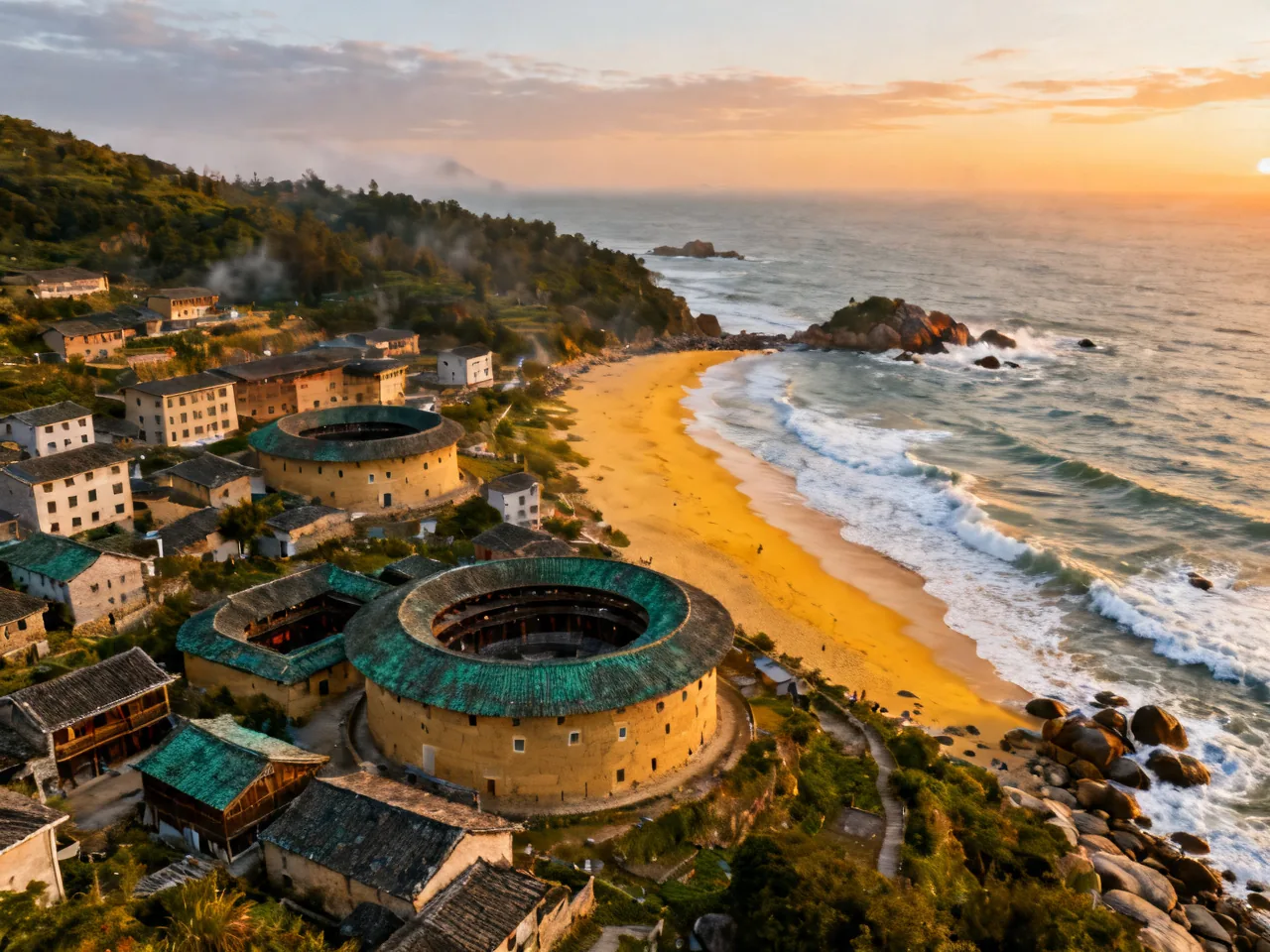
Tulou are earthen castles built by the Hakka people — from above they look like donuts dropped into mountain valleys. Travel down Fujian’s coastline and you’ll find this province far more diverse than you imagined.
Why This Route
Fujian Tulou are UNESCO World Heritage sites — circular and square rammed-earth building clusters scattered across southwestern Fujian’s mountains, China’s most unique residential architecture. Fujian’s coastline from Quanzhou to Xiamen to Zhangzhou connects the Maritime Silk Road’s starting point, Gulangyu, and Dongshan Island. Seven days from mountains to coast covers Fujian’s essence.
Day-by-Day Itinerary
Days 1–2: Nanjing/Yongding Tulou
From Xiamen or Zhangzhou to Nanjing Tulou (~3 hours by road). Nanjing Tulou cluster (¥90) includes Tianluokeng (“four dishes and a soup” — four round buildings surrounding one square building, looking like a table setting from the viewing platform) and Yuchanglou (the “crooked building” — all pillars lean at angles yet it’s stood for 700 years).
Day 2: Yongding Tulou (¥90) — Chengqilou is the largest circular tulou, four concentric rings, outermost diameter 73m, once housing 800+ people. Walk inside and look up — four stories of circular corridors nest like tree rings. Residents still live in tulou; you can drink tea inside and buy homemade persimmon cakes and tea from tulou families.
Day 3: Tulou to Quanzhou
Morning: depart for Quanzhou (~4 hours). Quanzhou became a UNESCO World Heritage city in 2021 — during the Song-Yuan period it was one of the world’s largest ports; Marco Polo called it “Zayton, City of Light.” Afternoon: Kaiyuan Temple (free) — Quanzhou’s oldest temple, its twin East-West pagodas are the city’s symbol. Inside: a 1,300-year-old mulberry tree.
Evening: West Street and Clock Tower — Quanzhou’s most vibrant old quarter. Mianxianhu (Quanzhou’s breakfast staple), tu sun dong, vinegar pork, runbing (southern Fujian spring rolls) — street-side shops are more authentic than restaurants.
Day 4: Quanzhou In-Depth
Morning: Quanzhou Maritime Museum (free) — learn about Quanzhou as the Maritime Silk Road’s starting point. Collections include Arab merchant tombstones, ancient ship models, and religious relics from multiple faiths. Then Qingjing Mosque (¥3) — one of China’s oldest surviving Islamic mosques, built in 1009, with well-preserved Arabic-style stone gateway.
Afternoon: Xunpu Village — a fishing village near Quanzhou where Xunpu women wear “zanhua wei” (fresh flower headdresses), a tradition maintained for centuries. Tourists can now experience zanhua (¥30–50) — wear a head full of fresh flowers and photograph in front of oyster-shell houses (walls built from oyster shells).
Day 5: Quanzhou to Xiamen Gulangyu
Morning HSR to Xiamen (~30 min). Afternoon: ferry to Gulangyu (round trip ¥35, ~20 min). Gulangyu is small — walkable in 2–3 hours. Sunlight Rock (highest point), Shuzhuang Garden, and Organ Museum are must-sees. No motor vehicles on the island — just piano music and waves.
Day 6: Xiamen & Dongshan Island
Morning: Nanputuo Temple (free) and Xiamen University (reservation required). Afternoon: drive to Zhangzhou’s Dongshan Island (~3 hours) — one of Fujian’s most beautiful islands, much quieter than Gulangyu. Evening: Jinluan Bay for sunset — long beach, few people, clean water.
Day 7: Dongshan Island & Departure
Morning: Wind-Moving Stone Scenic Area (¥60) — a massive boulder perched on a cliff edge, swaying slightly in wind yet standing for millennia. Dongshan’s icon. Then Tongling Ancient City — a Ming Dynasty anti-pirate fortress with well-preserved walls and Guan Di Temple. Lunch: Dongshan baby squid and seafood congee. Afternoon: depart.
Practical Notes
Best season: March–May and October–December. Fujian summers are hot with typhoons. Tulou are visitable year-round but mountain roads are slippery in rainy season (March–June).
Budget: ~¥4,000–7,000 per person for 7 days (excluding intercity transport). Quanzhou and Zhangzhou are affordable; Xiamen/Gulangyu are pricier.
Bottom Line
Fujian tulou show what miracles Chinese people built from earth; the coastline shows how open China once was, facing the sea — this route cultivates both inner and outer.
Related Reads
- 10-Day East China Five-City Loop
- Lijiang Old Town: Naxi Culture & Snow Mountain Views
- Zhangjiajie Glass Bridge & Tianmen Mountain Guide
- Guilin Li River Scenic Tour Complete Guide
- Spring Bloom Map: China’s Most Beautiful Flower Fields