Under Nanjing’s Plane Trees, I Learned City Memory Is Not a Slogan
At first glance, Nanjing’s plane trees invite the usual romantic reading: leaves stitching broken shadows across the road, the wind turning an avenue into a strip of old film. Yet what held me on the edge of Zhongshan Road was not the beauty of the canopy. It was the way people used the city beneath it. Scooters gathered where the shade was deepest. An older woman rested her vegetable basket against a root. A delivery rider leaned on his seat and answered messages. Visitors looked up for photographs while locals kept their eyes on the crossing. The trees did not announce memory, but they received ordinary gestures all day long.
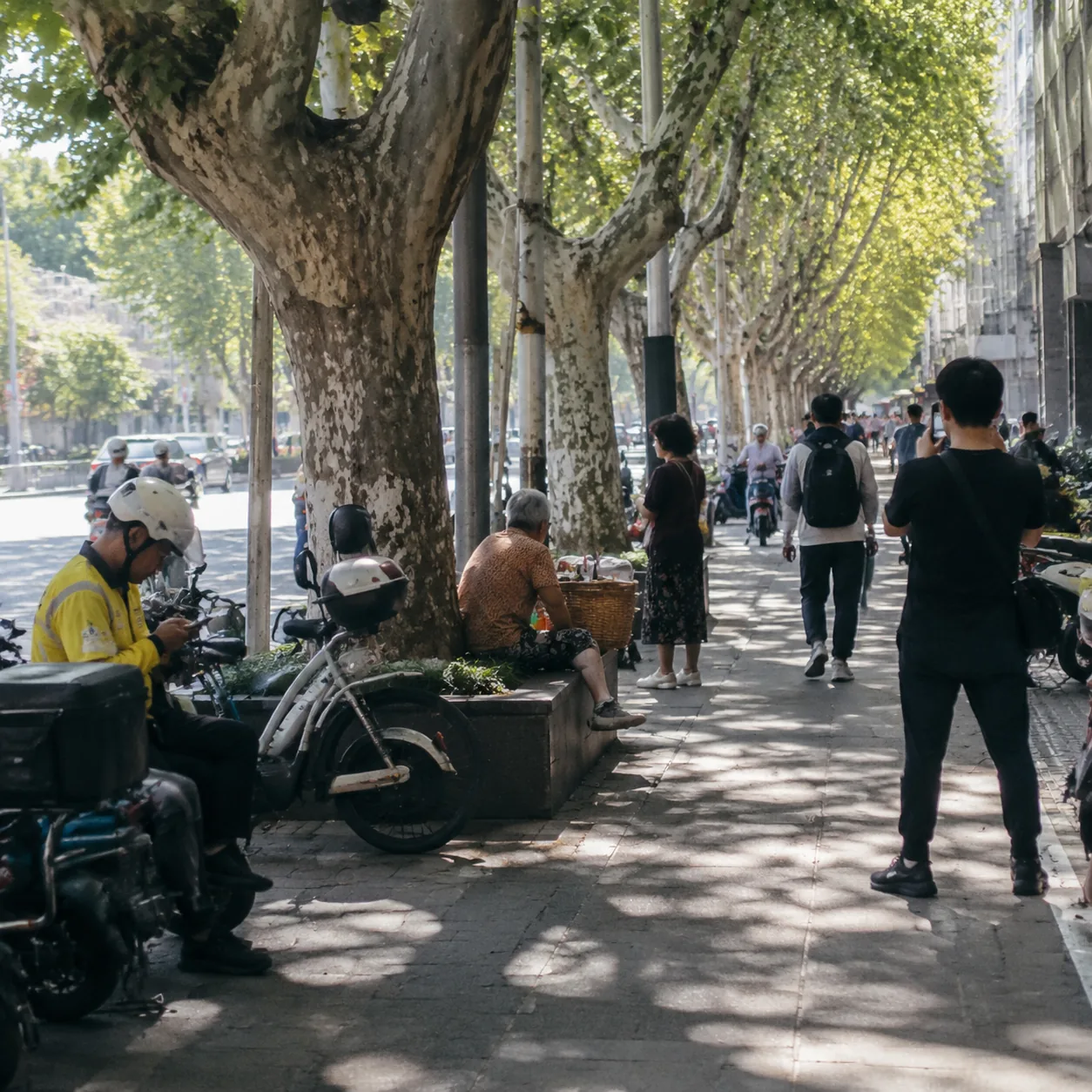
I began to treat the walk as a small field note. The first layer of memory was underfoot: roots had lifted the bricks, the pavement was not perfectly even, and pedestrians slowed almost naturally, as if the city were asking them not to move only at the speed of efficiency. The second layer was in the ear: bus announcements, bicycle bells, the sound of shop shutters, all blended with the rustle of leaves. The third layer was on the skin: step from sunlight into shade and the body cools before the mind names the change. City memory is not a souvenir locked in a display case. It begins as a difference the body recognizes.
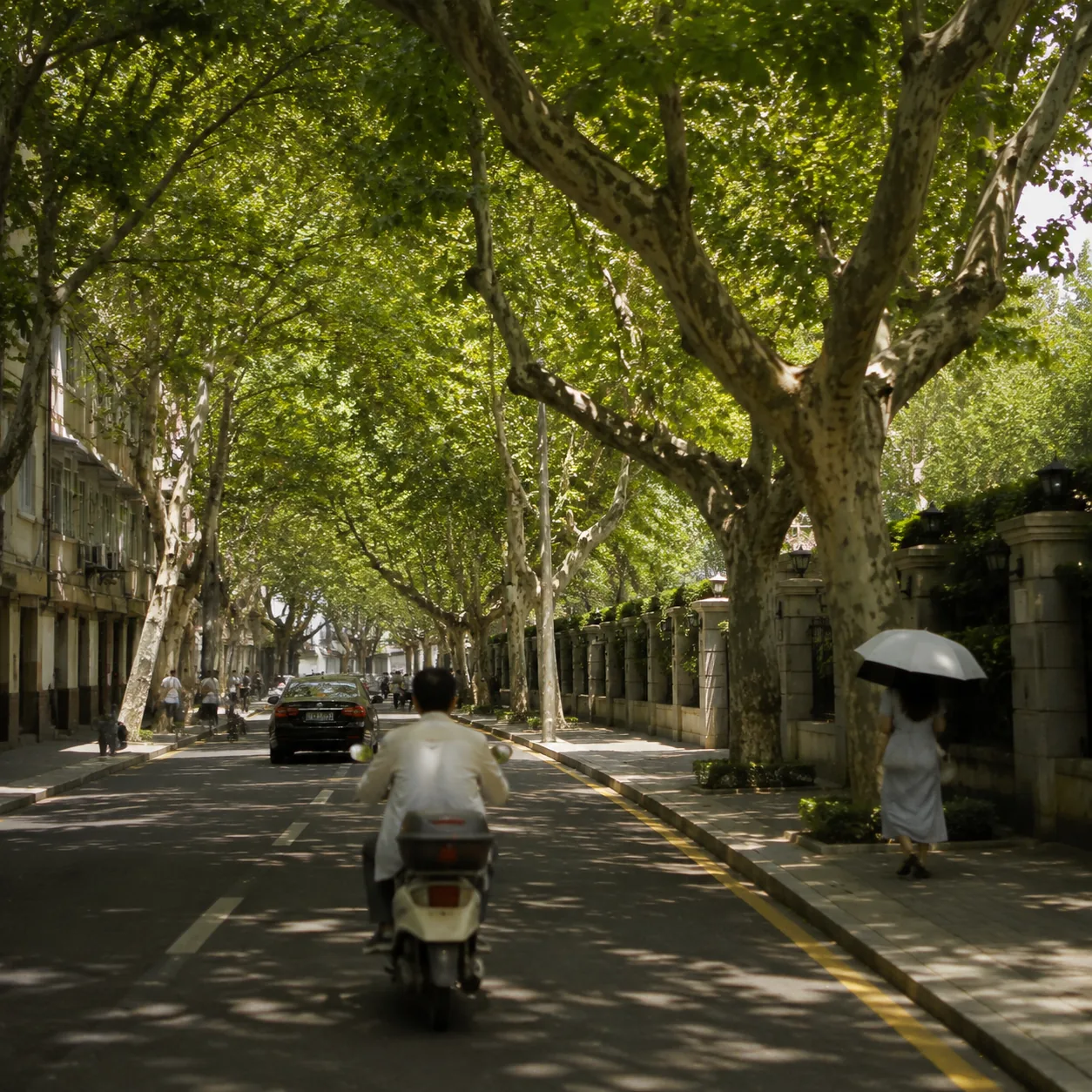
In Nanjing, the plane trees are often described as historical symbols, but the word symbol can be too rigid, as if a tree must be explained before it deserves to be remembered. That afternoon I preferred a quieter idea: memory settles through repeated use. Shade has protected people from summer heat, kept a roadside stall bearable, lent patience to someone waiting for a bus, and softened streetlights for people walking home at night. Years later, a person may not recall the exact date a road was widened or which section is most famous. They may simply remember that it was cool there, that it felt like childhood, that walking there did not feel rushed.
Following the shade, I came upon a man repairing bicycles. His stand had no sign. A tool box lay open on the ground, with patching fluid, wrenches, and an old rag arranged by habit rather than design. He said the road was busy when it was busy and never truly empty when it was quiet, because someone always needed to pass. For him, the plane trees were not scenery but part of his working conditions: the morning shade leaned east, the afternoon shade leaned west, leaves dripped after rain, and in autumn the fallen ones had to be swept aside before bikes could be set down. His account contained no grand vocabulary, yet it came closer to long companionship with a city than any slogan could.
City memory is often mistaken for a single answer: what a city should remember, how it should speak, what posture it should take toward outsiders. Nanjing under the trees suggested something else. Memory has many entrances. Some people enter through Republican-era buildings, some through duck-blood vermicelli soup, some through the night colors of the Qinhuai River, and some through a stretch of afternoon shade. Different entrances do not prove that one memory is shallow and another deep. They show that a city has not been completely captured by one narrative. Durable memory leaves room for ordinary people to place their own small experience inside it.
On one section the crowns met so closely that sunlight arrived only in fragments. Two students walked by reciting vocabulary in low voices, as if they did not want to disturb the quiet along the curb. An older gentleman, hands clasped behind his back, moved slowly and stopped before a trunk to study the bark. He did not take a picture. He simply looked for a while. In that moment I understood that city memory does not always need to be shared, uploaded, or proven to anyone. It may be one person standing before a familiar tree, recognizing that time has changed while certain textures remain legible.
The trees also create practical problems: roots lift pavement, fallen leaves block drains, branches require pruning, and after storms safety checks become urgent. If we speak of them only poetically, we miss the labor of urban management. If we reduce them to landscaping equipment, we lose another scale of meaning. They are living things that require care, and they are containers of street memory. A mature city does not flatten complicated things into one conclusion. It admits that a tree can be troublesome, necessary, fragile, reliable, and connected to many private histories at the same time.
Toward evening, the shadows lengthened and the walls of roadside buildings turned warm. The street, silenced by the heat of the day, slowly recovered its voices. Someone carried stools to the front of a small shop. Cyclists flashed through patterns of leaves. At that hour I understood Nanjing’s slowness most clearly. It is not an absence of change, nor a deliberate nostalgia. Beneath the visible surface of renewal, the city keeps certain things by which people can orient themselves. The shade of the plane trees is like an old map: it does not label every place, but it tells you that you are still inside a continuity.
When I left the road, I did not carry away a sentence that neatly summarized Nanjing. I carried fragments that felt steadier than a summary: the bicycle repairman reaching for a wrench, students reciting English under the leaves, an old man studying bark, a bus emerging from green shadow, fallen leaves pressed to the wet curb. These images did not make the city more legendary. They made it more believable. When memory becomes only a slogan, it drifts away from daily life. When it settles into shade, footsteps, smells, and waiting, it becomes touchable again.
What Nanjing’s plane trees gave me, then, was not the simple message that history exists here. They showed me how history continues through the everyday. It is not only at museum entrances or beside monuments. It is on a road walked again and again, in a patch of coolness where someone chooses to pause, and in a city’s patience toward old trees that still need care. City memory does not require everyone to recite the same explanation. It allows different people under the same shade to find their own version of time. That day I stopped treating the plane trees as background. I heard them as one of the ways Nanjing speaks softly.