Chinese Mahjong Culture: Rules, Etiquette & the Social Code
Your first mahjong invitation probably goes something like this:
Spring Festival, you’re visiting a Chinese friend’s home. Dinner is over, dishes still on the counter, the table is cleared, four chairs arranged. A set of mahjong tiles clatters onto the table. Your friend’s mother says: “Come, we need a fourth — I’ll teach you.” Before you can say “I don’t know how,” she’s already stacking your tiles.
Two hours later, you’ve lost 300 yuan, but you’ve learned one thing: mahjong is not a game. Mahjong is the social operating system of the Chinese people.
What Exactly Is Mahjong?
Mahjong is a four-player tabletop game using 144 tiles engraved with patterns (rules and tile counts vary by region). The goal is to draw and discard tiles until you form a winning combination — “hú pái.”
Sounds like poker? On the surface, yes. But mahjong is far more complex — it simultaneously tests luck, memory, probability calculation, and psychological warfare. An expert can memorize every tile that’s been discarded, deduce what the other three players likely hold, and decide which tile to discard with the least risk.
Basic tile types:
Mahjong tiles fall into three main categories: Characters (wàn, numbers 1-9 with the character for “ten thousand”), Bamboo (tiáo, bamboo patterns 1-9), and Dots (tǒng, circle patterns 1-9). Plus Wind tiles (East, South, West, North) and Dragon tiles (Red, Green, White). Some regional variants add Flower tiles (Spring, Summer, Autumn, Winter, Plum, Orchid, Bamboo, Chrysanthemum).
Basic winning requirement: 14 tiles forming 4 “melds” (sets of three — either sequential runs or matching triplets) plus 1 “pair” (two identical tiles). Sounds simple, but there are thousands of variations.
Regional Mahjong Styles Across China
There are no “unified rules” for mahjong in China. Every region has its own style, and people from every region firmly believe their style is the authentic one.
Sichuan Mahjong (Blood Battle to the End): Sichuan people’s mahjong obsession is nationally famous. “Blood battle to the end” means: when one person wins, the game doesn’t stop — play continues until only one player hasn’t won. Every round is played to completion, no “one winner and we’re done.” Sichuan mahjong has another feature — no Bamboo tiles, only Characters and Dots plus Winds and Dragons, making the pace faster.
In Chengdu’s teahouses, from 2 PM to 11 PM, nearly every table has a mahjong game going. Chengdu people have a saying: “Life is short — play mahjong while you can.” This is not entirely a joke.
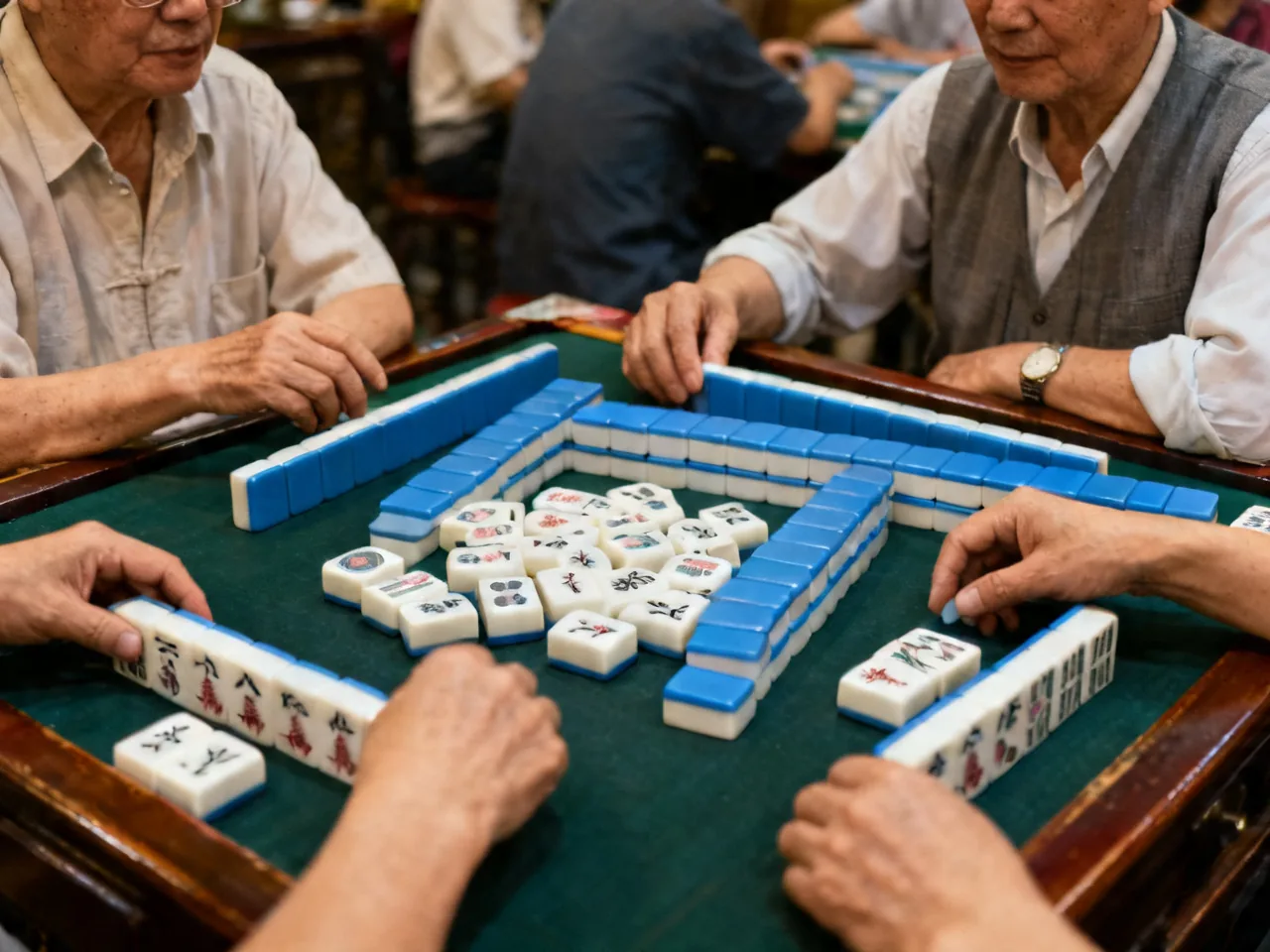
Cantonese Mahjong: Cantonese players emphasize “eating the win” — the more special your winning combination, the higher the score. “Thirteen Orphans” (one of each terminal and honor tile plus one pair) is the highest-level win and can earn a lot of money. Cantonese players like to “play big” — stakes tend to be higher than in the north, but they don’t call it gambling — they call it “entertainment.”
Beijing Mahjong: Rules are relatively simple, but with a unique concept — “hùnr,” a wild card that can substitute for any tile. Beijing mahjong is slower-paced because Beijingers’ main purpose isn’t winning money — it’s chatting. A round lasting forty minutes is normal, twenty of which are spent talking.
Shanghai Mahjong: Shanghai players are the most meticulous. Shanghai mahjong features a “flower tile” bonus system — drawing flower tiles earns extra points. It also has “universal wild cards” and a complex scoring system. Shanghai players talk less during games but exchange frequent glances — one look and they know what the person across the table is building.
| Style | Features | Pace | Stakes | Atmosphere |
|---|---|---|---|---|
| Sichuan | Blood battle, no Bamboo | Very fast | Medium | Lively, loud |
| Cantonese | Many bonus types, complex scoring | Fast | Higher | Serious, focused |
| Beijing | Wild cards, simple rules | Slow | Low | Chatting mostly |
| Shanghai | Flower tiles, wild cards, precise scoring | Medium | Medium | Quiet, lots of eye contact |
Social Codes at the Mahjong Table
Mahjong is not just about playing tiles. It is a microcosm of Chinese social life — face, guanxi, renqing, all condensed onto the table.
Deliberately losing: If you’re playing mahjong with your boss and you’ve won three rounds while he hasn’t won any — you’d better “accidentally” discard a tile that lets him win. This isn’t cheating — this is “giving face.” In Chinese business culture, wins and losses at the mahjong table sometimes matter more than PowerPoint presentations in the conference room.
Playing reveals character: Chinese people have a saying — “your mahjong manners reflect your character.” Your behavior at the table mirrors your personality. Someone who gloats when winning is considered unreliable. Someone who slams tiles and curses when losing is considered bad-tempered. The most popular playing partners are those who treat everyone to late-night snacks when they win, and smile saying “you all had great luck today” when they lose.
Unwritten rules of mahjong socializing:
First, being invited to play mahjong is a signal of trust. Chinese people don’t casually invite strangers to the table — the mahjong table is a social space for the “inner circle.” If you’re invited, it means you’ve entered their social circle.
Second, don’t take the money too seriously. In most family mahjong games, a night’s wins or losses don’t exceed a few hundred yuan. The real meaning of this money isn’t “gambling stakes” but “entertainment cost” — having something at stake keeps the game exciting. If you insist “I don’t play for money,” it actually makes things awkward.
Third, snacks and tea are standard. The mahjong table always has sunflower seeds, peanuts, fruit, and tea. Cracking seeds and chatting between rounds is an essential part of mahjong socializing. In some places (especially Sichuan), people even order delivery and eat hotpot while playing — this is the ultimate indulgence.
Automatic Mahjong Tables: The Chinese Home’s “Second TV”
Since the 2010s, automatic mahjong tables have become widespread. These machines range from 2,000 to 20,000 yuan, and their core function is: press a button, and all tiles are automatically shuffled, stacked, and raised from the center of the table. This eliminates the five minutes of manual shuffling and stacking, dramatically improving playing efficiency.
In many Chinese households, the automatic mahjong table ranks second only to the television. When renovating a new home, dedicating a “game room” for the mahjong table is standard practice. Some high-end models even include USB charging ports, cup holders, and heating functions — so your hands don’t get cold playing in winter.
Mahjong Experience Guide for Travelers
Where to experience it:
| APP |
| Location | Format | Cost | Best For |
|---|---|---|---|
| Chengdu teahouses | Join a group or observe | Tea seat ¥20-50, stakes flexible | Experiencing the most authentic atmosphere |
| Beijing hutong game rooms | Rooms provide tables and teaching | ¥30-80/hour | Zero-experience tourists wanting to learn |
| A friend’s home | Invited to family mahjong | Free (but you might lose money) | Travelers with Chinese friends |
| Mobile apps | “Happy Mahjong” etc. | Free | Learning rules before playing in person |
Tips for foreign players:
- Learn to recognize the tiles first. Characters, Bamboo, and Dots look quite different, but beginners often confuse them. Spend ten minutes memorizing them and you’re halfway there.
- Don’t be afraid to play slowly. It’s normal for beginners to take their time. Chinese people have enormous patience for teaching new players — especially foreigners, whom they’ll teach with great enthusiasm.
- Bring cash. Mahjong is usually settled in cash. Have a few hundred yuan in small bills ready.
- Learn a few mahjong terms: Pèng (three matching tiles), chī (three sequential tiles), gàng (four matching tiles), hú le (I win). Say these words crisply and decisively — that’s table etiquette.
The Philosophy of Mahjong
Chinese people like to say “life is like mahjong” — the tiles you’re dealt are fate, how you play them is skill.
This saying has a deeper layer: mahjong is a game of incomplete information. You never know what tiles the other three players hold — you can only deduce from what they discard. This is exactly like real life — you can never have complete information, you can only make the best decision based on what you know.
There’s another saying: “Thirty percent luck, seventy percent skill.” Ruining a good hand is foolish; making the most of a bad hand is talent. Chinese people don’t admire those who are lucky — they admire those who turn the tide against all odds.
Next time someone invites you to play mahjong, don’t refuse. You might lose a few hundred yuan, but you’ll gain a new perspective on understanding the Chinese people — and four new friends.
Related Reads
- Spring Bloom Map: China’s Most Beautiful Flower Fields
- Summer Escapes: Plateaus & Islands
- Huangshan Sea of Clouds & Welcome Pine: Beautiful in All Seasons
- Best Autumn Foliage Spots in China
- 10-Day East China Five-City Loop