Walking Slowly Across a Wooden Covered Bridge in the Rain
The rain began after noon, thin and close, as if someone had sifted the mountain sounds and kept only the eaves, the stream, bamboo leaves, and soles on wet stone. When Shen Lan followed Uncle Lin, the old carpenter from the village entrance, toward the wooden covered arch bridge, she did not hurry to raise her umbrella. The bridge lay between the two banks, its dark tiles shining after the rain, its beams deepened in color, like a quiet boat resting over the creek.
Uncle Lin walked slowly, not because age held him back, but as if he feared disturbing something. With his hands behind his back, he stopped at the bridgehead and signaled Shen Lan not to enter yet. A low echo came from within: someone was crossing from the other end with baskets of vegetables, the shoulder pole pressing gently down, the greens in the bamboo baskets brightened by damp air. As he passed, he smiled and said the bridge felt warmer than home today.
Shen Lan had come to write a travel piece. She had prepared the bridge’s name, age, structure, and route, and had ready a few sentences about how a timber arch could hold up years without a single iron nail. Yet standing before the bridge, she found the information suddenly weightless. Rain on the tiled roof did not feel like background sound; it felt like the bridge clearing its throat before speaking.
Uncle Lin said that on clear days most visitors looked at the bridge as a whole, stepping back to fit bridge, creek, mountain, and houses into one photograph. Rainy days were different. Rain softened the distance and left only the grain of wood close enough to touch. Once inside the covered bridge, a person had to admit they were not the owner of the scenery, only a guest briefly borrowing the bridge’s belly.
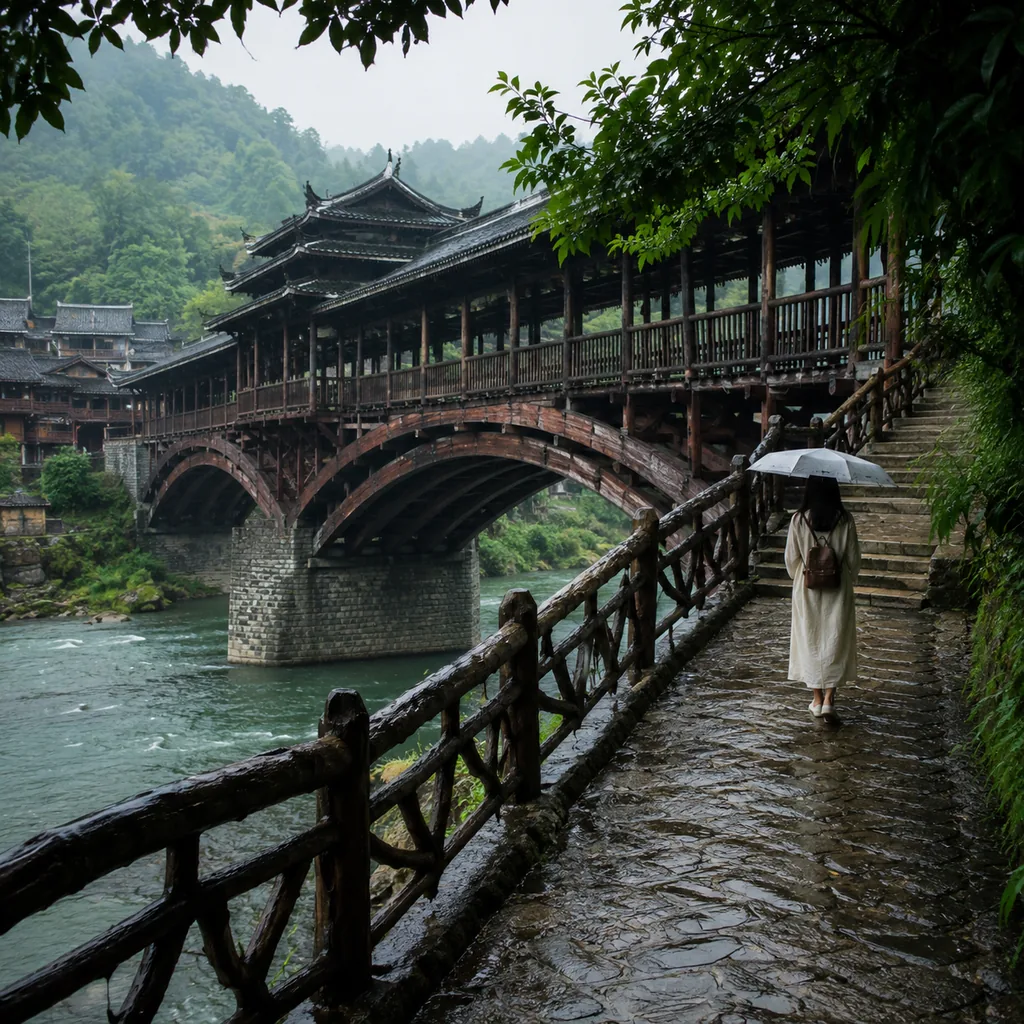
At last they stepped onto the bridge deck. The planks made a faint sound underfoot, not loud but springy, like an elder shifting posture after hearing visitors arrive. Shen Lan softened her steps, folded her umbrella over her arm, and watched drops fall from its ribs into the seams of the boards. Inside were long benches, narrow ledges for resting, beams darkened by years of smoke, and a small lamp still lit in daytime, shining on two dogs sheltering in the corner.
The stream outside had risen a little and ran close to the stone banks, not a transparent green but the gray-blue of rainy weather. A few leaves circled on the surface before being carried away by an unseen pull. Shen Lan leaned toward the railing, intending to listen to the water, but first heard the roof rain split into layers: quick on the tiles, scattered at the eaves, light as it fell into the creek, muffled as it slipped down the foot of the pillars.
Just then, a boy in a blue raincoat ran in from the bridgehead, holding a paper box against his chest. Uncle Lin stopped him and asked whether he had collected tadpoles again. The boy shook his head and opened the box for them. Inside was a dragonfly with rain-soaked wings. He said he would keep it inside the bridge until it dried and could fly. Watching the dragonfly tremble slightly, Shen Lan suddenly understood why the bridge always seemed to possess a human warmth.
The covered bridge was not an antique placed among mountains and water. It had shielded travelers from rain, shared the weight on porters’ shoulders, hidden children’s secrets, and held the afternoon conversations of elders. The timber arch supported not only two banks but also many village details too small for genealogies. When such details gathered, the bridge was no longer merely a structure; it became part of shared life.
Uncle Lin raised his hand and touched a diagonal brace, showing Shen Lan how the joints bit into one another. It was not the refinement of a museum case, but a wisdom that hid strength. The timbers pressed, yielded, and borrowed force from each other, much like villagers living their days: rarely saying everything aloud, yet knowing when to lend a hand. Rain fell on these crossing wooden bones, and even hard things were spoken into gentleness.
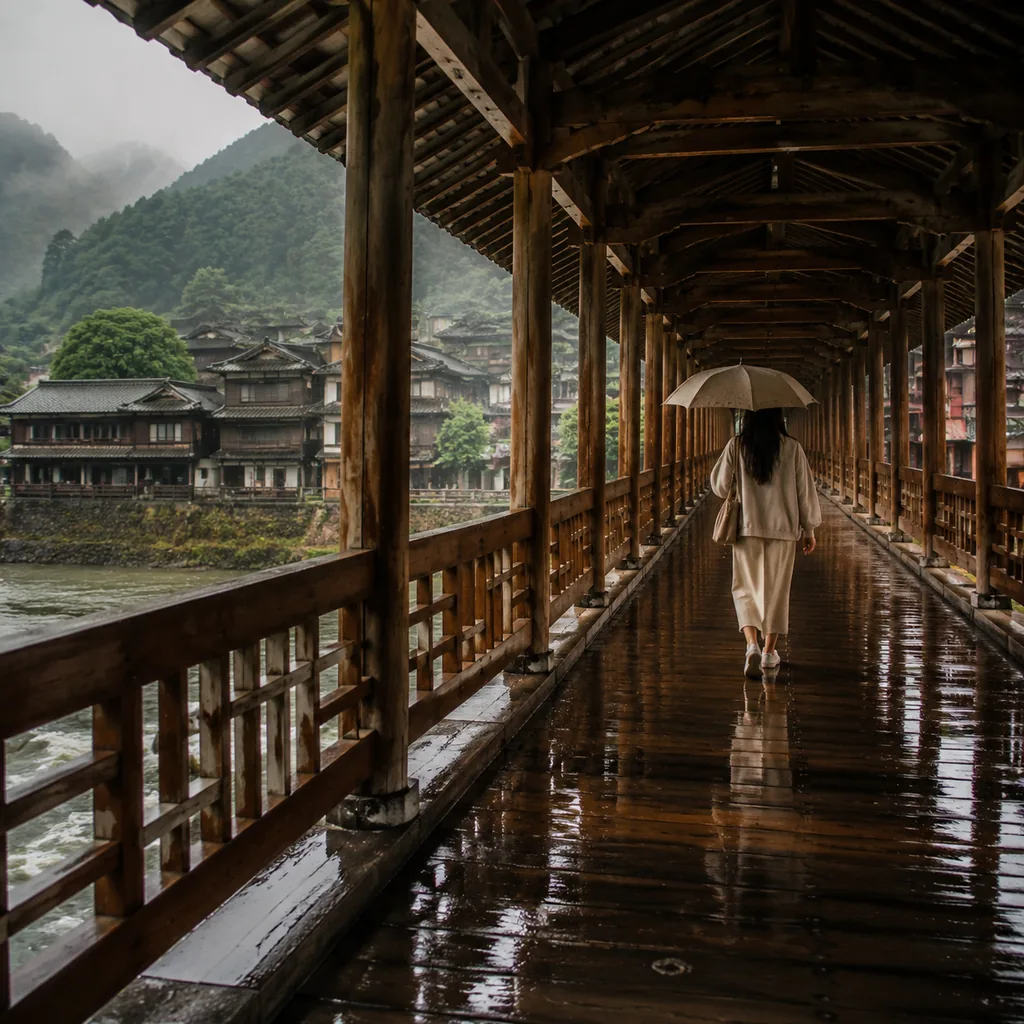
Shen Lan asked him what the bridge feared most. She expected the answer to be floods, insects, or fire. Uncle Lin said instead that it feared being treated only as a backdrop for a quick visit. After a pause, he added that wood did not fear being looked at; it feared being looked at too quickly. Look too fast and only the shape remains. Slow down, and one can hear how it gathers mountain wind, flowing water, and footsteps together.
At the middle of the bridge, a lattice window opened toward terraced fields. Rain mist softened the ridges, and the distant hills remained only as pale ink outlines. A woman came from the fields under a floral umbrella, the umbrella drifting through the mist like a quiet flower on water. When she reached the bridge, she closed it, shook the tip downward twice, and sat on the bench to change her shoes.
She knew Uncle Lin and asked whether he was showing another city visitor the bridge. Uncle Lin said it was not showing, but keeping the bridge company for a while. The woman laughed and said the bridge had a good temper: it accepted every kind of step, hurried or slow, heavy or light, without choosing. As a child she had feared thunder and would run into the bridge during storms, feeling that as long as the roof still sounded, the village was still there.
Shen Lan did not write the sentence down at once. She feared that once written, it would lose the warmth with which it had just fallen from the woman’s mouth. She simply leaned on the railing and watched Uncle Lin and the woman talk of harvests, children, and how this year’s rains had come earlier. Outside, the water kept flowing; inside, talk kept flowing too. The two sounds did not compete, like neighbors long used to each other.
More people entered: a young pair of travelers. The young man raised his phone first, but the young woman held him back and whispered that if the rain grew heavier, the bridge would sound better. Hearing this, Shen Lan could not help turning around. The young woman smiled shyly and said she had come the day before, learning that the most beautiful part of a covered bridge was not necessarily inside a lens. Then she put her phone in her pocket and stood with him by the window.
The rain did thicken. The tiled roof seemed tapped by countless fine fingers, and the whole bridge answered faintly. Shen Lan closed her eyes and heard footsteps moving from one end to the other, someone setting down and lifting a bamboo basket, a dog’s claws brushing the boards as it turned over, the dragonfly lightly touching the side of the paper box. Every sound was small, yet none felt unnecessary.
Uncle Lin said slow walking was not a deliberate attempt to look poetic. Mountain paths were wet, planks were slippery, and rainy days simply required slowness. Once a person slowed down, the eyes and ears could catch up with the body. Shen Lan found this more practical than any travel advice. Many places did not reject visitors; they only resisted being hastily summarized. Much beauty was not hidden; it waited for people to slow to a speed at which meeting was possible.
When they reached the other end, the sky had darkened a shade, and cooking smoke rose low through the rain from village houses. Uncle Lin did not leave the bridge at once. He turned to look back at the frame, as if checking that an old friend was well today too. Shen Lan looked back with him and found that the path they had just crossed seemed longer in the dim light, long enough to hold a rain, several conversations, and a heart gradually quieting down.
The boy came running with the paper box, excited that the dragonfly’s wings had dried. When the lid opened, it first paused on the edge, as if listening to the rain as well. Then it lifted suddenly, crossed the damp air at the bridge opening, and skimmed over the creek toward the bamboo grove. Everyone watched it. No one applauded. That quiet felt more like a blessing than applause would have.
When Shen Lan later wrote her piece, she did not turn the covered bridge into a place that had to be checked off. She wrote about how rain revealed the breathing of wood, how a bridge could soften the footsteps of strangers, how mountains and water here did not need to be shouted into brightness, only heard. She also wrote Uncle Lin’s sentence: wood does not fear being looked at; it fears being looked at too quickly.
If someone comes to this wooden covered arch bridge on a rainy day, the best way may not be to search first for an angle, but to stand still for a while. Let the eyes adjust to the dimness inside, let the ears distinguish the layers of rain, let the fingers feel the tiny rises in the wood grain. When the feet are willing to slow, the bridge will speak the mountains lighter, the water nearer, and the burdens of the heart less heavy.