What to Eat at Chinese Festivals: The Table Code of Three Major Holidays
Three days before Chinese New Year, my mother starts stocking up.
Not toys, not clothes — meat. Pork belly, pig’s trotters, cured sausage, a whole chicken. The fridge gets packed to bursting. She says the New Year’s Eve dinner must have every dish. Miss one, and you lose a piece of luck.
There’s no fixed menu for New Year’s Eve dinner, but there’s a fixed logic: fish is mandatory (the word for fish sounds like “surplus”), dumplings in the north or glutinous rice balls in the south, and a whole chicken symbolizing the whole family together.
This isn’t superstition — it’s ritual. Chinese people use food to say things they can’t say out loud: I hope our family has a good year. They don’t say it. They put it on the table.
In northern China, making dumplings matters more than eating them. The family gathers around the table — some roll the wrappers, some fill them, grandparents teach children to pleat the edges, lopsided and imperfect. Some families hide a coin inside one dumpling: whoever bites into it will have good fortune that year. Many families have stopped doing this, but they still smile when they talk about it.
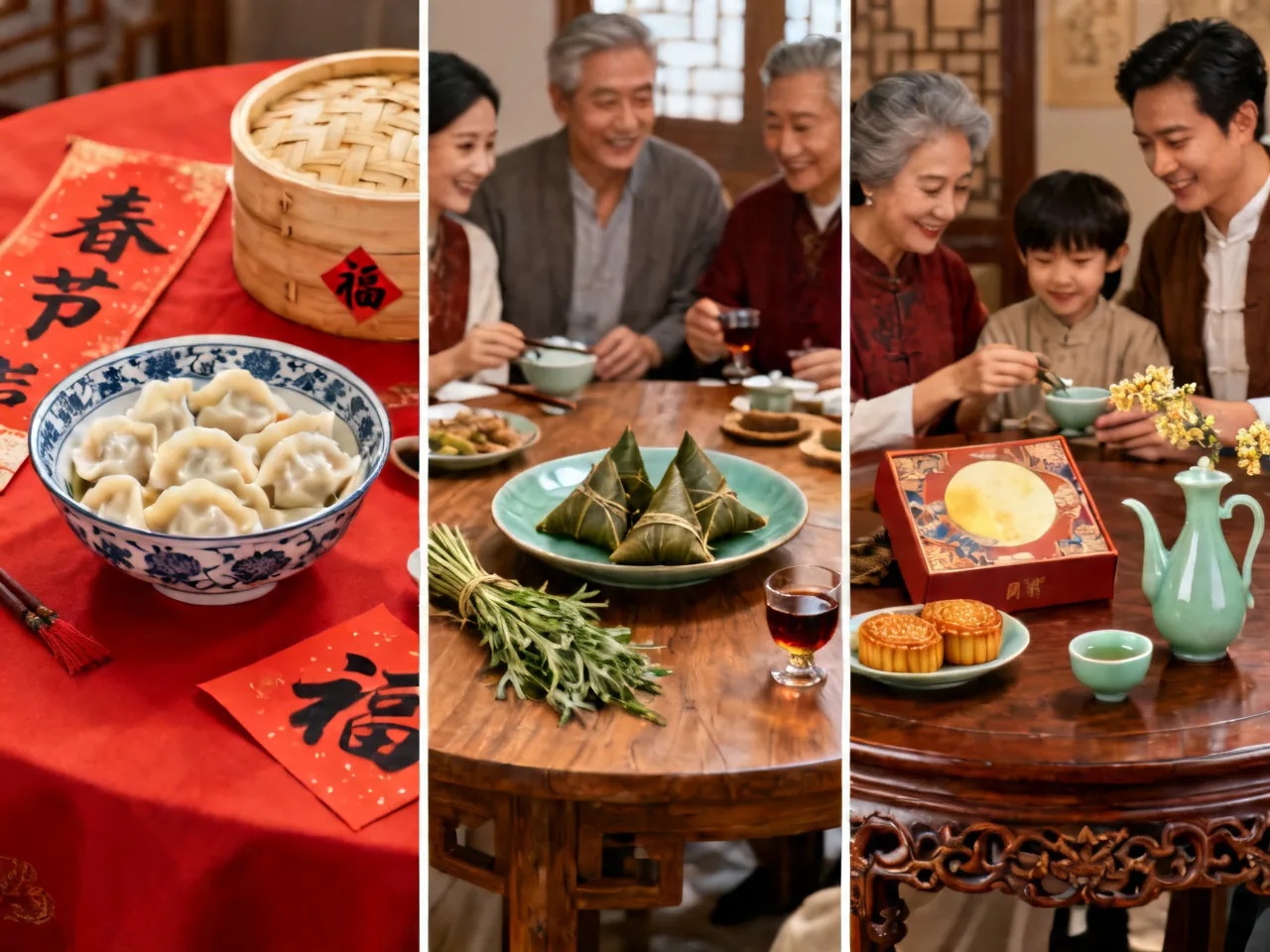
Every year around the Dragon Boat Festival, a war breaks out on Chinese social media: should zongzi be sweet or savory?
Sweet camp: red bean, candied dates, lotus paste — glutinous rice was made for sweet fillings. Savory camp: pork belly, salted egg yolk, shiitake mushroom — this is what real depth of flavor looks like.
Each side thinks the other is eating something bizarre.
The geographic dividing line roughly follows the Huai River — north tends sweet, south tends savory — but there are so many exceptions the line barely means anything. A Cantonese savory zongzi can be too big for one person to finish. A Jiaxing fresh pork zongzi from Zhejiang glistens with fat. Sichuan’s pepper-and-salt version is a universe of its own.
The textbook origin of eating zongzi at Dragon Boat Festival is to commemorate the poet Qu Yuan. But the more honest answer is: this is exactly when glutinous rice ripens and reed leaves are at their fullest. Food and season were always one thing.
Mooncakes are simultaneously the most overrated and most underrated food in China.
Overrated: many people buy mooncakes not to eat, but to give as gifts. Fancy boxes, double-yolk lotus paste, five-nut filling — the giver feels dignified, the recipient leaves them on the shelf and forgets, then throws them away.
Underrated: a genuinely good mooncake is something else entirely.
Suzhou-style mooncakes have flaky, layered pastry that crumbles when you bite in. The fresh pork filling eaten hot — fat and meat fragrance together — is a completely different food from Cantonese mooncakes. Yunnan’s fresh flower cakes use rose petals as filling, sweet without being cloying; first-timers usually pause for a moment. Chaoshan’s lard-pastry mooncakes with mung bean filling are the kind of thing you eat and then immediately want to know the name of.
The heart of Mid-Autumn Festival isn’t the mooncake — it’s reunion itself. The mooncake is just a vessel: its round shape symbolizes wholeness. In China, many important feelings need a food to carry them, because saying them directly would feel strange.
If you happen to be in China during any of these three festivals, don’t just look at the temple fairs and lanterns. Find a family, or an unremarkable little restaurant, sit down, and order the dish that only appears during the festival.
That’s the real China.
Related Reads
- Spring Bloom Map: China’s Most Beautiful Flower Fields
- Summer Escapes: Plateaus & Islands
- Huangshan Sea of Clouds & Welcome Pine: Beautiful in All Seasons
- Best Autumn Foliage Spots in China
- 10-Day East China Five-City Loop