I Came to China With a German-Style Itinerary, but What Actually Saved Me Was This Tool Kit
On my first trip to China, I arrived with the typical German habit of wanting every minute accounted for. I had train tickets saved in separate folders, the hotel address printed on paper, and even notes about possible weather changes each day. But the moment I stepped out of the high-speed rail station, with repeated announcements overhead, a drifting GPS signal on my phone, and a crowd moving like a fast tide around me, I understood something immediately: in China, what decides whether your trip runs smoothly is often not the sightseeing guide, but a handful of practical tools and whether you know how to use them at the exact moment you need them.
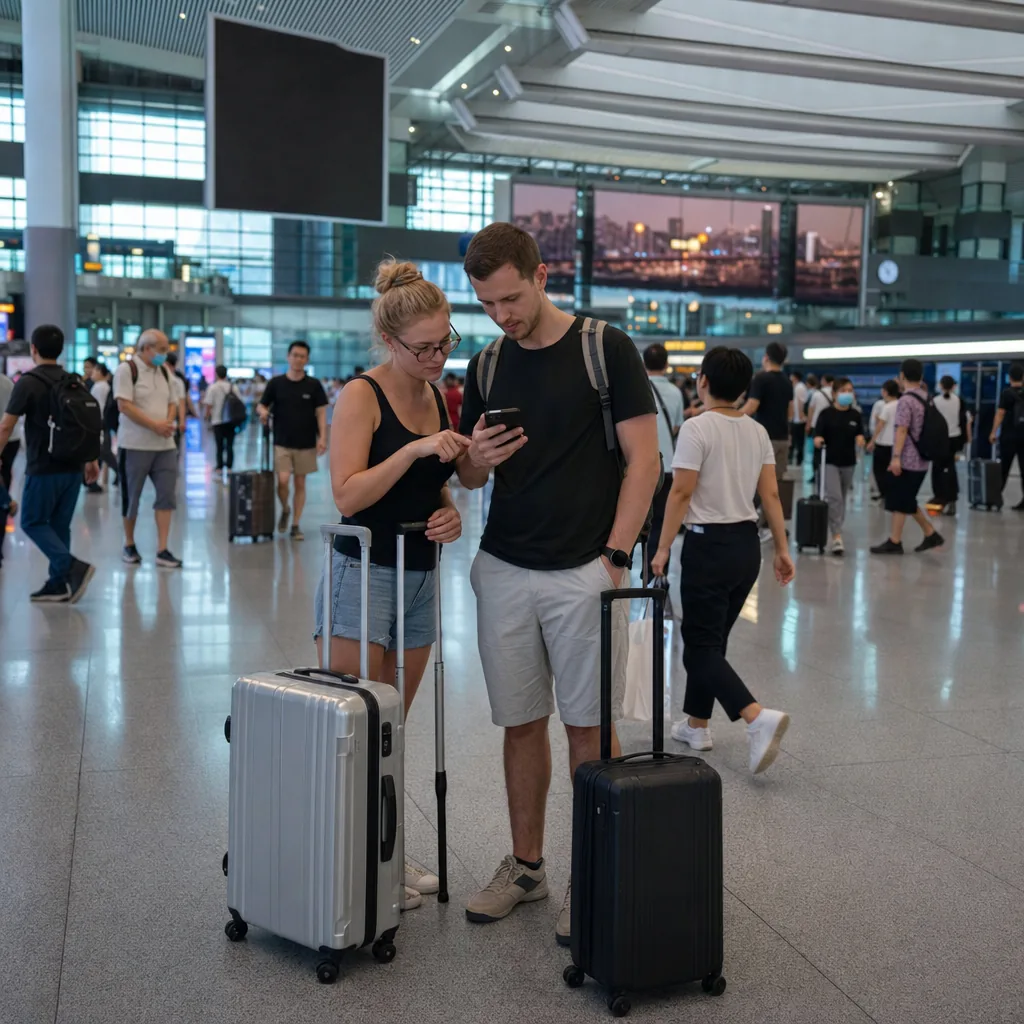
That happened at Hangzhou East Railway Station. My partner and I had just arrived and still felt calm, assuming that as long as we followed signs for “Taxi,” “Metro,” or “Ride-hailing,” everything would be straightforward. But many large Chinese stations are not simple “see a door and walk out” places. Different exits connect to different levels, and ride-hailing pickup zones are often divided very precisely. I followed the map for three minutes until the blue dot suddenly jumped across the road. My partner started wondering whether we had already gone the wrong way. Then a young woman carrying milk tea glanced at us and said, “Don’t trust the map first. Find the exit number first, then locate yourselves once you’re outside.” That sentence helped more than any beautifully written travel guide.
So later I started thinking about a “tool checklist” in a different way. It was no longer just a cold list of app names, but a survival order for real moments at platforms, hotel counters, street corners, convenience stores, and the back seat of a taxi. I am not organizing these tools by software category, but by the order in which problems actually appear. That is because the most common travel mistake is preparing like an office archivist while forgetting that real life on the ground keeps moving.
Save Your Orientation Before You Save Your Mood
Now, whenever I arrive at a new station in China, the first thing I open is not a messaging app or a translator, but a map. The key is not just “having a map,” but having two systems. I now always keep one local map app such as Amap or Baidu Maps, plus one international map tool that feels more familiar to me. The reason is simple: local maps in China are usually much better for shopping malls, underground exits, station corridors, temporary barriers, and construction detours, especially for walking routes and exact entrances. But when you need a broader geographical sense and want to match it with English place names, the second map keeps you from losing all reference points.
The mistake I learned from was very concrete. Once in Xi’an, our hotel was actually not far from the city wall, but the map led us to a side street entrance with no lit sign, only a small delivery truck unloading bottled water. My partner had already started wondering whether we had booked some suspicious place. Instead of walking in circles, I did three things immediately: I checked the hotel’s Chinese name, then the phone number in the booking, and finally copied the address into the local map app again. It turned out the main entrance was on another street, only five minutes away on foot. But if I had kept staring at that drifting location dot, panic would have grown much faster than distance.
So I developed a very German habit that turned out to be unusually useful in China: in every new city, I save four points immediately. The hotel entrance, the nearest metro exit, the nearest convenience store, and one obvious landmark. That way, even if the network stutters, the GPS lags, or a driver only understands one keyword, I still have backup anchors. Often the problem is not that you cannot read a map, but that you placed all your hope in one blue dot.
At the Hotel Counter, Translation Is Not for “Cultural Exchange”
Many foreign travelers assume translation tools matter most when ordering food or making small talk. I actually think the hotel front desk is where they matter most. The reason is that hotel conversations are usually short, but the information is critical: the guest name, passport, breakfast hours, laundry room floor, deposit rules, whether delivery can come upstairs, and whether you need a key card after midnight. If you miss two lines here, the rest of your day may be dragged along by avoidable problems.
My method is simple. I do not aim for elegant translation, only for something the front desk can understand immediately. I keep a few high-frequency Chinese lines in my notes: I have a reservation, could you please check it for me; what time does breakfast start; could you write this address for the driver; if I order delivery, does it go to the front desk or the room. When needed, I copy them into a translator or just show the Chinese directly. Germans often like to make a sentence complete, with context, reason, and layers of politeness, but in high-frequency service situations in China, short sentences are often much more effective.
Once in Chengdu, a receptionist gave me a long explanation, and I only caught the words “breakfast” and “elevator.” If I had simply nodded and pretended, a problem would almost certainly have appeared later. Instead, I opened the translation app, said, “Could you please speak a little more slowly,” and kept the live transcription running. She immediately switched to a slower pace and even added details like, “The delivery robot stops after 11 p.m.” In that moment, I became certain that the most important function of a translator is not making you appear fluent in Chinese, but helping you avoid pretending you understood when you did not.

For Payment, Do Not Prepare Only One “Best” Method
Before leaving for China, I read so many articles saying “you must master mobile payment in China” that I almost believed cash and cards had disappeared entirely. The reality was softer and more complicated. Most of the time, mobile payment is indeed extremely convenient. Convenience stores, coffee shops, station kiosks, vending machines near scenic entrances, almost everything encourages you to scan and pay. But the truly reliable approach is not worshiping one tool, but keeping at least three layers of payment options.
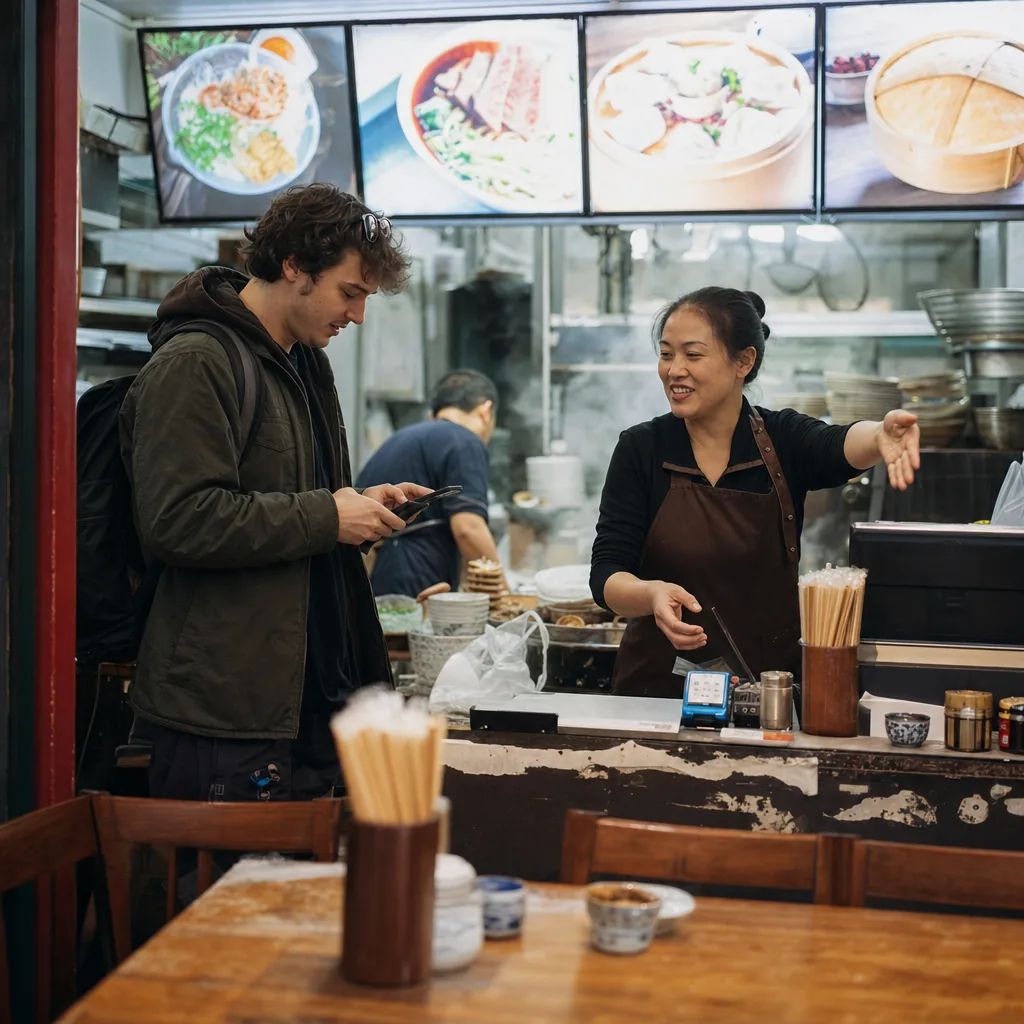
My own order now is this: first layer, the main payment tool on the phone; second layer, an international bank card that reliably works; third layer, a small amount of cash, not much, but definitely present. Many people assume cash is unnecessary. I used to think the same, until one evening in a noodle shop in Suzhou, when the payment page froze during a network switch. Three people were already waiting behind us at the register, steam was rising from the soup pots, and the owner, seeing our awkward pause, waved her hand and said, “Go sit down first and try again in a minute.” I ended up solving it with a banknote, and the whole rhythm of the shop stayed intact. That feeling of relief was more real than any polished slogan about a “cashless lifestyle.”
Here is a detail people often overlook: in China, payment is not only about whether you can pay, but whether you can pay without interrupting everyone else’s rhythm. If you stand at a morning-rush coffee counter searching for a verification code, switching networks, failing to bind a card, or scanning the wrong code, you will feel stressed, and everyone behind you will feel it too. That is why I now do two things in advance. First, I open the payment page before entering the store. Second, in fast-flow settings such as metro stations, convenience stores, or scenic entrances, I use the method I know best. That is not the moment to experiment with new features.
If I had to reduce payment advice to one practical sentence, it would be this: in China, the most advanced method is not the most important one, the smoothest one is. You are not here to prove how digitally sophisticated you are. You are here to catch the train, eat the noodles, and get into your room without friction.
Between Stations, Hotels, and Taxis, Screenshots Beat Memory
I used to trust my memory too much, believing that if I had seen something once, I would remember it. That is another classic weakness of the heavily planned traveler. But the information flow in China moves too fast, especially when crossing cities. In a single day, you may deal with train numbers, station names, hotel addresses, check-in hours, pickup points, room numbers, payment pages, and translation records all at once. You think you remembered it, but often you only remembered it for ten minutes.
So now I screenshot almost mechanically, and I categorize those screenshots. One for the train ticket, one for the hotel booking, one for the hotel’s Chinese address, one for the hotel business card, and another for a key map route. I even keep something as simple as “what the hotel entrance looks like,” because some hotels are easy to spot on a map but hidden behind office podiums or side entrances in reality. German caution is not wrong here. You simply need to turn caution into callable information, not vague memory stored in your head.
My partner and I later developed a small division of labor, and it worked very well. I save the formal information, such as bookings, addresses, and train numbers. My partner saves the situational information, such as which exit is less crowded, which street is better lit at night, and which convenience store has breakfast for the next morning. That way, we are not both staring at the same kind of data. Travel is not an exam. One person does not need to remember everything if the two of you can cover each other intelligently.
The Most Useful “Checklist” Eventually Turns Into Actions
If I were only allowed to keep a few key actions, they would probably be these: identify the exit number before checking the map; save the Chinese address before speaking to a driver; prepare the payment page before approaching the cashier; confirm the hotel’s key rules before going upstairs with your luggage; take the screenshot before trusting your memory. At that point, this is no longer a normal tool list. The tools are just the shell. What actually creates calm is the order of actions.
Looking back now, my original desire to turn China travel into a perfect timetable was not wrong. It was simply missing a little on-the-ground flexibility. Many Chinese cities are highly efficient, mobile payment is fast, rail transit is dense, and service systems are increasingly smooth. But that does not mean downloading a few apps solves everything. Real ease comes from whether you look at the signs before the map when leaving a station, clarify the hotel rules before going upstairs, switch payment methods immediately when one fails, and grab the Chinese address before panic takes over when you lose your way.
When we left Hangzhou, my partner and I arrived at the station forty minutes early. We were no longer guessing as we walked, the way we had on the first day. We looked at the screen first, then the exit, then the gate number. Nearby, a small boy was holding a bag of hot buns with steam escaping from the top, while his mother pulled him along and held up the ticket to a staff member. The announcements were still loud, and the crowd was still thick, but inside I felt completely different. Not because the station had suddenly become simpler, but because the tools in my hand were no longer just downloaded icons. They had become things that genuinely rescue you in the middle of travel in China.