The Half-Second Acts of Yielding at Hefei Crossings Explain the City Better Than Any Guide
A Hefei intersection during the morning rush feels like a slow but powerful lung: it contracts at the red light, expands at the green, and streams of people from every direction move with the signal’s breathing. I stood near an intersection around Changjiang Middle Road as the morning had just brightened, pale gray still resting on the glass of buildings. A bus released a hiss as it pulled into the stop, and electric scooters lined the non-motorized lane in dense rows. There was no salty damp wind of a coastal city here, nor the vast sky of a plateau city. Hefei’s morning was more like a cup of tea at the right temperature: practical, clear, and quietly warm. There were many people at the intersection, but it was not chaotic. Office workers held laptop bags, students carried backpacks, elders held vegetable bags, and delivery riders checked routes on their phones. Everyone seemed to carry a private destination, yet all had to share the same pause before the crosswalk. During those dozens of seconds of red light, the city layered everyone’s speed together and made strangers stand side by side in a temporary line.
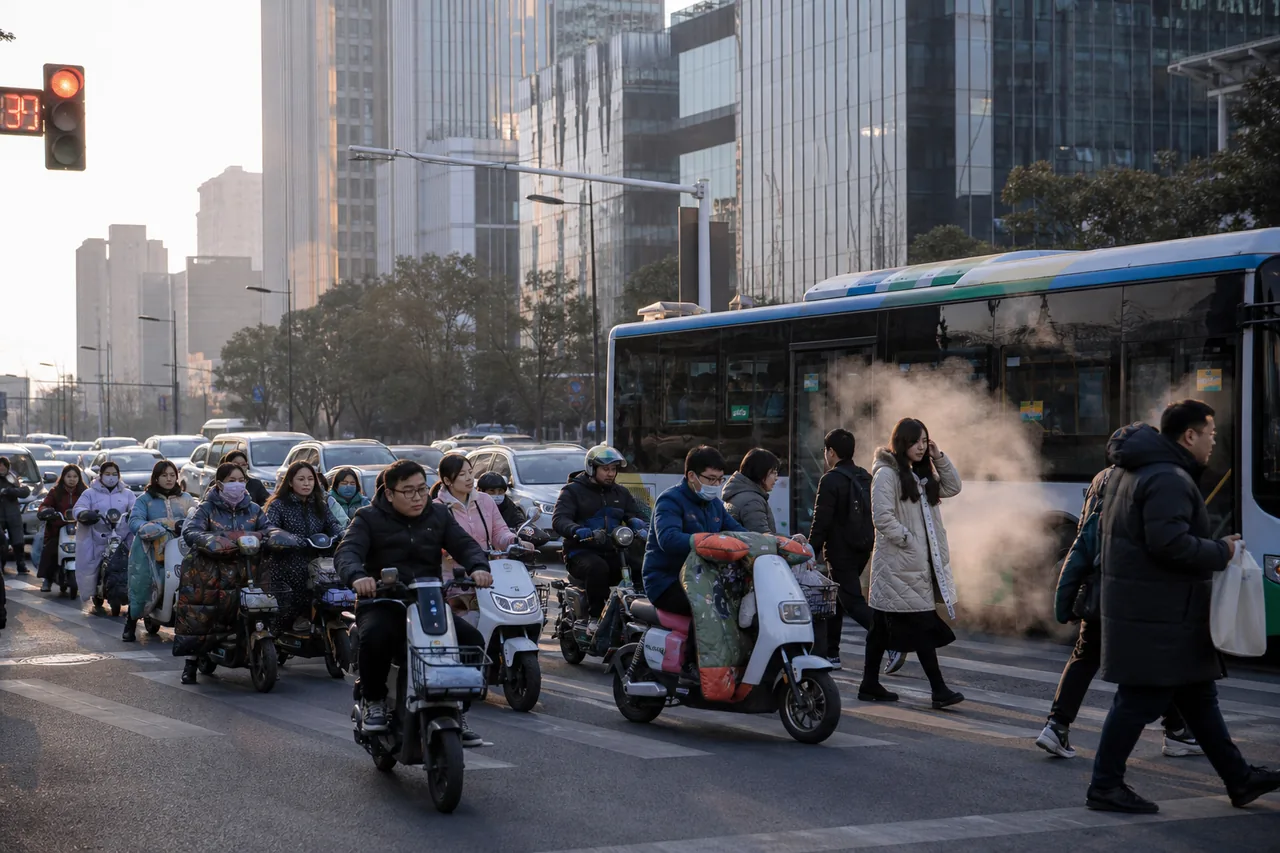
When the green light came on, the intersection seemed like a gate gently opened. The crowd did not rush out all at once. First the front row stepped forward, then those behind followed, and the bells of electric scooters, the sound of soles, and bus announcements mixed into an ordinary ensemble. The crosswalk filled quickly with footsteps, white stripes appearing and disappearing under moving silhouettes. A boy in a school uniform walked while biting into a steamed bun, his mother beside him reminding him to watch the cars. A young man in a suit lowered his head to reply to a message and nearly bumped into an elder who had paused ahead, then immediately looked up and apologized. Two sanitation workers pushed a tool cart slowly from the side, its wheels bumping softly over a seam in the road. The human flow at a Hefei intersection does not offer dramatic stories, but it contains countless tiny adjustments and courtesies. Urban order is not maintained only by markings and traffic lights, but also by judgments each person makes in half a second: faster, slower, give way, say a reminder.
I bought a cup of soy milk by the roadside, and the vendor moved so quickly that he seemed synchronized with the rhythm of the intersection. The paper cup was hot when he handed it to me, steam spreading in the slightly cool air. Beside the cart were fried dough sticks, glutinous rice cakes, and egg pancakes. Many people did not sit down; they bought breakfast and carried it into the next part of their commute. Hefei is a city that understands the phrase “on the way.” Many fragments of life are placed near intersections: breakfast carts, shared bike docks, bus stops, subway entrances, convenience stores, and key-repair stalls. They are not scenic landmarks, yet they support the most practical needs at the beginning of the day. Someone waiting for the light buys breakfast, someone rushing to the subway grabs a bottle of water at a convenience store entrance, and someone on a bike stops to inflate a tire. The human flow here does not merely pass through space; it continually exchanges with it: handing out money, receiving food, sending messages, and slowly summoning the spirit needed for the day.
After nine in the morning, the flow at the intersection loosened a little, but it did not truly stop. The rush hour receded like tidewater, leaving clearer individuals behind. A courier parked by the roadside and sorted a stack of parcels; an auntie held her granddaughter’s hand while crossing, and the little girl hopped from one white stripe to another; several young people who looked like university students came out of the subway, discussing classes and internships as they walked. Hefei’s urban character became concrete in these people. It carries the busyness of a provincial capital and the closeness of everyday life. This intersection does not make one feel swallowed, as in some megacities, nor does it feel overly familiar like a small town. It holds a moderate density, allowing you to feel part of the human stream while still keeping your own outline. As the sun rose higher, tree shadows fell across the crosswalk, and pedestrian shadows overlapped with leaves, as if the city had woven nature into the pattern of commuting.
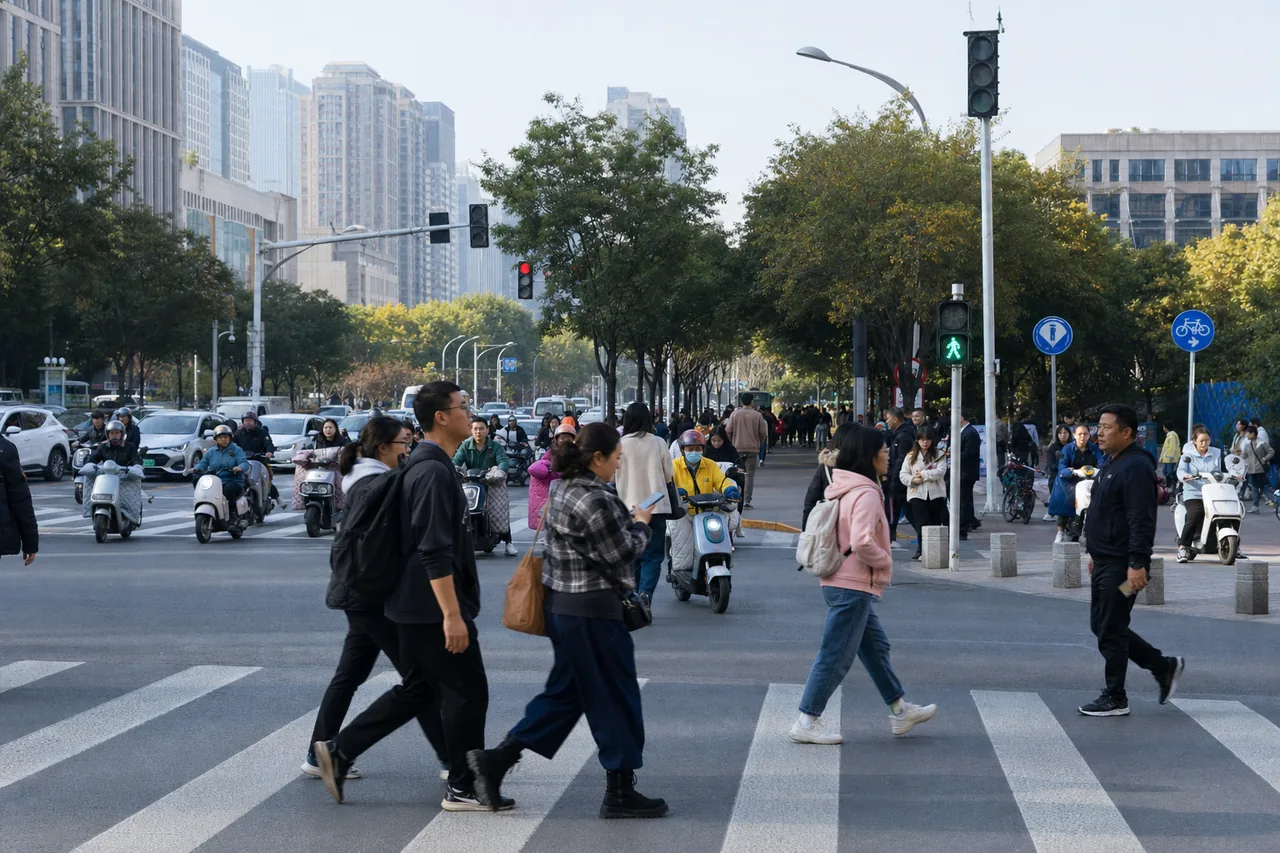
At noon, the intersection changed rhythm. People came out of office buildings for lunch, crossing the road in twos and threes while discussing which nearby fast-food place would not have too long a line today. Delivery riders became more numerous, their boxes brightly colored as they moved quickly along the edges of traffic. Sunlight struck the road, and the air smelled of hot oil, coffee, exhaust, and camphor leaves. A traffic assistant stood in the middle, his gestures concise and whistle short, separating and merging several streams of people and vehicles. His presence made me notice that an intersection is actually a continuing negotiation. Every crossing needs rules, but it also needs human presence. Red lights cannot answer every detail, and road markings cannot handle every hesitation, so someone always fills the gaps with a look, a gesture, or a sentence. The operation of a city seems grand, but at an intersection it becomes specific: who goes first, who waits, who is seen, and who is reminded.
In the afternoon, the intersection carried a brief weariness. Sunlight slanted between buildings, the road reflecting a pale brightness. People waiting for rides stood under tree shade, and even the electric scooters seemed less hurried. At the entrance of a convenience store, parcel lockers sounded from time to time. Someone picked up a package, opened it, flattened the cardboard, and placed it in a recycling bin. A small umbrella-and-shoe repair stall leaned by the roadside, its owner dozing on a low stool while the sign beside him had not yet lit up. Around three or four in the afternoon, cities often reveal their reverse side: not the tension of morning or the liveliness of night, but a temporarily loosened state. The human flow remains, only thinner, like a river reaching a gentle stretch. Such moments are easily overlooked, yet they show that intersections do not only serve peaks; they also hold waiting, pauses, and idleness. If a city had only speed, it would exhaust people. With these afternoon gaps, speed has a place to breathe.
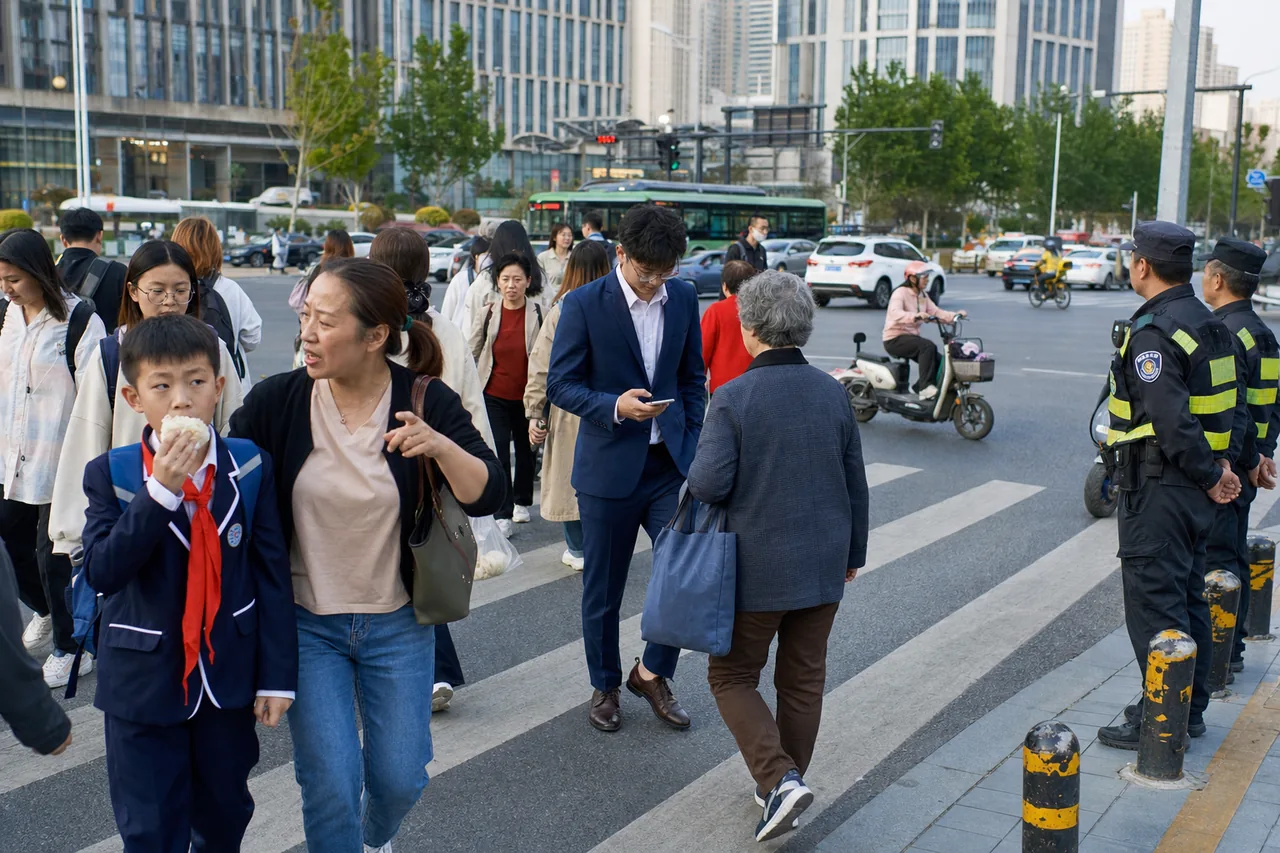
As evening arrived, the intersection was lit again. People off work poured from office buildings and subway exits, long lines formed before bus stops, and electric scooters of parents picking up children created a field of blinking taillights by the roadside. The sky was not fully dark, but streetlamps had already come on, warm yellow light crossing with the white light of vehicles. Hefei’s evening has a very ordinary liveliness: not exaggerated, but solid. Someone carries vegetables home, someone plans to eat crayfish with friends, someone waits by the road for a ride-hailing car, and someone asks over the phone, “Where are you now?” These sounds assembled together are the city’s shift from work mode to life mode. The human flow at the intersection therefore gains more emotion. In the morning most people move outward; in the evening more people flow back toward home, dinner tables, friends, and rest. Every face carries traces left by the day: fatigue, relief, anxiety, or expectation, briefly appearing under the lights.
I crossed with the crowd again and again, deliberately not leaving the intersection too soon. I walked to the opposite side and back, standing at different angles to watch the same traffic lights and crosswalks, and surprisingly saw different versions of the city. From beside the bus stop, the intersection was a timetable, and people cared when the bus would arrive and whether seats would be available. From the breakfast stall’s position, it was a dining table, with everyone seeking the most convenient warm bite of the day. From under the pedestrian bridge, it was a machine, with wheels, footsteps, lights, and signs meshing together. From the tree shade, it became a neighborhood space, where elders chatted, children waited, and cyclists stopped to wipe sweat. The same place changed layers according to the point of observation. This made me feel that understanding a city is not about finding one total answer, but about being willing to look repeatedly at an ordinary place from several angles.
After night fully arrived, the human flow at the intersection did not disappear; it changed into another group. Young people came out of the mall carrying milk tea and shopping bags. Night runners passed along the sidewalk, bracelets glowing faintly on their wrists. Vendors pushed carts to more visible positions, and the smell of fried rice and grilled cold noodles began to fill the air. The intersection that emphasized efficiency by day gained a little right to linger at night. People were no longer only rushing; they waited for friends, chatted, checked phones, and ate by the roadside. The traffic lights still changed in a fixed rhythm, but people’s moods had loosened. A girl stood before the crosswalk fixing hair blown messy by wind, while the boy beside her held her bag. A driver rolled down his window to ask for directions, and a pedestrian pointed ahead. Several children beside their parents counted down with the signal timer, stepping out excitedly when the light turned green. Night did not change the rules of the intersection, but it made the warmth inside those rules easier to see.
The human flow at a Hefei intersection made me think of the city’s broader character. It does not always place its prettiest side in front like some tourist cities, nor does it display itself through overwhelming speed like some megacities. Hefei is more willing to appear through daily routines: the road to work, the road to buy vegetables, the road to pick up children, the road home. Its changes are fast, with towers and new districts rising, subway lines extending, and science parks and university campuses bringing new rhythms into the city. Yet at the intersection, the most basic human order remains clear. No matter how advanced a city becomes, someone still waits for a red light, someone still rushes for a bus, someone still stops for a cup of soy milk, and someone still tightens their grip on a child’s hand before the crosswalk. An intersection is the city’s plainest slice. When cut open, it shows not abstract development, but how concrete life moves forward second by second.
When I left the intersection, it was already past nine at night. Traffic was lighter than in the evening, and the road seemed wider under the lamps. A cleaning vehicle moved slowly by, mist spreading behind it and pressing down the dust left by the day. The last group of late workers hurried across the road, a few vendors still called to customers, and only scattered figures remained waiting at the bus stop. I looked back at the traffic lights, which continued changing colors tirelessly, like an eye of the city that never closes. Perhaps tomorrow morning the same human flow will gather again, and perhaps most of those people will never know one another. Still, they will continue sharing red and green lights here, sharing a crosswalk, sharing the brief pause and renewed departure that the city gives each person. The Hefei intersection did not take me far away, but it showed me the richness nearby. So-called human flow is not faceless movement; it is countless specific people bringing their lives to one crossing point, then scattering from there in different directions.