Chinese Expressions That Snuck Into English When Nobody Was Looking
In 2018, “add oil” was added to the Oxford English Dictionary. When I saw the news at the office, I nearly spat out my coffee — because at that exact moment I was explaining to a British colleague that “add oil means encouragement, not a trip to the petrol station.” He’d been confused all morning about why a Chinese coworker had messaged “add oil for your presentation.”
This got me investigating a fascinating linguistic phenomenon: how many Chinglish expressions have actually, quietly, legitimately, entered the English-speaking world? The answer is far more than most people imagine.
“Long time no see
“Long time no see” is probably Chinglish’s greatest triumph. Grammatically, it should be “It has been a long time since we last met” or at least “I haven’t seen you for a long time.” But “long time no see” has no subject, no predicate, no tense — it’s a word-for-word calque of the Chinese 好久不见 (hǎojiǔ bújiàn).
The earliest written record of this expression dates to around 1900 in the American West, originating from Chinese immigrant speech. Over a century later, every native English speaker uses this phrase — and most have no idea it comes from Chinese. It took just one generation to go from “error” to “standard usage.” That’s how language works: when enough people use it, wrong becomes right.
Back to the “add oil” story. Its path into English was entirely different from “long time no see.” The latter naturally permeated over a century; “add oil” was pushed in by a specific event — in 2018, a Hong Kong scholar submitted an inclusion application to the Oxford English Dictionary, backed by extensive evidence of usage on international social media. The editors determined that the expression was already widely understood and used in English-language contexts, particularly in Asian English circles.
Interestingly, “add oil” makes zero literal sense in English. Oil in English evokes petroleum, motor oil, cooking oil — no one would connect “adding oil” with “encouragement.” But that’s precisely its charm: it entered English carrying an untranslatable cultural texture. Much like when Japanese “umami” entered English, nobody tried translating it to “delicious taste” — because translation would destroy that precision.
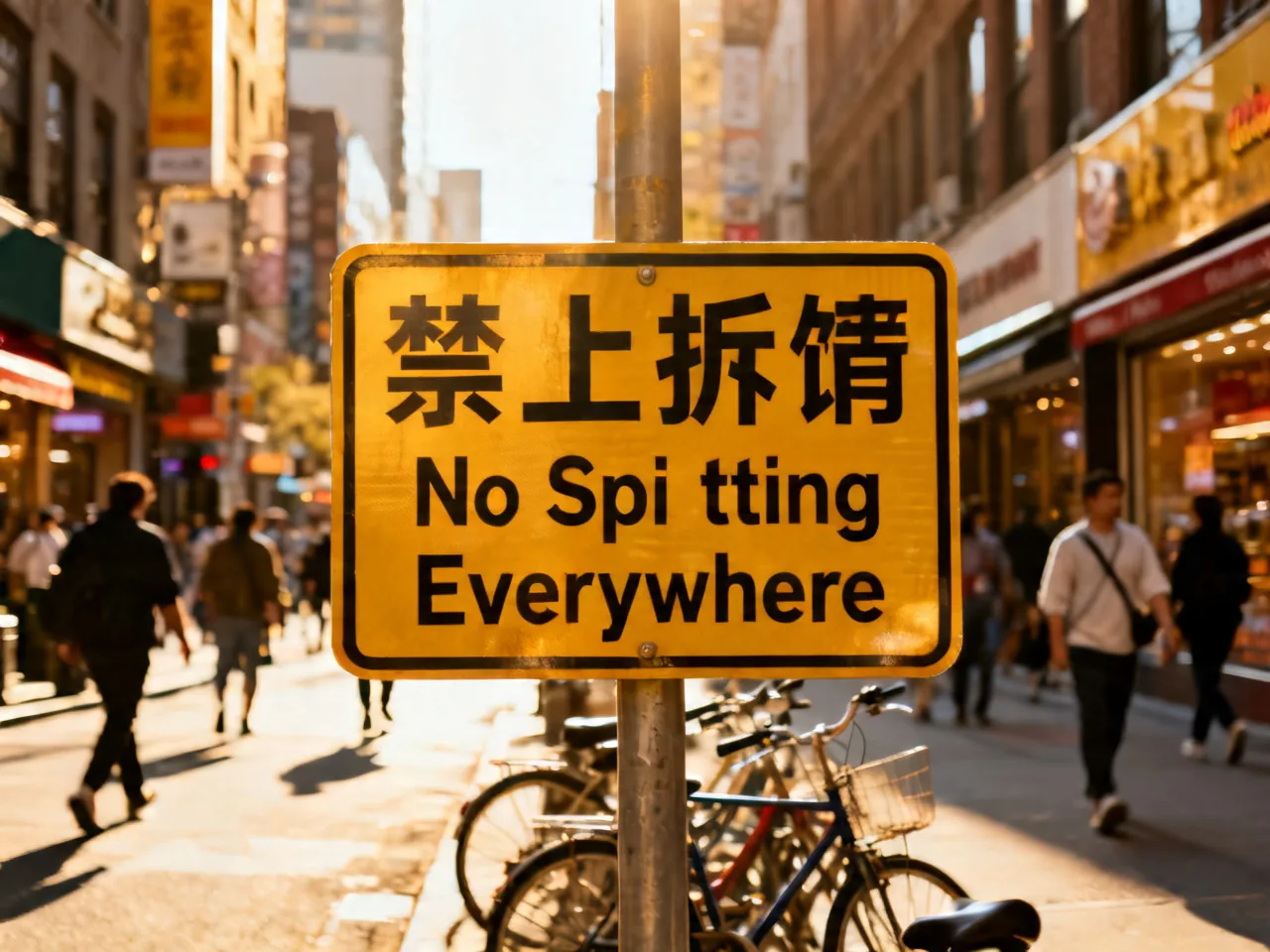
There’s a classic collection on the Chinese internet called the “Chinglish Hall of Fame,” documenting translation disasters in public spaces: “小心滑倒 (Caution: Slippery)” rendered as “Slip Carefully,” “一次性用品 (Disposable Items)” as “A Time Sex Thing,” “干货区 (Dried Goods Section)” as “Fuck Goods Area.” These are genuine translation errors, but the reason they’re funny reveals the enormous conceptual chasm between Chinese and English — not merely that “Chinese people are bad at English.”
Take “people mountain people sea” (人山人海). The calque is grammatically wrong, but its expressive power is immense — any native English speaker immediately grasps its meaning upon first hearing, and might even find it more vivid than “extremely crowded.” I’ve seen Westerners on Reddit use “people mountain people sea” to describe festival crowds, with not a single grammar correction in the comments.

There’s a concept in linguistics called language contact — when speakers of two languages coexist over time, the languages inevitably permeate each other. Chinglish isn’t a bug; it’s the natural product of Chinese-English contact.
English itself is a “mixed-blood language” — Germanic foundations layered with Latin, French, Old Norse, and Hindi vocabulary. “Typhoon” comes from Cantonese “大风 (daai fung),” “ketchup” from Hokkien “鲑汁 (kê-tsiap),” “tea” from Hokkien “tê.” Chinese influence on English isn’t new — most people just haven’t noticed.
As China’s global influence expands, more Chinese expressions will predictably enter English. “Guanxi” is already common in business English; “wok,” “dim sum,” and “kung fu” have long been English words. What’s next? My bet is on “neijuan (involution)” — although involution already exists in English, its special Chinese meaning (destructive competition, futile effort) is spreading to the English-speaking world via social media.
Language was never a wall; it’s always been a river. It’s constantly flowing, constantly accepting new tributaries. Next time you say “Long time no see,” remember you’re speaking a piece of “incorrect” English that tumbled out of a Chinese immigrant’s mouth over a century ago — and today, the whole world uses it.