Sea Fog in Qingdao Turned My Photo Plan into a Walking Plan
When I arrived in Qingdao, I came with a very clear photography plan. In the early morning I would photograph seagulls at Zhanqiao Pier, at noon I would look for old-town corners with red roofs and green trees, at sunset I would wait by the sea for golden light, and at night I would take a few photos of sea wind under lamps. The plan looked beautiful, as if the weather were obliged to cooperate. But when I opened the curtains the next morning, I did not see blue sea and sunlight. I saw fog softening the edges of buildings.
At first I felt disappointed. The weather app showed low visibility and strong wind by the sea, and of course there would be no sunrise to watch. I put the camera battery in, then hesitated and set the camera back on the table, suddenly unsure whether I should go out. In travel, the most discouraging weather is not always heavy rain, but this kind of fog without clear boundaries. It does not tell you the day is impossible, but quietly removes the colors, distances, and light you expected.
I still went out, but left the tripod in the room. The street downstairs was wet, drops hung from roadside leaves, and the sound of taxi tires seemed clearer than usual. The air smelled faintly of the sea and also of steam from breakfast shops. Fog made the city feel closer. The distance became unclear, while nearby things were enlarged: the worn edge of a sign, water marks on a plastic stool, tiny droplets on a pedestrian’s jacket shoulder. Everything near me became specific.
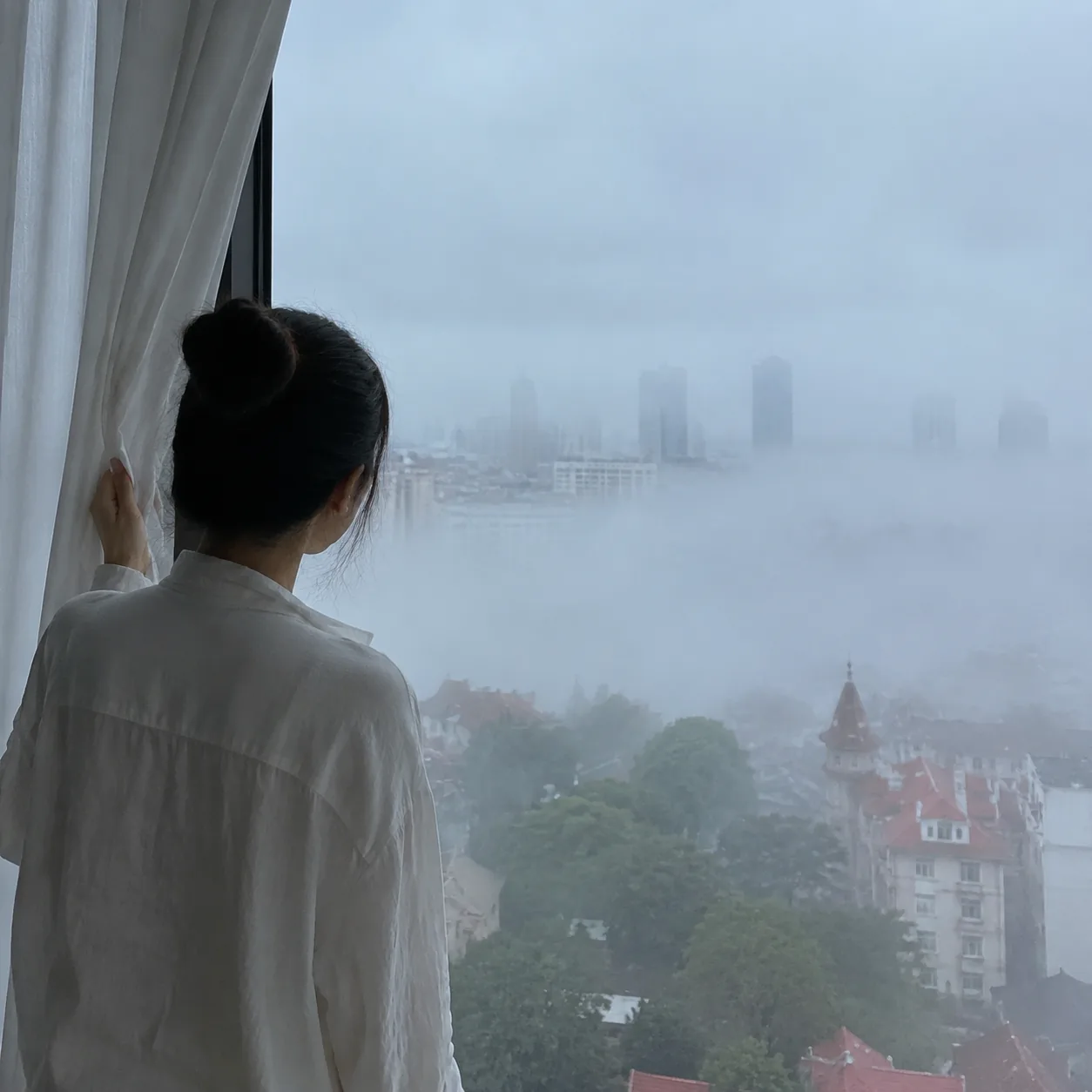
Before reaching the seaside, I still held a little hope. Maybe the fog would suddenly lift; maybe the sea would reveal blue for a few minutes. But near Zhanqiao Pier, what I saw was a line slowly disappearing into whiteness. People took photos at the pier entrance, with backgrounds that were almost blank. Seagulls flew out of the fog and were quickly swallowed by it again. Their calls arrived before their bodies and stayed in the ears longer.
If judged by the original photography plan, that morning was almost a failure. There was no transparent sky, no clearly layered sea surface, and no sunlight lighting the buildings. But after standing for a while, I discovered that the fog was not hiding Qingdao. It was letting the city appear in another way. Once the sea’s boundary blurred, sound, humidity, and wind became more important. Unable to see distant Xiaoqingdao, I could hear the fine broken sound of waves slipping back from the stone steps.
I put the camera into my bag and decided not to wait for the fog to lift. The decision made me feel much lighter, as if I had stepped out of a task that required a finished work. I walked slowly along the seaside with no fixed endpoint, letting my steps follow the railing and the sound of waves. A foggy coast has little bright decoration and few colors: a gray-white sky, a slightly darker sea, wet black rocks, and occasionally a red raincoat passing through the scene.
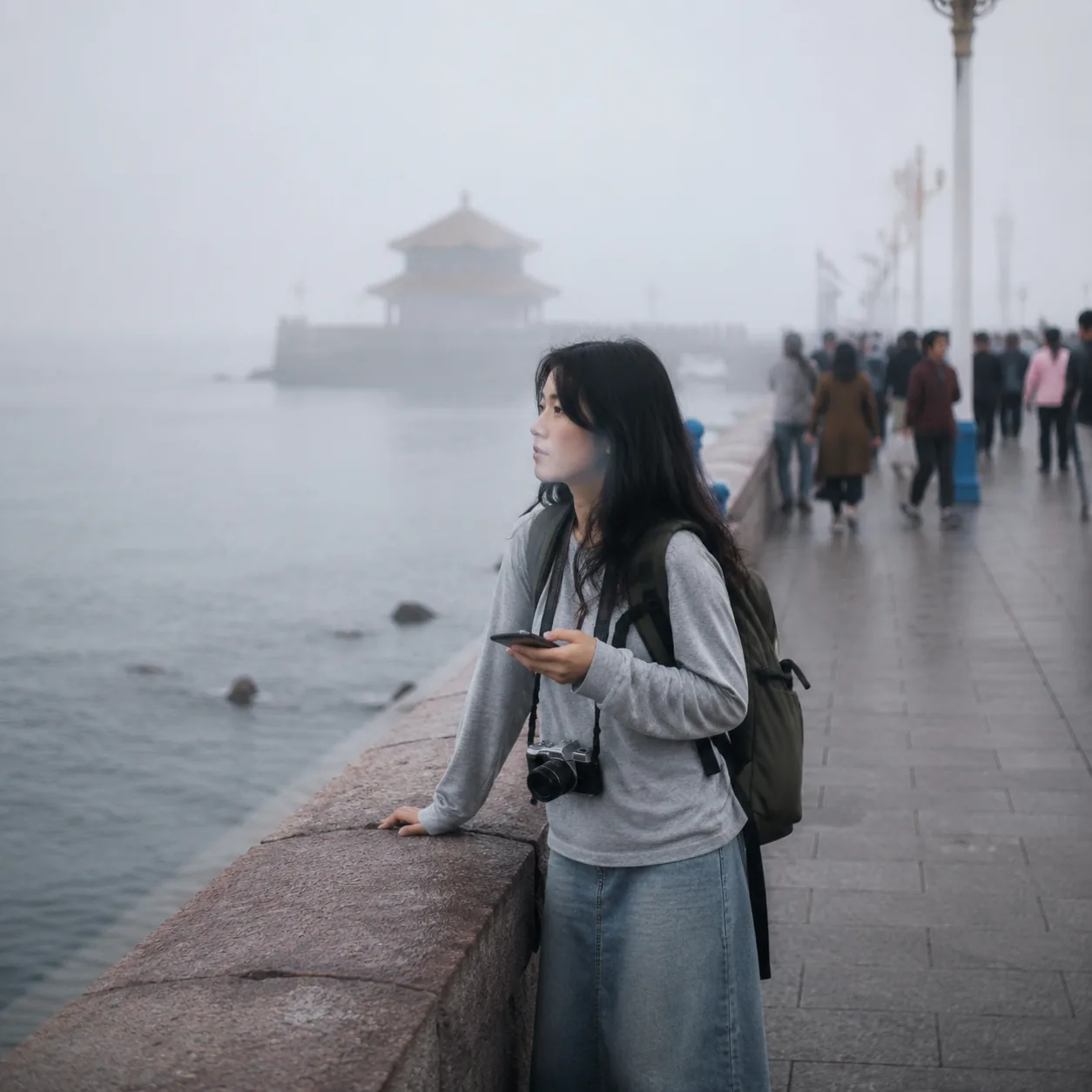
In this weather, Qingdao’s seaside became less like a postcard and more like a real morning. Someone walked a dog, and the dog lowered its head to smell wet grass. Someone jogged in sportswear and became only a blurred back in the deeper fog. An uncle carried a small bucket toward the rocks, looking very familiar with this dampness. The difference between visitors and locals became less obvious in the fog. Everyone was gently wrapped by the same moisture.
I passed a wooden boardwalk. The planks were damp with fog water and made a low sound underfoot. Beyond the railing, the sea had no clear distance, only white edges turning near me. I used to think seaside travel required vastness, a long view, and a beautiful line between sky and water. But after the fog erased that line, I began to notice what was underfoot: gaps between boards, dense droplets on the railing, a little sand lifted by my soles.
A gust of wind came from the sea, pushing fog toward shore like thin cloth. I stood by the road adjusting my scarf, and an auntie selling hot drinks asked whether I was cold. I said I was fine, only that I could not see the sea. She smiled and said foggy days have their own way of being seen, and I should not keep staring far away. I bought a cup of hot soy milk. The cup was warm in my hands, and the sea fog mixed with the steam. Suddenly her words felt more suitable than any photography tip.
So I made walking the main content of the day. I no longer hurried to the next camera position, but followed the coastline with pauses. Sometimes I sat on a bench and watched fog swallow distant pedestrians little by little. Sometimes I walked near the rocks and listened to waves hit and withdraw. Sometimes I turned into a lane near the sea and looked at old walls colored unevenly by damp air. Nothing was spectacular, yet everywhere allowed stopping.
The old town in fog also became softer. Red roofs were not as vivid as on sunny days, green canopies had lower brightness, and buildings seemed to develop slowly from old photographs. The café at the corner was not full yet, condensation gathered on the window, and someone inside lowered their head over a book. The German-style buildings along the street felt less like monuments and more like places lived in. I suddenly liked this lack of clarity. It allowed the city to drop its pose of being viewed.
At noon I ate beside a sloping street, and the window outside remained pale and foggy. Two local people at the next table chatted, saying this kind of fog was common in spring; it might clear after a while, or it might last all day. After hearing that, I stopped feeling anxious. It was not a problem waiting for me to solve, only Qingdao’s character for that day. I ordered hot noodle soup, and when it arrived, the steam above the bowl connected with the fog outside, as if indoors and outdoors were using the same weather.
In the afternoon the fog thinned a little but did not truly clear. The sea occasionally revealed a deeper color, and distant boats looked like short pencil lines. I walked near Badaguan, where trees, courtyard walls, and street signs all carried moisture. This area is usually good for photos of sunlight through tree shadows, but that day the shadows did not fall clearly. Only damp branches crossed above me. Without patches of light, the road became quieter, suitable for listening to my own footsteps.
I began to understand that my photography plan had disappointed me because it had fixed Qingdao in advance as several images: blue sky, red roofs, seagulls, sunset, waves. The fog broke those images apart, giving me a chance to meet Qingdao outside them. For example, a shop clerk wiping umbrellas at a convenience store entrance, grass emerging from a stone wall crack, and a child stretching a hand into the fog and saying it felt like touching a cloud. These things might not be ideal to post, but they were very good to remember.
At dusk I returned to the seaside. The sunset from my original plan, of course, did not appear. The sky simply changed from light gray to dark gray, and streetlights came on one by one. Strangely, I did not feel regret. On a coast without sunset, attention naturally lands elsewhere: couples walk closer side by side, cyclists slow down, and waves look whiter in the dark. The fog took away a dramatic ending but gave a gentler closing.
I sat by the sea for twenty final minutes. The camera held only a few photos, and my phone album did not contain the impressive images I had expected. But the day was not empty. It had damp cuffs, hot soy milk, a pier without a visible end, roofs lowered by fog, the sound of wet boards, and a mood that slowed along the way. Sometimes travel works not because the weather is perfect, but because you are willing to change the way you stay with it.
If I meet sea fog like this in Qingdao again, I probably will not rush to judge whether the day is worth going out. I will first wear a windproof jacket, protect the camera from moisture, and reduce the destinations to one or two. More importantly, I will leave room for walking. A foggy day is not good for chasing distant views, but it is good for moving closer to a city. It is not good for cutting time into too many pieces, but it is good for letting the road extend by itself.
When I returned to my lodging, my jacket still carried the damp smell of sea wind. I placed the camera on the table and found that I was not upset about taking fewer photos. The fog, wind, and sounds that had not been clearly photographed were more complete in memory. Qingdao did not appear according to my plan that day, yet it stayed in a quieter way. It taught me that seaside travel has more than one answer beyond clear weather. Fog can also lead a person where they need to go.