Fuzhou’s Banyan Trees and Crossroads Showed Me How the City Moves
A Fuzhou intersection has many expressions within a single day. In the morning it carries damp mist; in the afternoon it shines under the sun; by evening it is filled with electric bike lights, bus doors, and pedestrians’ conversations. Standing at an ordinary intersection and watching the flow of people is like watching a river without a fixed channel. People arrive from all directions, then stop, separate, and merge according to the rhythm of traffic lights. The air in Fuzhou is often warm and moist. Banyan leaves spread broad shadows by the road, and their roots stretch along the ground like the veins of the city. The crowd passes through these shadows with different purposes, yet together it forms the city’s most daily and truthful movement.
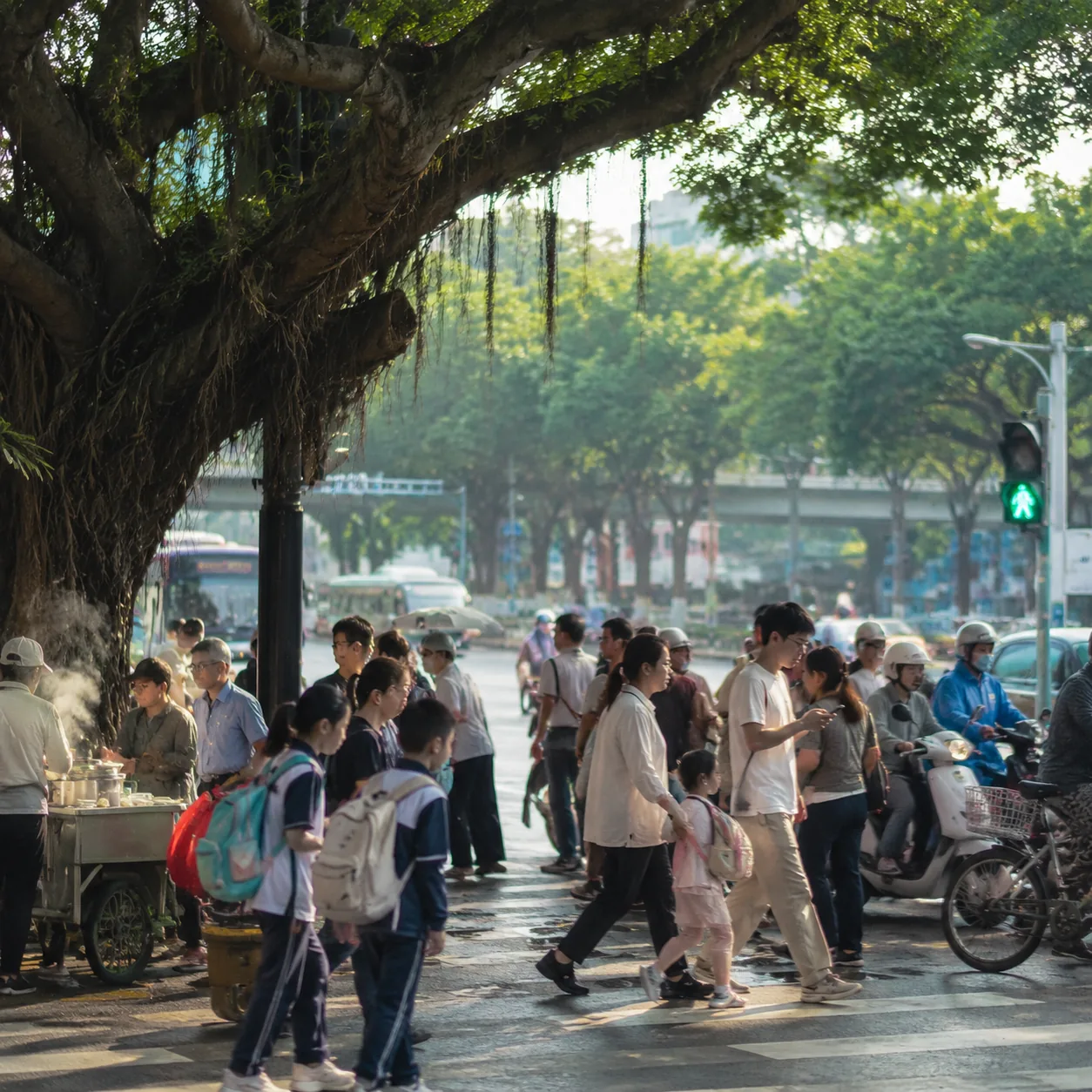
The morning rush hour best reveals the density of life at the intersection. Students carry schoolbags, their uniform hems lifted slightly by the wind; office workers walk while checking phones, perhaps hearing news, music, or meeting reminders through earphones; a short line forms beside a breakfast stall, where the fragrance of guobian paste mixes with the steam of soy milk. The instant the green light appears, the waiting crowd seems gently pushed by one shared signal, and feet move forward together. Some walk quickly, some push bicycles, some hold children’s hands, and electric bikes line up beyond the white line, riders wearing sun hats or rain capes. The intersection feels crowded but not chaotic, because everyone understands this shared method of moving forward.
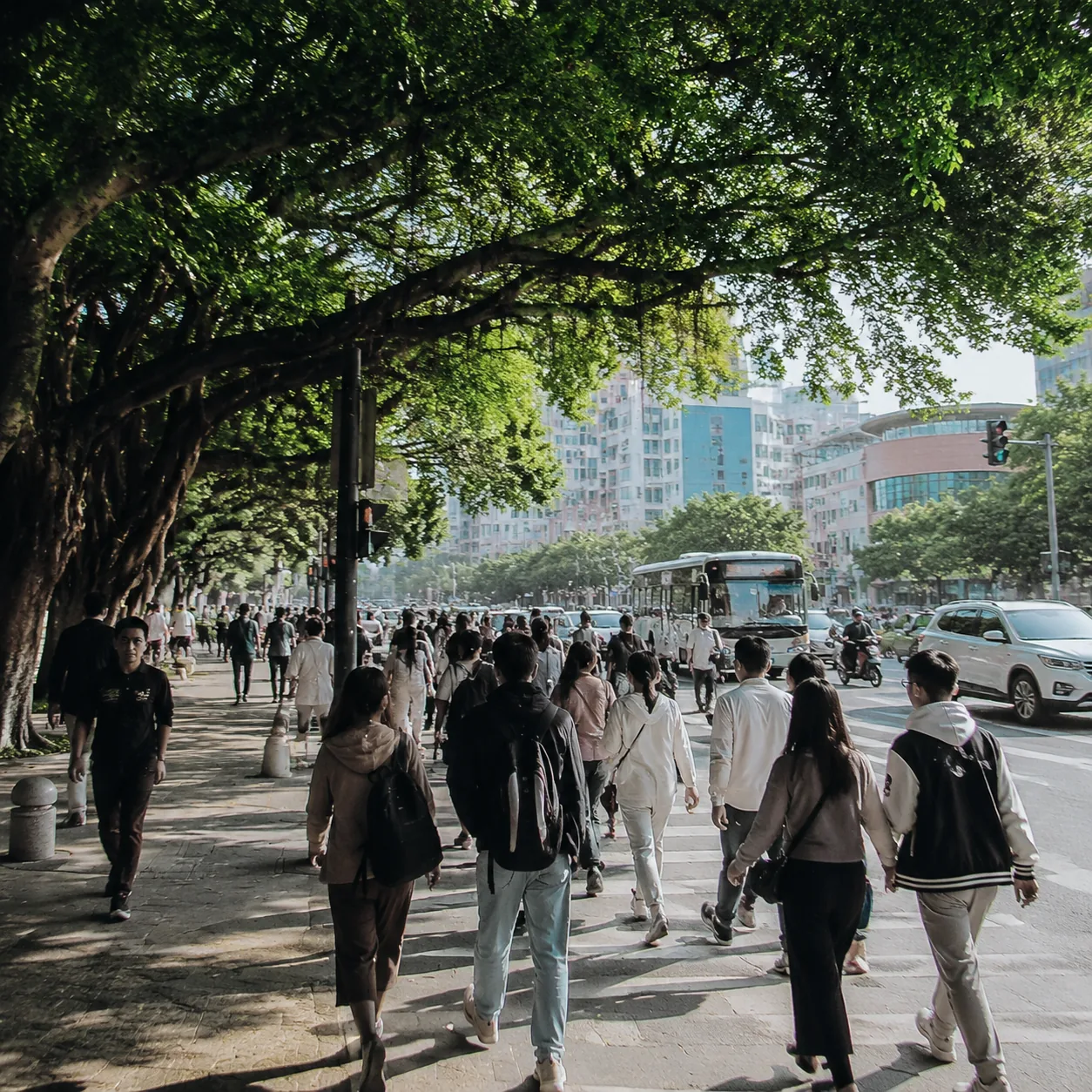
Fuzhou intersections are rarely without banyan trees. They stand nearby not like decoration, but like long-term witnesses. Their crowns cover part of the sky, and sunlight passes through leaves to form trembling spots on the zebra crossing. People waiting for the red light naturally move toward the shade, and even a little extra coolness is enough to make waiting bearable. Elderly people come from the market carrying vegetables, with greens and fish tails showing from plastic bags; young people emerge from the subway, their steps carrying the speed of a renewed city; delivery riders stop by the roadside and check orders. The banyan trees watch these people come and go, as if watching seasons repeat and the city constantly rewrite itself.
The afternoon intersection has another rhythm. The sun rises high, traffic noise grows bright, and the asphalt seems to steam slightly. The flow of people is not as concentrated as in the morning, but more scattered and fragmented. Someone leaves an office building to buy coffee; someone walks from the direction of a hospital carrying medicine; someone lowers a sun umbrella so that only hurried feet are visible. When a bus stops, the doors open and cool air rushes out with human voices; when the doors close, the intersection returns to heat and waiting. Fuzhou’s heat is not merely temperature. It carries the moisture of river water, leaves, and old lanes, so when people stop at the crossing, they often feel sweat slowly rising across the back.
Evening is when the intersection becomes richest. The sky is still bright, shop lights have already come on, roadside stalls begin to set up, and pedestrians change their pace. Office workers step out of the day’s tasks with a little fatigue in their stride; students walk together after school, their voices louder than in the morning; shoppers wait for transport with heavy bags hanging from their hands. The red light holds the crowd briefly, and the green light lets it spread again. Each pause feels like the city inhaling; each release feels like the city exhaling. Standing beside the crossing, one senses that Fuzhou is not a static map, but a warm living body.
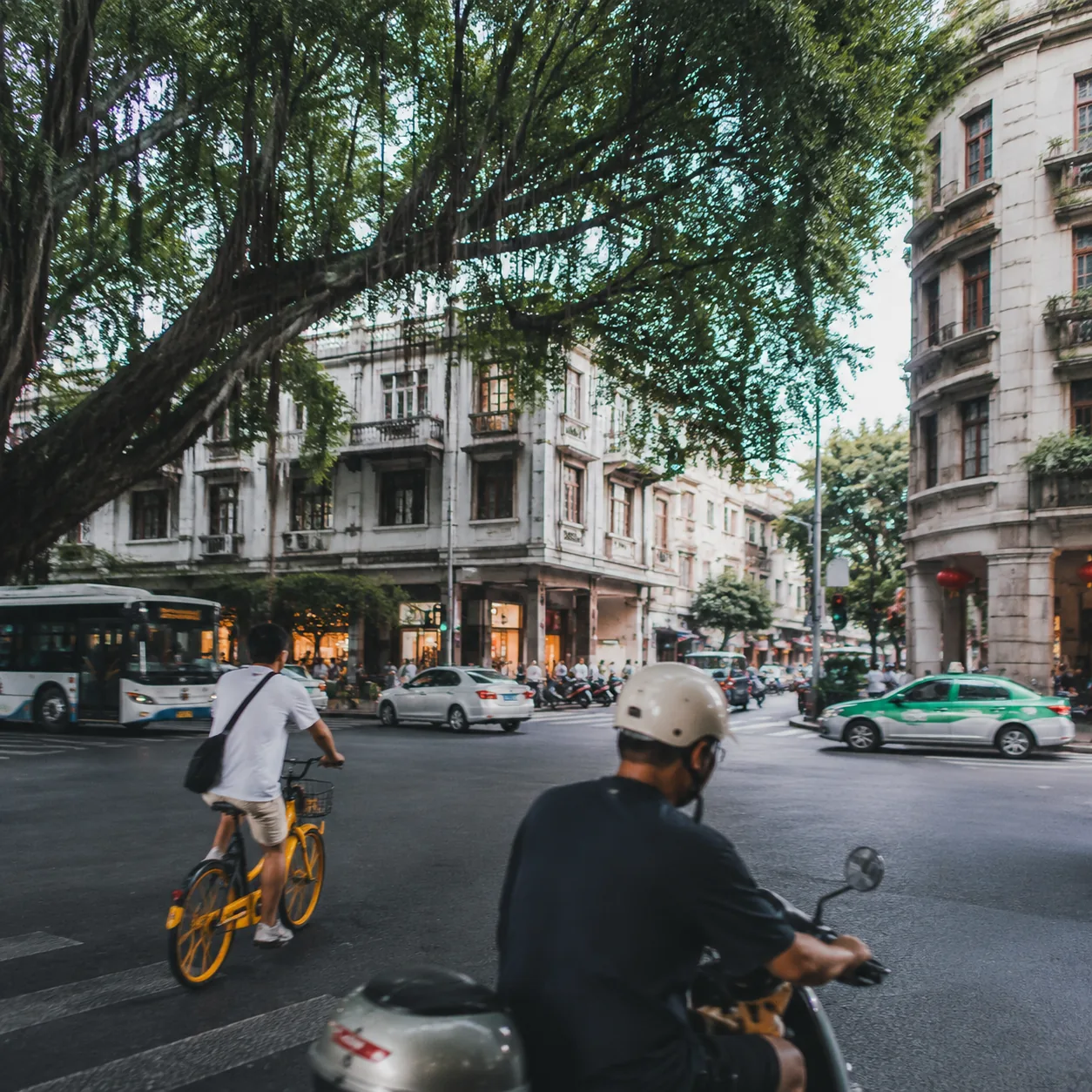
There are many brief encounters within the flow of people at an intersection. Two people pass each other in the middle of the crosswalk and will not remember one another, yet for the same second they share the same piece of road. An elderly person walks slowly, and a younger person beside him slightly slows down without speaking, simply leaving a bit of space. A child’s balloon drifts in the wind, the mother reaches out to pull it back, and the people behind pause naturally for a moment. Electric bike riders and pedestrians judge distance with their eyes, and a bus driver waits before turning until the last person reaches the sidewalk. These tiny adjustments form the order of the crossing. It is not a rule written on paper, but an understanding shaped by countless passages.
The atmosphere of old Fuzhou also appears at intersections. On one side of some crossings stands a newly built commercial building, while the other side leads into narrow lanes, old houses, and snack shops. You can see people in formal clothes leaving glass doors, and you can see small shops selling fish balls, mixed noodles, and meat swallow dumplings sending steam toward the street. The crowd here is not uniform; it places people of different ages, occupations, and rhythms of life under the same traffic light. The complexity of a city often hides in such ordinary waiting. Everyone is stopped by the same red light, so even very different people share an equal pause for several dozen seconds.
A rainy intersection is another scene entirely. Rain in Fuzhou sometimes arrives suddenly; air that was muggy moments before is quickly filled with rain sound. The crowd becomes more compact in the rain, umbrellas close to umbrellas, rain capes swelling on electric bikes like moving patches of color. The zebra crossing is washed bright, and vehicle lights reflect on the ground, red, green, and white shaking together. Some people shelter under shop eaves, some simply hurry across, and some hold bags against their chests. Rain makes the intersection louder and human movements more direct. When the rain lightens, the flow of people opens again, like grass slowly straightening after being pressed down.
At night, the intersection carries the warmth of street life. Bulbs at roadside stalls come on, and the sounds of woks, scanned payments, greetings, and traffic mix together. Someone working late buys a meal at the corner; a rider picks up an order and quickly leaves; young people stand outside a milk tea shop discussing where to go next. The flow of people is no longer centered on work and school as it is by day, but feels more like the city releasing itself. Fuzhou nights have an intimacy, so the intersection does not feel cold. Even with many cars and bright lights, people’s expressions are more relaxed than during the day. Someone eats while walking, someone carries late-night food home, and someone waiting for a friend looks up at lamp shadows in the trees.
If one stands at the same intersection for a long time, one discovers that the flow of people has its own language. Quickened steps indicate lateness; hesitation by the roadside indicates uncertainty about direction; the distance between people walking side by side reveals closeness or formality; the way an elderly person carries bags shows the weight of today’s market purchases. The city does not translate these languages, yet they occur every day. Fuzhou intersections are especially suited to observing them, because life here has many layers: mountains in the distance, rivers in the city, old lanes hidden behind high-rises, tree shadows falling beside traffic. The crowd links these layers together, turning an abstract city into touchable daily life.
I like watching the first few seconds after the green light appears. In those seconds, the crowd changes from stillness into motion, like a painting suddenly moved by wind. Everyone still carries the posture of waiting, yet has already begun to move forward. Someone puts a phone into a pocket, someone adjusts a shoulder bag, someone straightens an umbrella handle, and someone looks back to check whether a companion has followed. A few seconds later, the crowd has scattered to the other side of the road, and the shape they briefly formed has disappeared. The charm of the intersection lies here: it keeps creating images and then canceling them. Nothing remains for long, and precisely because of that, every moment feels real.
The flow of people at Fuzhou intersections also reveals the city’s resilience. Whatever the weather, life always finds a way through the crossing. Before a typhoon, wind turns leaves over, and people lower hat brims and keep walking; on a hot afternoon, waiting becomes long, yet people stand patiently in shade; a sudden shower briefly unsettles the crowd, but order soon returns. The city is not free of difficulty; it constantly adjusts its steps within difficulty. Every change of traffic lights is a small act of reorganization. People make room for their own paths and also receive the paths of others, allowing the vast life of the city to continue.
When I leave that intersection, the flow of people has not stopped. New pedestrians emerge from lanes, new vehicles line up before the stop line, and new sounds rise between shops and bus stops. The intersection will not remember me, but I will remember it: the people waiting under banyan shade, the briefly crossing footsteps on the zebra crossing, the moments when heat, rain, car lights, and dialect mix together. The flow of people at a Fuzhou intersection makes one understand that the most moving part of a city is not necessarily a landmark or a tower. It may be the crossing one must pass every day. There is no fixed protagonist there; everyone is only passing through, yet together they walk the city into being.
Later, when I pass intersections in other cities, I still think of Fuzhou’s warm and layered flow of people. It does not deliberately display anything, yet it displays life itself fully. Someone hurries, someone waits, someone is lost, someone goes home; someone carries the fatigue of a day, someone carries newly bought flowers, someone holds a child’s small hand, and someone carries unread messages on a phone. When the red light appears, they stop behind the same line; when the green light appears, they each move toward different directions. This simple repetition forms the city’s most reliable beat. The flow of people at a Fuzhou intersection is like a song that begins again every day, ordinary in melody yet deepened by countless footsteps.