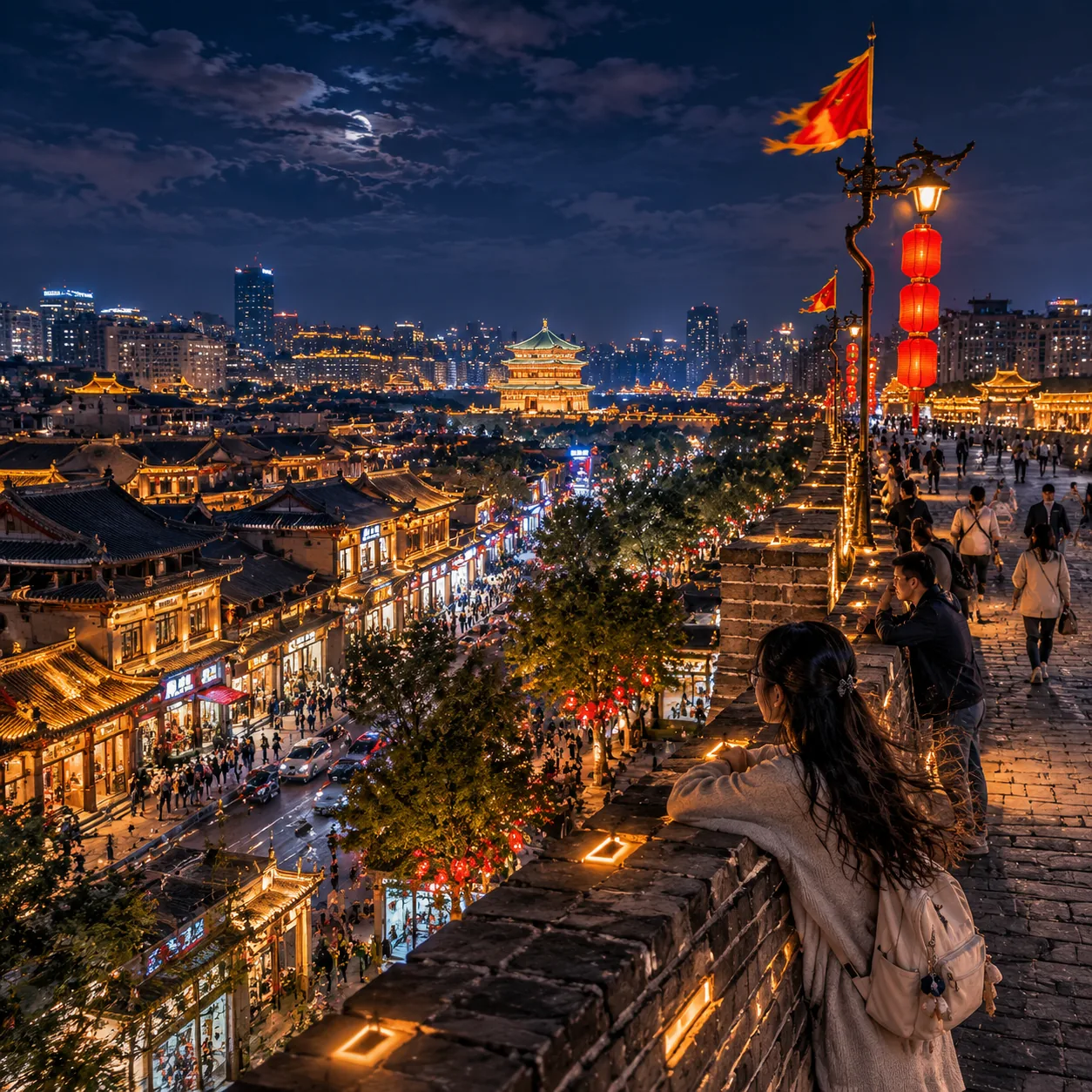
Walking Xi'an's City Wall at Night in May Was the First Time History Stopped Feeling Like a Textbook
Whenever I used to visit a city known for its history, I would slip automatically into something like student mode. I would see gates, old bricks, towers, and immediately start recalling dates, dynasties, and the familiar lines repeated in books and museum notes, as if the scene could only count once I had supplied the proper background. But the night I arrived in Xi’an, that habit failed for the first time. Before I could remember anything, the wind had already hit my face, the lights beneath the wall had already come on, and the uneven feeling of brick under my feet had already pulled me into the scene. In that moment I understood that history can reach you through the body before it ever reaches you through the mind.
It was May, and darkness came gently rather than all at once. A little warmth from the day was still hanging in the air. When I stood near Yongning Gate, the place was not quiet at all. It was alive. People were taking photos. Others were walking through the gate. A parent was crouching down to retie a child’s shoe. A young couple nearby was debating whether they should climb the wall or not. None of that liveliness weakened the feeling of an ancient capital. If anything, it made Xi’an feel more distinct. The city does not force a clean line between past and present. The wall is not there for you to admire from behind a barrier. It is still inside the breathing life of the city.
I eventually climbed up. The stairs were not difficult, but step by step, your attention naturally pulls away from your phone screen and back into your body. You start noticing how wide the bricks are, how rounded the edges have become, how the wind skims past your ears with a dry brushing sound. Once I reached the top, the view opened all at once. The lights inside and outside the old city spread like two different layers of the same drawing—one made of current traffic and shopfronts, the other shaped by the order this wall still imposes. The feeling was strange in the best way. It did not feel like moving through a “ruin.” It felt like walking inside a structure that still carries use, force, and weight.
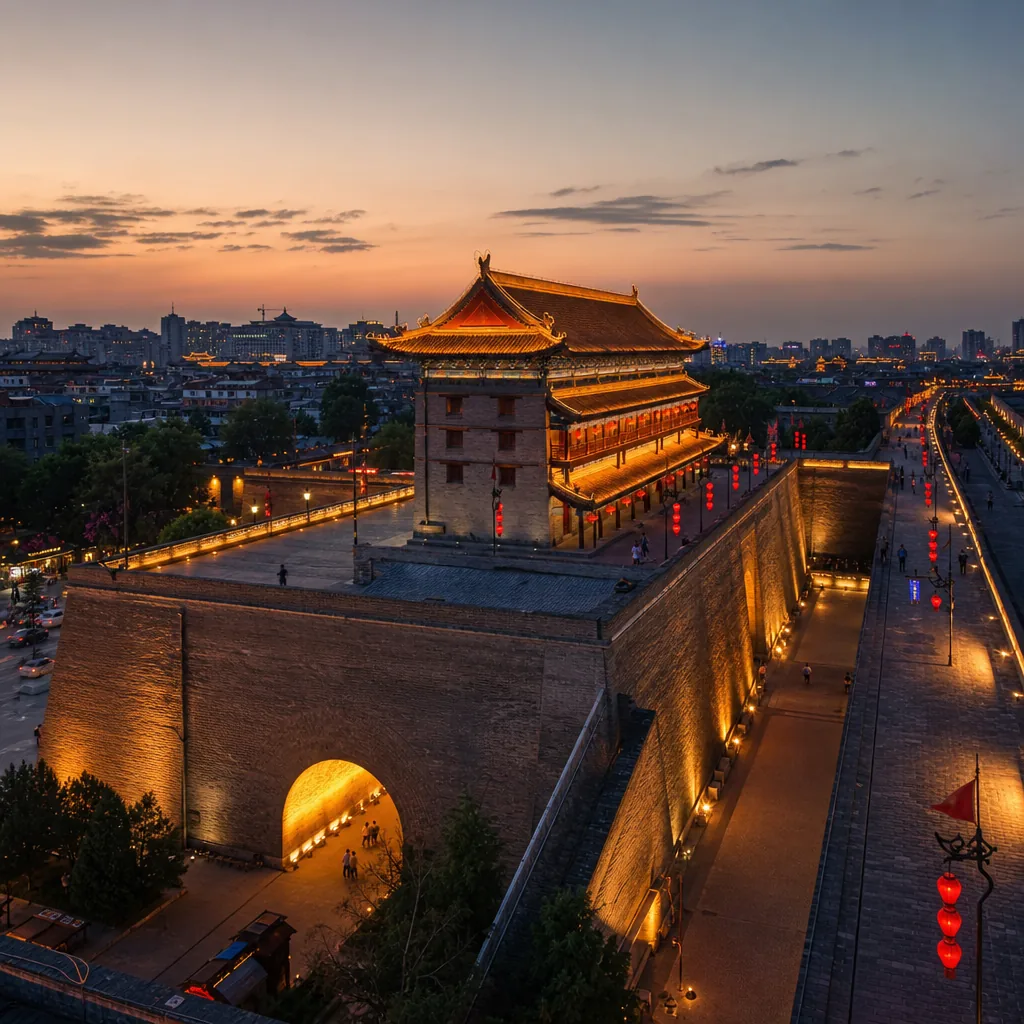
What I remember most is a very short stretch of the walk. A runner passed me lightly, and each step landed on the bricks with a soft dull beat. A little farther away, someone was leaning against the wall to take a night photo, the phone screen glowing across their face. In the wind there was also a trace of food smell drifting up from the stalls below. All of it together made me realize that a sense of history does not need solemn silence to exist. It can be ordinary, concrete, even a little smoky with everyday life. What moved me was not the abstract statement that “this place is cultural.” It was the fact that the past had not been locked away. It was sharing the same night as the people living now.
I kept walking slowly along the wall after that, without hunting for the “best photo point” or checking constantly where to go next. I watched the lights settle into brightness, and the roads of the city below turn into thin illuminated lines. In textbooks, history often feels complete, finished, something already over and left behind for later generations to summarize. But in Xi’an that night, history felt unfinished in the best sense. It had not stepped behind the present. It was still inside it. Most of the time we are simply moving too fast to place our feet firmly enough to feel it.
After I came down from the wall, I found a small place near the gate and sat down. The tabletop felt cool, and the outside of my cup was covered in condensation. A few people at the next table were still discussing which section of the night view had been best, but I kept thinking about the sensation of wind passing my ears. It was so specific that I could no longer reduce Xi’an to a “good historic city for travel.” Of course it is that. But it had also become something more personal to me: the first place where I understood, without reciting any knowledge at all, that history can hold temperature.
If someone asks me in the future what in Xi’an is most worth giving to the night, I probably will not begin with a dynasty or a famous anecdote. I will begin by saying: go walk a stretch of the wall, and wait for the wind, and wait until the lights and the bricks seem to hold the city up together. Some understandings are not heard or read first. There are moments when your body simply knows earlier than language does.