After Rain in Lhasa, Even a Pause Beside a Puddle Felt Like a Way of Entering the City
After Rain in Lhasa, I Changed Rushing into Slow Walking
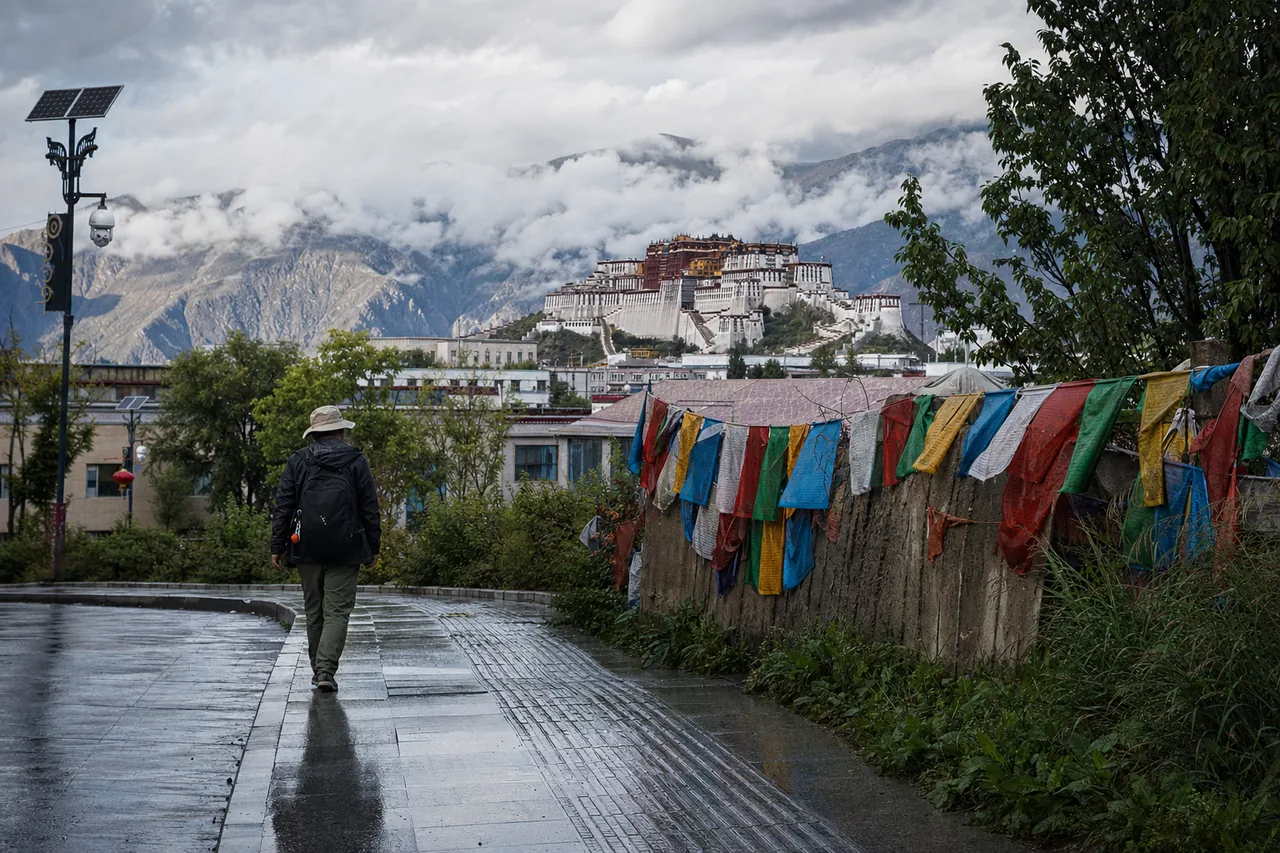
When the rain had just stopped, Lhasa seemed to have been lifted gently out of a clear bowl of water. Clouds still rested on the ridges, so low that their damp edges felt almost touchable, and the white walls of the Potala Palace looked quieter under the gray-blue light. It was not the dazzling white of postcards, but a washed white that had tucked dust and noise into the seams of stone for a while. I stepped out from my lodging without hurrying toward any attraction, choosing instead to follow the sidewalks that still shone with rain. Prayer flags hung lower after the shower, their colors deepened by moisture, red, yellow, blue, green, and white like sentences waking from a dream. The air carried soil, juniper, butter tea, and wet flagstone, cool in the lungs but not sharp. Someone swept water from a storefront into the gutter, the broom tracing a thin sound across the ground, like a footnote to morning. My soles broke shallow reflections in puddles, and the images closed again behind me. After rain, Lhasa does not urge anyone forward; it lowers the shoulders, slows the eyes, and pauses the clocks that keep marching inside the heart.
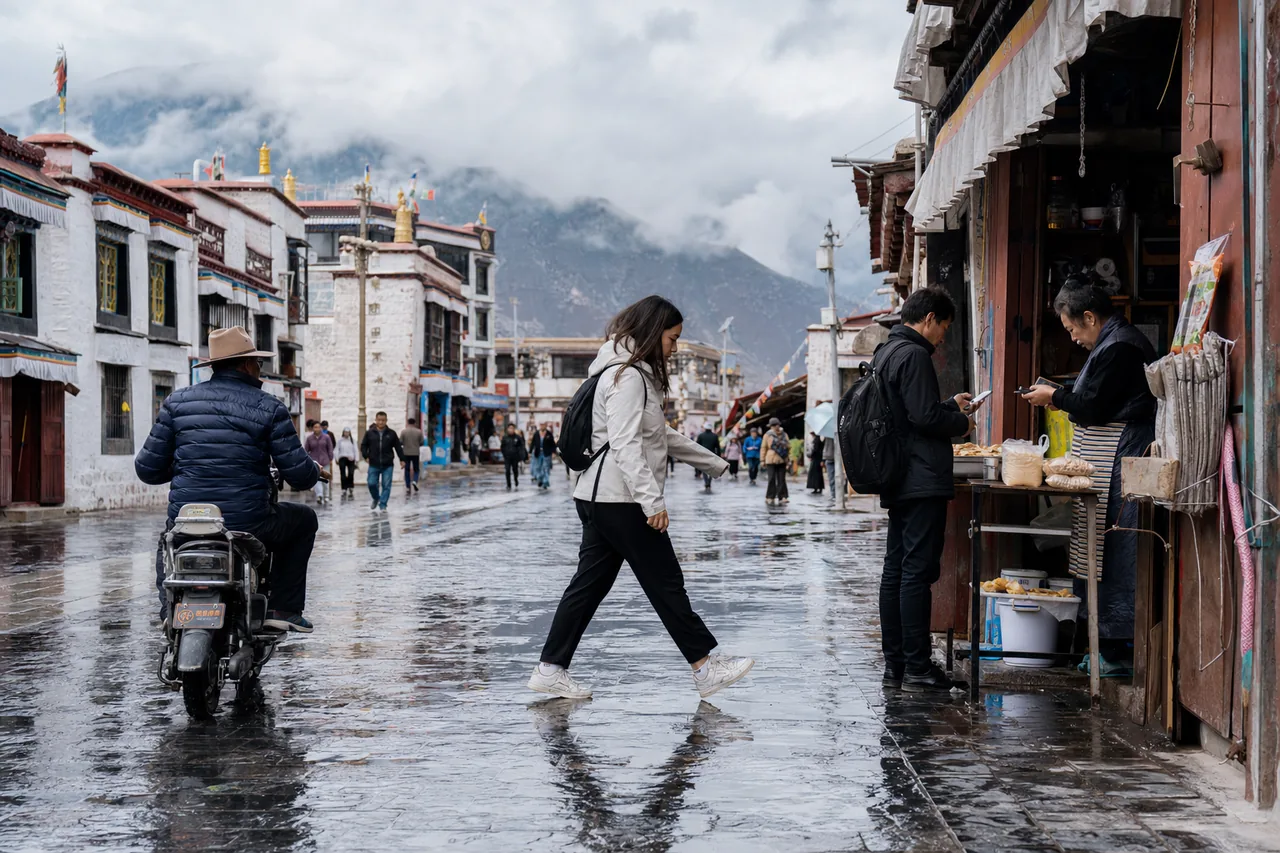
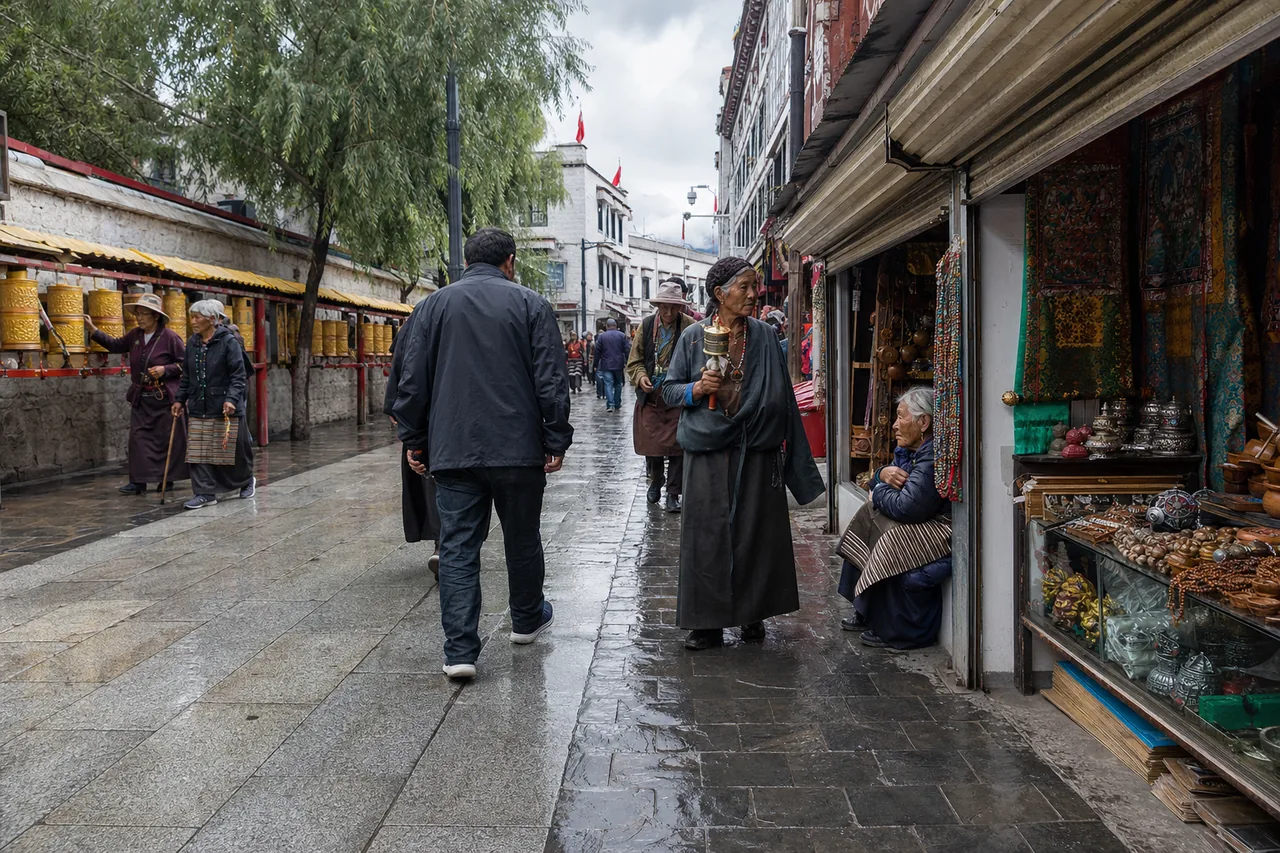
Walking along Beijing East Road toward Barkhor Street, I noticed how the dampness softened the traffic, even horns sounding as if wrapped in cloth. Shops opened one after another, and silver ornaments, thangkas, wooden bowls, and Tibetan incense revealed bits of color through half-open doors. Elderly people sat at thresholds with sleeves folded together, watching passersby with eyes that had seen enough seasons not to judge the moment too quickly. Pilgrims appeared at the intersection, some turning small prayer wheels, others simply murmuring under their breath, all moving along an old shared direction. The rain had polished the stone road until it shone; many footprints overlapped there, then were covered by fine dust brought by the next breeze. A young mother held a child by the hand, and the child crouched to examine an eave reflected in a puddle. The mother did not rush him, only waited beside him. That waiting resembles what Lhasa gives a traveler: it knows you will continue, and it also knows you may need to pause before a small pool of water. My slow walk was not laziness, but obedience to the rhythm unfolding in the air, and to the desire of every rain-washed detail to be noticed.
After rain, Barkhor Street feels especially like a breathing ring. The crowd is not thin, yet the shining pavement and low sky give it a deeper order. Everyone is reflected faintly by the road, as if walking on earth and water at once. Strings of bronze bells hang under eaves; when wind passes, they make a soft sound that does not travel far, but is enough to remind you that invisible time is moving here. Steam from sweet tea drifts out of small shops, fogging the glass, while people inside hold cups and speak with small movements of the lips, as if afraid to disturb the quiet after rain. Vendors selling tsampa and dried yak meat lift corners of plastic covers to check whether their goods have taken on moisture. Two backpackers stand by the road studying a map, wearing the earnest expression of people trying to understand a city, but Lhasa is not a map that can be read quickly. It is more like the circular path of circumambulation: the slower you walk, the more you understand that arrival is not always entering a building, but suddenly meeting your own breath along a road.
I stopped at a teahouse and ordered a pot of sweet tea. The wooden table had been polished by countless elbows, its surface marked with shallow scratches like narrow rivers left by time. Outside the window, rainwater dripped from the eaves in broken intervals, like a song unwilling to end. Several locals sat at the next table; sometimes they laughed while talking, the laughter short but warm. Tea poured into the cup, milk and leaves blending into a dense fragrance. The sweetness did not strike suddenly, but spread slowly, loosening the body from the fingertips inward. Holding the cup, I watched pedestrians pass outside: a cyclist in a raincoat, students with backpacks, an old man in a broad-brimmed hat, a woman carrying vegetables. Together they formed the true scenery of Lhasa after rain, more intricate than any grand building. Travelers often arrive on the plateau hoping to find miracles, yet in that teahouse I felt that miracles can also be small: the warmth of a cup of tea, a drop of water hesitating under an eave, the laughter of strangers lingering for a moment on a wooden wall.
When I left the teahouse, the sky had brightened a little, and the distant mountain line emerged from behind the clouds like ink slowly wiped dry. I turned into a lane where children chased one another near the entrance, their shoes splashing water and their laughter bouncing between walls. The walls were painted in uneven layers of old and new colors; some places had been mottled by rain, while others carried notices and faded posters. There was nothing spectacular in the lane, but there was the density of life: chopping sounds from behind one door, freshly washed clothes hung behind a window, a dog lying on a step and watching me pass with lazy eyes. The sunlight after rain did not grow strong at once; it leaked gradually through the clouds, edging wet walls and puddles with pale gold. In such light, time seemed less like a straight line and more like water taking detours, willing to linger in low places and flow away along invisible slopes. Before coming to Lhasa I had made many lists, but what I may remember most are these unlisted lanes, dogs, door sounds, and pieces of light.
By afternoon the rain clouds had opened wider, and people began drying things in the streets. Someone spread damp cushions at a doorway; someone placed scriptures and cloth bags briefly in the sun to air them. The air remained cool but no longer heavy with moisture. Juniper scent drifted from the direction of a temple, mingling with vehicle exhaust and baked bread, forming a complex breath that belonged only to the city itself. I reached an intersection from which the Potala Palace could be seen, and many people stopped to take photographs, raising and lowering their phones. After rain, the palace did not seem distant. It sat there steadily, like a silent elder, allowing people to approach at different speeds and allowing others simply to look from afar. I did not hurry to take a picture; I only stood for a while with my hands in my pockets. Wind came from across the street, carrying the last coolness of water. In that moment I understood that walking slowly is not a pose of depth, but a response to places that refuse to be consumed in haste. They require you to offer a little time before they unfold their layers.
Before evening I returned to the outer side of Barkhor Street. Rainwater had withdrawn from most cracks between stones, leaving only a dim shine in low places. Stall lights gradually came on, and metal ornaments reflected broken sparks, as if dividing the sky’s remaining water-color into many small pieces. Pilgrims were still walking, their pace hardly different from morning, as though the day’s changes had not altered the circle beneath their feet. More tourists appeared, and conversation, camera clicks, mobile payment sounds, and distant chanting layered together, yet the street did not feel chaotic. Perhaps the city after rain had already lowered the volume once, so even liveliness kept a basic quiet underneath. I bought a simple woven bracelet, and the vendor placed it in my palm with a softly spoken blessing. I was not sure I fully understood the words, but the tone was enough to make me believe that blessings do not require complicated grammar. As I walked on, the bracelet felt cool on my wrist, like a short piece of rain-washed road carried with me into night.
When night descended, the slow walk through Lhasa after rain shifted from daytime clarity to the tenderness of lights. Streetlamps glowed beside walls that had been wet, their halos larger than usual, as if each lamp had gained another layer of breath. The outlines of distant buildings sank into blue-black, while nearby faces softened under shop lights. Dinner smells drifted from everywhere: noodle soup, roasted meat, sweet tea, and barley wine meeting at lane entrances. My pace remained unhurried because I knew the day’s real gain was not how far I had walked, but that I had relearned how to walk. Modern life always places efficiency in front and treats arrival as the only answer, but Lhasa after rain told me that the road itself can answer questions. It answers with reflected water, with silence, with circles of footsteps and lamps coming on one by one. Before returning to my lodging, I looked back at the street I had followed. The water marks were almost dry, yet the slowness remained in my body, like a rain that had not completely stopped.
Later, I thought that if someone asked what is most worth seeing in Lhasa after rain, I might not begin with a palace or a temple. I would say: leave yourself an afternoon without arrangements. Do not hurry to fit the city into an album, and do not fear missing the so-called highlights. Simply walk out after the rain stops and watch water fall from eaves, clouds loosen from the mountains, and strangers’ daily lives continue in damp air. You will discover that the solemnity of the plateau does not always appear in grand forms. It also hides in the sound of a broom, in the warmth of a teacup, in the patience of a child crouching over a puddle while no one urges him onward. Slow walking lets these small things rise to the surface, turning travel from possession of scenery into a mutual lingering with it. Lhasa loses nothing because you walk slowly; instead, because of your slowness, it offers more light from its seams. The road after rain will eventually dry, and the clouds will scatter, but the feeling of being gently slowed by the city will remind me long afterward: some places are not meant to be rushed toward, but breathed with.