In a Shaoxing Yellow Wine Tavern After Rain, One Sentence Changed How I Understood Slowness
“What’s the hurry? The wine isn’t going anywhere.” The owner set a warmed pot of yellow wine on the wooden table just after the rain stopped, while the stone slabs of Cangqiao Straight Street in Shaoxing still glimmered with water outside. Two elderly men inside were splitting a small plate of fennel beans. Umbrellas by the door dripped one after another. The air held both the soft sweetness of fermented glutinous rice and the dense scent of old wood swollen with moisture. The sentence was not forceful, yet it landed like a hand gently pressing down on the tempo of the whole street.
Shaoxing is easy to summarize too quickly: water town, yellow wine, Lu Xun, black-awning boats. None of those words are wrong, but all of them are too fast, like stamping labels over a steaming basket before lifting the lid. To truly enter the city, one usually does not begin with the loudest landmarks. One slips in through scenes that do not compete for attention: the canal brushing softly against the side of a boat, the edges of bluestone steps rounded by countless shoes, someone in a tavern pausing mid-sentence to lower their head and smell the warmth rising from a cup. Here, slowness is not an abstract virtue. It is a physical action.
The yellow wine tavern was small, almost understated. Rain had darkened the wooden sign over the entrance. When the curtain lifted, a row of earth-toned wine jars appeared inside, their mouths sealed with red cloth and straw rope like a cast of silent old characters. Several old pewter pots hung behind the counter. The menu on the wall had yellowed with age; the handwriting was not elegant, yet somehow reassuring. From the window seats one could watch the lane outside: someone walking with trouser legs rolled up, someone carrying freshly bought river produce, a middle-school student passing on a bicycle, the wheel slicing through a puddle and sending up a thin bright arc.
The owner’s surname was Zhou. He was in his fifties, spoke slowly, and cleared tables without hurry. Whenever he warmed wine for a guest, he turned the spout slightly toward himself first, as though checking the temperature by habit, or perhaps giving the wine one brief pause. It was still early that afternoon, and the room was not yet full. A mother and daughter from out of town sat at the inner table; the daughter was photographing the wine jars while the mother asked quietly whether this kind of wine tended to be sweet. The two local old men near the door chimed in now and then, telling them warmed wine would taste rounder, and that fennel beans or dried-preserved-vegetable flatbread went well with it. Many of Shaoxing’s best moments are supported exactly like this—by strangers holding a scene up together.
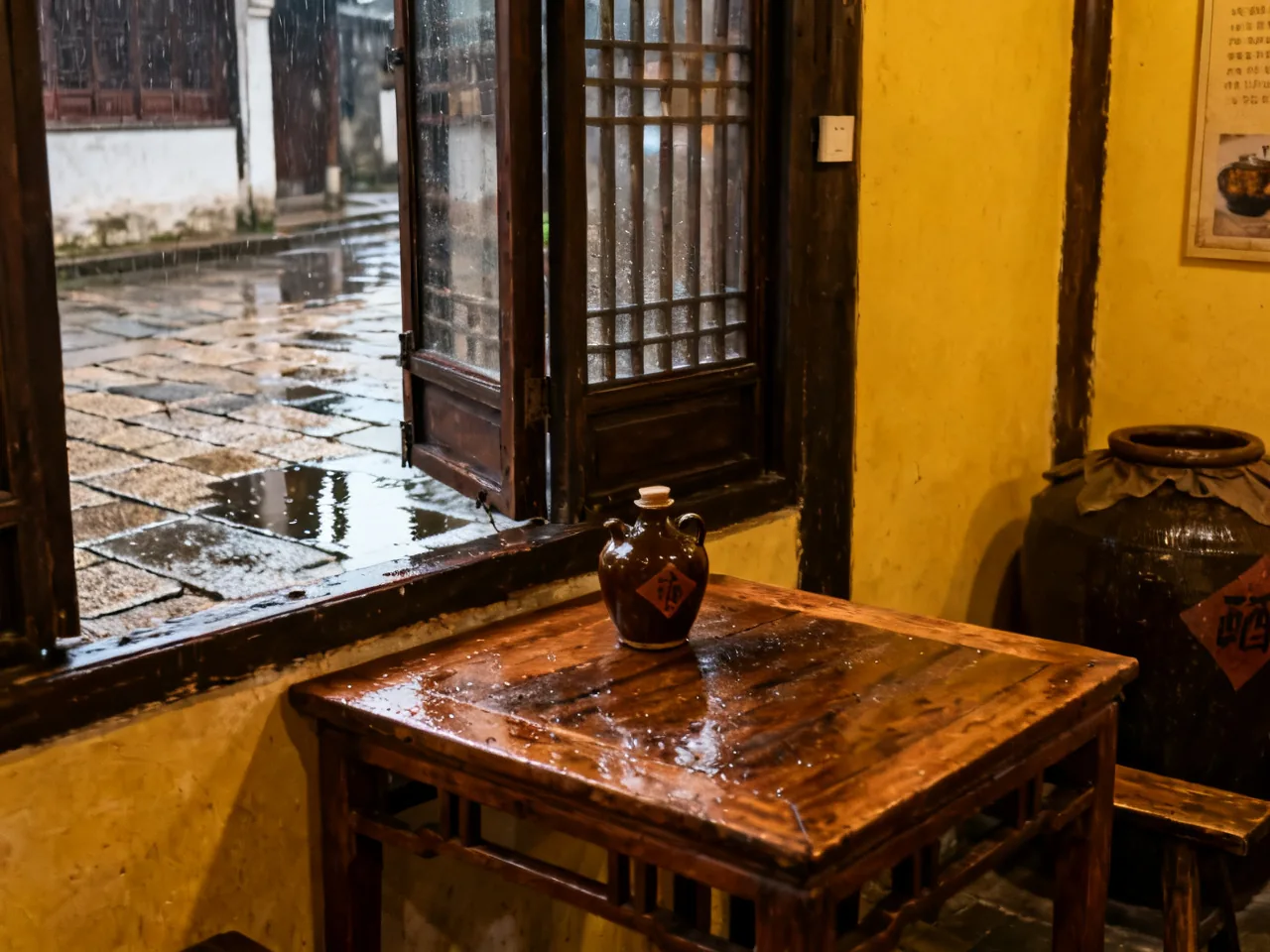
The problem that emerged was not dramatic at all, but a familiar small conflict of modern travel. A younger visitor in the group kept staring at a schedule on the phone, listing the next former residence, the next bridge, the next bookshop, anxious that after the rain the sky would darken quickly and there would not be enough time to “finish Shaoxing.” The anxiety was recognizable and representative: people want to consume a city as completely as possible within limited time, as if everything not checked off becomes a loss. The quiet inside the tavern and the constantly updating schedule on the phone collided like two entirely different clocks trying to tick on the same table.
Owner Zhou did not lecture anyone. He simply poured the warmed wine into a shallow bowl. The liquid was amber with a trace of reddish brown, its edge softened by steam, and then he said mildly, “Take the second sip first. Decide whether to rush after that.” What changed the atmosphere was precisely that non-argumentative sentence. The young traveler, already half-risen from the seat, sat back down again—partly out of politeness, partly because an old practical wisdom had intercepted the impulse. As the second sip went down, rainwater still collected under the eaves outside and dripped little by little, while someone in the room cracked fennel beans open with tiny crisp sounds.
Yellow wine did not enter the mouth exactly as expected. It was not simply “sweet,” nor was it some antique flavor that required exaggerated explanation. Once warmed, the first thing to rise was rounded rice aroma, then a light herbal note, and only afterward a certain thickness resting at the back of the tongue. It felt slowly polished by time, in no hurry to please anyone and in no hurry to prove the weight of tradition. Many cultural experiences in Shaoxing work the same way: they do not demand instant astonishment; they ask you to recognize their depth in a second and third layer. That is similar to the difference between merely rushing through a museum and actually learning how to see. The legacy article titled Museum visiting method in China offers a related reminder.
The conversation in the room moved slowly too, with a kind of looping cadence particular to water-town life. The two older men began talking about how yellow wine was warmed in winter when they were young, saying some families would set a small pot in hot water and raise it gradually rather than forcing it too hot all at once. The visiting mother laughed and asked whether that meant judging heat like tea. One of the old men waved his hand and said, “It’s not fussiness. You just shouldn’t bully the thing.” Hearing that, the daughter beside her slowly lowered the phone she had been holding up. In that instant, a shape appeared: a way of relating to food, objects, and time without too much force.
Shaoxing’s slowness, then, is not inefficiency, nor is it a performative kind of literary chic. It is more like a skill of matching materials, weather, body, and mood. Why does a yellow wine tavern feel right after rain? Because the air is damp, the stone streets turn cool again, breathing shortens without your noticing, and warmed wine draws the body inward at exactly the right moment. Why sit long enough for the second sip? Because the first sip often merely registers novelty; the second begins entry. Why do locals not rush their speech? Because they know quick judgments flatten the surface of water and miss the aftertaste inside the wine.
This differs sharply from what many visitors imagine as a “local cultural experience.” People often assume the experience means doing one representative thing: taking a boat ride, drinking a bowl of wine, snapping a photo against an old street, and then moving on. But if the internal tempo of the act never changes, even the most “representative” activity can become hollow. It is like drinking gaiwan tea in Chengdu: simply holding the cup does not mean you have understood the breathing rhythm of the teahouse. The legacy article titled Gaiwan Tea in Kuanzhai Alley expresses that especially well.
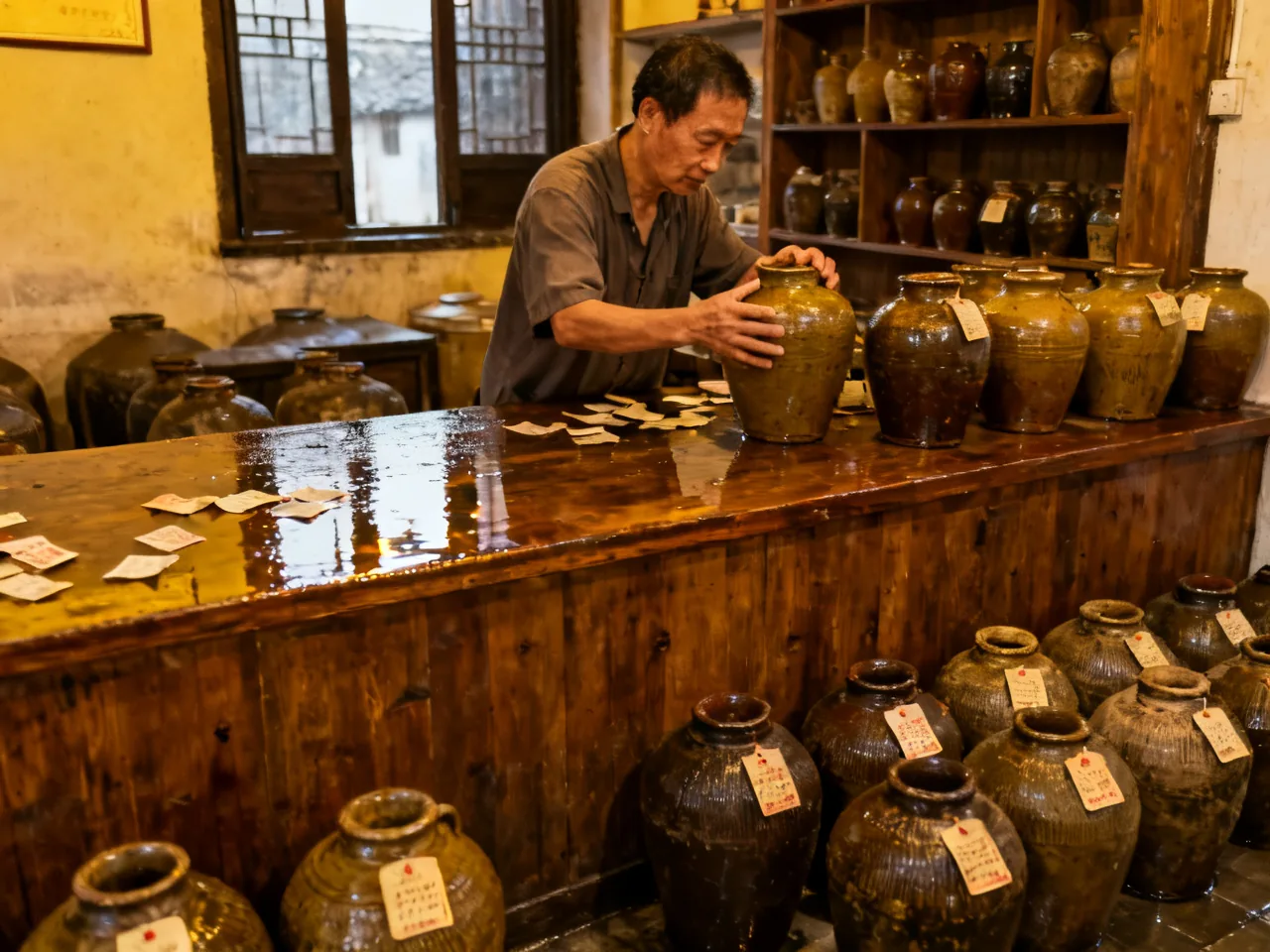
Outside, the light slipped toward evening almost without notice. The canal grew calmer than it had been during the rain. Now and then a black-awning boat passed, its canopy brushing low light. The rag hanging by the tavern door no longer dripped, while the wooden threshold grew shinier with each pair of shoes crossing it. When Zhou collected the empty bowls, he did not ask, “Another pot?” as though he knew anyone who truly wished to stay would speak up on their own. Even the young traveler who had been glued to the schedule was quiet now, asking instead about the clay seal on the jars, different vintages, and the difference between drinking in winter and summer. The hurry had not been scolded away. It had simply been replaced by better questions.
Perhaps that is the hardest part of Shaoxing to reproduce elsewhere. It is not that the city lacks sights or stories. It is that it does not rush to stuff its virtues into your hands all at once. It allows you to pause on a bridge, catch the aroma of sauce brewing at the mouth of an alley, and let one sentence in a small tavern rearrange your schedule. Places with real staying power often preserve exactly this proportion: they do not flatter, do not hurry, and are not afraid if you fail to understand them immediately. If you are willing to slow down a little, they unfold on their own.
When leaving the tavern, the road still held the wetness of the rain. Lanterns had already lit up, and the water reflected one section of red and another of yellow. At a street-side window, someone set out freshly steamed preserved-vegetable pork belly to cool, its aroma pressing thickly against the edge of the evening. At the head of a bridge, a child in rain boots stamped through a shallow puddle with a slap of sound and ran off laughing. Zhou’s sentence—“The wine isn’t going anywhere”—remained behind, sounding as if it were about the wine but also about a city, a meal, an encounter. Slowness is not stretching time longer. It is finally agreeing to place yourself fully inside the thing before you.
Farther along, the shops on Cangqiao Straight Street each pulled half a door closed, while the last bright color on the canal was kneaded apart by the evening breeze. By the stone bridge, someone stood eating stinky tofu from a paper tray with white steam rising upward. A little farther away, a household lowered a bamboo blind, and the warm yellow indoor light fell across the threshold. No one announced that the evening was ending, and no moment had been arranged as a climax. The whole street simply settled the meaning of “Shaoxing” into a real scene—through the smell after rain, the mild warmth after wine, and footsteps that had finally slowed down.