In Chongqing at night, I learned to treat fear as part of the view
Opening
If Chongqing in the daytime feels like a city of complicated structure, then Chongqing at night feels more like a three-dimensional dream. When I arrived at dusk, the sky was sinking from gray-blue into something deeper. Buildings stacked upward in layers, bridges stretched across the river, and lights flickered on one by one as if someone were pressing switches inside an enormous model. As a foreigner visiting for the first time, I was so excited that I almost forgot how poor my sense of direction was—until my map led me onto a slope that seemed like it would never end. Then I remembered: this city does not let itself be “mastered” easily.
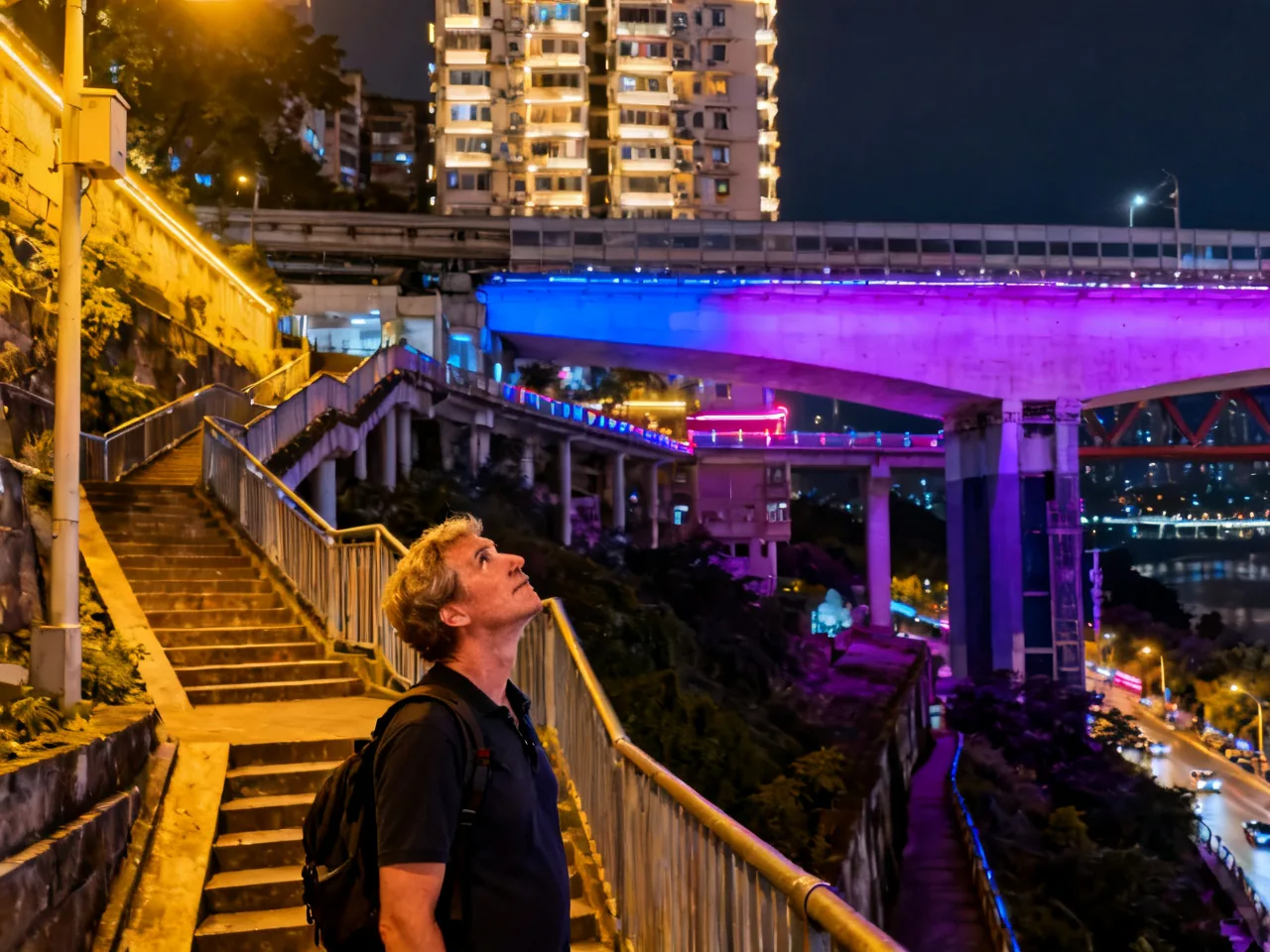
Scene 1: Getting lost among slopes and stairways
I thought I was simply heading to a small riverside restaurant for dinner, but I ended up wandering for almost half an hour among staircases, overpasses, corners, and platforms. I seemed to pass the same place three times from three different heights. The blue dot on my map kept moving, but I had no idea which level I was actually on. A middle-aged woman on the street saw me standing still and asked where I was trying to go. I showed her my phone. She laughed first, then gave directions in a way that was probably perfectly ordinary for Chongqing locals and completely puzzle-like to me: “Go down first, then through, then up again. When you get under the rail line, turn left.”
I followed her instructions and, somehow, actually arrived. In that moment I was tired, amused, and just a little shaken. When you travel alone, getting lost is not always romantic; sometimes it makes you briefly question whether you have overestimated your ability to adapt. But Chongqing does something strange: it turns that nervousness into part of the experience. You are not moving across a flat map. You are traveling through a city that folds, unfolds, and suddenly delivers you to the riverside.
Scene 2: In a hotpot restaurant, warmth replaces distance
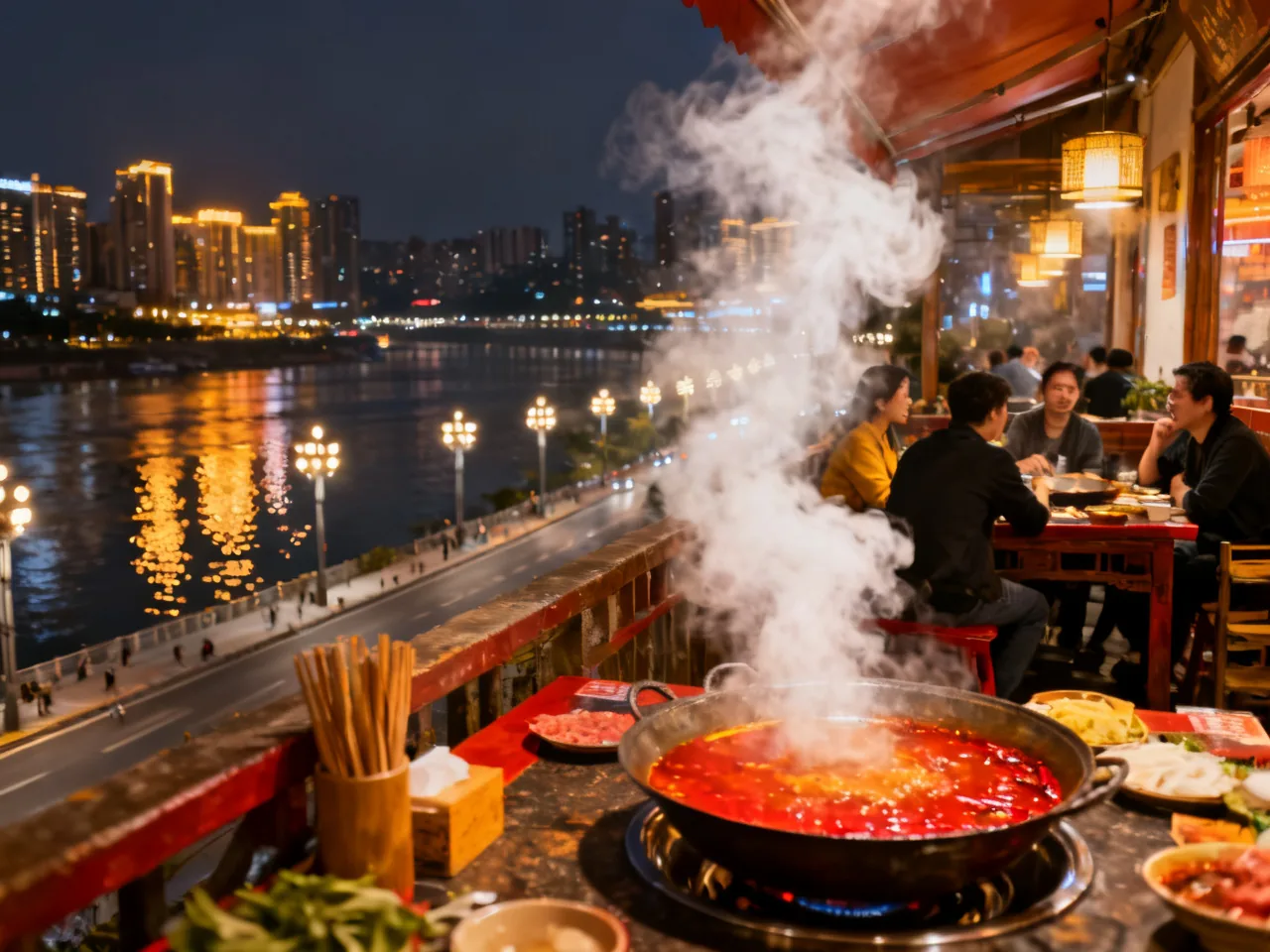
After I found the place, I sat down in a hotpot restaurant full of steam and noise. Once the door closed, the river wind and the city’s complicated routes felt sealed away in another world. Inside, the broth boiled furiously, and the air smelled of chili, beef fat, garlic, and Sichuan pepper. I had been a little nervous, wondering whether it would feel strange to sit alone there as a foreigner, but everyone around me was busy eating. No one actually cared. When the server saw me studying the menu for too long, she came over and chose a broth and dishes that were, in her words, “good for a first time.”
With my first bite, I nearly coughed from the heat, and the people at the next table immediately laughed, handed me a soy drink, and showed me how to mix a dipping sauce that would be, in their words, “more life-saving.” We did not fully share a language, but the temporary closeness created around the boiling pot was immediate. The spice, the numbing heat, the steam, the laughter, the clinking glasses—all of it compressed the distance that normally exists between strangers. Some travel connections are not made through deep conversation, but through being hit by the same wave of heat.
Scene 3: Beyond Hongyadong, the riverbank night itself
After dinner, I walked toward the river. The famous tourist area was lively, of course. Lights made the buildings look like a movie set, and phone screens glowed everywhere. But I kept walking a little farther to the side, and once I left the most crowded viewpoint, the night suddenly became quieter. Wind came off the river carrying a trace of dampness. The distant bridges were still lit, the boats were still moving, and the towers had not gone dark, yet my mood changed from “I need to see more” to “standing here like this is enough.”
I think that may be what moved me most about Chongqing. It is not gentle, and it is not easy. It makes you get lost, sweat, climb, and at times feel small. But precisely because of that, once you finally find your own rhythm, the feeling of being held by the city becomes unusually real. The night did not make me braver, exactly—but it did help me admit that fear, in travel, is already part of the view.
Closing
By the time I returned to my hotel, the soles of my shoes felt hot from walking, and my hair still seemed to carry the smell of hotpot and river wind. That night in Chongqing did not give me a neatly arranged “perfect experience.” It gave me something more valuable: a real memory made of getting lost, sharp spice, strangers’ kindness, and the city’s overwhelming scale. Many places can simply be seen and moved past, but Chongqing stays with you, because it does not invite easy affection. It confuses you first, and only then allows itself to be understood.
Travel Notes Summary
This is my real story of spending a night alone in Chongqing: getting lost in the mountain city after dark, finding warmth among strangers over hotpot, and finally learning by the river to accept anxiety and smallness as part of travel itself. Chongqing is not an easy city, but it leaves a deep and lasting impression.