It Took Me Three Months to Figure Out What the Chinese Dragon Actually Is
I’m an Australian who has lived in Chengdu for six years. During my first year in China, someone asked me my zodiac sign. I said Dragon, and they immediately looked envious. I thought — this is a fire-breathing, castle-destroying monster, what’s there to envy? It took me a long time to understand: the Chinese dragon and the Western dragon are not even the same species. They don’t exist in the same narrative universe.
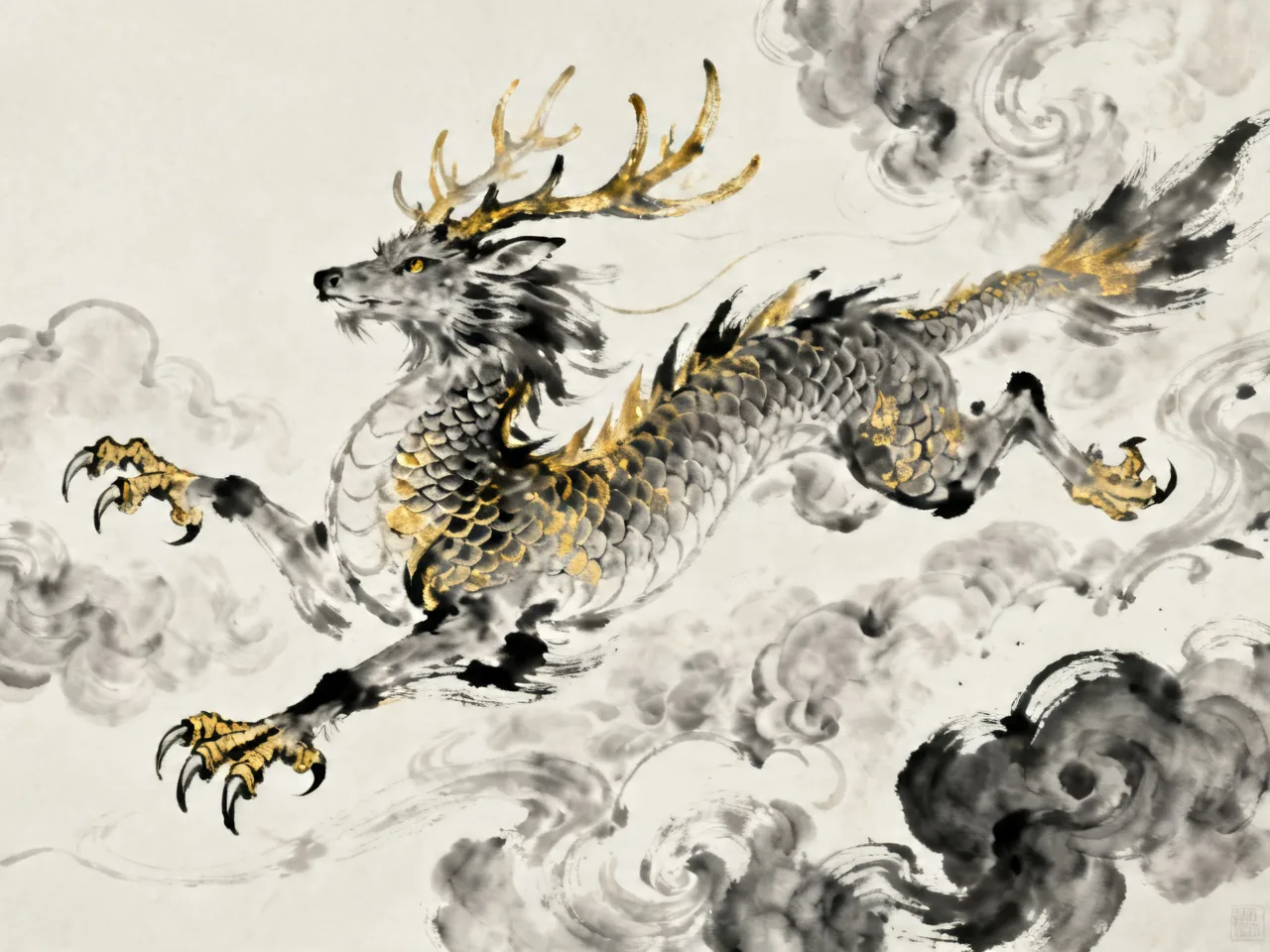
What does a Chinese dragon look like? The classic description lists “nine resemblances”: antlers of a deer, head of a camel, eyes of a rabbit, neck of a snake, belly of a clam, scales of a fish, claws of an eagle, paws of a tiger, ears of a cow. In other words, it’s a composite creature. The most mainstream academic theory is “totem fusion”: ancient tribes each worshipped different animals, and when they unified, their totems were merged into one — the dragon. Scholar Wen Yiduo first systematically articulated this view in his 1940s papers.
From the moment Qin Shi Huang called himself the “Ancestral Dragon,” the dragon became deeply bound to imperial power. After the Han dynasty, five-clawed dragons were reserved exclusively for the emperor — commoners could only use three or four claws. The Ming and Qing dynasties were even stricter: dragon robes had fixed numbers and positions of dragons, with specific rules for front-facing, walking, and ascending dragons. I tried counting the dragons inside the Hall of Supreme Harmony at the Palace Museum — reportedly the entire hall contains over 13,000 dragon images inside and out. I gave up after two hundred.
Ordinary people only gained the freedom to use dragon imagery after 1912. The Xinhai Revolution toppled the imperial system, and the dragon transformed from a royal symbol to a universal cultural icon. But the transition was incomplete — even today, many Chinese maintain a sense of reverence toward the dragon. Not fear, exactly, but a feeling that it’s “too powerful” to be used casually. I once wore a T-shirt printed with a Chinese dragon to dinner at a friend’s house. His mother glanced at it and said, “You’re really brave.”
In 1978, Taiwanese musician Hou Dejian wrote “Descendants of the Dragon.” The backdrop was the political earthquake of US-China diplomatic normalization that year, which left Taiwan severed from formal ties. The lyrics declare: “In the ancient East there is a dragon, its name is China” — using the dragon to forge a sense of national identity that transcended the strait. When the song reached mainland China in 1983, it became something every Chinese person could sing.
I once heard two thousand people sing this song in unison at a National Day gala. Honestly, as a foreigner, it gave me goosebumps. Not because of nationalism, but because you could feel that “Descendants of the Dragon” wasn’t a metaphor for these people — it was a genuine sense of identity. Just as I picture kangaroos and the Great Barrier Reef when I say “I’m Australian,” they picture five thousand years of heritage when they say “I’m a descendant of the dragon.”
In recent years, more and more Chinese scholars and official institutions have argued that the Chinese dragon should not be translated as “Dragon” but rather as “Loong.” The reasoning is simple — the English Dragon is an evil, fire-breathing, winged reptile, the exact opposite of the Chinese dragon’s image. In 2024, the Year of the Loong (Jiachen Dragon Year), Chinese state media began widely using “Loong Year” instead of “Dragon Year,” and CCTV’s Spring Festival Gala English subtitles adopted “Loong” as well.
This issue occupied my mind for a long time. Language translation can indeed distort culture — if you use a negative word to translate a positive symbol, the reader’s first impression is already wrong. Then again, “Loong” is a completely coined term for English speakers, with zero associative foundation. Getting the world to accept a new word might take a generation or two.

The dragon isn’t just an abstract symbol in China. Every Lantern Festival, lion and dragon dances erupt across the country — the Tongliang dragon dance, the dragon figures in Chaoshan Yingge dance (that’s a whole other fascinating intangible heritage story). Dragon boat racing during the Duanwu Festival is a top priority in southern provinces — I watched one on the Xiang River in Changsha, dozens of dragon boats launching simultaneously, spectators on both banks more excited than the rowers. On the second day of the second lunar month, “the dragon raises its head,” and barbershops see long queues because a haircut on this day symbolizes “the dragon rises, good fortune arrives.”
The Chinese dragon has no wings, breathes no fire, and doesn’t squat in a cave guarding gold. It lives in clouds, in water, and in the daily vocabulary of 1.4 billion people. Next time you hear “dragon” in China, don’t think of Smaug — think of an ancient composite of nine animals, swimming through rain clouds, defining a generation’s identity through a pop song, and currently in the process of getting a new English name.