What Hooks Major Foreign Creators in Chongqing Is Never Only the Glow of Hongyadong
Over the last two years, more and more foreign travel creators have pointed their cameras toward China, and Chongqing has become one of the most repeated stops. On the surface, this is easy to explain as a traffic choice: layered buildings, trains through towers, bright night views, and photogenic hotpot. But once several major creators’ public China videos are placed side by side, the picture becomes more complicated than “cyberpunk city equals easy clicks.” For them, Chongqing is not only a city with strong visual impact. It is also a place where route design, transport, meals, slopes, viewpoints, and urban scale get recombined into a different kind of travel narrative.
This article is not trying to translate several creators’ videos line by line. It takes a third-party reporting angle instead, asking what these creators actually turned into shareable travel experience in China, especially in Chongqing. The writer is less interested in who sounded the most dramatic and more interested in who truly captured the layered nature of traveling through a Chinese city.
What Gets Pushed to the Front First Is Chongqing’s Vertical Layering
Whether it is Drew Binsky or city-immersion channels like Pasta and Panda, they are almost always pulled first by the same thing when they reach Chongqing: this city does not unfold on a flat plane. Bridges are not just for crossing rivers, elevators do not merely serve towers, and streets do not simply move forward. What confronts an outsider first is not a single attraction, but the repeated disruption of spatial judgment. What seemed like ground level becomes another platform. What looked like the end of a railing turns into another staircase and another street around the corner.
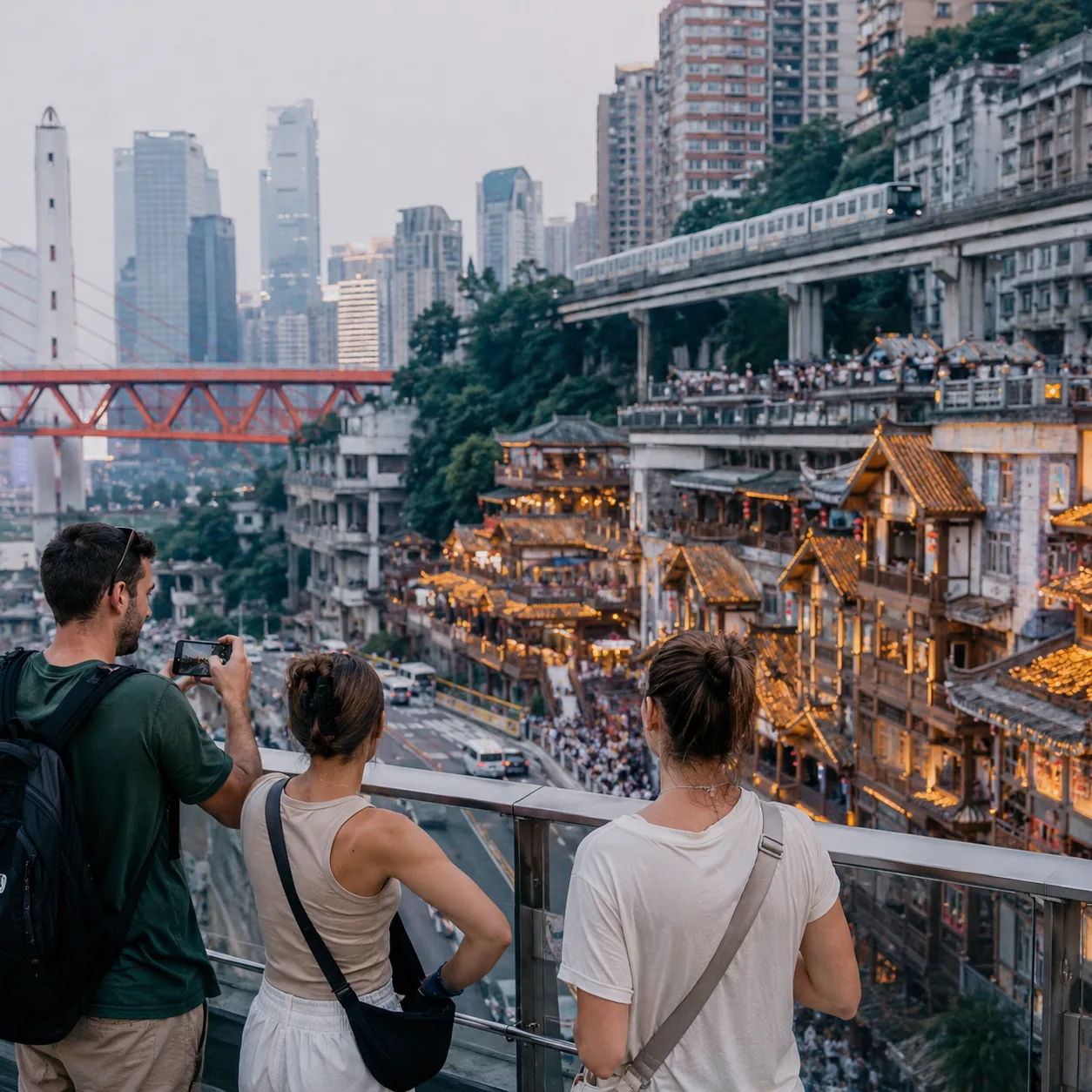
That is also why Chongqing creates such a strong “I need to see this myself” reaction on foreign video platforms. Many destinations go viral because the image is easy to understand. Chongqing works in the opposite way. It goes viral because the image refuses to finish itself in one glance. Viewers are not given a conclusion. They are given a reaction: wait, how exactly does this connect? For major creators, that delayed understanding becomes ideal material for narrative momentum.
A public thumbnail like this already reveals something important: what foreign creators sell first in Chongqing is not one landmark, but the sense that the entire city is a structure that must be decoded with the body.
What Drew Binsky Captured Was How a Megacity Pulls a Traveler Inside
For a creator like Drew Binsky, whose style is built around high-frequency travel and fast narrative entry points, Chongqing clearly fits his method well. Even the public-facing title makes the focus bluntly clear: entering one of the world’s largest cities. That angle naturally magnifies scale, transport systems, and the emotional reaction of a first-time visitor stepping in. For his audience, Chongqing is not first understood through cultural terminology. It is first understood through size, complexity, density, and the basic question of how huge a city can feel from the inside.
It is a smart way of filming because it rewrites abstract Chinese urban concepts—population, tiers, hills, layered transport—into bodily experience. Viewers may not initially care about administrative geography or development history. But they do care about why one city can place the metro, a zoo, old streets, viewpoints, and skyline within the same continuous movement. They care about why a traveler can be looking for direction one second and have their pace changed the next by a steep incline and a rising pot of food.
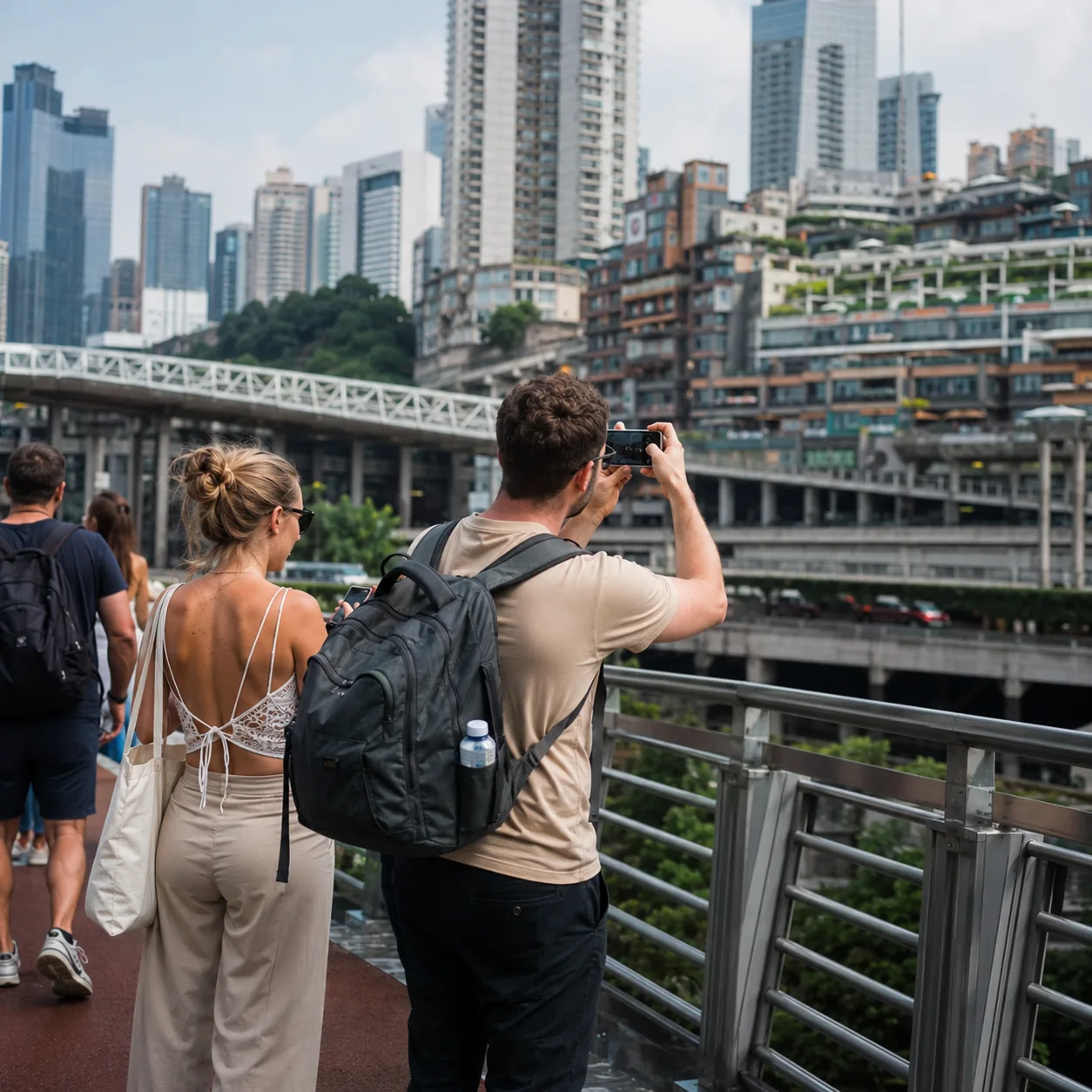
In the writer’s view, the major contribution of this type of creator is not “discovering a hidden destination.” It is turning the entry threshold of a Chinese megacity into a route that can be understood. A city that might otherwise exist only in news reports or statistics becomes imaginable, repeatable, and challengingly real as a travel object.
This kind of borrowed image should remain limited inside an article. One or two are enough to identify the public subject and show where the route focus landed. What the article should add afterward is the practical layer: once a reader reaches China, how do these dramatic-looking moments become a usable route rather than just a spectacle?
Pasta and Panda Did Not Film Only Spectacle, but Also How People Live Inside It
If some major creators first frame Chongqing through pure scale and shock, then creators like Pasta and Panda move closer to the perspective of staying long enough to sink into it. In their public material, high viewpoints, trains, and skyline shots repeatedly return to street food, urban walking, daily life, and fragments of transport. That angle matters because it nudges Chongqing one step away from being merely a visual internet city and one step closer to being a complex city that people actually inhabit.
This approach is particularly useful for Travel Notes because ordinary readers coming to China do not only want to know which level gives the brightest skyline. They want to know where to sit when the noon fatigue arrives, how to reroute after two serious climbs, whether there are slower sections worth keeping beyond hotpot and noodles, and where a city that looks intense suddenly becomes loose. Those are exactly the questions immersion-driven creators are most likely to film well.
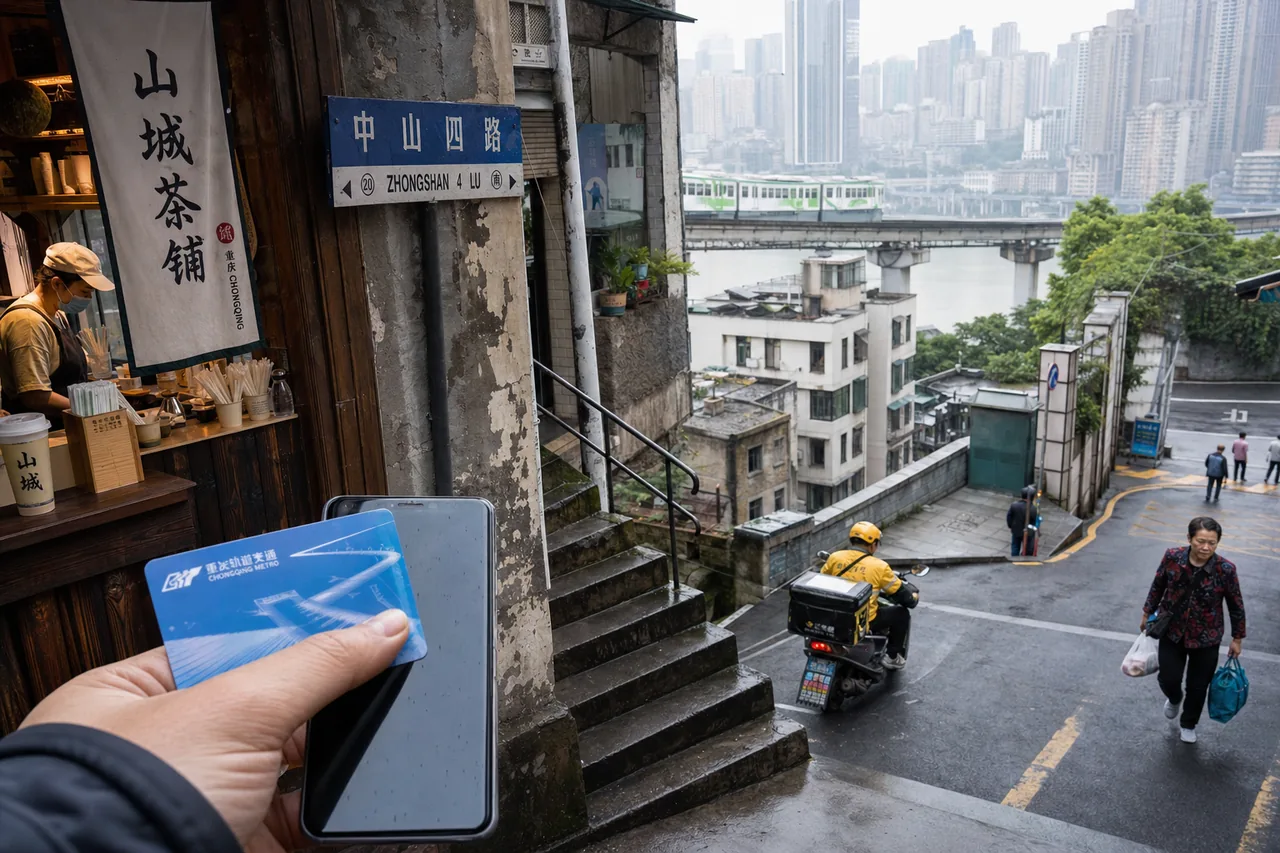
The value of this material in third-person reporting is not that “they said the food was good” or “they found the city shocking.” Its value lies in the way they accidentally perform a route rehearsal for the audience. Viewers learn in advance that Chongqing is tiring, winding, bright, steep, fragrant, hot, and noisy. By the time they actually land in China, the city is no longer just an exaggerated label. It becomes a sequence of movements that can be prepared for.
Why This Kind of China Content from Major Foreign Creators Keeps Getting Shared
Part of the answer is obviously curiosity. For many overseas viewers, the prior image of Chinese cities still rests either on a handful of old landmarks or on a very abstract media picture. Once a major creator walks into the city with visible personal reactions, the audience starts using that reaction as a substitute experience. He gets lost first on their behalf, gets surprised first, gets hit by the steam of hotpot first, and then works out why the city is worth staying in.
But another reason is even more important. The moment a major creator’s China route stops filming only spectacle and starts filming movement, walking intensity, public transport, street pauses, and meal rhythm, it changes very quickly from “something to watch” into “something to use.” That matters enormously for China travel content. What actually pushes readers into making the trip is often not the loud line—this is unbelievable—but the quieter one: I could probably walk this too.
For Travel Notes, the Most Valuable Thing to Borrow Is Not the Emotion, but the Route Logic
The writer does not believe Travel Notes should imitate these creators’ tones of amazement. Those tones belong to their own camera personalities. What is worth borrowing is something more structural that their public itineraries have repeatedly proven: a city like Chongqing cannot be walked with a flat-city mindset; what moves viewers is not a simple “I was here,” but the sense that the route itself reeducated the traveler; and what stays memorable is never only the skyline, but the climb, transfer, street food, and stopping point that came before it.
That is exactly why a third-person reported format suits Travel Notes so well when transforming foreign creator content into site articles. It keeps the outside angle—where this person went, what was publicly filmed, and why it spread—while adding the part Travel Notes does best: breaking the route down, clarifying bodily rhythm, and filling in the overlooked ways of moving through a Chinese city. Written that way, the article stops being a mere platform reshuffle. It becomes something that can actually guide a reader.
What May Change Next
From the public material available now, major foreign creators filming China are no longer satisfied with using a single landmark as cover art. More and more of them are willing to treat an entire city as the narrative stage, pulling transport, terrain, food, and nightfall into the same frame. The writer is more interested in the next shift: not simply repeating how vertical Chongqing is, but moving into finer layers—day routes versus night routes, how outsiders can avoid wasting effort, and which old streets or residential edges remain more memorable than the most famous viewing platforms.
If that shift continues, then major foreign creators will be bringing more than outside attention. They will gradually become a new entry route into China travel itself. The viewer is first jolted by the video, then taught the route more clearly in an article, and finally arrives in China to walk it with fewer mistakes. For Travel Notes, that is exactly the opportunity worth catching: turn borrowed attention into travel judgment a reader can genuinely use.
Public Source Notes
- Drew Binsky, “Entering the World’s Largest City (Chongqing, China)”
- Pasta and Panda (Dav and J), “1 Month In Chongqing: China’s Real-Life Cyberpunk Megacity”
- Island Hopper TV, “15 Best Places to Travel in China 2026 | Ultimate China Travel Guide”
The article uses publicly visible video titles, channel identifiers, and a very limited number of public thumbnails for third-person reporting and route analysis rather than wholesale reproduction.