Woodblock New Year Print Experience: The First Time I Saw New Year Spirit Printed onto Paper
When I travel in China, I am often moved by traditions in which festive feeling is not abstract at all, but something you can truly see, touch, and bring home. Woodblock New Year prints are exactly like that. At first, what attracted me was simply their almost unreasonable brightness: deep red, vivid yellow, grassy green, and figures whose expressions feel so full that they seem ready to push good fortune straight through the door. But once I actually joined a woodblock New Year print experience, I understood that the real charm of this folk art lies not only in its celebratory imagery, but in the way it ties blessing, craft, and domestic space together.
In the workshop, several carved woodblocks were laid out beside pigments, brushes, and a stack of absorbent paper. The instructor first showed us finished prints and then explained the process in reverse: why the lines had to be carved so clearly, why each color was applied block by block, and why the faces, garments, and decorative details had to be precisely organized in advance on the block. As she spoke, she brushed ink across the surface. My immediate feeling was that this craft possessed a remarkably frank sense of order. Unlike some forms of painting that emphasize improvisation, it first builds structure, and then allows color and image to settle firmly within that structure.
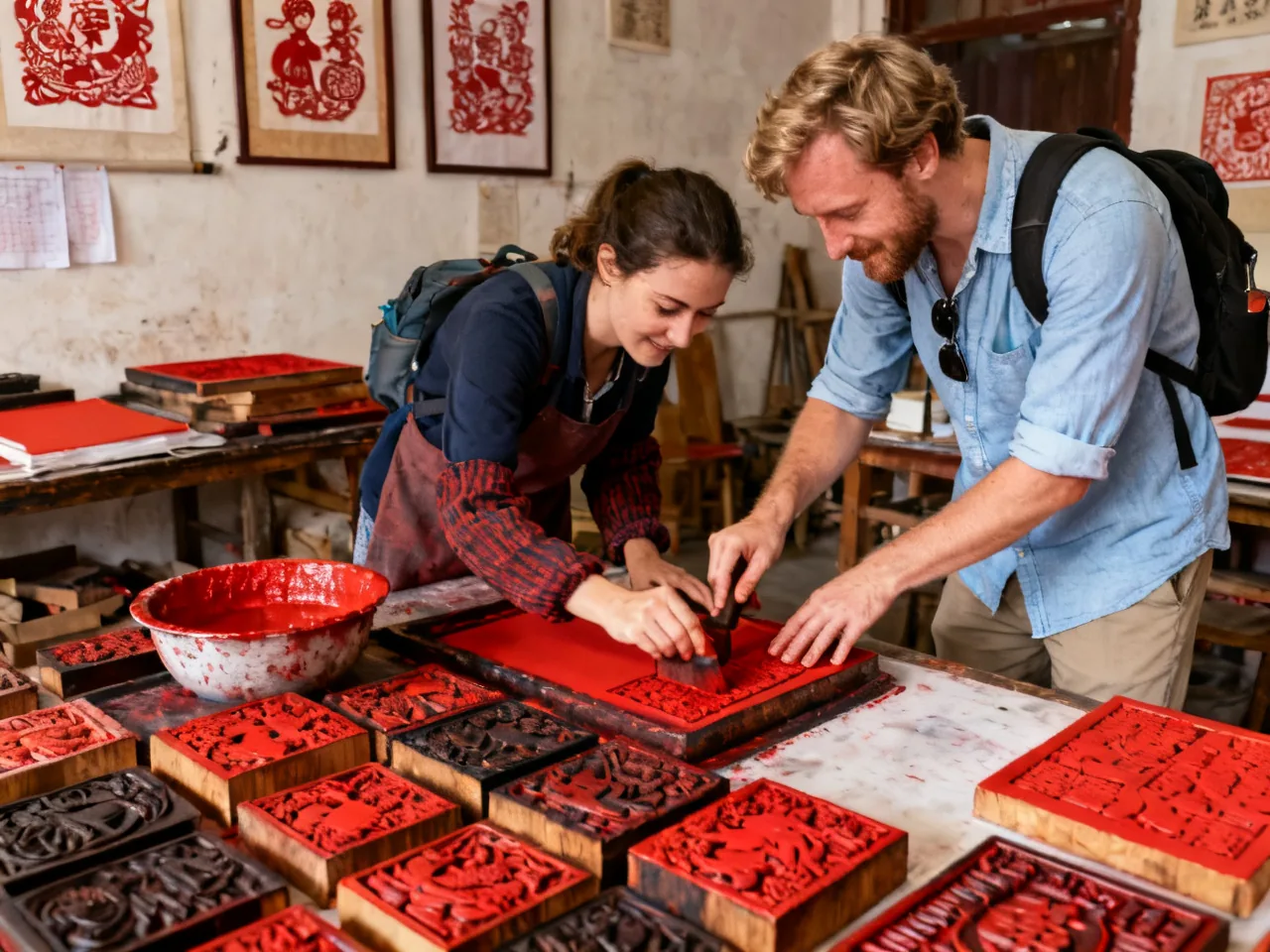
I tried a relatively simple small print, not very complicated, but enough to show me why multi-block printing makes people tense. The first step looks easy: brush on the pigment evenly, place the paper, press it firmly with a tool, and then lift it carefully. But when you actually do it, every step carries risk. Too much pigment and the image blurs; too little and it turns weak. If the paper shifts even slightly, the alignment slips. If you hurry, the corners do not receive even pressure. When I added the second color, I could almost feel myself holding my breath, because whether the image would really stand up often depended on whether that one layer landed in the right place.
The moment of lifting the paper felt theatrical. Like many hands-on crafts, woodblock New Year prints have the charm of revealing their truth in the final second. When the paper leaves the block, the image does not emerge gradually. It appears all at once: lines, color areas, figures, and auspicious meaning arriving together before your eyes. In that instant, I understood why these prints can have such a strong presence in domestic space around the Spring Festival. They are not meant to be subtle. Their purpose is to make a room feel lively, stable, and fortunate the moment you enter.
That was also when I thought of German woodcut traditions and festive printed imagery. Germany, of course, has a deep history of woodcut, from religious images to book illustration and later printmaking that foregrounded individual artistic expression. The medium matters there too. But what I felt in the Chinese New Year print experience emphasized something different. German woodcuts often place more weight on line, dramatic narrative, or religious and historical resonance, while Chinese New Year prints are more explicitly tied to festive use in everyday life. They are meant to be posted, seen, and used as vehicles of blessing. In other words, they are not only images. They are part of domestic order and seasonal time.
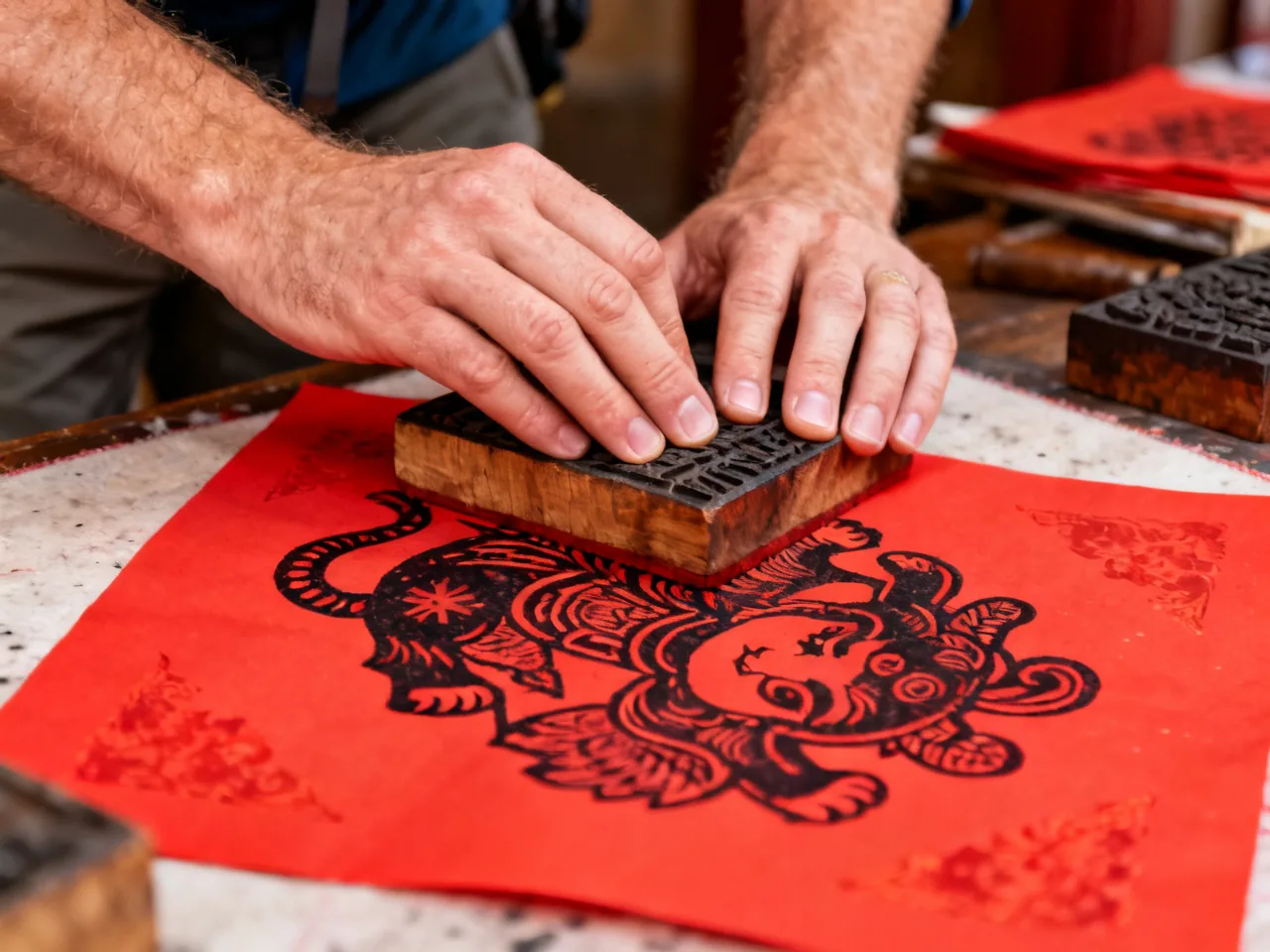
Later, the instructor explained common subjects such as door gods, chubby children, fish, ingots, and opera figures, and why these images recur so often. She explained them plainly and did not package them as lofty theory. She simply told us that these designs survive because people genuinely need them: to welcome a new year, to express wishes, and to make a home visibly feel like New Year has arrived. I liked that explanation very much, because it returned folk art to life itself instead of leaving it at a museum distance.
For a foreign participant like me, woodblock New Year prints have another powerful attraction: they help me understand very directly why the Chinese Spring Festival is not only a new year in time, but also a new year in visual terms. Many cultures decorate their homes during festivals, but Chinese New Year prints are distinctive because they turn blessing into an image language that can be reproduced, circulated, and posted on doors and walls. You do not need to read a stack of books first. Just by brushing color once and pressing paper once in the workshop, you begin to understand why this imagery has lived so long among ordinary people.
If someone asked me today which Chinese folk-art experience explains festival custom most clearly, I would gladly recommend woodblock New Year prints. They are easy to approach without being shallow; they involve real technical discipline while preserving the directness and liveliness of popular imagery. Most importantly, when I held my own finished print in my hands, I could clearly feel that I was not carrying away a decorative sheet of paper. I was carrying a visual idea about home, wish, and the order of the New Year. That kind of understanding goes far deeper than simply reading labels on a display.